The friend of the family, p.1
The Friend of the Family,
p.1


‘Ignat Avsey’s excellent translation and stimulating introduction and notes enable the English reader to appreciate this novel, and its weird humour, to the full’
TELEGRAPH
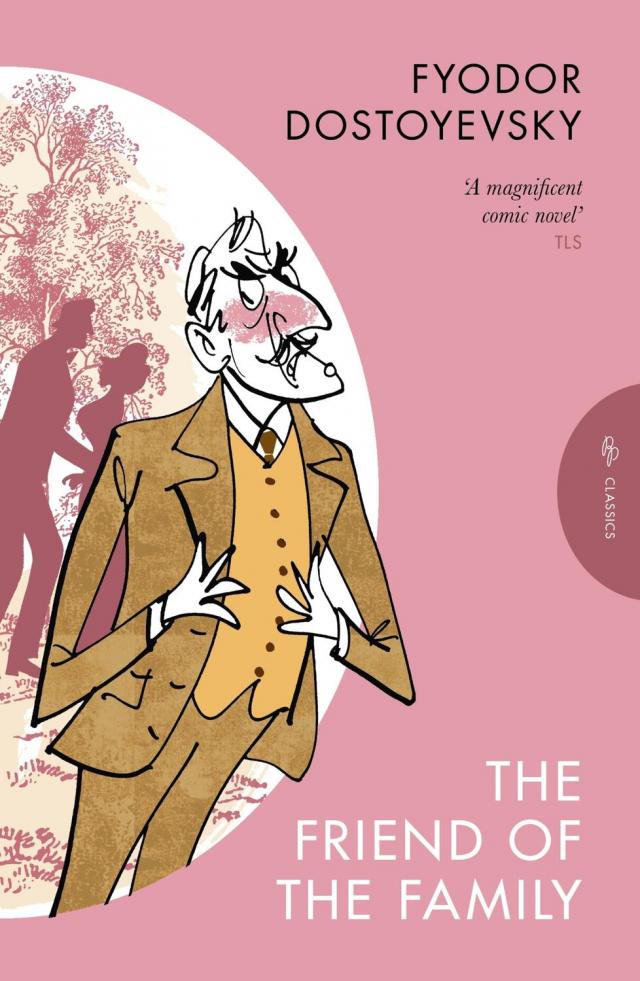
THE
FRIEND OF
THE FAMILY
OR, THE VILLAGE OF STEPANCHIKOVO
AND ITS INHABITANTS
FYODOR
DOSTOYEVSKY
TRANSLATED FROM THE RUSSIAN
BY IGNAT AVSEY
PUSHKIN PRESS CLASSICS
Contents
Title Page
Dedication
Translator’s Preface
Translator’s Introduction
PART I
1. Introductory
2. Mr Bakhcheyev
3. Uncle
4. At Tea
5. Yezhevikin
6. Concerning the White Bull and a Peasant Named Komarinsky
7. Foma Fomich
8. Declaration of Love
9. Your Excellency
10. Mizinchikov
11. Bewilderment
12. Catastrophe
PART II
1. Pursuit
2. News
3. Ilyusha’s Name-day
4. Expulsion
5. Foma Fomich Creates Universal Happiness
6. Conclusion
Notes
Available and Coming Soon from Pushkin Press Classics
About the Authors
Copyright
For Judie
Translator’s Preface
The Village of Stepanchikovo and its Inhabitants is Dostoyevsky’s fifth medium-length fictional work. It has remained in the shadow of his major novels since his lifetime, and in English it is less well known even than his second short novel The Double. Yet whereas The Double and the other ‘novels’ and stories of Dostoyevsky’s pre-Siberian period are apprentice works, The Village of Stepanchikovo represents its author at a further stage of his development, poised to write the great fiction of his maturity.
Transitional work that it is, The Village of Stepanchikovo is a striking, accomplished and highly entertaining story, uniquely combining abundant humour with the seeds of Dostoyevsky’s future concerns as a novelist. It contains in Foma Fomich Opiskin one of the most notorious characters in Russian literature, in D. S. Mirsky’s words ‘a weird figure of grotesque, gratuitous, irresponsible, petty, and ultimately joyless evil that together with Saltykov’s Porfiry Golovlyov and Sologub’s Peredonov forms a trinity to which probably no foreign literature has anything to compare.’ (Mirsky’s further somewhat shattered comment ‘it must be confessed that though the element of humour is unmistakenly present, it is a kind of humour that requires a rather peculiar constitution to enjoy’ catches the unusual nature of this work, though sixty years after his History of Russian Literature was written, readers’ ‘constitutions’ are demonstrably tougher.)
The only previous English translations known to me are Frederick Whishaw’s of 1887 in abridged form, under the title The Friend of the Family; Constance Garnett’s of 1920 using the same title; and Olga Shartse’s of 1961, included in a composite volume of short works by Dostoyevsky entitled A Funny Man’s Dream, published in Moscow. It is with the strong feeling that this work should be altogether better known in English that the present translation is offered, in which I have aimed at as modern a rendering as seemed possible or appropriate, especially in dialogue.
The text I have used is the long-established one of 1866, which incorporates Dostoyevsky’s slight revisions from the first serial printing. I am particularly indebted to Volume 3 of the 30-volume edition of Dostoyevsky published in Leningrad in 1972, edited by G. M. Fridlender, A. Arkhipova and others, for my annotation.
i. a.
Translator’s Introduction
The Village of Stepanchikovo and its Inhabitants is unique among Dostoyevsky’s works in that it is a sustained exercise in comedy. Successive generations of critics — nineteenth-century Russian, Soviet and English — have proved at variance with Dostoyevsky’s approach in this work, so that a major component of its author’s creativity, his humour — present in other works too, but nowhere in such concentrated measure as in The Village of Stepanchikovo — has been largely overlooked by the English-reading public.
The least discerning Russian critical approach has been to regard Dostoyevsky’s fifth medium-length fictional work as a piece of frivolous ‘revisionism’ in which he sought to generate cheap humour out of human degradation at a time when the Russian conscience was at last moving towards socio-political reform. The work was neglected by critics and public on publication in 1859. Four eventful years later — which included 1861, the year of the ‘emancipation’ of the serfs, one of the most significant dates in Russian history — one critic compared The Village of Stepanchikovo unfavourably with the newly published House of the Dead:
Whoever would see in literature the full benefit to be derived from a study of life and the positive influence of such a study, let him compare the two recent works The Village of Stepanchikovo and The House of the Dead; the forced melodrama of the former, with the genuine drama of the latter; the forced counterfeit humour of the one, designed merely to attract the reader’s attention, with the real entertainment value of the second. As to the true worth of the two works one can only say that to the extent that one is socially edifying, the other is utterly useless.
A somewhat similar opinion was expressed by another critic in the year of emancipation itself. While conceding that The Village of Stepanchikovo was not devoid of ‘remarkable qualities’, he opined that Dostoyevsky was ‘on the wrong tack’, since humour ‘is not Mr Dostoyevsky’s forte’. Modern Soviet critics have continued to be muted about the work, L. Grossman, for example, finding Dostoyevsky’s ‘blessed village of Stepanchikovo’ regrettably innocuous and socio-historically irrelevant.* (The novel actually contains a good deal more social relevance than most commentators seem to have noticed; it took some time for its underlying symbolism to work through — and indeed, for history to catch up with it, as we shall see. Early Soviet critics were more perceptive than those Russian commentators so far quoted.)
Even modern Western critics, with the notable exception of Ronald Hingley, who has given a penetrating analysis of The Village of Stepanchikovo in his The Undiscovered Dostoyevsky,† find it difficult to relate to Dostoyevsky as a humorist and either by-pass the subject altogether or, as in the case of E. H. Carr (writing in 1931 but more recently in print), ascribe it to an ‘unwonted mood of light-heartedness, in which the world and its evils could for once be treated as a joke rather than as a problem.’ Carr also comments that in this work Dostoyevsky ‘no longer probes the psychological foundations of visible human relations; he is content to describe external phenomena in a spirit of exaggeration and caricature.’‡ Such views belittle not only Dostoyevsky’s own artistic integrity, but more importantly, the intrinsic merits of a work which, besides being a delightful piece of comic entertainment, is also in a number of ways a fascinating small-scale prototype of ‘the Dostoyevskian novel’.
The Village of Stepanchikovo is in form actually a povest — ‘tale’, the Russian term indicating a work on a larger scale than a short story or novella, and shorter than the fully developed form of the ‘novel’ (roman). It is not, therefore, a ‘novel’ in the sense that, say, Crime and Punishment is, or even the next fictional work that Dostoyevsky wrote, The Insulted and Injured, which is twice the length of The Village.
Dostoyevsky’s writing career had been brought to an abrupt halt in April 1849 when he was arrested for being a member of the Petrashevsky Circle.§ Nicholas I, fearful of the revolutionary movements which had been sweeping Europe, suspected danger and sedition in any form of outspoken protest, especially when it concerned legal reform and the emancipation of the serfs, and it was precisely these and related issues which a motley crowd of journalists, writers and guards officers, Dostoyevsky amongst them, had been regularly gathering to discuss under the aegis of the eccentric intellectual M. V. Butashevich-Petrashevsky.
In 1847 the reform-minded critic Belinsky had written a blistering attack on Gogol for betraying his promise as an enlightened apologist for reform in his unexpectedly reactionary Selected Passages from Correspondence with Friends. In his Open Letter to Gogol Belinsky had accused the latter of adherence to despotism. Dostoyevsky read this letter out aloud at one of the regular meetings of the Petrashevsky Circle and had thus, according to the Legal Code of 1845, which strictly forbade any organized political discussion, committed a capital crime. His confinement in the Petropavlovsk Fortress, his trial, his mock execution, enacted in every grim detail up to the last moment of ‘reprieve’ in order to teach the prisoners a lesson, his four years of penal servitude, and his subsequent six years of exile in Siberia, all inevitably left their mark upon his view of life.
Dostoyevsky started working on The Village of Stepanchikovo while serving his term of exile as a common soldier in the remote garrison town of Semipalatinsk in Western Siberia. He attached great importance to this work, and hoped that it would enable him to return to the literary scene after his enforced absence. There were two other projects on which he was engaged at the same time, one of which he completed, a mildly entertaining comic tale of manners Uncle’s Dream, published in March 1859, and a long, unnamed novel to which, in a letter of 18 January 1858 to his brother Mikhail, he refers with gravity as his future chef-d’oeuvre. In a letter of 9 October 1859, however, his bro
ther is informed that this novel has been destroyed, but that the idea of writing a major serious work is still very much alive, and this time it may be concluded that Dostoyevsky referred to his plan for Notes from the House of the Dead which finally appeared in full in 1861–62. After his meteoric rise to fame with Poor Folk in 1846, this was his first truly successful publication, and it paved the way for his subsequent literary career, beginning with Notes from Underground published in 1864.
A far less ambitious work than the latter, and Crime and Punishment and the other monumental novels which succeeded it, The Village of Stepanchikovo is written in a spirit of fun, its primary aim being to amuse and entertain. Burdened as Dostoyevsky was at the time with unexpected ill-health, a capricious, irritable wife and lack of money, he may well have been motivated by a need for escapism, as can be surmised from a deceptively sanguine letter which he wrote to his friend Apollon Maykov in January 1856:
I began in fun to write a comedy and have managed to evoke so many comical scenes and characters and have grown to like my hero so much that I decided to drop the form of comedy, even though it was turning out quite well, for the sheer pleasure of prolonging the adventures of my new hero and enjoying a good laugh at him. This hero is not unlike myself. In short, I’m writing a comic novel.
Another friend, the young district procurator Baron Vrangel, whom Dostoyevsky met in Semipalatinsk, leaves us in his memoirs a vivid picture of Dostoyevsky’s state of mind a short while earlier when he conceived the work. The exiled writer would regularly spend his evenings at Vrangel’s house. ‘Having undone his greatcoat,’ Vrangel recalls,
with a Turkish pipe in his mouth, he would stride about the room, often conversing with himself … I see him now just as in one of such moments: at that time he set upon the idea of writing Uncle’s Dream and The Village of Stepanchikovo. He was in a wonderfully cheerful mood, was laughing and telling me of uncle’s adventures …¶
The fact that The Village of Stepanchikovo was initially conceived as a play was revealed by Dostoyevsky’s widow in conversation with Konstantin Stanislavsky when the latter was planning to adapt it for the stage in 1891. She declared, however, that the difficulties of mounting a production and obtaining the requisite public performance certificate from the censor at a time when her husband was in need of funds had persuaded him to revert to the genre of the novel. The work was in fact received with indifference by the first two publishers approached, and only at the third attempt, when his brother successfully negotiated with Krayevsky, the publisher of the journal Otechestvennyye zapiski, was it finally printed in serial form in the November and December issues of 1859.
It is difficult to say how far Dostoyevsky’s approach to his subject-matter was governed by his undoubted maturing in exile, and how far by his equally undoubted need for circumspection before the censor. Certainly it took little enough provocation to excite the searching censorship of tsarist Russia, and Dostoyevsky’s oblique and apparently detached rendering of provincial Russian society through the free play of humour and characterization was perhaps as much a protective device as an artistic achievement.
Dostoyevsky’s disenchantment with Gogol’s political stance had led to his ten years of penal servitude and exile, but he still had this enormously potent and influential writer very much in his blood when he wrote Uncle’s Dream and The Village of Stepanchikovo. Indeed, as Richard Freeborn has commented, ‘Once having seen a production of The Inspector General or having read Dead Souls, who could fail to regard the Russian provinces as comic?’|| And the minute, closed society of Semipalatinsk, a town that boasted a single piano and a dozen subscribers to newspapers or periodicals, could not have been a very great distance from Stepanchikovo itself.
The ‘spirit of exaggeration and caricature’ that undoubtedly pervades The Village of Stepanchikovo is thoroughly Gogolian — and Gogol himself is the real-life model for its chief character, the despotic humbug Foma Fomich Opiskin. A. Arkhipova, in her commentary on the work in the 1972 Soviet edition of Dostoyevsky in 30 volumes, writes: ‘Dostoyevsky saw in him [Gogol] a Russian typical of his time, with a characteristic duality in his soul, harbouring a deep spiritual “underground”. It is this “underground” which, according to Dostoyevsky, had driven Gogol to write his Selected Passages in tones of exaggerated psychological exultation which at times acquired tragi-comic overtones.’# Into the figure of Foma Fomich Opiskin Dostoyevsky injected all his pent-up gall against the artist turned false prophet and erring philosopher, parodying Gogol’s ‘revisionist’ view of Russian despotism as paternal benevolence through Opiskin’s pompous, sanctimonious, self-aggrandizing, bombastic utterances, often drawing directly on Gogol’s writings in the process, especially Selected Passages and his published letters. But creatively, Dostoyevsky still remained almost as much under the sway of his great predecessor as he had been at the time of writing The Double and his other early works, and in the very act of running down his former idol, he gave ample substance to one of his most candid and generous admissions — that ‘we have all emerged from Gogol’s Greatcoat.’ The name of Foma Fomich Opiskin itself is in the tradition of Gogol, who liked repetitive patronymics such as Ivan Ivanovich, Pyotr Petrovich Petukh, and, the most famous of them all, Akaky Akakyevich.
Another literary presence stands behind Gogol in The Village of Stepanchikovo — Dickens. During penal servitude Dostoyevsky, starved of reading-matter, had eagerly devoured David Copperfield and Pickwick Papers; Dickens’s works were available in Russia in translation not long after their original publication. Opiskin has been claimed as the ‘spiritual progeny’ of Uriah Heep and Mr Pecksniff, besides which it may be observed that Dostoyevsky’s unbuttoned delight in caricature and the depiction of outrageous and eccentric characters is as much Dickensian as Gogolian.
Dostoyevsky has skilfully used the trappings of bucolic farce to weave a tight, dynamic story which seems to span a much longer period than the forty-eight hours into which all the main action is packed. The Village of Stepanchikovo, indeed, is a tour de farce of endless comic invention — of character, dialogue and plot — in which the principle of exaggeration is carried to glorious absurdity. The circumstance that brings the narrator to the remote country estate of his uncle, the retired Colonel Rostanev — he is summoned from his studies in St Petersburg by the urgent request to come to Stepanchikovo to marry a former ward of his uncle, the young and pretty Nastenka Yezhevikin (with whom the Colonel turns out to be in love himself), in order to save her from Opiskin’s persecution — is patently far-fetched. As for the narrator himself, the wistfully romantic young Sergey Aleksandrovich (he is never given a surname, and Dostoyevsky’s title-page bears the subtitle ‘From the Notes of an Unknown’), he is not so much a narrator as an eye-witness addressing the reader from the midst of events, no more able to foretell or make sense of what happens than any of the inhabitants of Stepanchikovo. The latter are done in highly coloured caricature, and their obsessions and distorted viewpoints are given free and highly expressive rein in dialogue, which is the main vehicle of the novel. In a world of grotesque comedy, Opiskin, the most ridiculous figure of all, sounds darker notes of oppression and cruelty.
Before arriving at Stepanchikovo the narrator makes the acquaintance of the garrulous landowner Bakhcheyev, who warns him that all is not well in Stepanchikovo. Following the death of Rostanev’s step-father, General Krakhotkin, Foma Fomich Opiskin, a vagrant of obscure origins first employed by the General as a reader when his sight fails, has installed himself in a position of power in the household and rules it with an iron rod, aided and abetted by the Colonel’s mother, the General’s widow. On arrival Sergey finds the worst reports he has heard fully confirmed, and he is soon brimming with indignation at the injustices which he sees being committed; but all his attempts to remedy the situation are ineffective. Moreover, his youthful pride suffers a severe blow through a painful awareness of his own inability to assert himself and to prevent himself from being turned into a figure of fun. The preoccupation of the narrator at this stage with his own image has much autobiographical content; Dostoyevsky himself in his young days is known to have been awkward, shy and highly-strung.