Microtrends the small fo.., p.1
Microtrends_The Small Forces Behind Tomorrow’s Big Changes,
p.1
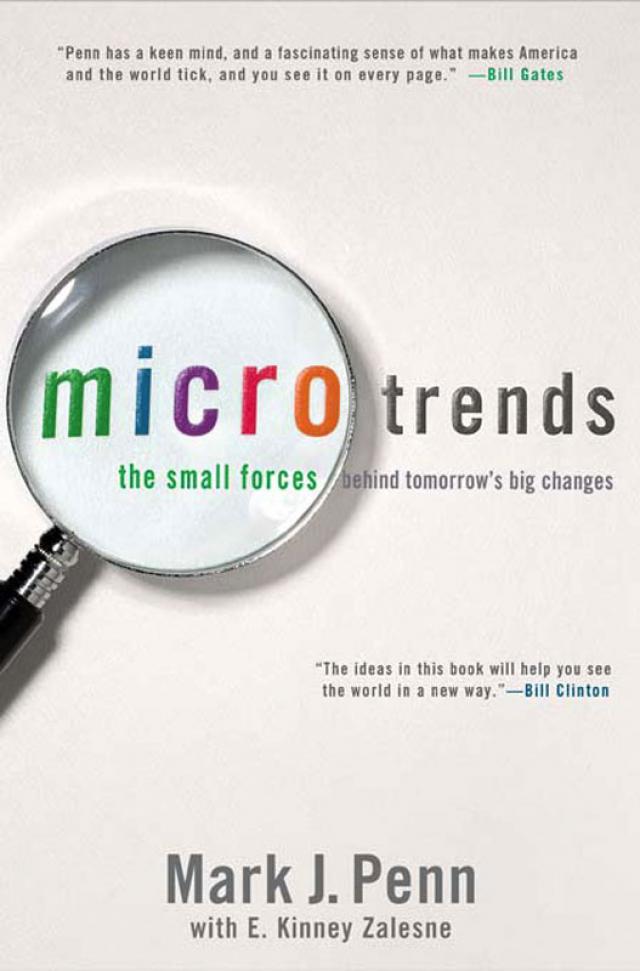


Copyright © 2007 by Mark Penn
All rights reserved. Except as permitted under the U.S. Copyright Act of 1976, no part of this publication may be reproduced, distributed, or transmitted in any form or by any means, or stored in a database or retrieval system, without the prior written permission of the publisher.
Twelve
Hachette Book Group
237 Park Avenue
New York, NY 10017
Visit our website at www.HachetteBookGroup.com.
The Twelve name and logo are trademarks of Hachette Book Group, Inc.
First eBook Edition: September 2007
ISBN: 978-0-446-40206-4
Contents
Copyright
Introduction
PART I: Love, Sex, and Relationships
Sex-Ratio Singles
Cougars
Office Romancers
Commuter Couples
Internet Marrieds
PART II: Work Life
Working Retired
Extreme Commuters
Stay-at-Home Workers
Wordy Women
Ardent Amazons
PART III: Race and Religion
Stained Glass Ceiling Breakers
Pro-Semites
Interracial Families
Protestant Hispanics
Moderate Muslims
PART IV: Health and Wellness
Sun-Haters
30-Winkers
Southpaws Unbound
DIY Doctors
Hard-of-Hearers
PART V: Family Life
Old New Dads
Pet Parents
Pampering Parents
Late-Breaking Gays
Dutiful Sons
PART VI: Politics
Impressionable Elites
Swing Is Still King
Militant Illegals
Christian Zionists
Newly Released Ex-Cons
PART VII: Teens
The Mildly Disordered
Young Knitters
Black Teen Idols
High School Moguls
Aspiring Snipers
PART VIII: Food, Drink, and Diet
Vegan Children
A Disproportionate Burden
Starving for Life
Caffeine Crazies
PART IX: Lifestyle
Long Attention Spanners
Neglected Dads
Native Language Speakers
Unisexuals
PART X: Money and Class
Second-Home Buyers
Modern Mary Poppinses
Shy Millionaires
Bourgeois and Bankrupt
Non-Profiteers
PART XI: Looks and Fashion
Uptown Tattooed
Snowed-Under Slobs
Surgery Lovers
Powerful Petites
PART XII: Technology
Social Geeks
New Luddites
Tech Fatales
Car-Buying Soccer Moms
PART XIII: Leisure and Entertainment
Archery Moms?
XXX Men
Video Game Grown-ups
Neo-Classicals
PART XIV: Education
Smart Child Left Behind
America’s Home-Schooled
College Dropouts
Numbers Junkies
PART XV: International
Mini-Churched
International Home-Buyers
LAT Couples (U.K.)
Mammonis (Italy)
Eurostars
Vietnamese Entrepreneurs
French Teetotalers
Chinese Picassos
Russian Swings
Indian Women Rising
Educated Terrorists
Conclusion
Acknowledgments
Sources
About Twelve
To Nancy, Jackie, Miles, Margot, and Blair
Introduction
In 1960, Volkswagen shook up the car world with a full-page ad that had just two words on it: Think Small. It was a revolutionary idea—a call for the shrinking of perspective, ambition, and scale in an era when success was all about accumulation and territorial gain, even when you were just driving down the street.
At the same time that America was becoming the world’s superpower, growing the dominant economy and setting the pace for global markets, the Beetle took off as a counterculture phenomenon—representing individuality in reaction to the conformity of the 1950s.
America never quite got used to small when it came to cars. But ask two-thirds of America, and they will tell you they work for a small business. Americans are willing to make big changes only when they first see the small, concrete steps that will lead to those changes. And they yearn for the lifestyles of small-town America. Many of the biggest movements in America today are small—generally hidden from all but the most careful observer.
Microtrends is based on the idea that the most powerful forces in our society are the emerging, counterintuitive trends that are shaping tomorrow right before us. With so much of a spotlight on teen crime, it is hard to see the young people who are succeeding as never before. With so much focus on poverty as the cause of terrorism, it is hard to see that it is richer, educated terrorists who have been behind many of the attacks. With so much attention to big organized religion, it is hard to see that it is newer, small sects that are the fastest-growing.
The power of individual choice has never been greater, and the reasons and patterns for those choices never harder to understand and analyze. The skill of microtargeting—identifying small, intense subgroups and communicating with them about their individual needs and wants—has never been more critical in marketing or in political campaigns. The one-size-fits-all approach to the world is dead.
Thirty years ago sitting in Harvard’s Lamont Library, I read a book that started out, “The perverse and unorthodox thesis of this little book is that the voters are not fools.” Its author, V.O. Key, Jr., made an argument that, since that day, has guided how I think not just about voters but consumers, corporations, governments and the world at large. If you use the right tools and look at the facts, it turns out that the average Joe is actually pretty smart, making some very rational choices.
Yet almost every day, I hear experts say that voters and consumers are misguided scatterbrains, making decisions on the basis of the color of a tie. That’s why politicians pay consultants to tell them to wear earth-tone suits, or get their facial lines removed. That’s why many commercials feature pointless stories with no relation to the products. Too often, candidates and marketers don’t believe the facts or the issues matter that much. Oftentimes, it is they who are the fools. I bet at least two-thirds of all communications are wasted with messages and images that only their creators understood.
The perspective of this book is that, thirty years later, V.O Key, Jr.’s, observation is not only sound, but should be the guiding principle of understanding the trends we see in America and around the world. People have never been more sophisticated, more individualistic, or more knowledgeable about the choices they make in their daily lives. Yet, as Key observed, it takes intensive, scientific study to find the logical patterns that underlie those choices. When faced with people’s seemingly contradictory choices, it can be a lot easier to chalk them up to brown suits and Botox.
And indeed, the contradictions today are striking. While people are eating more healthful foods than ever, Big Mac sales have never been higher. While Fox News is number one in the ratings, the antiwar movement dominates most news coverage. While America is growing older, most of what we see in advertising and entertainment has been created with youth in mind. While people are dating as never before, they have never been more interested in deeper, longer-lasting relationships. While more people than ever before are drinking clear, natural water, more people are also drinking “monster” energy drinks loaded with chemicals and caffeine.
In fact, the whole idea that there are a few huge trends that determine how America and the world work is breaking down. There are no longer a couple of megaforces sweeping us all along. Instead, America and the world are being pulled apart by an intricate maze of choices, accumulating in “microtrends”—small, under-the-radar forces that can involve as little as 1 percent of the population, but which are powerfully shaping our society. It’s not just that small is the new big. It’s that in order to truly know what’s going on, we need better tools than just the naked eye and an eloquent tongue. We need the equivalent of magnifying glasses and microscopes, which in sociological terms are polls, surveys, and statistics. They take a slice of the matter being studied and lay it open—bigger and clearer—for examination. And inside, you will find yourself, your friends, your clients, your customers, and your competition, clearer than you ever thought you might.
Working for President Clinton in 1996, I identified the under-the-radar group that became known as the Soccer Moms. (I like to think I did something for the youth soccer movement, although I really didn’t mean to. The phrase was just meant to get at busy suburban women devoted to their jobs and their kids, who had real concerns about real presidential policies.) Until that campaign, it was generally thought that politics was dominated by men, who decided how their households would vote. But the truth was, in 1996, most male voters had al
ready made up their minds by the campaign. The people left to influence were the new group of independent Moms, devoted to both work and their kids, who had not yet firmly decided which party would be good for their families. They, not their husbands, were the critical swing voters. To win them over, President Clinton initiated a campaign to give them a helping hand in raising their kids—drug-testing in schools, measures against teen smoking, limits on violence in the media, and school uniforms. These Moms did not want more government in their lives, but they were quite happy to have a little more government in their kids’ lives to keep them on the straight and narrow.
In retrospect, a profound political change was spawned by this bit of trend-spotting. Previously, almost all Democrats had targeted downscale, noncollege workers, particularly in the manufacturing sector. But union membership and manufacturing jobs were shrinking, more people were going to college, and almost the entire electorate in the U.S. was calling itself middle class. If Democrats missed the key trends, they would miss the boat.
Now candidates enthusiastically target Soccer Moms—although someone may want to let them know that trends move fast, and Soccer Moms, too, have moved on. Now, a decade later, their kids are getting ready for college, many of them have been through a divorce, and their own financial security has become as big an issue for them as raising their children was ten years ago.
And with all of the attention being paid to those Moms, Dads—suburban-based, family-focused, office-park-working Dads—are all but neglected in politics, advertising, and the media. In the twenty-first century, Dads spend more time with their children then ever in history. Has Madison Avenue adjusted? Are Dads ever the target of back-to-school campaigns?
There could be as big a shift ahead in marketing as 1996 saw in Democratic politics.
The art of trend-spotting, through polls, is to find groups that are pursuing common activities and desires, and that have either started to come together or can be brought together by the right appeal that crystallizes their needs. Soccer Moms had been there for a decade or more—but they became a political class only when they were recognized as a remarkably powerful voting bloc in America.
Today, changing lifestyles, the Internet, the balkanization of communications, and the global economy are all coming together to create a new sense of individualism that is powerfully transforming our society. The world may be getting flatter, in terms of globalization, but it is occupied by 6 billion little bumps who do not have to follow the herd to be heard. No matter how offbeat their choices, they can now find 100,000 people or more who share their taste for deep fried yak on a stick.
In fact, by the time a trend hits 1 percent, it is ready to spawn a hit movie, best-selling book, or new political movement. The power of individual choice is increasingly influencing politics, religion, entertainment, and even war. In today’s mass societies, it takes only 1 percent of people making a dedicated choice—contrary to the mainstream’s choice—to create a movement that can change the world.
Just look at what has happened in the U.S. to illegal immigrants. A few years ago, they were the forgotten Americans, hiding from daylight and the authorities. Today they are holding political rallies, and given where they and their legal, voting relatives live, they may turn out to be the new Soccer Moms. Militant immigrants fed up with a broken immigration system just may be the most important voters in the next presidential election, distributed in the key Southwest states that are becoming the new battleground areas.
It’s the same in business, too, since the Internet has made it so easy to link people together. In the past, it was almost impossible to market to small groups who were spread around the country. Now it’s a virtual piece of cake to find 1 million people who want to try your grapefruit diet, or who can’t get their kids to sleep at night.
The math can be not just strategic, but also catastrophic. If Islamic terrorists were to convince even just one-tenth of 1 percent of America’s population that they were right, they would have 300,000 soldiers of terror, more than enough to destabilize our society. If bin Laden could convert just 1 percent of the world’s 1 billion Muslims to take up violence, that would be 10 million terrorists, a group that could dwarf even the largest armies and police forces on earth. This is the power of small groups that come together today.
The power of choice is especially evident as more and more Americans make decisions about their own lives. For example, the population growth in America has slowed to .9 percent, but the number of households has exploded. Between people getting divorced, staying single longer, living longer, and never marrying at all, we are experiencing an explosion in the number of people who are heads of households—almost 115 million in 2006 compared to about 80 million in 1980. The percentage of households consisting of one person living alone increased from 17 percent in 1970 to 26 percent in 2003. The proportion of married-with-kids households has fallen to less than 25 percent.
All these people out there living a more single, independent life are slivering America into hundreds of small niches. Single people, and people without kids at home, have more time to follow their interests, pick up hobbies, get on the Internet, have a political debate, or go out to movies. By all rights, no one should even go to the movies anymore—you can get movies practically as fast by downloading them or using pay-per-view—but for people with a free Saturday night, movies are such a solid preference that theaters are raising their prices, not lowering them. More people have more disposable resources (including money, time, and energy) than ever before. They are deploying them in pursuit of personal satisfaction like never before. And as a result, we’re getting a clearer picture of who people are and what they want. And in business, politics, and social-problem-solving, having that information can make all the difference.
This book is all about the niching of America. How there is no One America anymore, or Two, or Three, or Eight. In fact, there are hundreds of Americas, hundreds of new niches made up of people drawn together by common interests.
Nor is niching confined just to America. It is a global phenomenon that is making it extremely difficult to unify people in the twenty-first century. Just when we thought that, thanks to the Internet, the world would be not only connected but ultimately unified around shared values favoring democracy, peace and security, exactly the opposite is happening. We are flying apart at a record pace.
I recently went bowling and, contrary to another popular but misguided idea, no one was there alone. But actually, the people hurling the balls down the lanes weren’t the clichéd pot-bellied, beer-drinking bowlers, either. In fact, there appeared to be no similarity at all from one group to another. In one lane was a family of Indian immigrants, including the grandparents. In another lane was a black Mom with two adolescent kids. In a third lane were four white teens, some with tattoos, some with polo shirts. And two lanes down, a Spanish-speaking man and woman were clearly on a bowling date, smooching between spares.
With the rise in freedom of choice has come a rise in individuality. And with the rise of individuality has come a rise in the power of choice. The more choices people have, the more they segregate themselves into smaller and smaller niches in society.
The Explosion of Choice
At the Boston Tea Party in 1773, there was probably only one kind of tea hurled overboard—English Breakfast. Today, if Americans staged that rebellion, there would be hundreds of different teas flying into the harbor, from caffeine-free jasmine rose to Moroccan mint to sweet Thai delight.
You can’t even buy potato chips anymore without having to pick from among baked, fried, rippled, fat-reduced, salted, or flavored—with flavor subcategories including barbeque, sweet potato, onion and chive, and Monterey Pepper Jack.
We live in a world with a deluge of choices. In almost every area of life, Americans have wider freedom of choice today than ever in history, including new kinds of jobs, new foods, new religions, new technologies, and new forms of communication and interaction.
In some sense, it’s the triumph of the Starbucks economy over the Ford economy. In the early 1900s, Henry Ford created the assembly line so that mass consumerism could take place—uniformly. Thousands of workers turned out one black car, millions and millions of times.
Today, few products still exist like that. (One that does, ironically, is the personal computer, which has made it to every desk in every home in essentially the same form. There is some customization around the edges, but if you go to a typical CompUSA to buy a computer, you’ll have fewer options than you do choosing lettuce in the supermarket.)