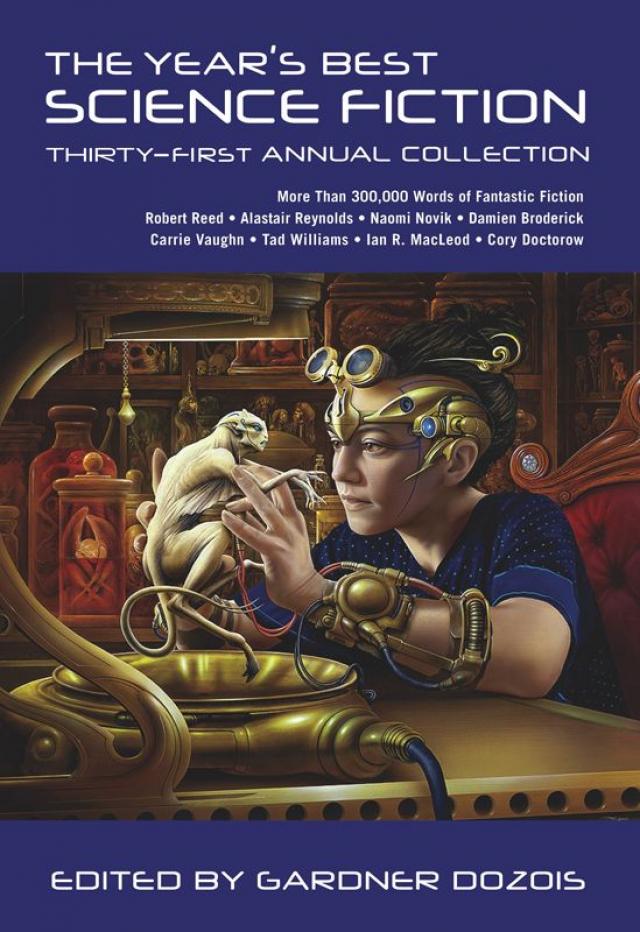
The years best science f.., p.100
The Year's Best Science Fiction: Thirty-First Annual Collection,
p.100


The blaster was on the floorplates at her feet. She swore silently, unable to bend, and made herself concentrate on Ashe’s words. GREEN, then RED—but there was no RED anywhere in sight, unless he’d meant for her to break one of the Ancestral devices? She had the cutter still, but that would take time, and the sound would surely bring Ashe’s “darling” or his men. She would kill Ashe for that herself, later—She laughed silently. It seemed unlikely there would be a “later.”
GREEN, then RED. First GREEN, check, she’d done that, then RED—no, then the red curtain.
The red curtain, the shimmering veil of scarlet thread that covered half the narrow alcove, the alcove that probably was Ashe’s mysterious lifesaving device. First take the GREEN, and then the red curtain.… She staggered toward it, her feet slurring on the floor. The buttons’ effects were starting to wear off, the pain surging; the GREEN pulsed cold with every heartbeat, so cold she thought her bones would crack, her fingers blacken.
The curtain swayed as she came close, a few tentative strands lifting as though to sample the air. She stopped, swaying herself, unsure of what she was really seeing, and still more threads rose, reaching for the exposed skin of her face, her hands. Their touch was pleasant, sweet and soothing, warm as the smell of tea. She let herself be wound in, the threads tugging her gently forward until she was entirely surrounded, tucked into the alcove. Its walls shifted against her, forming to her body, and the final layer of the curtain swept in to enclose her. She felt an instant of panic, but then sleepy warmth suffused her, the pain retreating to nothing, and her eyes closed.
She opened them again an infinity later, her breath easier than it had been in years, the pain a receding memory. She filled her lungs, marveling at the play of muscles and ribs, flattened her hand against her stomach. Vest and shirt and undershirt were in tatters, but her skin was smooth and whole. The last of the threads dropped from her shoulders, unwound from her ankles, dissolving into dust. Out of power? Their job complete? She hoped it was the latter, hoped she would have the time to find out. But for now, there was Darling to worry about.
She scooped up her blaster, the charge still ready, and for good measure drew her cutter and set it to standby before she slid it into her belt. It wouldn’t be much help unless she got into hand-to-hand, and that was to be avoided, but it was better than nothing.
Armed, she peered out the circular hatch. The corridor was dark, but lights moved in the distance, in the nearer of the two compartments between this one and the one with the linked circles. She eased through the hatch, still amazed that her body responded, pressed her back to the bulkhead as she moved as quietly as she could toward the light.
She heard the voices before she was close enough to see, Darling’s cool and calm.
“I’m not buying it, Ashe.”
“I swear,” Ashe said. “This is the only other place to look, and—I don’t know. Maybe I got it wrong. Maybe there’s nothing here.”
“You don’t make mistakes,” Darling said.
“Yes, I do. Even I do,” Ashe said. “I just got it wrong.”
“Usslo!” There was scuffling, and a choked sound that might have been Dai, before Darling spoke again. “Ashe, you are determined to be difficult.”
“I’m not, I swear. I got it wrong—”
Cassilde reached the door, angled her head carefully to see inside. Dai was on his knees, his hands clasped on his head, a man wearing a monocular holding a blaster to his head. Ashe stood beside a hole in the bulkhead, the edges still black from the cutter’s beam. There was RED inside, glimmering in the single worklight, RED and GOLD and maybe even a hint of GREEN—a season’s solid work, a lucky find, and still Darling shook his head.
“A Gift was here, I know that. Don’t make me do this.”
There was no more time. Cassilde took a step, aimed, and fired twice, catching One-Eye in neck and chest. He fell forward, and Dai rolled with him, scrambling for the dropped blaster. Cassilde turned her blaster on Darling, two shots, three, four, all to the chest and belly, driving him back—
“Silde!” That was Dai, blaster in hand, Darling’s last two men crumpled against the bulkhead, and Cassilde drew a shaken breath.
“I’m fine,” she said.
“Yeah, but how—” Dai stopped abruptly, and Cassilde nodded.
“He knows.” She looked at Ashe. “You do, don’t you?”
“It was the device,” Ashe said. His voice cracked. “That was the thing, the lifesaver, oh, God. The Gift. It worked.”
“We need to get out of here,” Dai said. “There’s no telling who else he’s got.” He kicked Darling’s body, not gently.
“He works alone or with small teams,” Ashe said. He had himself under control now, only the faintest trembling of the handlight to betray him. “This should be it.”
Cassilde took a breath. “We will discuss how you know that later—”
“I need to look at the Gift,” Ashe said. “Please, Silde. It’s more important than you know.”
“We don’t have time for that,” Dai said. “Are you fucking crazy?”
“Shut up, both of you,” Cassilde said. “Ashe, the device—it worked on me, and then the red stuff just dissolved. I don’t think there’s much left to look at.”
Ashe closed his eyes. “Damn it.…”
Cassilde ignored him, scanning the compartment. Dai was right, they needed to get away, get out of range of any of Darling’s friends still lurking nearby, but there was also too much easy salvage to abandon. “All right. Clean out that cache, quick and dirty. Anything else we see on the way, grab it, but no more cutting. We’ll come back if we can.”
Dai was already moving to obey, pulling gloves and expandables from his pockets to collect the Ancestral elements, and after a moment Ashe joined him, pulling out RED and GOLD in enormous expensive lumps. At any other moment, Cassilde would have been breathless with delight—this was a massive find, a solid year’s expenses paid for and more—but there was no time. They needed to get back to Carabosse, get themselves into the protection of the Guard. Then they could think about coming back.
The cache was empty, at least of the largest pieces. There would be more, crumbs and fragments, but there was no time to search further. “Back to the ship,” she said, and pinned Ashe with a look. “And you owe me answers.”
“Yes,” he said, and that was strange enough that she nearly dropped her carryall.
“Move,” she said.
* * *
Carabosse made an emergency lift from the chunk of wreckage, blowing the pitons and leaving the depleted atmosphere cartridge behind. They left Darling’s ship grappled to the opposite side of the claim as well, over Ashe’s protests, and set a fast course for the nearest Guard beacon. Cassilde adjusted the sensor net to its widest sweep, and set the active systems to random scan—she’d rather someone caught the pings than miss any pursuit from any more of Darling’s men, no matter what Ashe said about the man working alone—and made her way back to Central.
She still couldn’t believe how good she felt. It wasn’t just that the blaster wound was gone, it was that she could breathe, that her muscles moved with a fluid ease she could barely remember. Her joints no longer clicked and popped, she no longer stepped cautiously to avoid setting off shooting pains from the ankle she’d broken the year before. The Lightman’s was gone, she was sure of that, the incurable cured, but even more, all the minor aches and pains that came with age were also gone. Even the marks of the shock buttons had vanished, though there should have been puncture marks and deep bruises. They had to get back to the claim, recover what was left of the Gift.
Ashe was sitting at the unfolded table, his head tipped back to that Dai could tape his broken nose. Both eyes were blackened, and there was another swelling bruise on his left cheek.
“You look like hell,” Cassilde said. She wasn’t sure she was sorry, either, and felt vaguely guilty.
“Done,” Dai said, and Ashe sat up slowly. Dai turned away from the table, bundling the scraps from the aid kit into the disposal, then collected a bottle and glasses from the cabinet and poured them each a stiff drink. Ashe downed half of his in a single wincing gulp and held out his glass for a refill.
“Don’t be in too much of a hurry,” Cassilde said, and sat down across from him. “We need to talk.”
“I know.” Ashe took a more careful sip of the whiskey, and Dai perched on the edge of the table beside him.
“So what just happened?” Cassilde asked. Her own whiskey tasted wonderful, sweet and sharp and perfectly chilled.
“How are you feeling?” Ashe asked in turn.
Cassilde looked at him. “Well. Better than well. What just happened, Ashe?”
Ashe glanced at Dai, still looming, and wrapped his hands around his glass. “It’s—it was a Gift. The Ancestors made them, very rarely. We have no idea why, only that they exist—”
“Wait a minute,” Dai said. “You’re talking about a Miracle Box. I thought you didn’t believe in them.”
“I was wrong,” Ashe said. Something between a smile and a grimace crossed his face. “About this, too.”
“We’ll get back to him later,” Cassilde said. “You’re telling me that Miracle Boxes are real.”
“You’re here,” Ashe said, with some asperity. “You should be dead.”
Twice over, if not from the blaster bolt then from the Lightman’s, shock triggering a deadly attack. That was what she’d always expected would happen. Cassilde took another sip of her drink, sharp on her tongue and warm all the way down to her healed belly. “And you knew it would be there.”
“I suspected.” Ashe took a breath. “The Ancestors made the Gifts—that’s the word they used, not Miracle Box. Who knows why, and who knows why they left them, just the way they left everything else. But sometimes you find one, and it works. It heals the sick, revives the dying, cures everything from madness to Lightman’s to the common cold. It works once, three times, a hundred times—there are traditional shrines on some of the late-settled worlds that have to have begun as Miracle Boxes. And sometimes you find one that’s special. It only works once, but it carries a bonus. Not only does it heal whatever ails you, but—it changes you. You become one of them.”
“No,” Cassilde said. Even as she spoke, the denial faded, replaced by appalled certainty. That explained how she felt, the intense sensation, the fizzing energy along her veins.
Dai said, “You’re saying Silde has become an Ancestor?”
“I don’t know for sure,” Ashe said. “You’d have to test it, and I don’t have the tools to do it without actually harming her. But, yes, I think so. That was what the bug was telling me, that there was a special Gift there on the wreck.”
“You’re not cutting her,” Dai said, and Cassilde spoke over him.
“You mean that I heal like the Ancestors? That I’ll never be sick again? That I’ll live forever, stay forever just as I am?”
“If I’m right,” Ashe said. “Yes.”
“So.” Cassilde stretched to reach across the table, grabbed the serving knife from its slot in the edge of the table.
“Silde—” Dai’s voice broke.
“Let’s find out,” Cassilde said, and drew the blade across the skin of her forearm. It parted at the touch, welling blood and then a pain sharp enough to stop breath, far more than she had expected. She swayed, and the cut began to close, the blood reabsorbed, skin flowing over it, fading from pink to white to tan. Ashe let out a breath as though he’d been holding it, and Dai shook his head.
“God, Silde.”
“And there we are,” she said. It was hard to get her mind around it, but she was trying, the possibilities crowding in on her. There were things she could do now, things she’d put aside—and things she’d lose, over and over, never aging, never dying, but she thrust that thought aside. She would find a way to fix that, find a way to bring the others with her, so she wouldn’t be alone. She had all the time there was to find an answer. She smiled, slow and fierce. “All the myths are true.”
The Queen of Night’s Aria
IAN MCDONALD
British author Ian McDonald is an ambitious and daring writer with a wide range and an impressive amount of talent. His first story was published in 1982, and since then he has appeared with some frequency in Interzone, Asimov’s Science Fiction, and elsewhere. In 1989 he won the Locus Best First Novel award for Desolation Road. He won the Philip K. Dick Award in 1992 for his novel King of Morning, Queen of Day. His other books include the novels Out On Blue Six; Hearts, Hands and Voices: Terminal Café; Sacrifice of Fools; Evolution’s Shore; Kirinya; Ares Express: Brasyl; and The Dervish House; as well as three collections of his short fiction, Empire Dreams, Speaking in Tongues, and Cyberabad Days. His novel River of Gods was a finalist for both the Hugo Award and the Arthur C. Clarke Award in 2005, and a novella drawn from it, The Little Goddess, was a finalist for the Hugo and the Nebula. He won a Hugo Award in 2007 for his novelette “The Djinn’s Wife,” won the Theodore Sturgeon Award for his story “Tendeleo’s Story,” and in 2011 won the John W. Campbell Memorial Award for his novel The Dervish House. His most recent book is Empress of the Sun, the third volume in his YA trilogy that also includes Planesrunner and Be My Enemy. Coming up is a major retrospective collection, The Best of Ian McDonald. Born in Manchester, England, in 1960, McDonald has spent most of his life in Northern Ireland and now lives and works in Belfast. He has a Web site at www,lysator.liu.se/^unicorn/mcdonald/.
In most recent wars, entertainers have visited the frontline troops, often putting themselves in considerable danger. None have ever visited a battlefield as strange, though, or performed for an audience as bizarre and inhuman, or put themselves in as much imminent danger as do the hapless entertainers in the brilliant and slyly funny story that follows.
“God. Still on bloody Mars.”
Count Jack Fitzgerald, Virtuoso, Maestro, Sopratutto, stood at the window of the Grand Valley Hotel’s Heaven’s Tower Suite in just his shirt. Before his feet, the Sculpted City of Unshaina tumbled away in shelves and tiers, towers and tenements. Cable cars skirled along swooping lines between the carved pinnacles of the Royal Rookeries. Many-bodied stone gods roosted atop mile-high pillars; above them, the Skymasters of the Ninth Fleet hung in the red sky. Higher still were the rim rocks of the Grand Valley, carved into fretwork battlements and machicolations, and highest of all, on the edge of the atmosphere, twilight shadows festooned with riding lights, were the ships of Spacefleet. A lift-chair borne by a squadron of Twav bobbed past the picture window, dipping to the wing beats of the carriers. The chair bore a human in the long duster-coat of a civil servant of the Expeditionary Force. One hand clutched a diplomatic valise, the other the guy-lines of the lift-harness. The mouth beneath the dust goggles was open in fear.
“Oh God, look at that! I feel nauseous. You hideous government drone, how dare you make me feel nauseous first thing in the morning! You’ll never get me in one of those things, Faisal, never. They shit on you; it’s true. I’ve seen it. Bottom of the valley’s five hundred foot deep in Mars-bat guano.”
I come from a light-footed, subtle family, but for all my discretion, I could never catch Count Jack unawares. Tenors have good ears.
“Maestro, the Commanderie has issued guidelines. Mars-bats is not acceptable. The official expression is the Twav Civilization.”
“What nonsense. Mars-bats is what they look like, Mars-bats is what they are. No civilization was ever built on the basis of aerial defecation. Where’s my tea? I require tea.”
I handed the Maestro his morning cup. He took a long slurping sip—want of etiquette was part of his professional persona. The Country Count from Kildare: he insisted it appear on all his billings. Despite the titles and honorifics, Count Jack Fitzgerald had passed the summit of his career, if not his self-mythologising. The aristocratic title was a papal honor bestowed upon his grandfather, a dully devout shopkeeper who nonetheless was regarded as little less than a saint in Athy. The pious greengrocer’s apples would have browned at his grandson’s flagrant disregard for religion and its moralizing. The Heaven’s Tower Suite’s Emperor-sized bed was mercifully undisturbed by another body. Count James Fitzgerald drained his cup, drew himself to full six and half feet, sucked in his generous belly, clicked out cricks and stiffnesses in his joints.
“Oh bless you, dear boy. None of the others can make tea worth a tinker’s piss.”
For the past six months, long before this tour of Mars, I had been slipping a little stiffener into the morning tea.
“And did they love us? Did strong men weep like infants and women ovulate?”
“The Joint Chiefs were enchanted.”
“Well the enchantment didn’t reach as far as their bloody pockets. A little consideration wouldn’t have gone amiss. Philistines.”
A gratis performance at the Commanderie for the Generals and Admirals and Sky-Marshals was more or less mandatory for all Earth entertainers playing the Martian front. The Army and Navy shows usually featured exotic dancers and strippers. From the piano, you notice many things, like the well-decorated Sky-Lord nodding off during the Maestro’s Medley of Ould Irish Songs, but the news had reported that he had just returned from a hard-fought campaign against the Syrtian Hives.
“Ferid Bey wishes to see you.”
“That odious little Ottoman. What does he want? More money, I’ll warrant. I shan’t see him. He spoils my day. I abjure him.”
“Eleven o’clock, Maestro. At the Canal Court.”
Count Jack puffed out his cheeks in resignation.”
“What, he can’t afford the Grand Valley? With the percentage he skims? Not that they’d let him in; they should have a sign: no dogs, uniforms, or agents.”
We couldn’t afford the Grand Valley either, but such truths are best entrusted to the discretion of an accompanist. I have talked our way out of hotel bills before.