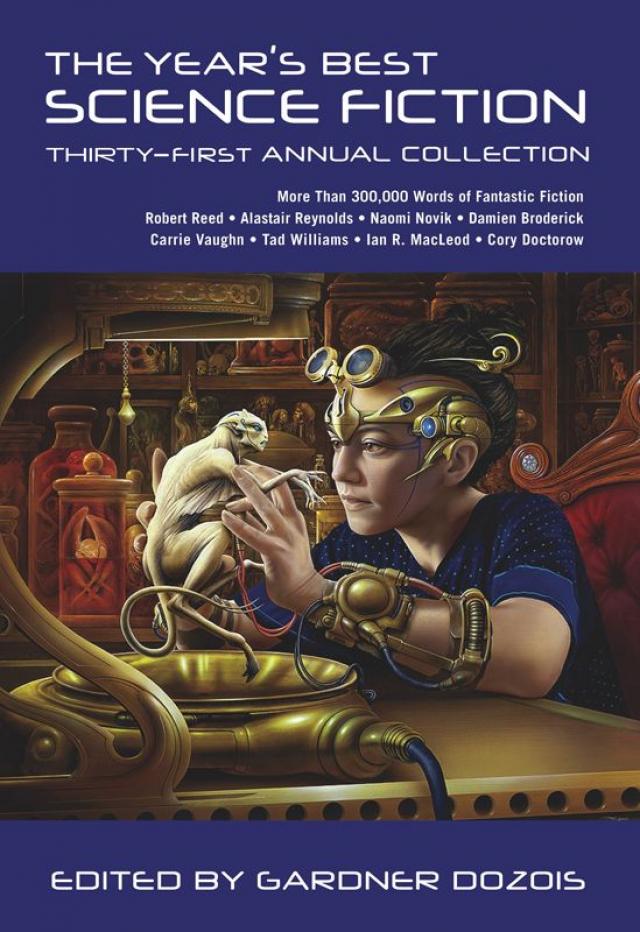
The years best science f.., p.83
The Year's Best Science Fiction: Thirty-First Annual Collection,
p.83


Give me the gun. It wasn’t an instruction in human language but a need, a chemical pattern, a chain of pheromones perpetually renewing. Somehow I found the strength to resist, and saw the snakes wriggling about my doppelganger lying under crystal ahead.
No, I managed.
It could send one of its exoforms to take me apart and thereafter seize the gun. I knew with absolute certainty that it had finished with me. I was a tool it had employed and all its tools died when their usefulness was at an end. I knew with utter certainty that I was going to die. I just did not want to die in ignorance.
Explain, I tried.
The Client at once understood that I accepted defeat and death, and relented.
The pressure came off and I found myself deeper in the Client’s distributed mind, ever dying and ever renewing. Chemical language offered itself and I accepted. I was me and the Client again and its memories opened. Of course the Client was able to manipulate its own genes and its own biology and, like all its kind, that manipulation was part of it and not some logically refined science. The Client’s species did have its geneticists, its bio-techs and even its bio-warfare experts, but the Client wasn’t one of them. That had been lie. However, it was an expert and it was that expertise that had enabled it to escape. It was an expert in U-space tech, it was an alien Iversus Skaidon, and it had built the farcaster.
I understood now what had killed the thetics and Harriet: energy dense micro-explosives no larger than spores but detonating inside with the force of gunshots. The Client had farcast such explosives into the prador aboard the Coin Collector, draining its limited supply of energy and those same explosives, before escaping aboard that ship so long ago, the worlds of its kind burning and tearing apart under prador kamikaze assault.
Why not all, I wondered.
It could have made more of these explosives and steadily annihilated every prador in existence, surely? No, because there were trillions of prador and each first-child or second-child, as the Client had learned, could not be killed with just one such explosive. And here was the complete killer of that idea: it needed to know the precise locations of its targets. It needed help; it needed spotters to locate prime target like father-captains, like the King of the prador. And it needed a weapon that once farcast into such a target would then wipe out all the prador around it—it’s family. That’s where the Polity came in, and that’s where I came in: one of the Polity’s prime biowarfare experts.
I felt the rage again. The orders had been explicit: nothing was to remain. Even as I hit the destruct to turn all my computer files to atomic dust and burn up my samples in thousand Watt laser bursts, the micro-dense explosives tore me apart, and I knew nothing. Now, however, I understood how little trust the Client had of its allies, how it had targeted them all, killing all the humans in the team, shattering the crystal minds of all the AIs. Then, realizing its mistake, it had come for me, and incorporated me—drawn me in like a damaged but still useful exoform.
But the journey, why the pointless search?
The Client needed me separate from it because as an exoform close to it I could pick up on some of its thoughts and might uncover the lie I had been told, and learn that the farcaster was intact and that what it wanted was the bio-weapon I had destroyed. That separation was maintained by the first-child ganglion in the tank and U-space communications that could be shut down in an instant. With our minds so close, why could it not take the design of that weapon straight from my brain? It couldn’t, because it wasn’t there—it was lost with a large chunk of my brain. However, the skills were still there and I was capable of remaking it.
It took the Client many years to build my avatar. It used one of the Golem whose mind it had destroyed, it used elements of the thetic program, which had been the product of one of the research team it had killed, and it did the best it could. It needed me motivated to rebuild that weapon. My motivation was an ersatz freedom, maintained by my ostensible separation from the Client and the firm knowledge that the bioweapon would work as well against it as against the prador. I responded as predicted. I remade that weapon, it resided aboard the Coin Collector, and it resided inside the bullets in the gun inside my thigh.
Give me the gun.
I realized that the action of handing over that weapon wasn’t the main thing the Client required, but its consequence. The knowledge was locked inside me and, by handing over the gun, I would unlock it.
Trillions of prador. I didn’t like them very much but such a genocide appalled me. The Client had its farcaster—had never been without it—and shortly it would have the weapon to annihilate them all. How it intended to target them I didn’t know, but it could find a way for it had the time of an immortal and the utter certainty of purpose. I put up futile resistance and agony filled my skull, not the one in my artificial body, but in that one over there, wrapped in worms and entombed in crystal. My vision was blurred as I stared at the seared ground and fought for, I don’t know, at least some redemption from what was to ensue. Then my vision cleared a little, and I saw a strange thing.
Ten objects lay scattered across the ground in front of me. They were, colourful curved spikes, shocking pink.
I gave up, simultaneously sending the signal to open the hatch in my thigh while reaching down to tear aside the canvas flap. My hand closed around the butt of my fungus gun and I withdrew it, all the knowledge of what its bullets incorporated riding up inside me. I really wanted to aim the weapon at the Client and pull the trigger, but that was utterly beyond me. I turned it, rested it in the flat of my hand and presented it. Already the Client was looping down, both mentally and physically multiple wings roaring to support its weight, its wasp-like leading segment reaching out with four limbs terminating in hands that seemed to be collections of black fish hooks, black hooks in my skull too.
But it was the hand of a reptile, sans claws, that took the gun.
* * *
“Tuppence,” said a voice, but I was still in that moment.
I saw Harriet aiming the gun with a dexterity she had seemingly not possessed in many decades. One shot went into the Client’s leading segment, into its thorax which in turn was partially melded to the head of the segment behind. The second shot went in two segments back from that. Then another two shots went in widely spaced, one after another. The hooks withdrew from my mind but I was rigid with agony, the Client’s agony. I managed to turn my head in time to see Harriet flung aside by a detonation in her side. It tore a hole, but what was revealed inside wasn’t bloody, but hard and glittery. She rolled, came up again and fired the remaining two shots.
“Tuppence.”
A roaring scream filled the cavern as of a whole crowd being thrown into a furnace. The Client reared back and wrapped itself around its tree, black lines rapidly spreading from the bullet impact sites. It shed its forward form, birthed behind, sucked on a crystal tree suddenly turned milk white as it filled with nutrient. It birthed and shed in quick succession, its discarded segments falling about me not as dry husks but soggy and heavy as any corpse. I saw one issuing brown sprouts, spore heads expanding. The Client fought on for survival, tearing at its tree, crystal began to fall and shatter then like the dried wings of its husks once had. Around me I now saw exoforms, but there was no coherence to them—they were just running, crashing into each other, crashing into the walls of the cavern.
“Tuppence.”
At last it ended, the Client freezing round its tree, final segments infected, one newly born freezing halfway down its birth canal, a last head segment falling. The Client died sprouting a fungus which, in its original form, killed mere ants. I died too. Under crystal I saw black threads spreading then all sight of my body blotted out as a spore head exploded in there.
“Oh will you snap out of it!”
I opened my eyes. I was aboard the Coin Collector, in my chair, facing my array of screens. The Client’s world was there in vacuum and, around it I could see the flash of fusion drives and the distant bulks of ships.
“Why am I alive?” I asked, peering down at my battered artificial body.
“You’re not,” said Harriet. “You’re dead.”
I turned to study her. She had put her artificial claws back on and had painted them bright custard yellow, even applied some eye-shadow of the same colour. It occurred to me then that I should have wondered, what with her supposedly being so inept with her claws, how she had always so neatly applied the nail varnish and other make-up. Transferring my gaze to her side I could see no sign of her injury, just clean scaled skin.
“What do you mean I’m dead?”
“The Client used stock memcrystal for the processing in your avatar. That crystal has more than enough storage to contain a human mind. You’re a copy and even though your human body is dead, you live. You are you, Tuppence.”
I wasn’t quite sure how I felt about that.
“Are you Polity?” I asked. “Are you a Polity agent.”
“No, completely independent,” she replied cheerfully.
“I’m confused.”
“Understandable—it’s been a trying day.” She paused while I stared at her, then relented. “Okay, you hired me and I got thoroughly screwed. The damage was bad and it was way beyond being repaired with the reward you gave me or the facilities available at that hospital. That war-drone made a real mess. Then, while I was in the hospital, I received an offer I couldn’t refuse. They’d pay to repair me. They’d bring in the expertise. They’d pay to turn me into what I am now—”
“And what are you now?”
“I’m practically indestructible, and more machine than lizard.” She paused. “And with a mind distributed about my body so it couldn’t be killed with a single farcaster shot.”
“Right,” I said. “Please continue.”
“I was to stick with you, and lead them to the Client.” Harriet paused. “However when I worked out what you were up to, I went for the bigger reward—the one for offing the Client.”
“The Polity,” I said, feeling slightly disgusted.
“Polity technology, certainly, but not the Polity and its AIs.” She pointed a claw at the screens. “Them.”
I stared at the screens for a long moment, then reached out and upped the magnification. They weren’t Polity ships out there swarming around the Client’s world; they were prador dreadnoughts.
I wasn’t sure about how I felt about that either.
“What now?” I asked.
Harriet raised a claw up in front of her face.
“The yellow was a mistake, I think.”
Just then the Coin Collector shuddered, and I realized something large had just docked. I guessed the prador were bringing her reward, and wondered if that might be a cause for regret.
Only Human
LAVIE TIDHAR
Here’s another story by Lavie Tidhar, whose “The Book Seller” appears elsewhere in this anthology. This one is set out on the most remote edges of his Central Station universe, and it demonstrates that in a high-tech world there will be brand-new temptations to be faced, and that the price for giving in to them can be a very high one indeed.
There are four Three-times-Three Sisters in the House of Mirth, and five in the House of Heaven and Hell, and two in the House of Shelter. Four plus five plus two Three-by-Threes, and they represent one faction of the city.
You may have heard tales of the city of Polyphemus Port, on Titan, that moon of raging storms. First city on that lunar landscape, second oldest foothold of the Outer System, or so it is said, though who can tell, with the profusion of habitats in those faraway places of the solar system? A dome covers the city, but Polyport spreads underground—vertical development they called it, the old architects. And its tunnels reach far into the distance, linking to other settlements, small desolate towns on that windswept world, where majestic Saturn rises in the murky skies.
There are two Five-times-Six Sisters in the House of Forgetting, and five Eight-by-Eights in the House of Domicile. We who are a ones, and will one day be zeros, we cannot hope to understand the way of the Sisterhoods of Polyphemus Port, on Titan.
Understanding, as Ogko once said, is forgiveness.
* * *
Shereen was a cleaner in the House of Mirth in the day, and in the evening in the House of Domicile. It was a good, steady job. On Polyport all jobs connect to trade, to cargo. A thousand cults across space arise and fall around cargo. In the islands of the solar system cargo achieves mythical overtones, the ebb and flow of commerce across the inner and outer systems, of wild hagiratech from Jettisoned, best-grade hydroponics marijuana and raw materials from the belt, argumentative robots from the Galilean Republics, pop culture from Mars, weapons from Earth, anything and everything. Polyphemus Port services the cluster of habitats that circle Saturn, and links to the Galilean Republics on the four major moons of Jupiter. It links the inner system with the wild outposts of Pluto—with Dragon’s World on Hydra and Jettisoned on Charon, and the small but persistent human settlements beyond Saturn, in the dark echoey space that lies in between Uranus and Neptune.
People are strange in the Outer System, and the few Others, too, who make their homes there. Some say the Others, those digital intelligences bred long ago by St. Cohen in Earth’s first, primitive Breeding Grounds, have relocated en masse to the cold moons of the Outer System, installing new Cores away from human habitation, but whether it is true or not, who can tell? Whatever the truth of all this is, it suffices to say that all jobs on Polyport, directly or indirectly, are linked with the business and worship of cargo, and that some jobs are always in demand.
Shereen apprenticed as a cleaner in the landing port beyond the city, a vast dust-bowl plane where RLVs like busy methane-breathing bees rise and fall from the surface to orbit, there to meet the incoming and outgoing space-going vessels to ferry people and cargo back and forth. She was seconded to Customs inspections slash Quarantine, scouring ships’ holds for unwanted passengers, the rodents and bacteria, fungus and von Neumann machines; from there she moved dome-side, abandoning her public sector job in favour of the private. She cleaned houses both above- and under-ground, until at last she settled on the dual work for the House of Mirth and the House of Domicile, a work associated, after all, with cargo and religion both.
* * *
It is said that Dragon, that enigmatic entity living on the moon Hydra, its body composed of millions of discarded battle dolls, had passed through Polyport on its way from Earth. If so, local historical documentation is nonexistent, and anecdotal evidence spurious. Nevertheless, an uncle of Shereen’s, a Guild-certified cleaner in his own right, used to tell the tale of Dragon’s arrival as though he had known it for truth.
In the story, Dragon’s Core, the hub of it, remained in orbit around Titan, carried as it were in a converted asteroid; and it trailed behind it kilometres-long lines of suspended second- and third-hand Vietnamese battle dolls, strung on wires; while Dragon manifested upon the streets of Polyport in a doll body of weathered humanoid form of little distinction. It was then, said Shereen’s uncle, that Dragon met the woman who had once been One-times-One, then One-times-Two, and was finally a Three-times-Three; but whose name had once been Haifa al-Sahara.
Did Dragon—who split itself across a million bodies—suggest to al-Sahara a similar possibility? Ask at the House of Mirth, or at the House of Forgetting, and you shall receive no answer. Yet whether it is felt the question too ridiculous to answer, or if, rather, there is a kernel of truth in it, the silence does not say.
Be that as it may. You can read more about the early history of the Houses in Sisters of Titan, by Hassan Sufjan, if you were so inclined or, of course, in Gidali’s classic novel, Three Times Three Is One (adapted by Phobos Studios into a lavish three-part production starring Sivan Shoshanim).
What’s important is that, at the time that Shereen was working at the Houses, trouble had been brewing for some time. And that, one day, a new novice came into service in the House of Mirth.
* * *
Or is that important? It was to Shereen, certainly, eventually. It was to the novice, too, whose name was Aliyah. How we assign importance depends on where we ourselves stand in the story. For Shereen, it was a moment of significance, the point in which light breaks through the transparent dome, and Saturn rises. Seeing Aliyah walk into the House of Mirth was like being thirsty, and then being given drink; like having been sick, and suddenly feeling better; and so on and so forth.
Aliyah came into the House of Mirth dressed in the modest jilaabah of the Sisters, in the plain black of the Noviates. Underneath it, Shereen knew, Aliyah would bear the scars and grafts of Noviatehood; while inside the filaments would be growing, burrowing under the skin and showing as fine blue lines under direct white light. Shereen was cleaning unobtrusively in the background. Robots could do some of the work, sure, but robots, or Others, were not welcome in the Houses of the Sisters. And humans were so much more … human. The Sisterhoods rejected the Way of Robot, and the ideal of Translation. They were, for whatever it’s worth, still human.
In a manner of speaking.
Underneath her head scarf, Shereen knew, Aliyah’s head would be shaven, misshaped by augmentation. Only her eyes could be seen, a startling, deep scarlet like the colour of the sky above the port. In her eyes were the storms of Titan. Perhaps it was then that Shereen fell in love. Or perhaps love is merely the illusion of body chemistry and brain software with deep-embedded evolutionary instincts. Though that hardly sounds very romantic.
The poet-traveller Bashō, who had visited Titan, once wrote:
* * *
Laf hemi wan samting
I no semak
Ol narafala samting
* * *
Which translates, from the Asteroid Pidgin, as: Love is one thing / that is not like / any other thing, and which is as unhelpful as Bashō ever got.