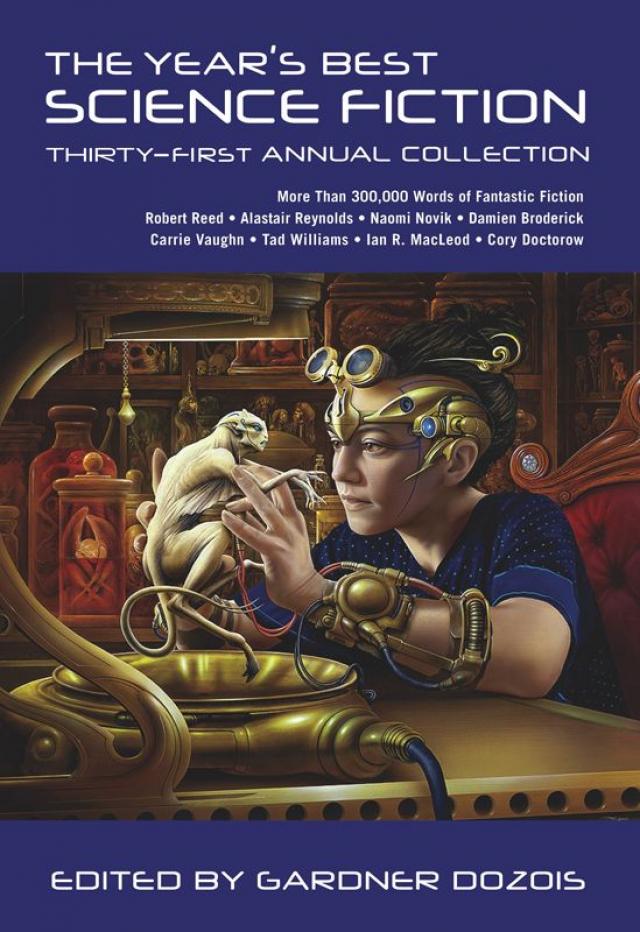
The years best science f.., p.103
The Year's Best Science Fiction: Thirty-First Annual Collection,
p.103


We never saw any of the battledores again.
Again, the Skymaster shook to an impact. Count Jack lunged forward as claws stabbed through the hull and tore three rips the entire length of the bulkhead. The Skymaster lurched to one side; we slid across the decking in our tailcoats and smoke-smudged dickie shirts. An impact jolted the rear of the air ship, I glimpsed blackness, and then the entire tail turret was gone and the rear of the Skymaster was open to the air. Through the open space I saw a four-winged flying thing stroke away from us, up through the pink stone arches of this endless labyrinth. It was enormous. I am no judge of comparative dimensions—I am an auditory man, not a visual one—but it was on a par with our own limping Skymaster. The creature part-furled its wings to clear the arch, then turned high against the red sky, and I saw glitters of silver at the nape of its neck and between its legs. Mechanisms, devices, Uliri crew.
While I gaped at the sheer impossible horror of what I beheld, the Skymaster was struck again, an impact so hard it flung us from one side of the hold to the other. I saw steel-shod claws the size of scimitars pierce the glass finger of the bridge like the skin of a ripe orange. The winged Martian horror ripped bridge from hull, and, with a flick of its foot—it held the bridge as lightly and easily as a pencil—hurled it spinning through the air. I saw one figure fall from it and closed my eyes. I did hear Count Jack mumble the incantations of his faith.
Robbed of control, the Skymaster yawed wildly. Engineering crew rushed around us, shouting tersely to each other, fighting to regain control, to bring us down in some survivable landing. There was no hope of escape now. What were those things? Those nightmare hunters of the labyrinth of night? Skin shredded, struts shrieked and buckled as the Skymaster grazed a rock chimney. We listed and started to spin.
“We’ve lost port-side engines!” I shouted, translating the engineers’ increasingly cold and desperate exchanges. We were going down, but it was too fast … too fast. The chief engineer yelled an order that translated as brace for impact in any language. I wrapped cargo strapping around my arms, and gripped for all my worth. Pianists have strong fingers.
“Patrick and Mary!!” Count Jack cried, and then we hit. The impact was so huge, so hard, that it drove all breath and intelligence and thought from me, everything except that death was certain and that the last, the very last, thing I would ever see would be a drop of fear-drool on the plump bottom lip of Count Jack Fitzgerald, and that I had never noticed how full, how kissable, those lips were. Death is such a sweet surrender.
We did not die. We bounced. We hit harder. The Skymaster’s skeleton groaned and snapped. Sparking wires fell around us. Still we did not stop, or die. I remember thinking, don’t tumble, if we tumble, we are dead, all of us, and so I knew we would survive. Shaken, smashed, stunned, but surviving. The corpse of the Skymaster slid to a crunching stop hard against the house-sized boulders at the foot of the canyon wall. I could see daylight in five places through the Skymaster’s violated hull. It was beautiful beyond words. The sky-horrors might still be circling, but I had to get out of the airship.
“Jack! Jack!” I cried. His eyes were wide, his face pale with shock. “Maestro!” He looked and saw me. I took him by the hand and together we ran from the smoking ruin of the Skymaster. The crew, military trained, had been more expeditious in their escape. Already they were running from the wreck. I felt a shadow pass over me. I looked up. Diving out of the tiny atom of the sun—how horrible, oh how horrible! I saw for the first time, whole and entire, one of the things that had been hunting us and my heart quailed. It swooped with ghastly speed and agility on its four wings and snatched the running men up into the air, each impaled on a scimitar-claw. It hovered in the air above us and I caught the foul heat and stench of the wind from its wings and beak. This, this is the death for which I had been reserved. Nothing so simple as an air crash. The sky-horror looked at me, looked at Count Jack with its six eyes, major and minor. Then with a terrible scrannel cry, like the souls of the dead engineers impaled on its claws, and with a gust of wing-driven wind, it rose up and swept away.
We had been marked for life.
* * *
Irony is the currency of time. We were marked for life, but three times I entertained killing Count Jack Fitzgerald. Pick up a rock and beat him to death with it, strangle him with his bow tie, just walk away from him and leave him in the dry gulches for the bone-picking things.
I reasoned, by dint of a ready water supply and a scrap of paper thrown in that showed a sluggish but definite flow, that we should follow the canal. I had little knowledge of the twisted areography of the Labyrinth of Night—no one did, I suspect—but I was certain that all waters flowed to the Grand Canal and that was the spine and nervous system of Operation Enduring Justice. I advised us to drink—Count Jack ordered me to look away as he knelt and supped up the oddly metallic Martian water. We set off to the sound of unholy cries high and far among the pinnacles of the canyon walls.
The sun had not crossed two fingers of narrow canyonland sky before Count Jack gave an enormous theatrical sigh and sat down on a canal-side barge bollard.
“Dear boy, I simply cannot take another step without some material sustenance.”
I indicated the alien expanse of ruck, dust, water, red sky; hinted at its barrenness.
“I see bushes,” Count Jack said. “I see fruit on those bushes.”
“They could be deadly poison, Maestro.”
“What’s fit for Martians cannot faze the robust Terrene digestive tract,” Count Jack proclaimed. “Anyway, better a quick death than lingering starvation, dear God.”
Argument was futile. Count Jack harvested a single, egg-shaped, purple fruit and took a small, delicate bite. We waited. The sun moved across its slot of sky.
“I remain obdurately alive,” said Count Jack, and ate the rest of the fruit. “The texture of a slightly underripe banana and a flavour of mild aniseed. Tolerable. But the belly is replete.”
Within half an hour of setting off again, Count Jack had called a halt.
“The gut, Faisal, the gut.” He ducked behind a rock. I heard groans and oaths and other, more liquid noises. He emerged pale and sweating.
“How do you feel?”
“Lighter, dear boy. Lighter.”
That was the first time that I considered killing him.
The fruit had opened more than his bowels. The silence of the canyons must have haunted him, for he talked. Dear God, he talked. I was treated to Count Jack Fitzgerald’s opinion on everything from the way I should have been ironing his dress shirts (apparently I required a secondary miniature ironing board specially designed for collar and cuffs) to the conduct of the war between the worlds.
I tried to shut him up by singing, trusting—knowing—that he could not resist an offer to show off and shine. I cracked out “Blaze Away” in my passable baritone, then “The Soldier’s Dream,” anything with a good marching beat. My voice rang boldly from the rim rocks.
Count Jack touched me lightly on the arm.
“Dear boy, dear dear boy. No. You only make the intolerable unendurable.”
And that was the second time that I was close to physically killing him. But we realised that if we were to survive—and though we could not entertain the notion that we might not, because it would surely have broken our hearts and killed us—we understood that to have any hope it making it back to occupied territory, we would have to proceed as more than maestro and accompanist. So, in the end, we talked, one man with another man. I told him of my childhood in middle-class, leafy Woking, and at the Royal Academy of Music, and the realisation, quiet, devastating, and quite quite irrefutable, that I would never be a concert great. I would never play the Albert Hall, the Marinsky, Carnegie Hall. I saw a Count Jack I had never seen before; sincere behind the bluster, humane and compassionate. I saw beyond an artiste. I saw an artist. He confided his fears to me: that the days of Palladiums and Pontiffs had blinded him. He realised too late that one night the lights would move to another and he would face the long, dark walk from the stage. But he had plans; yes, he had plans. A long walk in a hard terrain concentrated the mind wonderfully. He would pay the Revenue their due and retain Ferid Bey only long enough to secure the residency on Venus. And when his journey through the worlds was done and he had enough space dust under his nails, he would return to Ireland, to County Kildare, buy some land and set himself up as a tweedy, be-waistcoated, red-faced Bog Boy. He would sing only for the Church, at special masses and holy days of obligation and parish glees and tombolas; he could see a time when he might fall in love with religion again, not from any personal faith, but for the comfort and security of familiarity.
“Have you thought of marrying?” I asked. Count Jack had never any shortage of female admirers, even if they no longer threw underwear on to the stage as they had back in the days when his hair and moustache were glossy and black—and he would mop his face with them and throw them back to shrieks of approval from the crowd. “Not a dry seat in the house, dear boy.” But I had never seen anything that hinted at a more lasting relationship than bed and champagne breakfast.
“Never seen the need, dear boy. Not the marrying type. And you, Faisal?”
“Not the marrying type either.”
“I know. I’ve always known. But that’s what this bloody world needs. Really needs. Women, Faisal. Women. Leave men together and they soon agree to make a wasteland. Women are a civilising force.”
We rounded an abrupt turn in the canal, and came upon a scene that silenced even Count Jack. A battle had been fought here, a war of total commitment and destruction. But who had won, who had lost, we could not tell. Uliri war-tripods lay draped over ledges and arches like desiccated spiders. The wrecks of Skymasters were impaled on stone spires, wedged into rock clefts and groins. Shards of armor, human and Uliri, littered the canyon floor. Helmets and cuirasses were empty, long since picked clean by whatever scavengers hid from the light of the distant sun to gnaw and rend in the night. We stood in a landscape of hull plates, braces, struts, smashed tanks, and tangles of wiring and machinery we could not begin to identify. Highest, most terrible of all, the hulk of a spaceship, melted with the fires of reentry, smashed like soft fruit, lay across the canyon, rim to rim. Holes big enough to fly a Skymaster through had been punched through the hull, side to side.
Count Jack raised his eyes to the fallen spaceship, then his hands.
“Dear God. I may never play the Hammersmith Palais again.”
Chimes answered him, a tintinnabulation of metal ringing on metal. This was the final madness. This was when I understood that we were dead—that we had died in the Skymaster crash—and that war was Hell. Then I felt the ground tremble beneath the soles of my good black concert shoes and I understood. Metal rang on metal, wreckage on wreckage. The earth shook, dust rose. The spoilage of war started to stir, and move. The ground shook, my feet were unsteady, there was nothing to hold on to, no surety except Count Jack. We held each other as the dust rose before us and the scrap started to slide and roll. Higher the ground rose, and higher, and that was the third time I almost killed him, for I still did not fully understand what was happening, and imagined that if I stopped Jack, I would stop the madness. This was his doing; he had somehow summoned some old Martian evil from the ground. Then a shining conical drill-head emerged from the soil, and the dust and rocks tumbled as the mole-machine emerged from the ground. It rose twenty, thirty feet above us, a gimlet-nosed cylinder of soil-scabbed metal. Then it put out metal feet from hatches along its belly, fell forward, and came to rest a stone’s throw from us. Hatches sprang open behind the still-spinning drill head, fanned out like flower petals. I glimpsed silver writhing in the interior darkness. Uliri padvas streamed out, their tentacles carrying them dexterously over the violated metal and rock. Their cranial cases were helmeted, their breathing mantles armored in delicately worked cuirasses, and their palps held ray-rifles. We threw our hands up. They swarmed around us, and, without a sound, herded us into the dark maw of the Martian mole-machine.
* * *
The spider-car deposited us at a platform of heat ray–polished sandstone before the onyx gates. The steel tentacle-tips of our guards clacked on the mirror rock. The gates stood five times human height—they must have been overpowering to the shorter Uliri—and were divided in three according to Uliri architecture, and decorated with beautiful patterns of woven tentacles in high relief, as complex as Celtic knot-work. A dot of light appeared at the centre of the gates and split into three lines, a bright Y. They swung slowly outward and upwards. There was no other possibility than to enter.
How blind we humans had been, how sure that our mastery of sky and space gave us mastery of this world. The Uliri had not been driven back by our space bombardments and massed Skymaster strikes, they had been driven deep. Even as the great Hives of Syrtia and Tempe stood shattered and burning, Uliri proles had been delving deeper even than the roots of their geothermal cores, down toward the still warm lifeblood of their world, tapping into its mineral and energy resources. Downward and outward; hive to nest to manufactory, underground redoubt to subterranean fortress, a network of tunnels and delvings and underground vacuum-tubes that reached so far, so wide, so deep, that Tharsia was like a sponge. Down there, in the magma-warmed dark, they built a society far beyond the reach of our space-bombs. Biding their time, drawing their plans together, sending their tendrils under our camps and command centres and bases, gathering their volcano-forged forces against us.
I remembered little of the journey in the mole-machine except that it was generally downward, interminable long, and smelled strongly of acetic acid. Count Jack, with his sensitivities, discreetly covered his nose and mouth with his handkerchief. I could not understand his reticence: the Uliri had thousands better reasons to have turned us to ash than affront at their personal perfume.
Our captors were neither harsh nor kind. Those are both human emotions. The lesson that we were slow to learn after the Horsell Common attack was that Martian emotions are Martian. They do not have love, anger, despair, the desire for revenge, jealousy. They did not attack us from hate, or defend themselves from love. They have their own needs and motivations and emotions. So they only seemed to gently usher us from the open hatches of the mole-machine (one among hundreds, lined up in silos, aimed at the upper world) into a vast underground dock warm with heart-rock, and along a pier to a station, where a spider-shaped glass car hung by many arms from a monorail. The spider-car accelerated with jolting force. We plunged into a lightless tunnel, then we were in the middle of an underground city, tier upon tier of lighted windows and roadways tumbling down to a red-lit mist. Through underwater waterfalls, through vast cylindrical farms bright with the light of the lost sun. Over marshaling yards and parade grounds as dense with padvas as the shore is with sand grains. Factories, breeding vats, engineering plants sparkling with welding arcs and molten steel. I saw pits miles deep, braced with buttresses and arches and spires, down and down and down, like a cathedral turned inside out. Those slender stone vaults and spires were festooned with winged horrors—those same four-winged monsters that had plucked us out the sky and so casually, so easily, dismembered our crew. And allowed us to live.
I had no doubt that we had been chosen. And I had no doubt why we were chosen.
Over another jarring switch-over, through another terrifying, roaring tunnel, and then out into a behemoth gallery of launch silos: hundreds of them, side by side, each loaded with fat rocket ships stiff with gun turrets and missile racks. I feared for our vaunted Spacefleet, and, realising that, feared more for myself. Not even the alien values of the Uliri would show us so much if there were even the remotest possibility we could return the information to the Commanderie.
Count Jack realised it in the same instant.
“Christ on crutches, Faisal,” he whispered.
On and on, through the riddled, maggoty, mined and tunnelled and bored and reamed Under-Mars. And now the onyx gates stood wide and the padvas fell into a guard around us and prodded us through them. The polished sandstone now formed a long catwalk. On each side rose seats, tier upon tier of obsidian eggcups. Each held an Uliri, proles, gestates, padvas, panjas; arranged by mantle color and rank. From the detail of the etchings on their helmets and carapace covers, I guessed them to be of the greatest importance. A parliament, a conclave, a cabinet. But the true power was at the end of the long walk: the Queen of Noctis herself. No image had even been captured, no corpse or prisoner recovered, of an Uliri Queen. They were creatures of legend. The reality in every way transcended our myth-making imaginations. She was immense. She filled the chamber like a sunrise. Her skin was golden; her mantle patterned with soft diamond-shaped scales like fairy armor. Relays of inseminators carried eggs from her tattooed multiple ovipostors, slathering them in luminous milt. Rings of rank and honor had been pierced through her eyelids and at the base of her tentacles. Her cuirass and helmet glowed with jewels and finest filigree. She was a thing of might, majesty and incontestable beauty. Our dress heels click-clacked on the gleaming stone.
“With me, Faisal,” whispered Count Jack. “Quick smart.” The guard stopped, but Count Jack strode forward. He snapped to attention. Every royal eye fixed on him. He clicked his heels and gave a small, formal bow. I was a heartbeat behind him. “It’s all small beer after the Pope.”
A tentacle snaked toward us. I resisted the urge to step back, even when the skin of the palp retraced and there, there was a human head. And not any human head: the head of Yuzbashi Osman, the music lover of Camp Oudeman, whom we had last seen leading a bold and stirring—and ultimately futile—charge against the padva hordes. Now the horror was complete. Yuzbashi opened his eyes and let out a gasping sigh. The head looked me up and down, then gave Count Jack a deeper scrutiny.