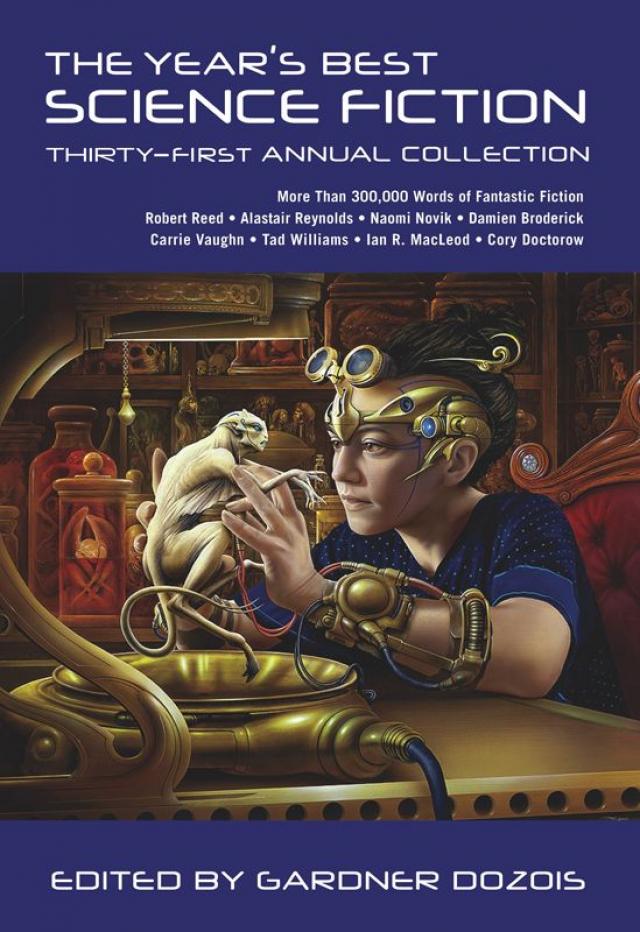
The years best science f.., p.77
The Year's Best Science Fiction: Thirty-First Annual Collection,
p.77


Making his way down the narrow stairs and out through the church, Dale found Bartley and McGovern waiting outside for him, the latter with the palm of his hand pressed firm against the wall.
“Heard you’d finally gone to see the priest,” McGovern said.
“This one was worried for ya,” Bartley added, shaking his head.
McGovern shrugged. “Civility never broke a man’s jaw.”
“Clearly you’ve never been in a pilots’ ready room,” Dale said. “But thank you, Gerry. I appreciate it.”
“Come on now,” said Bartley. “Tell us, is your business done?”
“My business is done here,” he said. “But I’ve got one more thing to do, if you want to join me…”
“You’ll stand us the line?” the old man asked with a wink.
Dale grinned, the keys to his rental car already in his hand. “Sure.”
Ten minutes later they were out of the village, crystal moonlight making everything unreal as they drove into The Burren. The pale-faced sky-child of earlier was gone, as was the golden hue of dusk, the Moon’s disc having slipped to a colder, sterner blue which cast long, chaotic shadows all round them. Hills squeezed the twisting road and each shape was another sculpture in a garden of demented stone where everything became reverent and cruel. In a field by the road with the light streaming through it, the silhouette of a horse stood proud on the hilltop. Dale thought he glimpsed an empty saddle on its back but couldn’t know for sure. They drove on.
He remembered, back in training, Rodriguez and himself; still young men, men who had fought together, who had chosen a most dangerous profession.
“You’ll take me back to Houston?” Dale had said.
“If you take me back to County Clare.”
Beer-bottle necks had clinked at the arrangement, but Dale never thought he’d have to see it through, never once reckoned that he’d end up here with his friend in a metal can.
“What’d’ya think,” McGovern said. “Does this look good?”
Dale nodded, “Yeah.” He pulled in from the road and stopped the engine. Everything was silent. Leaning over the steering wheel, he stared into the sky where the spirit of his friend flew free. The image of disintegration was burned into his mind. The whirling debris, the cloud of vapour when the remaining hydrogen and oxygen collapsed against each other. Aquarius, he thought; the water carrier.
The president had made a speech which came back to him from time to time. “The cause for which they died will go on,” he’d said. “Our journey into space will continue.” He quoted it to Bartley and McGovern.
“Always liked him,” Bartley said. “A good lad, now. A good lad.”
“Yes,” said Dale, who had met him once, a tall, sad man whose ambition had surpassed his reach. “I guess he always seemed to be.” He picked up the canister and opened the door of the car. “Let’s go.” He led them out onto the bare shoulder, through the stile and up into a steep, rocky field. There was no soil, or very little anyway, and it was odd, he thought, to recognise the kind of features he had been trained to see on lunar missions, erratics and stratigraphic markers. He picked up a stone from the rough surface and turned it over in his hand.
“What’s that?” McGovern asked.
“The technical term is FLR. At least according to Rodriguez.”
“FLR?”
“Funny Looking Rock.” He smiled as he dropped it to the ground. Rodriguez always said that levity was appropriate in a dangerous trade and he was right, Dale realized, as he picked his way through loose stones, careful not to lose his footing on the crumpled ground. One had to be able to laugh at one’s self, at the job, at the danger.
“Woah,” he said, catching his toe in one of the great, deep cracks which slithered everywhere.
Bartley sniggered. “You alright there, Dale?”
“Yeah,” the American said. “Thanks.”
They were on the true Burren now, a vast, wrinkled plain of undulating stone weathered into near oblivion. A kaleidoscope of grey, it spread on and on, beyond history, beyond the night, out of sight beyond Dale’s unrelenting dreams. Behind them, the few stray streetlights of the village sparkled in the distance, and, above, the wash of moonlight made it seem another world entirely.
It was, Dale decided, as good a place as any. “Here,” he said.
Beside him Bartley nodded. “When they buried my brother it wasn’t like this,” he said, “it was a fine spring day.”
Dale and McGovern both turned to look at him, startled by his openness.
“He was a hero,” Bartley went on. “Of the kind they name streets after, you know? Brought down a lot of them lot here at the time.”
“The Tans,” McGovern said. “The British.”
“Aye,” said Bartley. “And they’d men from his column there to see him away, draping the tricolour across his box, a few of them with rifles that they let off. The noise of it all,” he said. “Twas a fierce honour.”
Dale cast him an unsure look. “You’re not … armed now, are you Bartley?”
The old man laughed, a booming ho-ho as loud as any shot. “Not at all. Not at all, a’course. I’m just saying, you know, the moment should be marked.”
“And what had you in mind?” McGovern asked.
Bartley grinned, and with great effort brought himself to his full height. He raised his right arm and bent his elbow, bringing his hand to his head in a salute. McGovern quickly did the same.
Dale nodded, and carefully he opened up the flask, tipping its cremated contents out onto the breeze. The cloud flattened out at once, dove towards the rocky pavement, and then took flight, specks of ash like busy stars exploding all around him while the world turned overhead. Dale straightened up and saluted too, the remains of Rodriguez taking wing into the night.
When it was over he brought his hand down and, behind him, his two friends mumbled something as they let their own arms fall, Bartley rubbing at his shoulder.
“We should take a stroll now,” McGovern said quietly.
“What?” Bartley said.
“You know, as we’re here, we should give Dale the air of the place.”
“Ah, will you not be—”
“No,” Dale said. He laid his hand on Bartley’s shoulder, “I’d like that.” He was tired, that was true, it was late, and yet some new energy was coming to him. It compelled him to move, to walk, to see what he could find.
“Well then,” McGovern said, “come on so,” and he led them out across the hillside.
They were at last, Dale thought, the crew he had imagined, ambling across this odd terrain with the strange, loping gait required to leap from one great limestone block to another. Step-by-step the three of them picked their way across the broken surface, away from the road, away from the lights of the village and everything that Dale had come to know. This was a separate place, severe and beautiful and altogether alien. There, in the stone, were red and orange tints which he could not explain. In the sky, the universe’s mechanism whirled while the three men drifted on, and, as the grey rock fell off toward the close horizon, they could have been walking on the moon.
The Other Gun
NEAL ASHER
Neal Asher was born in Essex, England, but now lives in Crete. He started writing at the age of sixteen but didn’t explode into public print until a few years ago; a quite prolific author, he now seems to be everywhere at once. His stories have appeared in Asimov’s Science Fiction, Interzone, The Agony Column, Hadrosaur Tales, and elsewhere, and have been collected in Runcible Tales, The Engineer, and Mason’s Rats. His extremely popular novels include Gridlinked, Cowl, The Skinner, The Line of Polity, Brass Man, Voyage of the Sable Keech, The Engineer Reconditioned, Prador Moon: A Novel of the Polity, and Hilldiggers. His most recent books are a novel, The Line War, and a collection, The Gabble and Other Stories.
Here he gives us a typical Asher story: fast-paced, ultraviolent, grim, highly inventive, sometimes gruesome, and thoroughly entertaining.
As the bathysphere landed I fought to regain my humanity, even though my latest communication with the Client had been some hours ago. Talking to that entity was always a bizarre and confusing experience, and one I would never get used to, didn’t want to. Every time afterwards it felt to me like I was a new occupant of my old and battered body. I blinked, remembering the lack of eyelids, held up my hand to clench and unclench it and remembered a lack of fingers, or at least fingers like these, then, with the bathysphere settling, reached out and pressed a thumb against the door control.
The twenty-foot-wide circular door thumped away from me, releasing from its seals to allow in a waft of vapour and smell like rotting vegetables, turned its inner locking ring to unlock then slowly hinged down, first exposing a yellow sky bruised with brown clouds.
“Don’t take anything for granted,” I said to my companion.
“I never do,” sighed Harriet, her voice as always surprisingly gentle from such a large mouth full of so many teeth.
I glanced at her and wondered how the people of this colony would react to her. Harriet was a Mesozoic era dinosaur, a troodon in the style of those dinosaurs from one of the paleo-history fashions when feathers were out and colourful skin was back in. She was jade on her upper surfaces and mustard yellow below and her back mackerel patterned with hints of navy blue. To add to her gaudy appearance she had painted her claws gold, and wore a variety of silver and gold bangles and neck rings. I was glad that in recent years she’d lost interest in applying eye-shadow. She now stood up on her toes and extended her long neck to raise her sharp reptilian head, which was first at a level with mine, to peer over the door at the landscape lying beyond, and blinked bright slot-pupil eyes.
“Tasty,” she said, which was often her response to overly muscled humans. She then clicked her fore-claws in frustration and ducked back down. This probably meant the humans concerned were armed.
The door finally came down to rest on boggy ground mounded with heather-like plants and nodular mosses, stabbed through here and there with black reeds. The colony raft sat about a mile beyond, a structure a mile wide and bearing some resemblance to an ancient aircraft carrier. Members of the Frobishers, who were the family I had come to trade with, stood between the bathysphere door and the vehicle they’d come over in—a swamp car with cage wheels. Four heavies clad in quilted body suits and rain capes stood out there, three of them carrying light laser carbines and a fourth holding something that looked suspiciously like a proton weapon. Before these stood a woman, clad much the same as them but studying an ancient computer tablet. This must be the woman I had come to see, scourge of the Cleaver family and a character with growing off-world interests. I moved forwards, raindrops spattering against my crocodile-skin jacket and thick canvas trousers, my heavy boots sinking into the boggy ground as I stepped off the door.
“Madeleine Frobisher?” I enquired.
She was already looking up, studying both me and my companion warily. I advanced towards her and held out my hand, trying to ignore the laser carbines tracking my progress. “I’m Tuppence.”
She didn’t offer her hand in return, instead nodding towards the bathysphere behind.
“Novel form of transport,” she opined.
I lowered my hand and turned to look back. The spherical craft was shifting—adjusting its gravmotors to pull itself back up out of the soft ground. Those motors were far too inefficient to support the entire weight of the craft and send it airborne, not because of their decrepitude, for even though they were centuries old they still functioned as they always had, but because when they were made the prador had only just begun inventing the technology. This was why the craft’s main method of ascent and descent was attached to its crown: a wrist-thick stent-weave diamond-filament cable that speared upwards to disappear into the bruised sky. Hundreds of miles of it attached at its further end to a giant reel in the underbelly of the Coin Collector—an ancient prador tug that had once born a very different name under previous ownership.
“It is,” I replied, “but it serves.”
“And what is this?” Madeleine gestured to Harriet.
Pointing to my troodon companion, I replied, “Let me introduce Harriet, who by her appearance you would not realize was once an exotic dancer on Cheyne III.”
Harriet dipped her head in acknowledgement. “Pleased to eat you.”
“She of course means ‘pleased to meet you’ since her artificial vocal chords sometimes struggle with the shape of her mouth.” I eyed Harriet. The changes her brain had undergone, having been compressed in that reptilian skull, were a worry. Though, at that point, I couldn’t figure out whether that “pleased to eat you” was a Freudian slip due to her lost intelligence or just a little joke at my expense.
“Is she … alien?”
I turned back to Madeleine. “Harriet is just the result of an extreme desire for change using adaptogenic drugs, zooetics and nanodaption, and is, if you were to stretch the term almost to breaking point, a human being.”
“She will remain here,” said Madeleine.
I shook my head. “She comes with me—that’s not negotiable.”
“Then our negotiations are over before they have truly started.”
“Very well,” I smiled at her congenially. “I have to admit to being disappointed, but if you’re going to grandstand by setting pointless conditions…” I shrugged and began to turn back to my bathysphere. I was halfway back up the ramp door before she relented.
“Oh, if she must,” she finally said.
I turned back to see her waving a dismissive hand, this all obviously being a matter of no consequence.
“It’s just that there’s little room in the ATV,” she added.
“That’s not a problem. Harriet is more than capable of keeping up on foot.” I gestured to her vehicle as I returned to her. “Shall we?”
She held up one hand. “I do hope you’ve brought payment and are not wasting my time.”
“Of course,” I replied. “Twenty pounds of prador diamond-slate, etched sapphires to the value of one million New Carth Shillings and the fusion reactor parts you detailed.”
“Good.” She nodded.
Catching her speculative glance towards the bathysphere I remembered to send the signal to close the door, and heard it groaning shut as I followed two of the heavies up the steps leading inside the swamp car. Within, seats lined the two sides with plenty of room for Harriet to squat between, but I didn’t point this out. The heavies sat down, silent and watchful, while Madeleine sat beside the driver who was obviously another of the Frobisher line. This weedy looking individual bore similar facial features as the rest in here but also had a wart growing in precisely the same position on each of his eyelids—a sure sign of interbreeding. He started up the car—a hydrogen turbine engine by the sound of it—and set it into motion. I stretched up to look out of the narrow heavily scratched plastic windows to see Harriet bounding along beside the vehicle, then settled down patiently. Within five minutes we were in the shadow of the family raft then driving up a ramp and parking, the engine winding down to silence.
“So where did you find the artefact?” I asked as I followed Madeleine out into a crammed tube of a swamp-car park.
“It’s been here in our raft for as long as I can remember,” she replied, “but it was only when one of my people studied your broadcast was it identified … that was about ten years ago.”
“Solstan?”
Madeleine paused, glanced round at me. “I haven’t heard that expression in a while … no, it’s maybe seventeen solstan years ago.”
I grimaced. I’d been chasing rumours about the elements of the farcaster in the Wasteland for twenty years now and found nothing. I often wondered if they truly existed because why, as the Client claimed, would the Polity AIs have ordered it broken up and scattered? If they had truly considered it such a danger why hadn’t they just destroyed it completely? I also often considered the unlikelihood of Polity AIs ridding themselves of such a potentially potent weapon, because that seemed very unlike them. But I could only obey and keep on searching, meanwhile slowly plotting my route to freedom.
Harriet had now re-joined us, panting but probably invigorated by the run. The armed escort closed in all around, seemingly a lot more confident now. I wondered if this indicated that they were thinking of doing something stupid. Past experience of trades like this told me they probably were, and knowing the Frobisher’s history did not make me optimistic.
Confirmation came just a minute later as Madeleine led the way up steps so worn the plating was gone to expose closed-cell bubble-metal. Concentrating on my footing with my body’s eyes I also looked through other eyes at the two swamp cars that had just pulled up by my bathysphere. I then watched some Frobishers unloading a heavy atomic shear from one of them, and wondered if this family had become so interbred there had been a loss of intelligence. It would be interesting to see what would happen when the atomic shear hit the prador alloy of the vehicle. The metal might not be the kind that armoured their war ships, but it was very tough, and the defence system might be old, but had proven effective on many occasions.
“So what’s its condition?” I asked, so as to keep up the pretence. Of course, by the data package Madeleine had sent there had been a good chance that this could have been the real deal, but not now.
“I can’t really say. It produces the power signatures you detailed and it’s of the shape you described.” Madeleine shrugged. “Hopefully you know your stuff and will be able to tell me.” She then added, “But we still get the agreed first payment.”
“Of course,” I said.
I did know my stuff, perhaps more so than she would want. A century of research and experimentation and of perpetual mental updates of the latest research in the Polity since the war had made me an expert in many fields. I would also recognize a fake which, as I had been at pains to stress during my broadcast across the Wasteland, would result in no payment at all and quite likely some extreme response.