The years best science f.., p.31
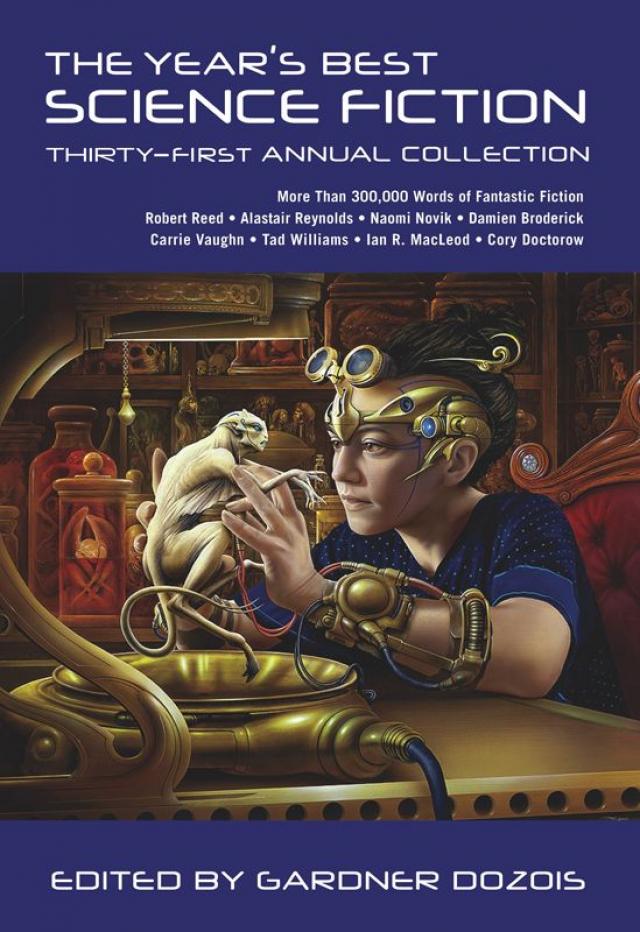
The Year's Best Science Fiction: Thirty-First Annual Collection,
p.31


After a decade of international conferences I have colleagues all over the world. I call them all. Most are sympathetic. A South African cosmologist I know tells me I’m grandstanding, then laughs like it’s a joke, but not really. They all tell me to be patient. Just wait.
Life goes on. My other research, the asteroid research I was doing, has piled up, and I get polite but firm hints that I really ought to work on that if I want to keep my job. I go to conferences, I publish, I do another dozen interviews, holding up the plastic model of the object that I’ll likely never get close to. The ache in my heart feels just like it did when Peter left me. That was three years ago, and I can still feel it. The ache that says: I can’t possibly start over, can I?
The ache faded when I found UO-1.
* * *
“JPL rejected your proposal to repurpose Angelus. Thank God.” Marsh leans on my doorway like usual. He’s grinning like he won a prize.
I got the news via email. The bastards can’t even be bothered to call. I’d called them back, thinking there must have been a mistake. The pitying tone in their voices didn’t sound like kindness anymore. It was definitely condescension. I cried. I’ve been crying all afternoon, as the pile of wadded-up tissues on my desk attests. My eyes are still puffy. Marsh can see I’ve been crying; he knows what it looks like when I cry. He was there three years ago. I take a breath to keep from starting up again and stare at him like he’s punched me.
“How can you say that? Do you know what they’re talking about now? They’re talking about just leaving it! They’re saying the orbit is stable, we’ll always know where it is and we can go after it when we have a better handle on the technology. But what if something happens to it? What if an asteroid hits it, or it crashes into Jupiter, or—”
“Jane, it’s been traveling for how many hundreds of billions of miles—why would something happen to it now?”
“I don’t know! It shouldn’t even be there at all! And they won’t even listen to me!”
He sounds tired. “Why should they?”
“Because it’s mine!”
His normally comforting smile is sad, pitying, smug, and amused, all at once. “It’s not yours, not any more than gravity belonged to Newton.”
I want to scream. Because maybe this isn’t the most important thing to happen to humanity. That’s probably, oh, the invention of the wheel, or language. Maybe this is just the most important thing to happen to me.
I grab another tissue. Look at the picture of UO-1. It’s beautiful. It tells me that the universe, as vast as we already know it is, is bigger than we think.
Marsh sits in the second chair without waiting for an invitation. “What do you think it is, Jane? Be honest. No job, no credibility, no speaking gig for Discovery on the line. What do you think when you look at it?” He nods at the picture.
There are some cable shows that will win you credibility for appearing on them. There are some that will destroy any credibility you ever had. I have been standing right on that line, answering the question of “What is it?” as vaguely as possible. We need to know more, no way to speculate, et cetera. But I know. I know what it is.
“I think it’s Voyager. Not the Voyager. Their Voyager. The probe they sent out to explore, and it just kept going.”
He doesn’t laugh. “You think we’ll find a plaque on it? A message? A recording?”
“It’s what I want to find.” I smile wistfully. “But what are the odds?”
“Gershwin,” he says. I blink, but he doesn’t seem offended by my confusion. He leans back in the chair, comfortable in his thick middle-aged body, genial, someone who clearly believes all is well with the world, at least at the moment. “We’ve had fourteen billion years of particles colliding, stars exploding, nebulae compressing, planets forming, all of it cycling over and over again, and then just the right amino acids converged, life forms, and a couple of billion years of evolution later—we get Gene Kelly and Leslie Caron dancing by a fountain to Gershwin and it’s beautiful. For no particular evolution-driven reason, it’s beautiful. I think: what are the odds? That they’re dancing, that it’s on film, and that I’m here watching and thinking it’s gorgeous. If the whole universe exists just to make this one moment happen, I wouldn’t be at all surprised.”
“So if I think sometimes that maybe I was meant to find UO-1, because maybe there’s a message there and that I’m the only one who can read it—then maybe that’s not crazy?” Like thinking that the universe sent me UO-1 at a time in my life when I desperately needed something to focus on, to be meaningful …
“Oh no, it’s definitely crazy. But it’s understandable.” This time his smile is kind.
“Marsh—this really is the most important thing to happen to humanity ever, isn’t it?”
“Yes. But we still need to study and map near-Earth asteroids, right?”
* * *
I don’t tell Marsh that I’ve never seen An American in Paris. I’ve never watched Gene Kelly in anything. But Marsh obviously thinks it’s important, so I watch the movie. I decide he’s right. That dance at the fountain, it’s a moment suspended in time. Like an alien spacecraft that shouldn’t be there but is.
* * *
Two things happen next.
At the next IAU meeting an archaeologist presents a lecture on UO-1, which I think is very presumptuous, but I go, because I go to everything having to do with UO-1. She talks about preservation and uses terms like “in situ,” and how modern archaeological practice often involves excavating artifacts, examining them—and then putting them back in the ground. She argues that we don’t know what years of space travel have done to the metal and structures of UO-1. We don’t know how our methods of studying it will impact it. She showed pictures of Mayan friezes that were excavated and left exposed to the elements versus ones that remained buried for their own protection, so that later scientists with better equipment and techniques will be able to return to them someday. The exposed ones have dissolved, decayed past recognition. She gives me an image: I reach out and finally put my hand on UO-1, and its metallic skin, weakened by a billion micrometeoroid impacts gathered over millennia, disintegrates under my touch.
I think of that and start to sweat. So yes, caution. I know this.
The second thing that happens: I turn my back on UO-1.
Not really, but it’s a striking image. I write another proposal, a different proposal, and submit it to one of the corporate foundations because Marsh may be right. If nothing else, it’ll get attention. I don’t mind a little grandstanding.
We already have teams tracking a best-guess trajectory to determine where UO-1 came from. It might have been cruising through space at nonrelativistic speed for dozens of years, or centuries, or millions of centuries, but based on the orbit it established here, we can estimate how it entered the solar system and the trajectory it traveled before then. We can trace backward.
My plan: to send a craft in that direction. It will do a minimal amount of science along the way, sending back radiation readings, but most of the energy and hardware is going into propulsion. It will be fast and it will have purpose, carrying an updated variation of Sagan’s Voyager plaques and recordings, digital and analog.
It’s a very simple message, in the end: Hey, we found your device. Want one of ours?
In all likelihood, the civilization that built UO-1 is extinct. The odds simply aren’t good for a species surviving—and caring—for long enough to send a message and receive a reply. But our sample size for drawing that conclusion about the average lifespan of an entire species on a particular world is exactly one, which isn’t a sample size at all. We weren’t supposed to ever find an alien ship in our backyard, either.
I tear up when the rocket launches, and that makes for good TV. As Marsh predicted, the documentary producers decide to make me the human face of the project, and I figure I’ll do what I have to, as best as I can. I develop a collection of quotes for the dozens of interviews that follow—I’m up to two-hundred thirty-five. I talk about taking the long view and transcending the everyday concerns that bog us down. About how we are children reaching across the sandbox with whatever we have to offer, to whoever shows up. About teaching our children to think as big as they possibly can, and that miracles sometimes really do happen. They happen often, because all of this, Gershwin’s music, the great curry I had for dinner last night, the way we hang pictures on our walls of things we love, are miracles that never should have happened.
It’s a hope, a need, a shout, a shot in the dark. It’s the best we can do. For now.
Transitional Forms
PAUL J. MCAULEY
Paul J. McAuley was born in Oxford, England, in 1955, and now makes his home in London. He has been a professional biologist for many years, sold his first story in 1984, and went on to be a frequent contributor to Interzone, as well as to markets such as Asimov’s Science Fiction, SCI FICTION, Amazing, The Magazine of Fantasy and Science Fiction, Skylife, The Third Alternative, When the Music’s Over, and elsewhere.
His first novel, Four Hundred Billion Stars, won the Philip K. Dick Award, and his novel Fairyland won both the Arthur C. Clarke Award and the John W. Campbell Award in 1996. His other books include the novels Of the Fall, Eternal Light, and a major trilogy of ambitious scope and scale set ten million years in the future, Pasquale’s Angel, Confluence; it comprises the novels Child of the River, Ancient of Days, and Shrine of Stars. Others include Life on Mars, The Secret of Life, Whole Wide World, White Devils, Mind’s Eye, Players, Cowboy Angels, The Quiet War, Gardens of the Sun, and In the Mouth of the Whale. His short fiction has been collected in The King of the Hill and Other Stories, The Invisible Country, Little Machines, and Stories From the Quiet War, and he is the coeditor, with Kim Newman, of an original anthology, In Dreams. His most recent books are a new novel, Evening’s Empire, and two collections, Life After Wartime and A Very British History: The Best of Paul McAuley, a big retrospective collection.
In the tense story that follows he takes us along with a ranger patrolling the borders of a Hot Zone, in which bizarre forms of artificial life have mutated and run riot—but in which, as always, the most dangerous forms of life prove to be other human beings.
At night, the hot zone was patched with drifts of soft pastel light. Violets and indigos; dark reds, translucent greens. Jellyfish genes for luminescence had been used as markers for tweaks in the first genetically modified organisms, and that tradition had been adopted by alife hackers. The colours were tags, territorial claims that pulsed and twinkled like spring blossom in an alien and verdant land.
Ray Roberts had been patrolling the hot zone and the desert around its perimeter for two years now, and he still thought it beautiful, at night. During the day, the trees and other alife organisms baked under the sunbleached sky. Black twisted lattices like the charred skeletons of cacti; carbonised spikes and spurs like the armatures of nuclear-blasted buildings. Tangles of burnt wire. Fields of grim sculpture. But at night, shrouded in soft clouds of colour, it was a fairyland.
That particular night, about a week after a salvage gang had infiltrated the zone and stripped copper and molybdenum beads from about twenty hectares of metal-concentrating trees, Ray was riding his bay gelding, Winston, along the dirt roads that switchbacked over the dump rock hills. He was plugged into the surveillance grid of cameras and drones. GPS tracked him to within a metre. He reported to dispatch every thirty minutes, and the reports of the other patrols crackled in his earpiece. The zone was on amber alert because the salvage gang would almost certainly be back for more, but that night everyone was reporting they’d nothing to report.
Around midnight, he met up with two colleagues at one of the monitoring stations near the pit of the exhausted copper mine at the core of the zone. They watered their horses from the standpipe, exchanged gossip, moved on. At sunup, Ray and Winston were heading home along the old boundary road when he spotted something up on a ridge. A glint, a speck in the eye, a dead pixel in a heads-up display. He glassed it in UV and infra-red, called up dispatch and sent a good shot from the camera built into his glasses, got permission to check it out.
He kept a wary eye on the spot, let Winston pick his way between rocks and mini-cathedrals of black spikes and clumps of prickly pear. At the top of the ridge, he reined in his horse and sat and waited, one hand close to the taser holstered at his hip. He’d never yet used it in anger, but you never could tell.
To the naked eye, the tent’s canvas perfectly matched the ground’s dry pebbly texture. Pretty soon a woman emerged, as if climbing out of a rent in the air. T-shirt and jeans, dirty blond hair in a ponytail, sunglasses heliographing early morning sun as she looked up at him.
Ray asked her if she was alone. “Neither of us need any surprises.”
“There’s no one here but me and the ants.”
“They do thrive out here.”
“I saw an owl, too.”
“This area’s been cleaned up by the alife, pretty much. The desert’s coming back in.”
Ray’s glasses had grabbed the woman’s face by now, checked it against the government databases. Janine Childs. B.Sc, Ph.D, both degrees from UCLA. A spell of employment in the California Department of Fish and Game, then some startup funded by South Korea, working in Kazakhstan. Currently freelance. The usual traffic citations, a divorce, no criminal record. Thirty-one, five eleven, blond hair, blue eyes.
She didn’t flinch when Ray swung down from his saddle. She was exactly his height.
He said, “You know why I came up here?”
“I guess I picked the wrong place to camp.”
“I guess you did. You’re about ten kilometres inside a state-designated exclusion zone.”
“I’ll pack up and move on right away. Unless you’re going to arrest me,” Janine Childs said, with a nice smile. “Are you going to arrest me?”
“That depends on what you have cached up yonder.”
“Oh. I was hoping you hadn’t spotted that.”
“Your camo is good, but it’s military surplus. And it’s surplus because someone figured out how to detect it. Let’s go see what you’ve got.”
After Janine Childs had pulled back the camo tarp, Ray studied the fans and the tubing and the rolling strips of sticky paper, then said, “You’re collecting spores.”
“Suppose I said I was doing pollen counts?”
“In September? I’d say you’re either six months late or six months early. I’d also say you should have picked a spot a couple of kilometres further in, if you were expecting to pick up anything from the core. The spores don’t travel far, even on a good wind.”
“Then I guess I’ve only broken the law a little bit. Will I get to keep my equipment?”
“That’s not for me to say, ma’am.”
“Janine.”
“Yes ma’am.”
She was one of those who liked to play the good sport when busted, asking Ray if he got a bonus for bringing in bandits, asking him how long he’d been riding the range, asking him where he’d bought his cowboy hat.
“It’s a Stetson. Western Straw. There’s a place in Yuma sells them.”
“It suits you better than the yellow safety jacket and black coveralls combo. Do they sell cowboy boots, in that place in Yuma?”
“They sell just about everything in that line.”
Ray couldn’t tell if she was serious or was ragging on him, discovered he didn’t mind.
She said, “I was thinking of buying a pair. I bet you wear them, off-duty.”
Eventually the backup arrived, two troopers in a Blazer. Janine Childs handed over the keys to the rented 4x4 she’d hidden under a camo tarp on the back slope, submitted to being cuffed, and allowed Ray to help her into the rear seat of the Blazer.
“Maybe I’ll see you again,” she said.
Ray filed papers back at the station, heard a couple of days later that Janine Childs’ equipment had been confiscated and she’d been freed with a caution.
“Think she has a taste for it?” the section supervisor said.
“She seemed to be having fun,” Ray said.
“Then she’ll be back,” the supervisor said. “You ask me, people like her are being given too much slack, these days. We catch them and hand them over the troopers, and instead of prosecuting them the state throws them right back into the mix.”
“I guess it keeps everyone in business,” Ray said.
Everyone knew that most of the hackers and ware pirates were funded by the skunk works of biotech companies. The state confiscated the data and samples and equipment of everyone caught infiltrating the zone, sold it back to the companies. It was the only way anyone could make any money until ownership of the zone was resolved.
The supervisor was an old-time guy who’d been laid off the Phoenix police force when it had been privatised. He said, “It’s policy, and we get paid to enforce it, but I don’t have to like it.”
Two months passed. Ray helped round up the salvage gang when they came back for more, and caught a pair of ware pirates with rucksacks packed with samples sawn from alife trees and shrubs, but saw no sign or trace of Janine Childs. Then, early in November, a new tweak caused a serious stepwise change in the dense ecology of alife organisms growing in the core of the hot zone.
The original alife organisms had been designed to extract low levels of copper, gold, silver and molybdenum from the bench terraces of the old copper mine and the dump rock hills around it. Powered by various forms of artificial photosynthesis, they put down long roots that ramified through bedrock like the threads of fungus through rotten wood, and selectively grabbed heavy metals and concentrated them in “berries” strung along their branches.
The process had worked pretty well until the third major recession since the turn of the century had bankrupted both the company that had planted the alife organisms and Arizona’s state government. The alife organisms had spread unchecked into the desert around the mine, and the biotech company that had purchased a license to use the site as an experimental facility was discovered to have been performing all kinds of clandestine work. Some of the original alife trees were still down in the mine’s pit, grown in tall tottering lattices like mediaeval siege towers, but most had been swamped by vigorous new forms of alife. The rogue company had set loose an uncatalogued variety of organisms, many infected with so-called cut-up and misprint hacks that not only allowed the organisms to swap and recombine loops of their artificial DNA, but also created random transcription errors: mutations. Introducing a kind of sex into the mix; turning the core of the hot zone into an uncontrolled evolutionary experiment. While ownership of the area and responsibility for cleaning it up was disputed in the courts, new varieties of alife organism spread through the zone like bacterial colonies growing across an agar plate, and hackers and hackers and ware pirates tried to infiltrate the zone and quarry its biodiversity, or use it as a testbed for new tweaks.