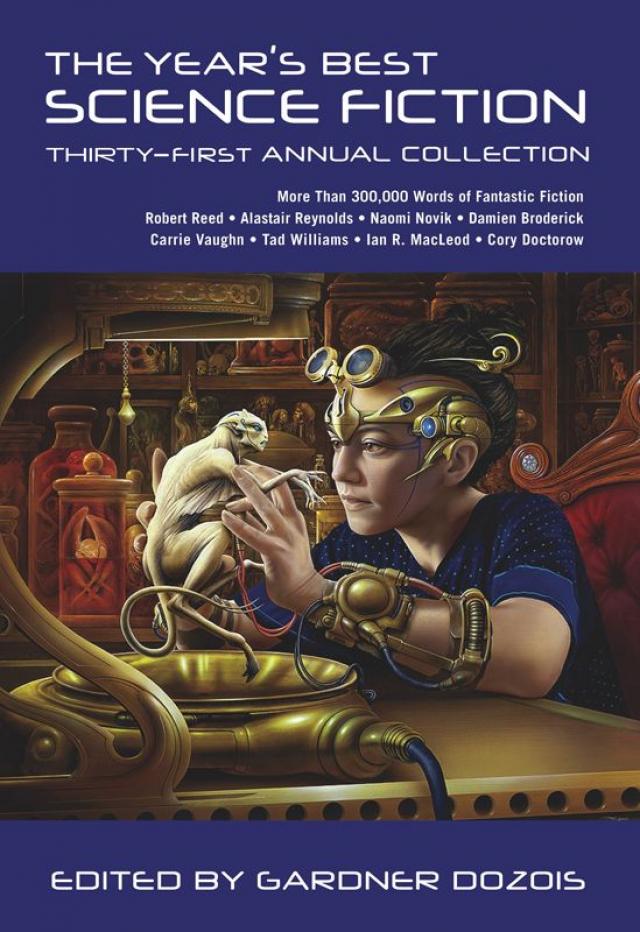
The years best science f.., p.101
The Year's Best Science Fiction: Thirty-First Annual Collection,
p.101


“I’ll book transport.”
“If you must.” His attention was once again turned to the canyon-scape of the great city of the Twav. The sun had risen over the canyon edge and sent the shadows of Unshaina’s spires and stacks and towers carved from raw rock chasing down the Great Valley. Summoned by the light, flocks of Twav poured from the slots of their roost-cotes. “Any chance of another wee drop of your particular tea?”
I took the cup and saucer from his outstretched hand
“Of course, Maestro.”
“Thank you, dear boy. I would, of course, be lost without you. Quite quite lost.”
A hand waved me away from his presence.
“Thank you. And Maestro?”
He turned from the window.
“Trousers.”
* * *
For a big man, Count James Fitzgerald threw up most discreetly. He leaned out of the Sky-chair, one quick convulsion and it fell in a single sheet between the sculpted pinnacles of Unshaina. He wiped his lips with a large very white handkerchief and that was it done. He would blame me, blame the Sky-chair bearers, blame the entire Twav Civilisation, but never the three cups of special tea he had taken while I packed for him, nor the bottle that was his perennial companion in the bedside cabinet.
Checkout had been challenging this time. I would never say so to Count Jack, but it had been a long time since I could parlay the Country Count from Kildare by name recognition alone.
“You are leaving the bags,” the manager said. He was Armenian. He had never heard of Ireland, let alone County Kildare.
“We will be returning, yes,” I said.
“But you are leaving the bags.”
“Christ on crutches,” Count Jack had exclaimed as the two Sky-chairs set down on to the Grand Valley’s landing apron. “What are you trying to do, kill me, you poncing infidel? My heart is tender, tender I tell you, bruised by decades of professional envy and poisonous notices.”
“It is the quickest and most direct way.”
“Swung hither and yon in a bloody Bat-cab and no money at the end of it, as like,” Count Jack muttered as he strapped in and the Twavs took the strain and lifted. He gave a faint cry as the Sky-chair swung out over the mile-deep drop to the needles of the Lower Rookeries, like an enfilade of pikes driven into the red rock of the Grand Valley. He clung white-knuckled to the guy-lines, moaning a little, as the Twav carriers swayed him between the scurrying cableway gondolas and around the many-windowed stone towers of the roosts.
I rather enjoyed the ride. My life has been low in excitements—I took the post of accompanist to the Maestro as an escape from filing his recording royalties, which was the highest entry position in the industry I could attain with my level of degree in Music. Glamorous it was, exciting, no. Glamour is just another work environment. One recovers from being starstruck rather quickly. My last great excitement had been the night before we left for Mars. Ships! Space travel! Why, I could hardly sleep the night before launch. I soon discovered that space travel is very much like an ocean cruise, without the promenade decks and the excursions, and far, far fewer people. And much, much worse food. However tedious and braying the company for me, I derived some pleasure from the fact that for them it was three months locked in with Count Jack.
I have a personal interest in this war. My grandfather was one of the martyrs who died in the opening minutes of the Horsell Common invasion. He was the first generation of my family to be born in England. He had been at prayer in the Woking Mosque and was consumed by the heat ray from the Uliri War Tripod. Many thousands died that day, and though it has taken us two generations to master the Uliri technology to keep our skies safe and to prepare a fleet to launch Operation Enduring Justice, the cry is ever fresh: Remember Shah Jehan! I stood among the crowds on that same Horsell Common around the crater, as people gathered by the other craters of the invasion, or on hilltops, on beaches, riverbanks, rooftops, holy places, anywhere with a view of open sky, to watch the night light up with the drives of our expeditionary fleet. The words on my lips, and the lips of everyone else on that cold November night, were Justice, Justice, but in my heart was Remember Shah Jehan!
Rejoice! Rejoice! Our Prime Minister told us when our drop-troopers captured Unshaina, conquered the Twav Civilisation, and turned the Grand Valley into our Martian headquarters and munitions factory. It’s harder to maintain your patriotic fervor when those spaceships are months away on the far side of the sun, and no one really believes the propaganda that the Twav were the devious military hive-masterminds of the Uliri war machine. Nor, when that story failed, did we swallow the second serving of propaganda: that the Twav were the enslaved mind-thralls of the Uliri, whom we had liberated for freedom and democracy. A species that achieves a special kind of sentience when it roosts and flocks together seems to me to embody the very nature of the demos. The many-bodied gods atop the flute-thin spires of Unshaina represent the truth that our best, our most creative, our most brilliant, may be all the divinity we need.
It has been a long time since I was at prayer.
Count Jack gave a small moan as his Sky-chair dipped down abruptly between the close-packed stone quills of Alabaster Needles. The Chair-boss whistled instructions to her crew—the lowest register of their language lay at the upper edge of our hearing—and they skillfully brought us spirally down past hives and through arches and under buttresses to the terraces of the Great Western Dock on the Grand Canal. Here humans had built cheap spray-stone lading houses and transit lodges among the sinuously carved stone. The Canal Court Hotel was cheap, but that was not its main allure; Ferid Bey had appetites best served by low rents and proximity to docks.
While Count Jack swooned and whimpered and swore that he would never regain his land-legs, never, I tipped the Chair-boss a generous handful of saucers and she clasped her lower hands in a gesture of respect.
* * *
“We’re broke,” Ferid Bey said. We sat drinking coffee on the terrace of the Canal Court watching Twav stevedores lift and lade pallets from the open hatches of cargo barges. I say coffee, it was Expeditionary Force ersatz, vile and weak and with a disturbing spritz of excremental. Ferid Bey, who as a citizen of the great Ottoman Empire appreciated coffee, grimaced at every sip. I say terrace; it was a cranny for two tables spaced beside the garbage bins which caught the wind and lifted the dust in a perpetual eddy. Ferid Bey wore his dust goggles, kept his scarf wrapped around his head, and sipped his execrable coffee.
“What do you mean, broke?” Count Jack thundered in his loudest Sopratutto voice. Startled Twavs flew up from their cargoes, twittering on the edge of audibility. “You’ve been at the bum-boys again, haven’t you?” Ferid Bey’s weakness for the rough was well known, particularly the kind who would go through his wallet the next morning. He sniffed loudly.
“Actually, Jack, this time it’s you.”
I often wondered if the slow decline of Count Jack’s career was partly attributable to the fact that, after years of daily contact, agent had started to sound like client? The Count’s eyes bulged. His blood pressure was bad. I’d seen the report from the pre-launch medical.
“It’s bums on seats Jack, bums on seats, and we’re not getting them.”
“I strew my pearls before buffoons in braid and their braying brides, and they throw them back in my face!” Count Jack bellowed. “I played La Scala, you know. La Scala! And the Pope. I’d be better off playing to the Space-bats. At least they appreciate a High-C. No Ferid, no no: you get me better audiences.”
“Any audiences would be good,” Ferid Bey muttered and then said aloud, “I’ve got you a tour.”
Count Jack grew inches taller.
“How many nights?”
“Five.”
“There are that many concert halls on this arse-wipe of a world?”
“Not so much concert halls.” Ferid Bey tried to hide as much of his face as possible behind scarf, goggles and coffee cup. “More concert parties.”
“The army?” Count Jacks face was pale now, his voice quiet. I had heard this precursor to a rage the size of Olympus Mons many times. Thankfully, I had never been its target. “Bloody shit-stupid squaddies who have to be told which end of a blaster to point at the enemy?”
“Yes, Jack.”
“Would this be … upcountry?”
“It would.”
“Would this be … close to the front?”
“I’ve extended your cover.”
“Well, it’s nice to know my ex-wives and agent are well provided for.”
“I’ve negotiated a fee commensurate with the risk.”
“What is the risk?”
“It’s a war zone, Jack.”
“What is the fee?”
“One thousand five hundred saucers. Per show.”
“Tell me we don’t need to do this, dear boy,” Count Jack said to me.
“The manager of the Grand Valley is holding your luggage to ransom,” I said. “We need to do it.”
“You’re coming with me.” Count Jack’s accusing finger hovered one inch from the bridge of his agent’s nose. Ferid Bey spread his hands in resignation.
“I would if I could, Jack. Truly. Honestly. Deeply. But I’ve got a lead on a possible concert recording here in Unshaina, and there are talent bookers from the big Venus casinos in town, so I’m told.”
“Venus?” The Cloud Cities, forever drifting in the Storm Zone, were the glittering jewels on the interplanetary circuit. The legendary residences were a long, comfortable, well-paid descent from the pinnacle of career.
“Five nights?”
“Five nights only. Then out.”
“Usual contract riders?”
“Of course.”
Count Jack laughed his great, canyon-deep laugh. “We’ll do it. Our brave legionnaires need steel in their steps and spunk in their spines. When do we leave?”
“I’ve booked you on the Empress of Mars from the Round ‘O’ Dock. Eight o’clock. Sharp.”
Count Jack pouted.
“I am prone to seasickness.”
“This is a canal. Anyway, the Commanderie has requisitioned all the air transport. It seems there’s a big push on.”
“I shall endure it.”
“You’re doing the right thing, Jack,” Ferid Bey said. “One, and another thing; Faisal, you couldn’t pick up for the coffee could you?” I suspected there was a reason Ferid Bey had brought us out to this tatty bargee hostel. “And while you’re at it, could you take care of my hotel?”
Already, Count Jack was hearing the distant applause of the audience, scenting like a rare moth the faint but unmistakable pheromone of celebrity.
“And am I … top of the bill?”
“Always, Jack,” said Ferid Bey. “Always.”
* * *
From our table on the promenade deck of the Empress of Mars, we watched the skymasters pass overhead. They were high and their hulls caught the evening light that had faded from the canal. I lost count after thirty; the sound of their many engines merged into a high thunder. The vibration sent ripples across the wine in our glasses on the little railed-off table at the stern of the barge. One glass for me, always untouched—I did not drink, but I liked to keep Count Jack company. He was a man who craved the attention of others—without it, he grew translucent and insubstantial. His hopes for another involuntary audience of passengers to charm and intimidate and cow with his relentless showbiz tales were disappointed. The Empress of Mars was a cargo tug pushing a twelve-barge tow with space for eight passengers, of which we were the sole two. I was his company. I had been so enough times to know his anecdotes as thoroughly as I knew the music for his set. But I listened, and I laughed, because it is not the story that matters, but the telling.
“Headed East,” Count Jack said. I did not correct him—he had never understood that on Mars, West was East and East was West. Sunrise, east; sunset, west dear boy, he declared. We watched the fleet, a vast, sky-filling arrowhead, drive towards the sunset hills on the close horizon. The Grand Valley had opened out into a trench so wide we could see the canyon walls, a terrain with its own inner terrain. “Godspeed that fleet.” He had been uncharacteristically quiet and ruminative this trip. It was not the absence of a captive audience. The fleet, the heavy canal traffic—I had counted eight tows headed up-channel from the front to Unshaina since we began this first bottle of what Count Jack called his “Evening Restorational”—had brought home to him that he was headed to war. Not pictures of war, news reports of war, rumors of war, but war itself. For the first time, he might be questioning the tour.
“Does it make your joints ache, Faisal?”
“Maestro?”
“The gravity. Or rather, the want of gravity. Wrists, ankles, fingers, all the flexing joints. Hurt like buggery. Thumbs are the worst. I’d’ve have thought it would have been the opposite with it being so light here. Not a bit of it. It’s all I can do to lift this glass to my lips.”
To my eyes, he navigated the glass from table to lips quite successfully. Count Jack poured another Evening Restorational and sank deep in his chair. The dark green waters of the canal slipped beneath our hull. Martian twilights were swift and deep. War had devastated this once populous and fertile land, left scars of black glass across the bottom lands where heat rays had scored the regolith. The rising evening wind, the Tharseen, that reversed direction depending on which end of the Grand Valley was in night, called melancholy flute sonatas from the shattered Roost pillars.
“It’s a ghastly world,” Count Jack said after a second glass.
“I find it rather peaceful. It has a particular beauty. Melancholic.”
“No, not Mars. Everywhere. Everywhere’s bloody ghastly and getting ghastlier. Ever since the war. War makes everything brutal. Brutal and ugly. War wants everything to be like it. It’s horrible, Faisal.”
“Yes. I think we’ve gone too far. We’re laying waste to entire civilisations. Unshaina, it’s older than any city on Earth. This has gone beyond righteous justice. We’re fighting because we love it.”
“Not the war, Faisal. I’ve moved on from the bloody war. Do keep up. Getting old. That’s what’s truly horrible. Old old old and I can’t do a thing about it. I feel it in my joints, Faisal. This bloody planet makes me feel old. A long slow decline into incompetence, imbecility, and incontinence. What have I got? A decent set of pipes. That’s all. And they won’t last forever. No investments, no property, and bugger-all recording royalties. Bloody Revenue cleaned me out. Rat up a drainpipe. Gone. And the bastards still have their hands out. They’ve threatened me, you know. Arrest. What is this, the bloody Marshalsea Gaol? I’m a Papal Knight, you know. I wield the sword of the Holy Father himself.”
“All they want is their money,” I said. Count Jack had always resented paying lawyers and accountants, with the result that he had signed disastrous recording contracts and only filed tax returns when the bailiffs were at the door. This entire Martian tour would barely meet his years of outstanding tax, plus interest. “Then they’ll leave you alone.”
“No, they won’t. They won’t ever let me alone. They know Count Jack is a soft touch. They’ll be back, the damnable dunners. Once they’ve got the taste of your blood, they won’t ever let their hooks out of you. Parasites. I am infested with fiscal parasites. Tax, war, and old age. They make everything gross and coarse and pointless.”
Beams of white light flickered along the twilight horizon. I could not tell whether they were from sky to ground or ground to sky. The fleet had gone. The heat rays danced along the edge of the world, flickered out. New beams took their place. Flashes beyond the close horizon threw the hills into momentary relief. I cried out as the edge of the world became a flickering palisade of heat rays. Count Jack was on his feet. The flashes lit his face. Seconds later, the first soft rumble of distant explosions reached us. The Twav deckhands fluttered on their perches. I could make out the lower register of their consternation as a treble shrill. The edge of the world was a carnival of beams and flashes. I saw an arc of fire descend from the sky to terminate in a white flash beneath the horizon. I did not doubt that I had seen a Skymaster and all her crew perish, but it was beautiful. The sky blazed with the most glorious fireworks. Count Jack’s eyes were wide with wonder. He threw his hand up to shield his eyes as a huge midair explosion turned the night white. Stark shadows lunged across the deck; the Twav rose up in a clatter of wings.
“Oh, the dear boys, the dear boys,” Count Jack whispered. The sound of the explosion hit us. It rattled the windows on the pilot deck, rattled the bottle and glasses on the table. I felt it shake the core of my being, shake me belly and bowel deep. The beams winked out. The horizon went dark.
We had seen a great and terrible battle, but who had fought, who had won, who had lost, whether there had been winners or losers, what its goals had been—we knew none of these. We had witnessed something terrible and beautiful and incomprehensible. I lifted the untouched glass of wine and took a sip.
“Good God,” Count Jack said, still standing. “I always thought you didn’t drink. Religious reasons and all that.”
“No, I don’t drink for musical reasons. It makes my joints hurt.”
I drank the wine. It may have been vinegar, it may have been the finest wine available to humanity, I did not know. I drained the glass.
“Dear boy.” Count Jack poured me another, one for himself, and together we watched the edge of the world glow with distant fires.
* * *
We played Camp Avenger on a stage rigged on empty beer barrels to a half-full audience that dwindled over the course of the concert to just six rows. A Brigadier who had been drinking steadily all through the concert tried to get his troopers up onstage to dance to the Medley of Ould Irish Songs. They sensibly declined. He tripped over his own feet trying to inveigle Count Jack to dance to “Walls of Limerick” with him and went straight off the stage. He split his head open on the rim of a beer keg.
At Syrtia Regional Command, the audience was less ambiguous. We were bottled off. The first one came looping in even as Count Jack came on, arms spread wide, to his theme song “I’ll Take You Home Again, Kathleen.” He stuck it through “Blaze Away,” “Nessun Dorma,” and “Il Mio Tesoro” before an accurately hurled Mars Export Pale Ale bottle deposited its load of warm urine down the front of his dickey. He finished “The Garden Where the Praties Grow,” bowed, and went straight off. I followed him as the first of the barrage of folding army chairs hit the stage. Without a word or a look, he went straight to his tent and stripped naked.