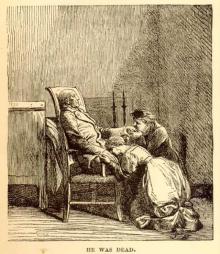
Les misyrables, p.130
Les Misérables,
p.130


CHAPTER IV--GAYETIES
None the less, these young girls filled this grave house with charmingsouvenirs.
At certain hours childhood sparkled in that cloister. The recreationhour struck. A door swung on its hinges. The birds said, "Good;here come the children!" An irruption of youth inundated that gardenintersected with a cross like a shroud. Radiant faces, white foreheads,innocent eyes, full of merry light, all sorts of auroras, were scatteredabout amid these shadows. After the psalmodies, the bells, the peals,and knells and offices, the sound of these little girls burst forth on asudden more sweetly than the noise of bees. The hive of joy was opened,and each one brought her honey. They played, they called to each other,they formed into groups, they ran about; pretty little white teethchattered in the corners; the veils superintended the laughs from adistance, shades kept watch of the sunbeams, but what mattered it? Stillthey beamed and laughed. Those four lugubrious walls had their momentof dazzling brilliancy. They looked on, vaguely blanched with thereflection of so much joy at this sweet swarming of the hives. It waslike a shower of roses falling athwart this house of mourning. The younggirls frolicked beneath the eyes of the nuns; the gaze of impeccabilitydoes not embarrass innocence. Thanks to these children, there was,among so many austere hours, one hour of ingenuousness. The little onesskipped about; the elder ones danced. In this cloister play was mingledwith heaven. Nothing is so delightful and so august as all these fresh,expanding young souls. Homer would have come thither to laugh withPerrault; and there was in that black garden, youth, health, noise,cries, giddiness, pleasure, happiness enough to smooth out the wrinklesof all their ancestresses, those of the epic as well as those of thefairy-tale, those of the throne as well as those of the thatched cottagefrom Hecuba to la Mère-Grand.
In that house more than anywhere else, perhaps, arise those children'ssayings which are so graceful and which evoke a smile that is full ofthoughtfulness. It was between those four gloomy walls that a child offive years exclaimed one day: "Mother! one of the big girls has justtold me that I have only nine years and ten months longer to remainhere. What happiness!"
It was here, too, that this memorable dialogue took place:--
_A Vocal Mother_. Why are you weeping, my child?
_The child_ (aged six). I told Alix that I knew my French history. Shesays that I do not know it, but I do.
_Alix_, the big girl (aged nine). No; she does not know it.
_The Mother_. How is that, my child?
_Alix_. She told me to open the book at random and to ask her anyquestion in the book, and she would answer it.
"Well?"
"She did not answer it."
"Let us see about it. What did you ask her?"
"I opened the book at random, as she proposed, and I put the firstquestion that I came across."
"And what was the question?"
"It was, 'What happened after that?'"
It was there that that profound remark was made anent a rather greedyparoquet which belonged to a lady boarder:--
"How well bred! it eats the top of the slice of bread and butter justlike a person!"
It was on one of the flagstones of this cloister that there was oncepicked up a confession which had been written out in advance, in orderthat she might not forget it, by a sinner of seven years:--
"Father, I accuse myself of having been avaricious.
"Father, I accuse myself of having been an adulteress.
"Father, I accuse myself of having raised my eyes to the gentlemen."
It was on one of the turf benches of this garden that a rosy mouth sixyears of age improvised the following tale, which was listened to byblue eyes aged four and five years:--
"There were three little cocks who owned a country where there werea great many flowers. They plucked the flowers and put them in theirpockets. After that they plucked the leaves and put them in theirplaythings. There was a wolf in that country; there was a great deal offorest; and the wolf was in the forest; and he ate the little cocks."
And this other poem:--
"There came a blow with a stick.
"It was Punchinello who bestowed it on the cat.
"It was not good for her; it hurt her.
"Then a lady put Punchinello in prison."
It was there that a little abandoned child, a foundling whom the conventwas bringing up out of charity, uttered this sweet and heart-breakingsaying. She heard the others talking of their mothers, and she murmuredin her corner:--
"As for me, my mother was not there when I was born!"
There was a stout portress who could always be seen hurrying through thecorridors with her bunch of keys, and whose name was Sister Agatha. The_big big girls_--those over ten years of age--called her _Agathocles_.
The refectory, a large apartment of an oblong square form, whichreceived no light except through a vaulted cloister on a level with thegarden, was dark and damp, and, as the children say, full of beasts. Allthe places round about furnished their contingent of insects.
Each of its four corners had received, in the language of the pupils,a special and expressive name. There was Spider corner, Caterpillarcorner, Wood-louse corner, and Cricket corner.
Cricket corner was near the kitchen and was highly esteemed. It was notso cold there as elsewhere. From the refectory the names had passed tothe boarding-school, and there served as in the old College Mazarinto distinguish four nations. Every pupil belonged to one of these fournations according to the corner of the refectory in which she sat atmeals. One day Monseigneur the Archbishop while making his pastoralvisit saw a pretty little rosy girl with beautiful golden hair enter theclass-room through which he was passing.
He inquired of another pupil, a charming brunette with rosy cheeks, whostood near him:--
"Who is that?"
"She is a spider, Monseigneur."
"Bah! And that one yonder?"
"She is a cricket."
"And that one?"
"She is a caterpillar."
"Really! and yourself?"
"I am a wood-louse, Monseigneur."
Every house of this sort has its own peculiarities. At the beginning ofthis century Écouen was one of those strict and graceful places whereyoung girls pass their childhood in a shadow that is almost august. AtÉcouen, in order to take rank in the procession of the Holy Sacrament,a distinction was made between virgins and florists. There were also the"dais" and the "censors,"--the first who held the cords of the dais, andthe others who carried incense before the Holy Sacrament. The flowersbelonged by right to the florists. Four "virgins" walked in advance. Onthe morning of that great day it was no rare thing to hear the questionput in the dormitory, "Who is a virgin?"
Madame Campan used to quote this saying of a "little one" of sevenyears, to a "big girl" of sixteen, who took the head of the procession,while she, the little one, remained at the rear, "You are a virgin, butI am not."