Les misyrables, p.180
Les Misérables,
p.180


CHAPTER IV--END OF THE BRIGAND
The conclusion of Marius' classical studies coincided with M.Gillenormand's departure from society. The old man bade farewell tothe Faubourg Saint-Germain and to Madame de T.'s salon, and establishedhimself in the Marais, in his house of the Rue des Filles-du-Calvaire.There he had for servants, in addition to the porter, that chambermaid,Nicolette, who had succeeded to Magnon, and that short-breathed andpursy Basque, who have been mentioned above.
In 1827, Marius had just attained his seventeenth year. One evening, onhis return home, he saw his grandfather holding a letter in his hand.
"Marius," said M. Gillenormand, "you will set out for Vernon to-morrow."
"Why?" said Marius.
"To see your father."
Marius was seized with a trembling fit. He had thought of everythingexcept this--that he should one day be called upon to see his father.Nothing could be more unexpected, more surprising, and, let us admitit, more disagreeable to him. It was forcing estrangement intoreconciliation. It was not an affliction, but it was an unpleasant duty.
Marius, in addition to his motives of political antipathy, was convincedthat his father, _the slasher_, as M. Gillenormand called him on hisamiable days, did not love him; this was evident, since he had abandonedhim to others. Feeling that he was not beloved, he did not love."Nothing is more simple," he said to himself.
He was so astounded that he did not question M. Gillenormand. Thegrandfather resumed:--
"It appears that he is ill. He demands your presence."
And after a pause, he added:--
"Set out to-morrow morning. I think there is a coach which leaves theCour des Fontaines at six o'clock, and which arrives in the evening.Take it. He says that here is haste."
Then he crushed the letter in his hand and thrust it into his pocket.Marius might have set out that very evening and have been with hisfather on the following morning. A diligence from the Rue du Bouloitook the trip to Rouen by night at that date, and passed through Vernon.Neither Marius nor M. Gillenormand thought of making inquiries about it.
The next day, at twilight, Marius reached Vernon. People were justbeginning to light their candles. He asked the first person whom hemet for "M. Pontmercy's house." For in his own mind, he agreed with theRestoration, and like it, did not recognize his father's claim to thetitle of either colonel or baron.
The house was pointed out to him. He rang; a woman with a little lamp inher hand opened the door.
"M. Pontmercy?" said Marius.
The woman remained motionless.
"Is this his house?" demanded Marius.
The woman nodded affirmatively.
"Can I speak with him?"
The woman shook her head.
"But I am his son!" persisted Marius. "He is expecting me."
"He no longer expects you," said the woman.
Then he perceived that she was weeping.
She pointed to the door of a room on the ground-floor; he entered.
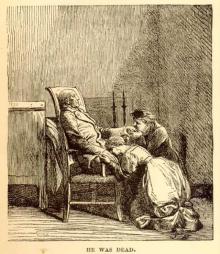
In that room, which was lighted by a tallow candle standing on thechimney-piece, there were three men, one standing erect, anotherkneeling, and one lying at full length, on the floor in his shirt. Theone on the floor was the colonel.
The other two were the doctor, and the priest, who was engaged inprayer.
The colonel had been attacked by brain fever three days previously. Ashe had a foreboding of evil at the very beginning of his illness, hehad written to M. Gillenormand to demand his son. The malady had grownworse. On the very evening of Marius' arrival at Vernon, the colonel hadhad an attack of delirium; he had risen from his bed, in spite of theservant's efforts to prevent him, crying: "My son is not coming! I shallgo to meet him!" Then he ran out of his room and fell prostrate on thefloor of the antechamber. He had just expired.
The doctor had been summoned, and the curé. The doctor had arrived toolate. The son had also arrived too late.
By the dim light of the candle, a large tear could be distinguished onthe pale and prostrate colonel's cheek, where it had trickled from hisdead eye. The eye was extinguished, but the tear was not yet dry. Thattear was his son's delay.
Marius gazed upon that man whom he beheld for the first time, on thatvenerable and manly face, on those open eyes which saw not, on thosewhite locks, those robust limbs, on which, here and there, brownlines, marking sword-thrusts, and a sort of red stars, which indicatedbullet-holes, were visible. He contemplated that gigantic sear whichstamped heroism on that countenance upon which God had imprintedgoodness. He reflected that this man was his father, and that this manwas dead, and a chill ran over him.
The sorrow which he felt was the sorrow which he would have felt in thepresence of any other man whom he had chanced to behold stretched out indeath.
Anguish, poignant anguish, was in that chamber. The servant-woman waslamenting in a corner, the curé was praying, and his sobs were audible,the doctor was wiping his eyes; the corpse itself was weeping.
The doctor, the priest, and the woman gazed at Marius in the midst oftheir affliction without uttering a word; he was the stranger there.Marius, who was far too little affected, felt ashamed and embarrassed athis own attitude; he held his hat in his hand; and he dropped it on thefloor, in order to produce the impression that grief had deprived him ofthe strength to hold it.
At the same time, he experienced remorse, and he despised himself forbehaving in this manner. But was it his fault? He did not love hisfather? Why should he!
The colonel had left nothing. The sale of big furniture barely paid theexpenses of his burial.
The servant found a scrap of paper, which she handed to Marius. Itcontained the following, in the colonel's handwriting:--
"_For my son_.--The Emperor made me a Baron on the battle-field ofWaterloo. Since the Restoration disputes my right to this title which Ipurchased with my blood, my son shall take it and bear it. That he willbe worthy of it is a matter of course." Below, the colonel had added:"At that same battle of Waterloo, a sergeant saved my life. The man'sname was Thénardier. I think that he has recently been keeping alittle inn, in a village in the neighborhood of Paris, at Chelles orMontfermeil. If my son meets him, he will do all the good he can toThénardier."
Marius took this paper and preserved it, not out of duty to his father,but because of that vague respect for death which is always imperious inthe heart of man.
Nothing remained of the colonel. M. Gillenormand had his sword anduniform sold to an old-clothes dealer. The neighbors devastated thegarden and pillaged the rare flowers. The other plants turned to nettlesand weeds, and died.
Marius remained only forty-eight hours at Vernon. After the interment hereturned to Paris, and applied himself again to his law studies, withno more thought of his father than if the latter had never lived. In twodays the colonel was buried, and in three forgotten.
Marius wore crape on his hat. That was all.