Les misyrables, p.150
Les Misérables,
p.150


CHAPTER V--IT IS NOT NECESSARY TO BE DRUNK IN ORDER TO BE IMMORTAL
On the following day, as the sun was declining, the very rare passers-byon the Boulevard du Maine pulled off their hats to an old-fashionedhearse, ornamented with skulls, cross-bones, and tears. This hearsecontained a coffin covered with a white cloth over which spread a largeblack cross, like a huge corpse with drooping arms. A mourning-coach, inwhich could be seen a priest in his surplice, and a choir boy in his redcap, followed. Two undertaker's men in gray uniforms trimmed with blackwalked on the right and the left of the hearse. Behind it came an oldman in the garments of a laborer, who limped along. The procession wasgoing in the direction of the Vaugirard cemetery.
The handle of a hammer, the blade of a cold chisel, and the antennæ of apair of pincers were visible, protruding from the man's pocket.
The Vaugirard cemetery formed an exception among the cemeteries ofParis. It had its peculiar usages, just as it had its carriageentrance and its house door, which old people in the quarter, who clungtenaciously to ancient words, still called the _porte cavalière_ and the_porte piétonne_.16 The Bernardines-Benedictines of the Rue Petit-Picpushad obtained permission, as we have already stated, to be buried therein a corner apart, and at night, the plot of land having formerlybelonged to their community. The grave-diggers being thus bound toservice in the evening in summer and at night in winter, in thiscemetery, they were subjected to a special discipline. The gates of theParis cemeteries closed, at that epoch, at sundown, and this being amunicipal regulation, the Vaugirard cemetery was bound by it like therest. The carriage gate and the house door were two contiguous gratedgates, adjoining a pavilion built by the architect Perronet, andinhabited by the door-keeper of the cemetery. These gates, therefore,swung inexorably on their hinges at the instant when the sun disappearedbehind the dome of the Invalides. If any grave-digger were delayedafter that moment in the cemetery, there was but one way for him toget out--his grave-digger's card furnished by the department of publicfunerals. A sort of letter-box was constructed in the porter's window.The grave-digger dropped his card into this box, the porter heard itfall, pulled the rope, and the small door opened. If the man had not hiscard, he mentioned his name, the porter, who was sometimes in bed andasleep, rose, came out and identified the man, and opened the gate withhis key; the grave-digger stepped out, but had to pay a fine of fifteenfrancs.
This cemetery, with its peculiarities outside the regulations,embarrassed the symmetry of the administration. It was suppresseda little later than 1830. The cemetery of Mont-Parnasse, called theEastern cemetery, succeeded to it, and inherited that famous dram-shopnext to the Vaugirard cemetery, which was surmounted by a quince paintedon a board, and which formed an angle, one side on the drinkers' tables,and the other on the tombs, with this sign: _Au Bon Coing_.
The Vaugirard cemetery was what may be called a faded cemetery. Itwas falling into disuse. Dampness was invading it, the flowers weredeserting it. The bourgeois did not care much about being buried inthe Vaugirard; it hinted at poverty. Père-Lachaise if you please! to beburied in Père-Lachaise is equivalent to having furniture of mahogany.It is recognized as elegant. The Vaugirard cemetery was a venerableenclosure, planted like an old-fashioned French garden. Straight alleys,box, thuya-trees, holly, ancient tombs beneath aged cypress-trees, andvery tall grass. In the evening it was tragic there. There were verylugubrious lines about it.
The sun had not yet set when the hearse with the white pall and theblack cross entered the avenue of the Vaugirard cemetery. The lame manwho followed it was no other than Fauchelevent.
The interment of Mother Crucifixion in the vault under the altar, theexit of Cosette, the introduction of Jean Valjean to the dead-room,--allhad been executed without difficulty, and there had been no hitch.
Let us remark in passing, that the burial of Mother Crucifixion underthe altar of the convent is a perfectly venial offence in our sight. Itis one of the faults which resemble a duty. The nuns had committed it,not only without difficulty, but even with the applause of their ownconsciences. In the cloister, what is called the "government" is onlyan intermeddling with authority, an interference which is alwaysquestionable. In the first place, the rule; as for the code, we shallsee. Make as many laws as you please, men; but keep them for yourselves.The tribute to Cæsar is never anything but the remnants of the tributeto God. A prince is nothing in the presence of a principle.
Fauchelevent limped along behind the hearse in a very contented frameof mind. His twin plots, the one with the nuns, the one for the convent,the other against it, the other with M. Madeleine, had succeeded, toall appearance. Jean Valjean's composure was one of those powerfultranquillities which are contagious. Fauchelevent no longer feltdoubtful as to his success.
What remained to be done was a mere nothing. Within the last two years,he had made good Father Mestienne, a chubby-cheeked person, drunk atleast ten times. He played with Father Mestienne. He did what he likedwith him. He made him dance according to his whim. Mestienne's headadjusted itself to the cap of Fauchelevent's will. Fauchelevent'sconfidence was perfect.
At the moment when the convoy entered the avenue leading to thecemetery, Fauchelevent glanced cheerfully at the hearse, and said halfaloud, as he rubbed his big hands:--
"Here's a fine farce!"
All at once the hearse halted; it had reached the gate. The permissionfor interment must be exhibited. The undertaker's man addressed himselfto the porter of the cemetery. During this colloquy, which always isproductive of a delay of from one to two minutes, some one, a stranger,came and placed himself behind the hearse, beside Fauchelevent. He wasa sort of laboring man, who wore a waistcoat with large pockets andcarried a mattock under his arm.
Fauchelevent surveyed this stranger.
"Who are you?" he demanded.
"The man replied:--
"The grave-digger."
If a man could survive the blow of a cannon-ball full in the breast, hewould make the same face that Fauchelevent made.
"The grave-digger?"
"Yes."
"You?"
"I."
"Father Mestienne is the grave-digger."
"He was."
"What! He was?"
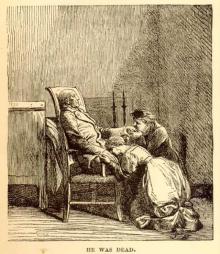
"He is dead."
Fauchelevent had expected anything but this, that a grave-digger coulddie. It is true, nevertheless, that grave-diggers do die themselves. Bydint of excavating graves for other people, one hollows out one's own.
Fauchelevent stood there with his mouth wide open. He had hardly thestrength to stammer:--
"But it is not possible!"
"It is so."
"But," he persisted feebly, "Father Mestienne is the grave-digger."
"After Napoleon, Louis XVIII. After Mestienne, Gribier. Peasant, my nameis Gribier."
Fauchelevent, who was deadly pale, stared at this Gribier.
He was a tall, thin, livid, utterly funereal man. He had the air of anunsuccessful doctor who had turned grave-digger.
Fauchelevent burst out laughing.
"Ah!" said he, "what queer things do happen! Father Mestienne is dead,but long live little Father Lenoir! Do you know who little Father Lenoiris? He is a jug of red wine. It is a jug of Surêne, morbigou! of realParis Surêne? Ah! So old Mestienne is dead! I am sorry for it; he wasa jolly fellow. But you are a jolly fellow, too. Are you not, comrade?We'll go and have a drink together presently."
The man replied:--
"I have been a student. I passed my fourth examination. I never drink."
The hearse had set out again, and was rolling up the grand alley of thecemetery.
Fauchelevent had slackened his pace. He limped more out of anxiety thanfrom infirmity.
The grave-digger walked on in front of him.
Fauchelevent passed the unexpected Gribier once more in review.
He was one of those men who, though very young, have the air of age, andwho, though slender, are extremely strong.
"Comrade!" cried Fauchelevent.
The man turned round.
"I am the convent grave-digger."
"My colleague," said the man.
Fauchelevent, who was illiterate but very sharp, understood that hehad to deal with a formidable species of man, with a fine talker. Hemuttered:
"So Father Mestienne is dead."
The man replied:--
"Completely. The good God consulted his note-book which shows when thetime is up. It was Father Mestienne's turn. Father Mestienne died."
Fauchelevent repeated mechanically: "The good God--"
"The good God," said the man authoritatively. "According to thephilosophers, the Eternal Father; according to the Jacobins, the SupremeBeing."
"Shall we not make each other's acquaintance?" stammered Fauchelevent.
"It is made. You are a peasant, I am a Parisian."
"People do not know each other until they have drunk together. He whoempties his glass empties his heart. You must come and have a drink withme. Such a thing cannot be refused."
"Business first."
Fauchelevent thought: "I am lost."
They were only a few turns of the wheel distant from the small alleyleading to the nuns' corner.
The grave-digger resumed:--
"Peasant, I have seven small children who must be fed. As they must eat,I cannot drink."
And he added, with the satisfaction of a serious man who is turning aphrase well:--
"Their hunger is the enemy of my thirst."
The hearse skirted a clump of cypress-trees, quitted the grand alley,turned into a narrow one, entered the waste land, and plunged intoa thicket. This indicated the immediate proximity of the place ofsepulture. Fauchelevent slackened his pace, but he could not detain thehearse. Fortunately, the soil, which was light and wet with the winterrains, clogged the wheels and retarded its speed.
He approached the grave-digger.
"They have such a nice little Argenteuil wine," murmured Fauchelevent.
"Villager," retorted the man, "I ought not be a grave-digger. Myfather was a porter at the Prytaneum [Town-Hall]. He destined me forliterature. But he had reverses. He had losses on 'change. I was obligedto renounce the profession of author. But I am still a public writer."
"So you are not a grave-digger, then?" returned Fauchelevent, clutchingat this branch, feeble as it was.
"The one does not hinder the other. I cumulate."
Fauchelevent did not understand this last word.
"Come have a drink," said he.
Here a remark becomes necessary. Fauchelevent, whatever his anguish,offered a drink, but he did not explain himself on one point; who was topay? Generally, Fauchelevent offered and Father Mestienne paid. An offerof a drink was the evident result of the novel situation created by thenew grave-digger, and it was necessary to make this offer, but the oldgardener left the proverbial quarter of an hour named after Rabelais inthe dark, and that not unintentionally. As for himself, Fauchelevent didnot wish to pay, troubled as he was.
The grave-digger went on with a superior smile:--
"One must eat. I have accepted Father Mestienne's reversion. One gets tobe a philosopher when one has nearly completed his classes. To the laborof the hand I join the labor of the arm. I have my scrivener's stall inthe market of the Rue de Sèvres. You know? the Umbrella Market. All thecooks of the Red Cross apply to me. I scribble their declarations oflove to the raw soldiers. In the morning I write love letters; in theevening I dig graves. Such is life, rustic."
The hearse was still advancing. Fauchelevent, uneasy to the last degree,was gazing about him on all sides. Great drops of perspiration trickleddown from his brow.
"But," continued the grave-digger, "a man cannot serve two mistresses.I must choose between the pen and the mattock. The mattock is ruining myhand."
The hearse halted.
The choir boy alighted from the mourning-coach, then the priest.
One of the small front wheels of the hearse had run up a little on apile of earth, beyond which an open grave was visible.
"What a farce this is!" repeated Fauchelevent in consternation.