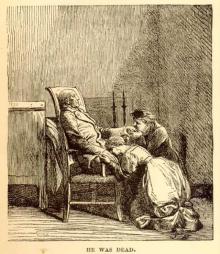
Les misyrables, p.179
Les Misérables,
p.179


CHAPTER III--REQUIESCANT
Madame de T.'s salon was all that Marius Pontmercy knew of the world. Itwas the only opening through which he could get a glimpse of life. Thisopening was sombre, and more cold than warmth, more night than day, cameto him through this skylight. This child, who had been all joy and lighton entering this strange world, soon became melancholy, and, what isstill more contrary to his age, grave. Surrounded by all those singularand imposing personages, he gazed about him with serious amazement.Everything conspired to increase this astonishment in him. There werein Madame de T.'s salon some very noble ladies named Mathan, Noé,Lévis,--which was pronounced Lévi,--Cambis, pronounced Cambyse. Theseantique visages and these Biblical names mingled in the child's mindwith the Old Testament which he was learning by heart, and when theywere all there, seated in a circle around a dying fire, sparely lightedby a lamp shaded with green, with their severe profiles, their gray orwhite hair, their long gowns of another age, whose lugubrious colorscould not be distinguished, dropping, at rare intervals, words whichwere both majestic and severe, little Marius stared at them withfrightened eyes, in the conviction that he beheld not women, butpatriarchs and magi, not real beings, but phantoms.
With these phantoms, priests were sometimes mingled, frequenters ofthis ancient salon, and some gentlemen; the Marquis de Sass****, privatesecretary to Madame de Berry, the Vicomte de Val***, who published,under the pseudonyme of _Charles-Antoine_, monorhymed odes, the Princede Beauff*******, who, though very young, had a gray head and a prettyand witty wife, whose very low-necked toilettes of scarlet velvet withgold torsades alarmed these shadows, the Marquis de C*****d'E******,the man in all France who best understood "proportioned politeness," theComte d'Am*****, the kindly man with the amiable chin, and the Chévalierde Port-de-Guy, a pillar of the library of the Louvre, called the King'scabinet, M. de Port-de-Guy, bald, and rather aged than old, was wontto relate that in 1793, at the age of sixteen, he had been put in thegalleys as refractory and chained with an octogenarian, the Bishopof Mirepoix, also refractory, but as a priest, while he was so in thecapacity of a soldier. This was at Toulon. Their business was to go atnight and gather up on the scaffold the heads and bodies of the personswho had been guillotined during the day; they bore away on their backsthese dripping corpses, and their red galley-slave blouses had a clot ofblood at the back of the neck, which was dry in the morning and wet atnight. These tragic tales abounded in Madame de T.'s salon, and bydint of cursing Marat, they applauded Trestaillon. Some deputies of theundiscoverable variety played their whist there; M. Thibord du Chalard,M. Lemarchant de Gomicourt, and the celebrated scoffer of the right, M.Cornet-Dincourt. The bailiff de Ferrette, with his short breechesand his thin legs, sometimes traversed this salon on his way to M. deTalleyrand. He had been M. le Comte d'Artois' companion in pleasures andunlike Aristotle crouching under Campaspe, he had made the Guimard crawlon all fours, and in that way he had exhibited to the ages a philosopheravenged by a bailiff. As for the priests, there was the Abbé Halma, thesame to whom M. Larose, his collaborator on _la Foudre_, said: "Bah! Whois there who is not fifty years old? a few greenhorns perhaps?" The AbbéLetourneur, preacher to the King, the Abbé Frayssinous, who was not, asyet, either count, or bishop, or minister, or peer, and who wore an oldcassock whose buttons were missing, and the Abbé Keravenant, Curé ofSaint-Germain-des-Prés; also the Pope's Nuncio, then Monsignor Macchi,Archbishop of Nisibi, later on Cardinal, remarkable for his long,pensive nose, and another Monsignor, entitled thus: Abbate Palmieri,domestic prelate, one of the seven participant prothonotaries of theHoly See, Canon of the illustrious Liberian basilica, Advocate ofthe saints, _Postulatore dei Santi_, which refers to matters ofcanonization, and signifies very nearly: Master of Requests of thesection of Paradise. Lastly, two cardinals, M. de la Luzerne, and M. deCl****** T*******. The Cardinal of Luzerne was a writer and was destinedto have, a few years later, the honor of signing in the _Conservateur_articles side by side with Chateaubriand; M. de Cl****** T******* wasArchbishop of Toul****, and often made trips to Paris, to his nephew,the Marquis de T*******, who was Minister of Marine and War. TheCardinal of Cl****** T******* was a merry little man, who displayed hisred stockings beneath his tucked-up cassock; his specialty was a hatredof the Encyclopædia, and his desperate play at billiards, and personswho, at that epoch, passed through the Rue M***** on summer evenings,where the hotel de Cl****** T******* then stood, halted to listen to theshock of the balls and the piercing voice of the Cardinal shouting tohis conclavist, Monseigneur Cotiret, Bishop _in partibus_ of Caryste:"Mark, Abbé, I make a cannon." The Cardinal de Cl****** T******* hadbeen brought to Madame de T.'s by his most intimate friend, M. deRoquelaure, former Bishop of Senlis, and one of the Forty. M. deRoquelaure was notable for his lofty figure and his assiduity at theAcademy; through the glass door of the neighboring hall of the librarywhere the French Academy then held its meetings, the curious could, onevery Tuesday, contemplate the Ex-Bishop of Senlis, usually standingerect, freshly powdered, in violet hose, with his back turned to thedoor, apparently for the purpose of allowing a better view of hislittle collar. All these ecclesiastics, though for the most part asmuch courtiers as churchmen, added to the gravity of the T. salon, whoseseigniorial aspect was accentuated by five peers of France, the Marquisde Vib****, the Marquis de Tal***, the Marquis de Herb*******, theVicomte Damb***, and the Duc de Val********. This Duc de Val********,although Prince de Mon***, that is to say a reigning prince abroad, hadso high an idea of France and its peerage, that he viewed everythingthrough their medium. It was he who said: "The Cardinals are the peersof France of Rome; the lords are the peers of France of England."Moreover, as it is indispensable that the Revolution should beeverywhere in this century, this feudal salon was, as we have said,dominated by a bourgeois. M. Gillenormand reigned there.
There lay the essence and quintessence of the Parisian white society.There reputations, even Royalist reputations, were held in quarantine.There is always a trace of anarchy in renown. Chateaubriand, had heentered there, would have produced the effect of Père Duchêne. Some ofthe scoffed-at did, nevertheless, penetrate thither on sufferance. ComteBeug*** was received there, subject to correction.
The "noble" salons of the present day no longer resemble those salons.The Faubourg Saint-Germain reeks of the fagot even now. The Royalists ofto-day are demagogues, let us record it to their credit.
At Madame de T.'s the society was superior, taste was exquisite andhaughty, under the cover of a great show of politeness. Manners thereadmitted of all sorts of involuntary refinements which were the oldrégime itself, buried but still alive. Some of these habits, especiallyin the matter of language, seem eccentric. Persons but superficiallyacquainted with them would have taken for provincial that which was onlyantique. A woman was called _Madame la Générale. Madame la Colonelle_was not entirely disused. The charming Madame de Léon, in memory, nodoubt, of the Duchesses de Longueville and de Chevreuse, preferred thisappellation to her title of Princesse. The Marquise de Créquy was alsocalled _Madame la Colonelle_.
It was this little high society which invented at the Tuileries therefinement of speaking to the King in private as _the King_, in thethird person, and never as _Your Majesty_, the designation of _YourMajesty_ having been "soiled by the usurper."
Men and deeds were brought to judgment there. They jeered at the age,which released them from the necessity of understanding it. They abettedeach other in amazement. They communicated to each other that modicumof light which they possessed. Methuselah bestowed information onEpimenides. The deaf man made the blind man acquainted with the courseof things. They declared that the time which had elapsed since Coblentzhad not existed. In the same manner that Louis XVIII. was by the graceof God, in the five and twentieth year of his reign, the emigrants were,by rights, in the five and twentieth year of their adolescence.
All was harmonious; nothing was too much alive; speech hardly amountedto a breath; the newspapers, agreeing with the salons, seemed a papyrus.There were some young people, but they were rather dead. The liveries inthe antechamber were antiquated. These utterly obsolete personages wereserved by domestics of the same stamp.
They all had the air of having lived a long time ago, and of obstinatelyresisting the sepulchre. Nearly the whole dictionary consisted of_Conserver, Conservation, Conservateur; to be in good odor_,--thatwas the point. There are, in fact, aromatics in the opinions of thesevenerable groups, and their ideas smelled of it. It was a mummifiedsociety. The masters were embalmed, the servants were stuffed withstraw.
A worthy old marquise, an _emigrée_ and ruined, who had but a solitarymaid, continued to say: "My people."
What did they do in Madame de T.'s salon? They were ultra.
To be ultra; this word, although what it represents may not havedisappeared, has no longer any meaning at the present day. Let usexplain it.
To be ultra is to go beyond. It is to attack the sceptre in the name ofthe throne, and the mitre in the name of the altar; it is to ill-treatthe thing which one is dragging, it is to kick over the traces; it isto cavil at the fagot on the score of the amount of cooking received byheretics; it is to reproach the idol with its small amount of idolatry;it is to insult through excess of respect; it is to discover that thePope is not sufficiently papish, that the King is not sufficientlyroyal, and that the night has too much light; it is to be discontentedwith alabaster, with snow, with the swan and the lily in the name ofwhiteness; it is to be a partisan of things to the point of becomingtheir enemy; it is to be so strongly for, as to be against.
The ultra spirit especially characterizes the first phase of theRestoration.
Nothing in history resembles that quarter of an hour which begins in1814 and terminates about 1820, with the advent of M. de Villèle,the practical man of the Right. These six years were an extraordinarymoment; at one and the same time brilliant and gloomy, smiling andsombre, illuminated as by the radiance of dawn and entirely covered, atthe same time, with the shadows of the great catastrophes which stillfilled the horizon and were slowly sinking into the past. There existedin that light and that shadow, a complete little new and old world,comic and sad, juvenile and senile, which was rubbing its eyes; nothingresembles an awakening like a return; a group which regarded Francewith ill-temper, and which France regarded with irony; good old owlsof marquises by the streetful, who had returned, and of ghosts, the"former" subjects of amazement at everything, brave and noble gentlemenwho smiled at being in France but wept also, delighted to beholdtheir country once more, in despair at not finding their monarchy; thenobility of the Crusades treating the nobility of the Empire, that is tosay, the nobility of the sword, with scorn; historic races who hadlost the sense of history; the sons of the companions of Charlemagnedisdaining the companions of Napoleon. The swords, as we have justremarked, returned the insult; the sword of Fontenoy was laughable andnothing but a scrap of rusty iron; the sword of Marengo was odious andwas only a sabre. Former days did not recognize Yesterday. People nolonger had the feeling for what was grand. There was some one who calledBonaparte Scapin. This Society no longer exists. Nothing of it, werepeat, exists to-day. When we select from it some one figure at random,and attempt to make it live again in thought, it seems as strange to usas the world before the Deluge. It is because it, too, as a matter offact, has been engulfed in a deluge. It has disappeared beneath twoRevolutions. What billows are ideas! How quickly they cover all that itis their mission to destroy and to bury, and how promptly they createfrightful gulfs!
Such was the physiognomy of the salons of those distant and candid timeswhen M. Martainville had more wit than Voltaire.
These salons had a literature and politics of their own. They believedin Fiévée. M. Agier laid down the law in them. They commentated M.Colnet, the old bookseller and publicist of the Quay Malaquais. Napoleonwas to them thoroughly the Corsican Ogre. Later on the introduction intohistory of M. le Marquis de Bonaparte, Lieutenant-General of the King'sarmies, was a concession to the spirit of the age.
These salons did not long preserve their purity. Beginning with 1818,doctrinarians began to spring up in them, a disturbing shade. Their waywas to be Royalists and to excuse themselves for being so. Where theultras were very proud, the doctrinarians were rather ashamed. They hadwit; they had silence; their political dogma was suitably impregnatedwith arrogance; they should have succeeded. They indulged, and usefullytoo, in excesses in the matter of white neckties and tightly buttonedcoats. The mistake or the misfortune of the doctrinarian party was tocreate aged youth. They assumed the poses of wise men. They dreamed ofengrafting a temperate power on the absolute and excessive principle.They opposed, and sometimes with rare intelligence, conservativeliberalism to the liberalism which demolishes. They were heard to say:"Thanks for Royalism! It has rendered more than one service. It hasbrought back tradition, worship, religion, respect. It is faithful,brave, chivalric, loving, devoted. It has mingled, though with regret,the secular grandeurs of the monarchy with the new grandeurs of thenation. Its mistake is not to understand the Revolution, the Empire,glory, liberty, young ideas, young generations, the age. But thismistake which it makes with regard to us,--have we not sometimes beenguilty of it towards them? The Revolution, whose heirs we are, ought tobe intelligent on all points. To attack Royalism is a misconstruction ofliberalism. What an error! And what blindness! Revolutionary France iswanting in respect towards historic France, that is to say, towards itsmother, that is to say, towards itself. After the 5th of September, thenobility of the monarchy is treated as the nobility of the Empire wastreated after the 5th of July. They were unjust to the eagle, we areunjust to the fleur-de-lys. It seems that we must always have somethingto proscribe! Does it serve any purpose to ungild the crown of LouisXIV., to scrape the coat of arms of Henry IV.? We scoff at M. deVaublanc for erasing the N's from the bridge of Jena! What was it thathe did? What are we doing? Bouvines belongs to us as well as Marengo.The fleurs-de-lys are ours as well as the N's. That is our patrimony. Towhat purpose shall we diminish it? We must not deny our country in thepast any more than in the present. Why not accept the whole of history?Why not love the whole of France?"
It is thus that doctrinarians criticised and protected Royalism, whichwas displeased at criticism and furious at protection.
The ultras marked the first epoch of Royalism, congregationcharacterized the second. Skill follows ardor. Let us confine ourselveshere to this sketch.
In the course of this narrative, the author of this book has encounteredin his path this curious moment of contemporary history; he has beenforced to cast a passing glance upon it, and to trace once more some ofthe singular features of this society which is unknown to-day. But hedoes it rapidly and without any bitter or derisive idea. Souvenirs bothrespectful and affectionate, for they touch his mother, attach him tothis past. Moreover, let us remark, this same petty world had a grandeurof its own. One may smile at it, but one can neither despise nor hateit. It was the France of former days.
Marius Pontmercy pursued some studies, as all children do. When heemerged from the hands of Aunt Gillenormand, his grandfather confidedhim to a worthy professor of the most purely classic innocence. Thisyoung soul which was expanding passed from a prude to a vulgar pedant.
Marius went through his years of college, then he entered the lawschool. He was a Royalist, fanatical and severe. He did not love hisgrandfather much, as the latter's gayety and cynicism repelled him, andhis feelings towards his father were gloomy.
He was, on the whole, a cold and ardent, noble, generous, proud,religious, enthusiastic lad; dignified to harshness, pure to shyness.