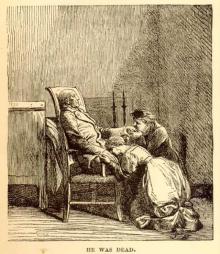
Les misyrables, p.161
Les Misérables,
p.161


CHAPTER VI--A BIT OF HISTORY
At the epoch, nearly contemporary by the way, when the action of thisbook takes place, there was not, as there is to-day, a policeman atthe corner of every street (a benefit which there is no time to discusshere); stray children abounded in Paris. The statistics give an averageof two hundred and sixty homeless children picked up annually at thatperiod, by the police patrols, in unenclosed lands, in houses in processof construction, and under the arches of the bridges. One of thesenests, which has become famous, produced "the swallows of the bridge ofArcola." This is, moreover, the most disastrous of social symptoms. Allcrimes of the man begin in the vagabondage of the child.
Let us make an exception in favor of Paris, nevertheless. In a relativemeasure, and in spite of the souvenir which we have just recalled, theexception is just. While in any other great city the vagabond child isa lost man, while nearly everywhere the child left to itself is, insome sort, sacrificed and abandoned to a kind of fatal immersion in thepublic vices which devour in him honesty and conscience, the street boyof Paris, we insist on this point, however defaced and injured on thesurface, is almost intact on the interior. It is a magnificent thing toput on record, and one which shines forth in the splendid probity of ourpopular revolutions, that a certain incorruptibility results from theidea which exists in the air of Paris, as salt exists in the water ofthe ocean. To breathe Paris preserves the soul.
What we have just said takes away nothing of the anguish of heart whichone experiences every time that one meets one of these children aroundwhom one fancies that he beholds floating the threads of a brokenfamily. In the civilization of the present day, incomplete as it stillis, it is not a very abnormal thing to behold these fractured familiespouring themselves out into the darkness, not knowing clearly what hasbecome of their children, and allowing their own entrails to fall on thepublic highway. Hence these obscure destinies. This is called, for thissad thing has given rise to an expression, "to be cast on the pavementsof Paris."
Let it be said by the way, that this abandonment of children was notdiscouraged by the ancient monarchy. A little of Egypt and Bohemia inthe lower regions suited the upper spheres, and compassed the aims ofthe powerful. The hatred of instruction for the children of the peoplewas a dogma. What is the use of "half-lights"? Such was the countersign.Now, the erring child is the corollary of the ignorant child.
Besides this, the monarchy sometimes was in need of children, and inthat case it skimmed the streets.
Under Louis XIV., not to go any further back, the king rightly desiredto create a fleet. The idea was a good one. But let us considerthe means. There can be no fleet, if, beside the sailing ship, thatplaything of the winds, and for the purpose of towing it, in case ofnecessity, there is not the vessel which goes where it pleases, eitherby means of oars or of steam; the galleys were then to the marine whatsteamers are to-day. Therefore, galleys were necessary; but the galleyis moved only by the galley-slave; hence, galley-slaves were required.Colbert had the commissioners of provinces and the parliaments makeas many convicts as possible. The magistracy showed a great deal ofcomplaisance in the matter. A man kept his hat on in the presence of aprocession--it was a Huguenot attitude; he was sent to the galleys. Achild was encountered in the streets; provided that he was fifteenyears of age and did not know where he was to sleep, he was sent to thegalleys. Grand reign; grand century.
Under Louis XV. children disappeared in Paris; the police carried themoff, for what mysterious purpose no one knew. People whispered withterror monstrous conjectures as to the king's baths of purple. Barbierspeaks ingenuously of these things. It sometimes happened that theexempts of the guard, when they ran short of children, took those whohad fathers. The fathers, in despair, attacked the exempts. In thatcase, the parliament intervened and had some one hung. Who? The exempts?No, the fathers.