Les misyrables, p.252
Les Misérables,
p.252


CHAPTER II--MOTHER PLUTARQUE FINDS NO DIFFICULTY IN EXPLAINING APHENOMENON
One evening, little Gavroche had had nothing to eat; he rememberedthat he had not dined on the preceding day either; this was becomingtiresome. He resolved to make an effort to secure some supper. Hestrolled out beyond the Salpêtrière into deserted regions; that iswhere windfalls are to be found; where there is no one, one alwaysfinds something. He reached a settlement which appeared to him to be thevillage of Austerlitz.
In one of his preceding lounges he had noticed there an old gardenhaunted by an old man and an old woman, and in that garden, a passableapple-tree. Beside the apple-tree stood a sort of fruit-house, which wasnot securely fastened, and where one might contrive to get an apple. Oneapple is a supper; one apple is life. That which was Adam's ruin mightprove Gavroche's salvation. The garden abutted on a solitary, unpavedlane, bordered with brushwood while awaiting the arrival of houses; thegarden was separated from it by a hedge.
Gavroche directed his steps towards this garden; he found the lane, herecognized the apple-tree, he verified the fruit-house, he examined thehedge; a hedge means merely one stride. The day was declining, there wasnot even a cat in the lane, the hour was propitious. Gavroche beganthe operation of scaling the hedge, then suddenly paused. Some one wastalking in the garden. Gavroche peeped through one of the breaks in thehedge.
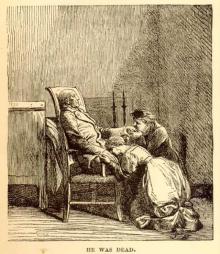
Enlarge
A couple of paces distant, at the foot of the hedge on the other side,exactly at the point where the gap which he was meditating would havebeen made, there was a sort of recumbent stone which formed a bench, andon this bench was seated the old man of the garden, while the old womanwas standing in front of him. The old woman was grumbling. Gavroche, whowas not very discreet, listened.
"Monsieur Mabeuf!" said the old woman.
"Mabeuf!" thought Gavroche, "that name is a perfect farce."
The old man who was thus addressed, did not stir. The old womanrepeated:--
"Monsieur Mabeuf!"
The old man, without raising his eyes from the ground, made up his mindto answer:--
"What is it, Mother Plutarque?"
"Mother Plutarque!" thought Gavroche, "another farcical name."
Mother Plutarque began again, and the old man was forced to accept theconversation:--
"The landlord is not pleased."
"Why?"
"We owe three quarters rent."
"In three months, we shall owe him for four quarters."
"He says that he will turn you out to sleep."
"I will go."
"The green-grocer insists on being paid. She will no longer leave herfagots. What will you warm yourself with this winter? We shall have nowood."
"There is the sun."
"The butcher refuses to give credit; he will not let us have any moremeat."
"That is quite right. I do not digest meat well. It is too heavy."
"What shall we have for dinner?"
"Bread."
"The baker demands a settlement, and says, 'no money, no bread.'"
"That is well."
"What will you eat?"
"We have apples in the apple-room."
"But, Monsieur, we can't live like that without money."
"I have none."
The old woman went away, the old man remained alone. He fell intothought. Gavroche became thoughtful also. It was almost dark.
The first result of Gavroche's meditation was, that instead of scalingthe hedge, he crouched down under it. The branches stood apart a littleat the foot of the thicket.
"Come," exclaimed Gavroche mentally, "here's a nook!" and he curled upin it. His back was almost in contact with Father Mabeuf's bench. Hecould hear the octogenarian breathe.
Then, by way of dinner, he tried to sleep.
It was a cat-nap, with one eye open. While he dozed, Gavroche kept onthe watch.
The twilight pallor of the sky blanched the earth, and the lane formed alivid line between two rows of dark bushes.
All at once, in this whitish band, two figures made their appearance.One was in front, the other some distance in the rear.
"There come two creatures," muttered Gavroche.
The first form seemed to be some elderly bourgeois, who was bent andthoughtful, dressed more than plainly, and who was walking slowlybecause of his age, and strolling about in the open evening air.
The second was straight, firm, slender. It regulated its pace by thatof the first; but in the voluntary slowness of its gait, supplenessand agility were discernible. This figure had also something fierce anddisquieting about it, the whole shape was that of what was then called_an elegant_; the hat was of good shape, the coat black, well cut,probably of fine cloth, and well fitted in at the waist. The head washeld erect with a sort of robust grace, and beneath the hat the paleprofile of a young man could be made out in the dim light. The profilehad a rose in its mouth. This second form was well known to Gavroche; itwas Montparnasse.
He could have told nothing about the other, except that he was arespectable old man.
Gavroche immediately began to take observations.
One of these two pedestrians evidently had a project connected withthe other. Gavroche was well placed to watch the course of events. Thebedroom had turned into a hiding-place at a very opportune moment.
Montparnasse on the hunt at such an hour, in such a place, betokenedsomething threatening. Gavroche felt his gamin's heart moved withcompassion for the old man.
What was he to do? Interfere? One weakness coming to the aid of another!It would be merely a laughing matter for Montparnasse. Gavroche did notshut his eyes to the fact that the old man, in the first place, and thechild in the second, would make but two mouthfuls for that redoubtableruffian eighteen years of age.
While Gavroche was deliberating, the attack took place, abruptly andhideously. The attack of the tiger on the wild ass, the attack of thespider on the fly. Montparnasse suddenly tossed away his rose, boundedupon the old man, seized him by the collar, grasped and clung to him,and Gavroche with difficulty restrained a scream. A moment later one ofthese men was underneath the other, groaning, struggling, with a kneeof marble upon his breast. Only, it was not just what Gavroche hadexpected. The one who lay on the earth was Montparnasse; the one whowas on top was the old man. All this took place a few paces distant fromGavroche.
The old man had received the shock, had returned it, and that in sucha terrible fashion, that in a twinkling, the assailant and the assailedhad exchanged rôles.
"Here's a hearty veteran!" thought Gavroche.
He could not refrain from clapping his hands. But it was applausewasted. It did not reach the combatants, absorbed and deafened as theywere, each by the other, as their breath mingled in the struggle.
Silence ensued. Montparnasse ceased his struggles. Gavroche indulged inthis aside: "Can he be dead!"
The goodman had not uttered a word, nor given vent to a cry. He rose tohis feet, and Gavroche heard him say to Montparnasse:--
"Get up."
Montparnasse rose, but the goodman held him fast. Montparnasse'sattitude was the humiliated and furious attitude of the wolf who hasbeen caught by a sheep.
Gavroche looked on and listened, making an effort to reinforce his eyeswith his ears. He was enjoying himself immensely.
He was repaid for his conscientious anxiety in the character of aspectator. He was able to catch on the wing a dialogue which borrowedfrom the darkness an indescribably tragic accent. The goodmanquestioned, Montparnasse replied.
"How old are you?"
"Nineteen."
"You are strong and healthy. Why do you not work?"
"It bores me."
"What is your trade?"
"An idler."
"Speak seriously. Can anything be done for you? What would you like tobe?"
"A thief."
A pause ensued. The old man seemed absorbed in profound thought. Hestood motionless, and did not relax his hold on Montparnasse.
Every moment the vigorous and agile young ruffian indulged in thetwitchings of a wild beast caught in a snare. He gave a jerk, tried acrook of the knee, twisted his limbs desperately, and made efforts toescape.
The old man did not appear to notice it, and held both his arms with onehand, with the sovereign indifference of absolute force.
The old man's revery lasted for some time, then, looking steadily atMontparnasse, he addressed to him in a gentle voice, in the midst of thedarkness where they stood, a solemn harangue, of which Gavroche did notlose a single syllable:--
"My child, you are entering, through indolence, on one of the mostlaborious of lives. Ah! You declare yourself to be an idler! prepare totoil. There is a certain formidable machine, have you seen it? It isthe rolling-mill. You must be on your guard against it, it is craftyand ferocious; if it catches hold of the skirt of your coat, you will bedrawn in bodily. That machine is laziness. Stop while there is yet time,and save yourself! Otherwise, it is all over with you; in a short timeyou will be among the gearing. Once entangled, hope for nothing more.Toil, lazybones! there is no more repose for you! The iron hand ofimplacable toil has seized you. You do not wish to earn your living, tohave a task, to fulfil a duty! It bores you to be like other men? Well!You will be different. Labor is the law; he who rejects it will findennui his torment. You do not wish to be a workingman, you will be aslave. Toil lets go of you on one side only to grasp you again on theother. You do not desire to be its friend, you shall be its negro slave.Ah! You would have none of the honest weariness of men, you shall havethe sweat of the damned. Where others sing, you will rattle in yourthroat. You will see afar off, from below, other men at work; it willseem to you that they are resting. The laborer, the harvester, thesailor, the blacksmith, will appear to you in glory like the blessedspirits in paradise. What radiance surrounds the forge! To guide theplough, to bind the sheaves, is joy. The bark at liberty in the wind,what delight! Do you, lazy idler, delve, drag on, roll, march! Drag yourhalter. You are a beast of burden in the team of hell! Ah! To do nothingis your object. Well, not a week, not a day, not an hour shall you havefree from oppression. You will be able to lift nothing without anguish.Every minute that passes will make your muscles crack. What is a featherto others will be a rock to you. The simplest things will become steepacclivities. Life will become monstrous all about you. To go, to come,to breathe, will be just so many terrible labors. Your lungs willproduce on you the effect of weighing a hundred pounds. Whether youshall walk here rather than there, will become a problem that must besolved. Any one who wants to go out simply gives his door a push, andthere he is in the open air. If you wish to go out, you will be obligedto pierce your wall. What does every one who wants to step into thestreet do? He goes down stairs; you will tear up your sheets, littleby little you will make of them a rope, then you will climb out of yourwindow, and you will suspend yourself by that thread over an abyss, andit will be night, amid storm, rain, and the hurricane, and if the ropeis too short, but one way of descending will remain to you, to fall. Todrop hap-hazard into the gulf, from an unknown height, on what? On whatis beneath, on the unknown. Or you will crawl up a chimney-flue, at therisk of burning; or you will creep through a sewer-pipe, at the risk ofdrowning; I do not speak of the holes that you will be obliged to mask,of the stones which you will have to take up and replace twenty times aday, of the plaster that you will have to hide in your straw pallet. Alock presents itself; the bourgeois has in his pocket a key made by alocksmith. If you wish to pass out, you will be condemned to execute aterrible work of art; you will take a large sou, you will cut it intwo plates; with what tools? You will have to invent them. That is yourbusiness. Then you will hollow out the interior of these plates, takinggreat care of the outside, and you will make on the edges a thread, sothat they can be adjusted one upon the other like a box and its cover.The top and bottom thus screwed together, nothing will be suspected. Tothe overseers it will be only a sou; to you it will be a box. What willyou put in this box? A small bit of steel. A watch-spring, in which youwill have cut teeth, and which will form a saw. With this saw, as longas a pin, and concealed in a sou, you will cut the bolt of the lock, youwill sever bolts, the padlock of your chain, and the bar at your window,and the fetter on your leg. This masterpiece finished, this prodigyaccomplished, all these miracles of art, address, skill, and patienceexecuted, what will be your recompense if it becomes known that youare the author? The dungeon. There is your future. What precipices areidleness and pleasure! Do you know that to do nothing is a melancholyresolution? To live in idleness on the property of society! to beuseless, that is to say, pernicious! This leads straight to the depthof wretchedness. Woe to the man who desires to be a parasite! He willbecome vermin! Ah! So it does not please you to work? Ah! You have butone thought, to drink well, to eat well, to sleep well. You will drinkwater, you will eat black bread, you will sleep on a plank with a fetterwhose cold touch you will feel on your flesh all night long, riveted toyour limbs. You will break those fetters, you will flee. That is well.You will crawl on your belly through the brushwood, and you will eatgrass like the beasts of the forest. And you will be recaptured. Andthen you will pass years in a dungeon, riveted to a wall, groping foryour jug that you may drink, gnawing at a horrible loaf of darknesswhich dogs would not touch, eating beans that the worms have eatenbefore you. You will be a wood-louse in a cellar. Ah! Have pity onyourself, you miserable young child, who were sucking at nurse lessthan twenty years ago, and who have, no doubt, a mother still alive! Iconjure you, listen to me, I entreat you. You desire fine black cloth,varnished shoes, to have your hair curled and sweet-smelling oils onyour locks, to please low women, to be handsome. You will be shavenclean, and you will wear a red blouse and wooden shoes. You want ringson your fingers, you will have an iron necklet on your neck. If youglance at a woman, you will receive a blow. And you will enter there atthe age of twenty. And you will come out at fifty! You will enter young,rosy, fresh, with brilliant eyes, and all your white teeth, and yourhandsome, youthful hair; you will come out broken, bent, wrinkled,toothless, horrible, with white locks! Ah! my poor child, you are on thewrong road; idleness is counselling you badly; the hardest of all workis thieving. Believe me, do not undertake that painful profession ofan idle man. It is not comfortable to become a rascal. It is lessdisagreeable to be an honest man. Now go, and ponder on what I have saidto you. By the way, what did you want of me? My purse? Here it is."
And the old man, releasing Montparnasse, put his purse in the latter'shand; Montparnasse weighed it for a moment, after which he allowed it toslide gently into the back pocket of his coat, with the same mechanicalprecaution as though he had stolen it.
All this having been said and done, the goodman turned his back andtranquilly resumed his stroll.
"The blockhead!" muttered Montparnasse.
Who was this goodman? The reader has, no doubt, already divined.
Montparnasse watched him with amazement, as he disappeared in the dusk.This contemplation was fatal to him.
While the old man was walking away, Gavroche drew near.
Gavroche had assured himself, with a sidelong glance, that Father Mabeufwas still sitting on his bench, probably sound asleep. Then the gaminemerged from his thicket, and began to crawl after Montparnasse in thedark, as the latter stood there motionless. In this manner he came upto Montparnasse without being seen or heard, gently insinuated his handinto the back pocket of that frock-coat of fine black cloth, seized thepurse, withdrew his hand, and having recourse once more to his crawling,he slipped away like an adder through the shadows. Montparnasse, whohad no reason to be on his guard, and who was engaged in thought for thefirst time in his life, perceived nothing. When Gavroche had once moreattained the point where Father Mabeuf was, he flung the purse over thehedge, and fled as fast as his legs would carry him.
The purse fell on Father Mabeuf's foot. This commotion roused him.
He bent over and picked up the purse.
He did not understand in the least, and opened it.
The purse had two compartments; in one of them there was some smallchange; in the other lay six napoleons.
M. Mabeuf, in great alarm, referred the matter to his housekeeper.
"That has fallen from heaven," said Mother Plutarque.
BOOK FIFTH.--THE END OF WHICH DOES NOT RESEMBLE THE BEGINNING