Complete works of willa.., p.1
Complete Works of Willa Cather,
p.1
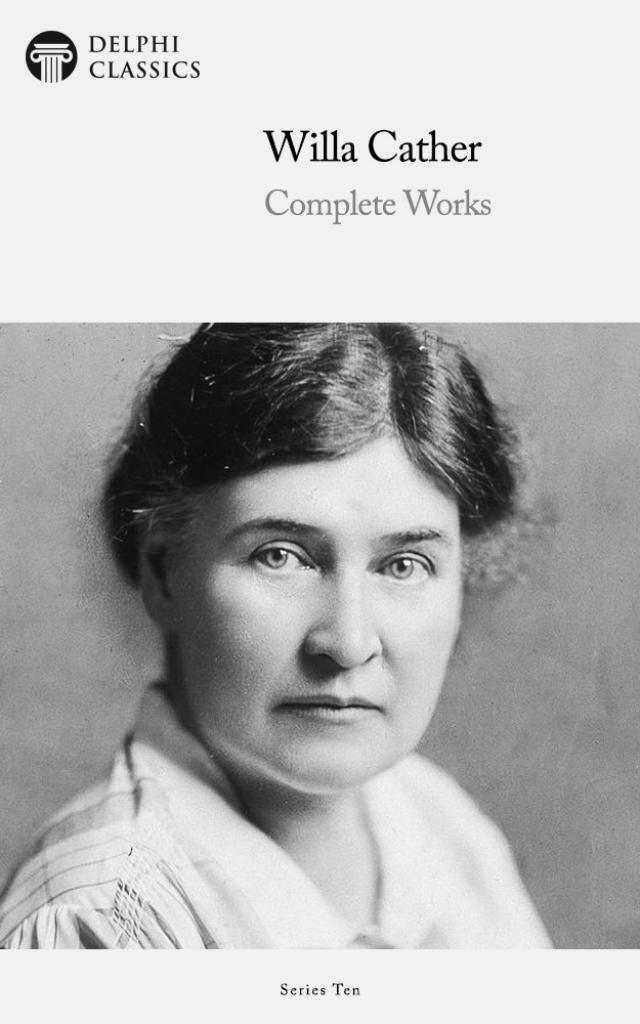


The Complete Works of
WILLA CATHER
(1873-1947)
Contents
The Prairie Trilogy
The Novels
Alexander’s Bridge
O Pioneers!
The Song of the Lark
My Ántonia
One of Ours
A Lost Lady
The Professor’s House
My Mortal Enemy
Death Comes for the Archbishop
Shadows on the Rock
Lucy Gayheart
Sapphira and the Slave Girl
The Short Story Collections
The Troll Garden
Youth and the Bright Medusa
Obscure Destinies
The Old Beauty and Others
A Collection of Stories, Reviews and Essays
Uncollected Short Stories
The Short Stories
List of Short Stories in Chronological Order
List of Short Stories in Alphabetical Order
The Poetry
April Twilights
The Non-Fiction
The Life of Mary Baker G. Eddy and the History of Christian Science
Not Under Forty
A Collection of Stories, Reviews and Essays
Miscellaneous Pieces
The Delphi Classics Catalogue
© Delphi Classics 2019
Version 1
Browse our Main Series
Browse our Ancient Classics
Browse our Poets
Browse our Art eBooks
Browse our Classical Music series
The Complete Works of
WILLA CATHER
with introductions by Gill Rossini
www.gillrossini.com
By Delphi Classics, 2019
COPYRIGHT
Complete Works of Willa Cather
First published in the United Kingdom in 2019 by Delphi Classics.
© Delphi Classics, 2019.
All rights reserved. No part of this publication may be reproduced, stored in a retrieval system, or transmitted, in any form or by any means, without the prior permission in writing of the publisher, nor be otherwise circulated in any form other than that in which it is published.
ISBN: 978 1 78877 990 6
Delphi Classics
is an imprint of
Delphi Publishing Ltd
Hastings, East Sussex
United Kingdom
Contact: sales@delphiclassics.com
www.delphiclassics.com
Parts Edition Now Available!
Love reading Willa Cather?
Did you know you can now purchase the Delphi Classics Parts Edition of this author and enjoy all the novels, plays, non-fiction books and other works as individual eBooks? Now, you can select and read individual novels etc. and know precisely where you are in an eBook. You will also be able to manage space better on your eReading devices.
The Parts Edition is only available direct from the Delphi Classics website.
For more information about this exciting new format and to try free Parts Edition downloads, please visit this link.
Explore classic American fiction with Delphi Classics
For the first time in digital publishing history, Delphi Classics is proud to present the complete works of these important American authors.
Explore Americans
The Prairie Trilogy
O Pioneers! (1913)
The Song of the Lark (1915)
My Ántonia (1918)
The Novels
The Willa Cather Birthplace, Rachel E. Boak House, a nineteenth-century residence near Gore in Frederick County, Virginia
A plaque commemorating Cather’s birthplace
Alexander’s Bridge
Published in 1912 in America by the Houghton Mifflin Company and in London by William Heinemann, Alexander’s Bridge is Cather’s first novel. It was a relatively late debut into novel writing as Cather was thirty-nine years old at the time, but her writing career had begun as an undergraduate at the University of Nebraska, when she published an article about Thomas Carlyle in the Nebraska State Journal. The novel also ran as a serial in McClure’s, with the title Alexander’s Masquerade, giving Cather some free time from her work for that magazine. Subsequently, Cather was to dismiss the work as imitative of Edith Wharton and Henry James, a comment rather typical of her strong self critique, but on publication the novel was almost universally well received; it has since been suggested that it is indeed imperfect, but that is to be expected for most first novels, even from a writer later regarded as eminent.
The story is based partly on a real event – the collapse of the Quebec Bridge in 1907, a project that had been beset with problems from the start. The incident caused the deaths of 75 workers that were on the bridge at the time of the collapse. However, Cather was always clear that the story of bridge building was never the central point of the narrative – the builder of the bridges takes centre stage. It is thought that the character of Hilda Burgoyne was based on the comedy actress Maire O’Neill, whom Cather saw in Playboy of the Western World in London in 1909. It has also been suggested that J. M. Barrie was one of the inspirations for the playwright McConnell, Alexander’s rival in the story for Hilda’s affections.
The story opens with the arrival of Professor Wilson in Boston. It is a trip heavy with nostalgia, as this is where the academic spent his student days. His destination in the city is the home of the Alexanders – his friend and former pupil Bartley Alexander has invited him to attend a Congress of Psychologists. He is delighted to be greeted by Mrs Winifred Alexander, a tall and striking woman, the wife of his friend and as they take tea together; it is clear that there is an instant rapport between them. He is puzzled, however, by her assertion that she finds her husband something of an enigma and that his youth is a mystery to her, despite the anecdotes she has heard. We meet Alexander when he returns to the house, ‘a big man…with a quick, heavy tread, bringing with him a smell of cigar smoke and chill out-of-doors air,’ a man who, according to his wife, who lives life only for the ‘fiery moment’. This tall, vigorous engineer looks strong enough to build one of his famous bridges single handed. Later, the two men chat about the new bridge Alexander is building in Canada and about Alexander’s forthcoming trip to England, to meet with some British engineers, but Wilson is worried by an unease he notes in his friend, a sign of some weariness that he at first puts down to the ‘dulling weariness of on-coming middle age’.
Alexander sails for England and on his arrival, dines with Mainhall, an old acquaintance, who also takes him to the Duke of York’s theatre to see the Irish actress, Hilda Burgoyne, perform in her latest popular comedy show. At the theatre, Mainhall gossips about Hilda’s background and mentions that the actress will not entertain any romantic associations with men, but that in her past there had been a romance with an American - not realising that Alexander was that American suitor. The affair had been broken off by Alexander on his return to America, as he had met his future wife, but now he has seen Hilda again, his curiosity about her is rekindled and he becomes increasingly preoccupied not just with memories of her, but his efforts to watch her covertly. It is revealed now to the reader that Wilson was right – Alexander is having a ‘mid life crisis’. Buffered by his wife’s wealth and social status, the edge has been eroded from Alexander’s ambition; he is busy with life, but now that the need to work has gone, he has increasingly drifted into social welfare and public committee activities and his sense of purpose has all, but gone:
‘He had expected that success would bring him freedom and power;, but it had brought only power that was in itself another kind of restraint…He found himself living exactly the kind of life he had determined to escape…Hardships and difficulties he had carried lightly; overwork had not exhausted him;, but this dead calm of middle life which confronted him, — of that he was afraid. He was not ready for it. It was like being buried alive.’
Eventually, Alexander is invited to a soiree at which Hilda is also present and where he is nervous to see her again, she simply greets him cheerfully, as one would an old friend. Determined to see Hilda alone, he eventually manages to dine with her when no other guests are present. During a delightful meal, they reminisce over old times and mutual friends and Alexander finds Hilda to be a sophisticated, charming and urbane woman now and not just that – she is also a reminder of his younger, freer days, when he had ambition and his achievements still ahead of him. It is an intoxicating combination and Alexander is becoming infatuated with Hilda once again. By the end of the evening, it is clear that Hilda’s attraction to him has also been revived and their affair is resumed.
Some months later, it is Christmas. Alexander is back home in Boston, determined to please his wife and guests, who include Wilson, but underneath his bon-hommie, his newly passion for Hilda continues to burn. In the New Year, Alexander is to travel to England yet again, on the pretext of work, but in truth, to reunite with his lover, Hilda. How much longer can his double life continue?
This is a strong first novel for Cather, with a style that is brisk for the times and takes the reader easily through the story. There are delicate hints to a character’s traits, building up effortlessly into a compelling portrait, although Hilda is a somewhat stereotypical fictional Irish woman of that time. Alexander’s dilemma is acutely portrayed and the reader is drawn into his torment as he struggles with his love for two women and Cather is adept at
dropping hints of future events almost without the reader noticing. For the modern reader, there are what seem today to be nice period touches (which would have been scenes of modern life when the book was freshly written). Through Cather’s words, we can picture the transitional period between the horse drawn and newer forms of transport, with ‘jangling street cars and shelving lumber drays’ side by side on the streets of Boston. She is at pains to create a picture of London at the time, describing the streets and landmarks for her American readership, using impressions no doubt made during her stay in London in 1909.
It may amuse the reader new to Cather’s fiction to watch out for a recurrent theme in her work – the tension between past and present, a sense of yearning and searching for something that may or may not be defined or obvious. Despite Cather’s own reservations, this remains a worthy representative of the author’s skill as a novelist and a useful yardstick to mark her progress as a writer in future stories.
The first edition
CONTENTS
CHAPTER I
CHAPTER II
CHAPTER III
CHAPTER IV
CHAPTER V
CHAPTER VI
CHAPTER VII
CHAPTER VIII
CHAPTER IX
CHAPTER X
EPILOGUE
The first edition’s title page
Photograph of actress Maire O'Neill (1885-1952), the model for Hilda Burgoyne
Drawing of the original design of Quebec Bridge
Wreckage of the 1907 collapse of Quebec Bridge
CHAPTER I
LATE ONE BRILLIANT April afternoon Professor Lucius Wilson stood at the head of Chestnut Street, looking about him with the pleased air of a man of taste who does not very often get to Boston. He had lived there as a student, but for twenty years and more, since he had been Professor of Philosophy in a Western university, he had seldom come East except to take a steamer for some foreign port. Wilson was standing quite still, contemplating with a whimsical smile the slanting street, with its worn paving, its irregular, gravely colored houses, and the row of naked trees on which the thin sunlight was still shining. The gleam of the river at the foot of the hill made him blink a little, not so much because it was too bright as because he found it so pleasant. The few passers-by glanced at him unconcernedly, and even the children who hurried along with their school-bags under their arms seemed to find it perfectly natural that a tall brown gentleman should be standing there, looking up through his glasses at the gray housetops.
The sun sank rapidly; the silvery light had faded from the bare boughs and the watery twilight was setting in when Wilson at last walked down the hill, descending into cooler and cooler depths of grayish shadow. His nostril, long unused to it, was quick to detect the smell of wood smoke in the air, blended with the odor of moist spring earth and the saltiness that came up the river with the tide. He crossed Charles Street between jangling street cars and shelving lumber drays, and after a moment of uncertainty wound into Brimmer Street. The street was quiet, deserted, and hung with a thin bluish haze. He had already fixed his sharp eye upon the house which he reasoned should be his objective point, when he noticed a woman approaching rapidly from the opposite direction. Always an interested observer of women, Wilson would have slackened his pace anywhere to follow this one with his impersonal, appreciative glance. She was a person of distinction he saw at once, and, moreover, very handsome. She was tall, carried her beautiful head proudly, and moved with ease and certainty. One immediately took for granted the costly privileges and fine spaces that must lie in the background from which such a figure could emerge with this rapid and elegant gait. Wilson noted her dress, too, — for, in his way, he had an eye for such things, — particularly her brown furs and her hat. He got a blurred impression of her fine color, the violets she wore, her white gloves, and, curiously enough, of her veil, as she turned up a flight of steps in front of him and disappeared.
Wilson was able to enjoy lovely things that passed him on the wing as completely and deliberately as if they had been dug-up marvels, long anticipated, and definitely fixed at the end of a railway journey. For a few pleasurable seconds he quite forgot where he was going, and only after the door had closed behind her did he realize that the young woman had entered the house to which he had directed his trunk from the South Station that morning. He hesitated a moment before mounting the steps. “Can that,” he murmured in amazement,— “can that possibly have been Mrs. Alexander?”
When the servant admitted him, Mrs. Alexander was still standing in the hallway. She heard him give his name, and came forward holding out her hand.
“Is it you, indeed, Professor Wilson? I was afraid that you might get here before I did. I was detained at a concert, and Bartley telephoned that he would be late. Thomas will show you your room. Had you rather have your tea brought to you there, or will you have it down here with me, while we wait for Bartley?”
Wilson was pleased to find that he had been the cause of her rapid walk, and with her he was even more vastly pleased than before. He followed her through the drawing-room into the library, where the wide back windows looked out upon the garden and the sunset and a fine stretch of silver-colored river. A harp-shaped elm stood stripped against the pale-colored evening sky, with ragged last year’s birds’ nests in its forks, and through the bare branches the evening star quivered in the misty air. The long brown room breathed the peace of a rich and amply guarded quiet. Tea was brought in immediately and placed in front of the wood fire. Mrs. Alexander sat down in a high-backed chair and began to pour it, while Wilson sank into a low seat opposite her and took his cup with a great sense of ease and harmony and comfort.
“You have had a long journey, haven’t you?” Mrs. Alexander asked, after showing gracious concern about his tea. “And I am so sorry Bartley is late. He’s often tired when he’s late. He flatters himself that it is a little on his account that you have come to this Congress of Psychologists.”
“It is,” Wilson assented, selecting his muffin carefully; “and I hope he won’t be tired tonight. But, on my own account, I’m glad to have a few moments alone with you, before Bartley comes. I was somehow afraid that my knowing him so well would not put me in the way of getting to know you.”
“That’s very nice of you.” She nodded at him above her cup and smiled, but there was a little formal tightness in her tone which had not been there when she greeted him in the hall.
Wilson leaned forward. “Have I said something awkward? I live very far out of the world, you know. But I didn’t mean that you would exactly fade dim, even if Bartley were here.”
Mrs. Alexander laughed relentingly. “Oh, I’m not so vain! How terribly discerning you are.”
She looked straight at Wilson, and he felt that this quick, frank glance brought about an understanding between them.
He liked everything about her, he told himself, but he particularly liked her eyes; when she looked at one directly for a moment they were like a glimpse of fine windy sky that may bring all sorts of weather.
“Since you noticed something,” Mrs. Alexander went on, “it must have been a flash of the distrust I have come to feel whenever I meet any of the people who knew Bartley when he was a boy. It is always as if they were talking of someone I had never met. Really, Professor Wilson, it would seem that he grew up among the strangest people. They usually say that he has turned out very well, or remark that he always was a fine fellow. I never know what reply to make.”
Wilson chuckled and leaned back in his chair, shaking his left foot gently. “I expect the fact is that we none of us knew him very well, Mrs. Alexander. Though I will say for myself that I was always confident he’d do something extraordinary.”