

The case of the moth eat.., p.1
The Case of the Moth-Eaten Mink,
p.1
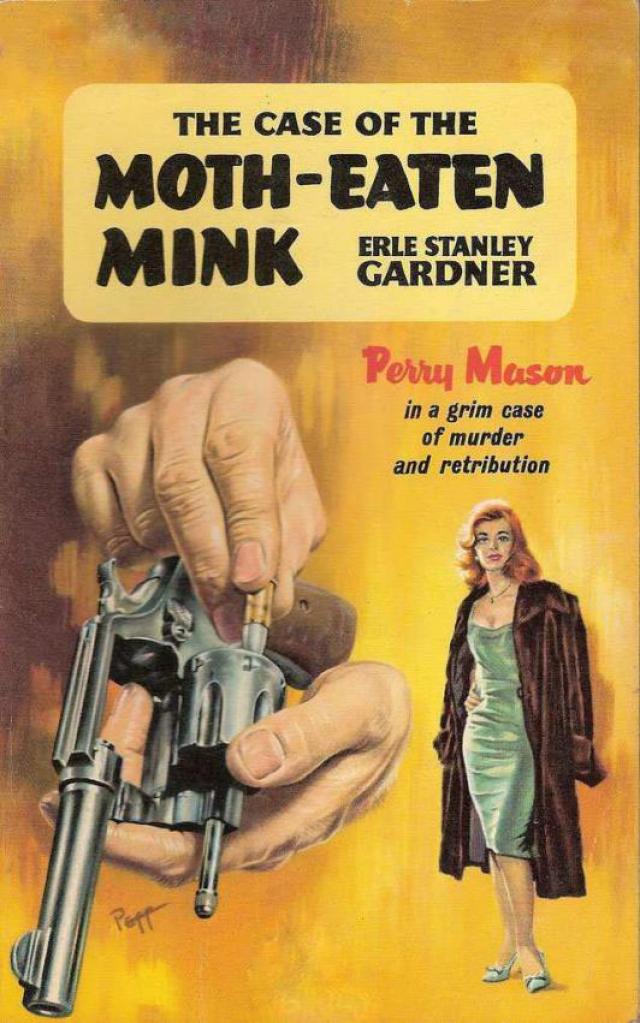


The Case of the
Moth-Eaten Mink
by
Erle Stanley Gardner
Copyright © 1952 by Erle Stanley Gardner. Renewed 1980 by Jean Bethel Gardner
Electronic Book: Copyright © 2012 by The Erle Stanley Gardner Literary Trust
All rights reserved.
Contents
Copyright
Foreword
Cast of Characters
Chapter 1
Chapter 2
Chapter 3
Chapter 4
Chapter 5
Chapter 6
Chapter 7
Chapter 8
Chapter 9
Chapter 10
Chapter 11
Chapter 12
Chapter 13
Chapter 14
Chapter 15
Chapter 16
Chapter 17
Chapter 18
Chapter 19
About the Author
Foreword
Captain Frances G. Lee, a seventy-year-old woman who has donated her life and her fortune to legal medicine, police work and scientific crime detection, is a character so fabulous that the most colorful creations of the mystery writer seem drab in comparison.
Several years ago she first invited me to attend one of the seminars on homicide investigation which are given under her auspices at the Harvard Medical School in Boston.
At this seminar my attention was attracted to one of the younger instructors, Dr. Russell S. Fisher, a man who had a thorough command of his subject, who had the knack of imparting information, and who, above all, had a manner of quiet sincerity. He was modest, almost to the point of self-effacement; yet the calm confidence with which he went about his work showed that he had faith in himself.
I am interested in mysteries, murders, police detection and in crime, but above all, as a writer, I am interested in people. I like to try to classify people and try to “read character.”
There are those who claim that it is impossible to “read character.” What these skeptics overlook is that as a man establishes the daily contacts of his life, he is, to a large extent, treated according to his character and his worth. It is quite possible that the man’s character may not show in any particular stamp of features; nevertheless by his bearing, his manner, and the tone of his voice, a careful observer can tell a great deal about that individual and how he is accustomed to being treated by those who know him well.
The man whose opinions are consistently ignored will either make his remarks apologetically, or try to offset the effect he feels his words will create by clothing himself in a synthetically positive manner, which is so patently assumed it fools no one.
The man who is suspect of carrying tales or double-crossing will always be on the defensive. The man whose opinions are good but not quite good enough will keep on talking long after he has made his point, trying to bolster up his ideas in the face of the expected refusal.
I have known people who are very expert at this sort of character reading, and it is a hobby with me to study these things. So I made it a point to study Dr. Fisher, and the more I saw of him the better I liked him.
During the next eighteen months, Captain Lee invited me to attend two more seminars, and each time I noted Dr. Fisher’s development with increased pleasure.
Then came a time when Maryland decided it must put up really adequate appropriations and quit playing around with homicides and murders, and put its ten-year-old Medical Examiner System on a solid footing. They wanted a man to head it who was thoroughly competent.
I knew generally that the five-man commission in Baltimore had decided to get the very best man available in the field. The position carried a salary which they felt would attract a man of top caliber.
Captain Lee is by way of being godmother to most of the state police organizations on the Atlantic Coast, and it was my good fortune to accompany her on a friendly tour of the state police, starting in New Hampshire (where she herself holds the title of Captain) and moving on down, state by state, until we came to Virginia.
The Maryland bigwigs in state and city police administration and crime detection went out of their way to honor Captain Lee, and I was included in the invitations. I caught a glimpse of real Southern hospitality, outstanding, it seems to me, because it is essentially founded upon sincerity and a recognition that friendships constitute the true wealth in life. Money may be desirable, but it is distinctly secondary.
It was a warm evening. There were mint juleps in frosted glasses, and a dinner served so efficiently, yet so unostentatiously, that one was inclined to take it as much for granted as the ice and the mint. Then, over the after-dinner coffee, the conversation gravitated toward the new position which was open, and I realized that these people had deferred naming the man who was to be Chief Medical Examiner until they could have a heart-to-heart talk with Captain Lee.
It came out of a clear sky so far as Captain Lee was concerned. She starting thinking out loud, checking over persons who were available, and then said, “There’s a young man who I think would fit in perfectly. He’s young, he’s at Harvard, and he’s going to go places. He’s competent, conscientious, and he has a lot of innate executive ability. His name is Dr. Russell S. Fisher.”
And then she turned to me and said, “You know him, Erle. What do you think of him?”
I agreed with her estimate in as few words as possible. It was her party. I was watching, listening and learning.
There was quite a bit of talk during the next ten minutes.
It was very apparent that the sponsors of this Maryland program felt that it was a matter of the greatest importance that everything get off to a good start. In fact, to a large extent their own reputations were at stake. They needed a man who was really outstanding.
Captain Lee gave them her ideas about Dr. Fisher. There was some thoughtful puckering of brows. Captain Lee’s recommendation went a great way, but one gathered that Dr. Fisher was going to be investigated up one side and down the other. And then they started asking questions.
During my years as a trial lawyer I have learned to appreciate what an art it is to extract definite information by short, pertinent, searching questions, and I pushed my chair back from the table so I could more thoroughly enjoy what was taking place.
There were seven or eight of the top-flight men gathered at this dinner, and they had brains. They had brains enough to work together, to co-ordinate each other’s efforts, and for ten or fifteen minutes Captain Lee was subjected to a cross-examination about Dr. Fisher that was an intellectual treat to an ex-trial lawyer who had enjoyed a wonderful dinner, who was basking happily in the glow of Southern hospitality, and who was listening to as shrewd a group of men as it had ever been his good fortune to see in action.
And then one of the men asked a highly pertinent question. “This Dr. Fisher,” he said, “he is young. We’ll concede from what you say, Captain Lee, that he has a competent grasp of the subject. Now, suppose he comes in here as Chief Medical Examiner and a murder case breaks where he goes on the stand and is subjected to cross-examination by some of the best attorneys in the country, who are, perhaps, trying to confuse him, trying to get him to shade his conclusions, or perhaps even trying to browbeat him and ridicule him. Is he the type of man who can go through an experience of that kind and maintain his dignity, who can rely on his knowledge, who can keep his temper and handle the situation simply through his competency and his knowledge?”
I was looking down at the tablecloth, waiting for Captain Lee to answer, thinking to myself that the person who asked that question had shown by the question itself that he had a keen insight into the technique of cross-examination.
There was a silence. I wondered if Captain Lee might be a little dubious. I glanced up at her, and saw that everyone was looking at me. For the first time I realized that the question had been addressed to me as an attorney.
It caught me by surprise so that I blurted out the two-word answer that told them exactly how I felt about Dr. Fisher. I said, “Hell, yes.”
They took some little time to investigate Dr. Fisher. Their findings were favorable, and they offered him the position. Dr. Fisher accepted, and the choice has been a particularly happy one.
In the years that have ensued, the Chief Medical Examiner’s Office of Maryland, located in splendidly equipped offices and laboratories provided by the city of Baltimore, has been the subject of discussion in many a gathering. No matter where you go throughout the United States, when you discuss legal medicine and the efficiency with which unexplained deaths are checked, homicides investigated, and facts placed in the hands of the prosecuting attorney, you find that Baltimore and Maryland rank high up in the top grouping of the top brackets.
Too few people realize how many murders go undetected because of ignorance, incompetence, or lack of proper investigative facilities on the part of those who are called upon to make medical (or medicolegal) investigations.
Too few people realize how frequently cool, calm efficiency on the part of a medical examiner can aid in the cause of justice.
There is one case which will illustrate my point, and which will, I think, prove to the reader Baltimore’s wisdom in seeking the best brains available in this particular field of investigation.
A few months ago, a young white man, accompanied by three friends, was operating his car on the streets of Baltimore. Another car, driven by a colored lad, cut th
em off at a corner.
There was ill feeling. The white driver speeded up and forced the colored boy’s car to the curb.
The colored boy got out of the right-hand front door of his car and stood on the sidewalk ready to defend himself.
The driver of the pursuing car jumped out of the door on the left-hand side, hurried around the car and approached the colored boy.
Witnesses said that the colored boy hit the white boy with his fist. The white boy promptly collapsed to the curb, unconscious. He was rushed to a hospital and died six hours later without regaining consciousness.
The colored lad was arrested and charged with manslaughter. The newspaper took up the case and racial feeling began to flare up.
Then Dr. Fisher performed an autopsy. He found something that a less skillful man would have missed. He found the cause of death was due to a ruptured aneurysm in that portion of the brain known as the “Circle of Willis.” There was no indication that the man had been struck. It was evident that a congenital aneurysm had ruptured under the influence of increased blood pressure due to anger.
So the Medical Examiner requested that the police start checking up on those who had seen the blow struck.
Then a peculiar thing developed.
Confronted with the findings of the Medical Examiner it turned out that no one really had seen a blow struck. The witnesses had been “pretty sure a blow was struck since the white boy fell just as a fight was starting.”
A careful reconstruction of the scene of the crime showed that some of the witnesses simply were not in a position to have seen the blow even if a blow had been struck. In view of the findings of the Medical Examiner it was proven that the man had died from natural causes, probably superinduced by his own anger.
And so I set forth an authentic example showing the responsibilities of a medical examiner, and one of the reasons why Maryland and Baltimore are ranked among the top areas in this work, feeling that you readers of mystery stories who, like myself, are interested in all the puzzling manifestations of crime and crime detection, will find it interesting. And I dedicate this book to my friend:
RUSSELL S. FISHER, M.D.
Chief Medical Examiner
State of Maryland
ERLE STANLEY GARDNER
CAST OF CHARACTERS
PERRY MASON—Came up with a double portion of trouble the night he stopped in at Morris Alburg’s restaurant
DELLA STREET—As Mason’s secretary, she had a good chance to examine the mink
MORRIS ALBURG—needed a lawyer—the very best—to get him out of the mess he found himself in
DIXIE DAYTON—A terrified waitress who ran so fast she forgot the mink
LIEUTENANT TRAGG—Co-operated with Mason, but it was much against his better judgment
PAUL DRAKE—Head of the Drake Detective Agency. The one time he regretted that Mason’s business was his bread and butter
GEORGE FAYETTE—A solitary diner—obviously his mind wasn’t on his steak
MAE NOLAN—Claimed Morris Alburg wasn’t a boss one could get enthused about
ROBERT CLAREMONT—A dedicated cop who was taken for a ride
THOMAS E. SEDGWICK—Suspected bookmaker and cop killer. When the heat was put on, he made himself scarce
SERGEANT JAFFREY—In charge of the Vice detail. The tie-in with Claremont’s murder brought him into the case
MINERVA HAMLIN—Night switchboard operator at the Drake Agency and a most efficient young woman
FRANK HOXIE—A hotel like the Keymont had use for a man of his particular talents
HAMILTON BURGER—Barrel-chested district attorney who clothed himself in an air of unctuous dignity
Chapter 1
It had been a hard, grueling day. Perry Mason and his secretary, Della Street, had finished taking a deposition. The witness had been cunning and evasive, his lawyer brimming with technical objections, and all of Perry Mason’s skill was needed finally to drag forth the significant facts.
The lawyer and his secretary, entering Morris Alburg’s restaurant, sought the privacy of a curtained booth in the rear. Della sighed her relief, glanced at Mason’s rugged features, said, “I don’t know how you do it. I’m like a wet dishrag.”
Morris Alburg made it a point to wave the waiter aside and himself take the order of his distinguished customer.
“Hard day, Mr. Mason?” he asked.
“A bear cat,” Mason admitted.
“In court all day, I presume?”
Mason shook his head.
“A deposition, Morris,” Della Street explained, indicating her shorthand books. “I took check notes.”
Alburg, not understanding, said, “Uh-huh,” vaguely, and then asked, “Cocktails?”
“Two double Bacardis,” Mason ordered, “a little on the sour side.”
Morris passed the cocktail order on to the waiter. “I have some nice fried chicken,” he suggested. “And the steaks are out of this world.”
He raised a thumb and forefinger to his lips.
Della Street laughed. “Are you going ritzy on us, Morris? Where did you get that?”
“The steaks?”
“No, the gesture.”
The restaurant proprietor grinned. “I saw a guy do that in a restaurant scene in the movies,” he confessed. “Then you should have seen the junk he brought on, steaks you could look at and tell they were tough like shoe leather.”
“Then never mind the gestures,” Mason told him. “We want two thick steaks, medium rare, lots of lyonnaise potatoes, some buttered bread, with—” He glanced expectantly at Della Street.
Della nodded.
“Garlic,” Mason said.
“Okay,” Morris Alburg said. “You’ll get it. The best!”
“Tender, juicy, medium rare,” Mason said.
“The best,” Alburg repeated again, and vanished, letting the green curtain drop back into place.
Mason extended his cigarette case to Della Street and held a match. The lawyer took a deep inhalation, slowly expelled the smoke, and half-closed his eyes. “If that old goat had only told the truth in the first place, instead of beating around the bush,” he said, “we’d have been finished in fifteen minutes.”
“Well, you finally got the truth out of him.”
“Finally,” Mason admitted. “It was like trying to pick up quicksilver with your bare fingers. You’d ask him a question and he’d run all over the place, twisting, turning, evading, throwing out red herrings, trying to change the subject.”
Della Street laughed and said, “Do you realize there was one question you asked him exactly twelve times?”
“I hadn’t counted the times,” Mason said, “but that was the turning point. I’d ask the question, he’d try to lead me off on some other conversational channel, and I’d wait until he’d finished, then ask the same question over again, in exactly the same words. He’d try new tactics to shake me off. I’d nod attentively as though I were taking it all in, and inspire him to new heights of verbal evasion. Then, when he’d finished, I’d ask him the same question in exactly the same words.”
The lawyer chuckled reminiscently.
“That was what finally broke him,” Della Street said. “When he caved in after that, he was your meat.”
Morris Alburg came back with the cocktails, glowing pink and cool in the big goblets.
Mason and Della Street touched glasses, drank a silent toast.
Morris Alburg in the door, watching them, said, “The way you talk with your eyes,” and shrugged his shoulders.
“Mr. Mason gets tired of talking with his voice, Morris,” Della Street said, slightly embarrassed.
“I guess that’s right, I guess lawyers talk,” Morris Alburg said hastily, trying to cover the fact that his observation had been too personal.
“Our steaks on the fire?” Mason asked.
Morris nodded.
“Good?”
“The best!” Morris grinned. Then, with a gesture that was like a silent benediction, he backed out of the booth and the curtain fell in place.
Mason and Della Street were undisturbed until, the cocktails finished, Alburg reappeared with a tray on which were stacked hot plates, platters with sizzling steaks, lyonnaise potatoes, and french bread toasted a delicious golden-brown, glistening with butter and little scrapings of garlic.















