The case of the moth eat.., p.6
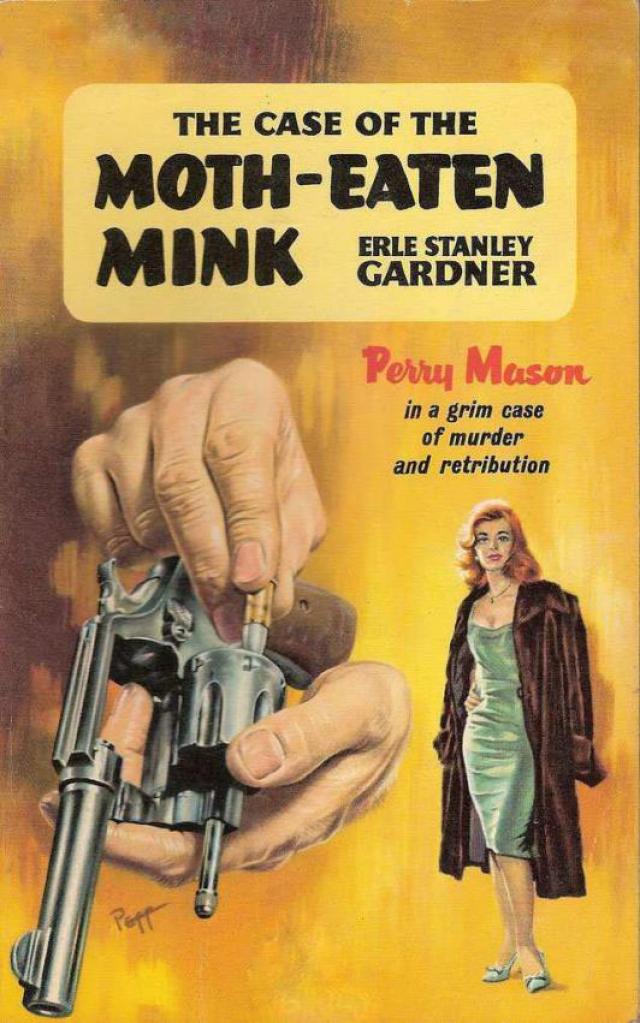
The Case of the Moth-Eaten Mink,
p.6


“Sure thing,” Mason said. “If Morris Alburg is cutting any corners with me, we’ll show him where he gets off.”
“Well, you talk with this girl and then see what you think,” Drake said.
“All right, bring her in.”
Della Street said, “I can run down and get her, Paul, if you and the chief want to talk.”
“Not that,” Drake said. “But I’m sure lazy, Della. If you’ll do the leg work, it’ll help…. She’s in my office. The girl at the telephone desk knows her. Just tell her to come on down here.”
“I’ll introduce myself?” Della Street asked. “That is, is there any reason why she wouldn’t know that …”
“None whatever,” Drake said, “not as far as I’m concerned.”
“Sure,” Mason said. “Go ahead, Della.”
“You have that Seattle pawn ticket?” Mason asked.
“Our Seattle correspondent has it,” Drake said. “They telephoned as soon as they’d contacted the pawn shop. He found the pawnbroker running around in circles, acting as though he’d been caught sucking eggs.”
“Wasn’t his nose clean?”
“It was supposed to have been, but something was bothering him. Under the circumstances my Seattle man didn’t tip his hand once he found out the police had the gun.”
Mason reached for a cigarette. “Want one, Paul?”
Drake shook his head. “Not now.”
Mason was just lighting up when they heard the sound of quick steps in the corridor, and Della Street, escorting a young woman into the office, said, “This is Mr. Mason, Miss Nolan.”
“How do you do, Mr. Mason.”
Mae Nolan was an artificial blonde, somewhere in her thirties. Her face was held in the lines of perpetual good nature, but the blue eyes above the smiling mouth were swift in their appraisal, and cold in their scrutiny.
“Sit down,” Mason invited.
“Thank you,” she said, with her best company manner.
Drake smiled indulgently and said, “No need to mince around any, Mae. Just tell Mr. Mason your story.”
She flashed him an angry glance, and said, “I wasn’t mincing around.”
Mason said, “I think you misunderstood Paul Drake, Miss Nolan. He merely was referring to the fact that you could get right down to brass tacks. He wasn’t referring to your manner, but pointing out there was no need for any verbal detours.”
“Oh, thank you,” she said, smiling at Mason, and batting her eyelashes. Then, swiftly turning to Paul Drake, said, “I’ve been nervous and upset today. What with one thing and another, I haven’t had a chance to get much sleep. We go on at six o’clock and work until twelve-thirty in the morning, right straight through.”
“Pretty tough job?” Mason asked.
“Sometimes.”
“The tables fill up pretty well?”
“Well, of course, it varies. On Saturday night we’re packed jammed. Then on Monday night there isn’t quite so much business. But, of course, every night during the rush hour everything is jammed. Then things taper off around ten o’clock except on Saturday night. Then there’s about an hour when things quiet down, but they start off again with a rush as soon as the theaters are out.”
“Certainly must be a job,” Della Street said sympathetically, “being on your feet all the time like that.”
“You don’t know the half of it, dearie,” Mae Nolan said, turning to Della Street. “You have a cinch in a job like this. Gosh, I— Oh, well, never mind. You folks aren’t interested in my troubles…. It isn’t the work so much as it is the people who are unappreciative, the people who bawl you out for their own mistakes…. A man will order roast beef and forget to tell you that he wants it rare. Then afterwards he’ll swear that he told you he didn’t want it unless it was real rare, and … Oh, what’s the use?”
“I thought you asked them how they wanted it when you took the order,” Della Street said.
Mae Nolan flashed her a cold glance. “I just used that as an illustration, dearie.”
“You were going to tell us something about Dixie Dayton,” Paul Drake said.
“Oh, was I?”
“I thought you were.”
“I don’t know whether I should go around shooting my mouth off. I don’t know what there is in it for me.”
“Probably nothing,” Mason said.
She studied him thoughtfully. “You come to the place every once in a while. I’ve waited on you.”
Mason nodded.
“And,” she said, “you’re a good tipper…. Most of the time you sit in the stalls though, don’t you?”
“I like privacy,” Mason said. “When I eat I like to relax, and when I’m out in the main dining room I’m recognized occasionally …”
“Occasionally? You should hear what people say about you when you eat out there. I know how you feel. I don’t blame you…. I don’t think I’ve waited on you over twice in all the time I’ve been there. I suppose one of these times I can get the privilege of waiting on the booths, if I stay there long enough. I’ll probably drop dead in my tracks before that waiter who’s in there now ever lets go.”
“As I remember it, you’re a very skillful waitress,” Mason said. “If I gave you a large tip, I can assure you it was because the service was more than satisfactory.”
“Well, thank you ever so much for those kind words. We don’t hear them too often. Like I was saying, when you’re out in front people crane their necks all over and there’s a lot of whispering. Then when I go to other tables to get the orders, people will beckon me to lean over closer, and say, ‘Isn’t that the famous Perry Mason over there at that other table?’ and I’ll nod, and then you know what they want to know, Mr. Mason?”
“What do they want to know?” Mason asked, winking at Paul Drake.
“They want to know who’s that woman with him.”
“And what do you tell them?” Mason asked.
“And then,” she said, “is when I draw myself up and tell them it’s none of their business.”
“You were going to tell us about Dixie,” Paul Drake interpolated.
“Oh, was I?—that may be what you thought, but …”
Mason turned to Paul Drake and said, “You know, Paul, there’s something funny about that Dixie Dayton.”
“In what way?” Drake asked, catching Mason’s eye.
“Well, she somehow didn’t seem to fit in,” Mason said. “I don’t know just how to express it but I had the idea that perhaps Morris Alburg was giving her the breaks.”
“Well, that’s the way I understood it,” Drake said. “Of course, Mae, here, evidently doesn’t want to discuss it any more.”
“I think I’ve shot off my big mouth all that’s good for me,” Mae Nolan said.
Mason ignored her, and continued to Paul Drake: “Of course, I’ve known Alburg for quite a while, and if he was giving Dixie Dayton any favors you can be pretty certain that it was because she was in a position to earn them—I mean in a business way. I think by the time you check into her past history, you’ll find that she had waited tables in some of the real swanky spots over the country, and that Alburg knew that and …”
Mason was interrupted by a loud, brazen laugh from Mae Nolan.
The lawyer turned to her and raised inquiring eyebrows.
“What a hot detective you turned out to be,” she said, and then, raising her hand, made the gesture of one shooing a fly away from her face. “That girl a waitress? Phooey! Whatever she had on the ball that appealed to your friend, Morris Alburg, wasn’t anything she displayed during working hours. Not that girl.”
“Bad?” Mason asked.
“Bad? She stunk.”
“But I can’t understand it,” Mason said, his voice showing that he was puzzled. “Alburg is such a keen businessman.”
“ ‘Keen businessman’?” she repeated. “Where do you get that noise? He may be a keen businessman when it comes to running the kitchen and putting the prices on the menu so that he’s damned certain he won’t lose any money, but don’t kid yourself that he’s a businessman when it comes to handling waitresses. My Gawd, I’ve seen girls twist him right around their fingers, just absolutely right around their fingers.”
“Indeed?” Mason said.
“You can bet your bottom dollar. I’ve waited tables ever since I was knee-high to a grasshopper, Mr. Mason, and I’ve yet to find the man running a joint who couldn’t be handed a line of taffy by a good-looking, up-and-coming hustler.”
Mason made his voice sound all but incredulous. “Do you mean to tell me that Morris Alburg could be taken in by …”
“Could he? Say, I guess you don’t know Morris very well. And that Dixie girl was the girl that did a job on him, too.”
“A fast worker, eh?”
“Well, I don’t know how fast she was, but she certainly was thorough.”
“Apparently she’d known him before,” Drake said.
Mason slowly shook his head.
“What are you shaking your head about?” Mae Nolan demanded. “Why, Morris Alburg knew her…. Say, you’re not talking to me! When she came walking into the joint Morris Alburg was having one of his spells of efficiency. He wanted ‘more this’ and ‘more that’ and ‘more the other,’ and then he looked up and saw that girl coming toward him, and his jaw fell open and his eyes bugged out like he was seeing a ghost.”
“What did he say?” Mason asked.
“He took a step or two back, and then his face broke into a smile, sort of a dubious smile, and he put out his hand and came forward, and that was when this Dixie pulled her first fast one.”
“What do you mean?”
“She spoke right up before he had a chance to say anything and she said, ‘Are you the proprietor here? Well, I understand you’re looking for a waitress, and I’m looking for a job.’ ”
“Then what happened?”
“Then Mr. Alburg sort of caught himself and straightened up and said, with dignity, ‘Well, if you’ll step into one of the booths there in back, I’ll talk with you in a few moments. Right now I’m busy giving instructions to my waitresses about how to handle the business. I’m expecting a heavy night tonight. Just step right in there and sit down.’ ”
“And she did?” Mason asked.
“Gave us girls one of those patronizing smiles and swept on past us to the booth at the farthest end of the line,” Mae Nolan said.
“Then what happened?”
“Then Mr. Alburg went into the booth and was in there for—oh, I guess ten or fifteen minutes.”
“Then what?”
“Then he came out and introduced Dixie to the rest of us girls and told us he was going to put her on as a waitress.”
“That was about a week ago?”
“Just a week ago, yes.”
“And then what?”
“Well,” Mae said, her manner thoughtfully judicial, “she had waited tables somewhere, but not very long, and it wasn’t a really high-class place. She wasn’t good at it. She made too many trips back to the kitchen, she didn’t space them so she could kill two birds with one stone, and she got terribly tired. And every time she did, Mr. Alburg would fix things so that people who came in went to the other tables.”
“Did she lose tips that way?”
“She lost tips and she got out of work, but, if you ask me, Mr. Alburg was making it up to her in some way because she’d flash him one of those graceful, gooey smiles whenever he’d steer customers over to the other tables and let her take it easy during the rush hour.”
“You other girls didn’t mind that?” Mason asked.
“Oh, we didn’t care. We’d have taken on the extra work for the extra tips, but what made us sore was the fact that when business was light and some person would come in who was a regular customer and was known as a good tipper, Mr. Alburg would steer him over to Dixie’s table. Now that isn’t right. If a man’s going to run a place like that, he should run it on a fair basis. If he wants to have friends, he can have them on the outside. We don’t care what he does, just so he’s fair to us girls in working hours.”
“You girls commented on this among yourselves?” Mason asked.
“Not so much. Morris doesn’t like for us to have those huddles. When he sees us talking together he manages to break it up, one way or another; puts us to work doing something. That way we keep pretty much to ourselves.”
“Then you haven’t talked this over with the other girls?”
“Not to speak of.”
“Then it may be your imagination.”
“What is?”
“What you’ve been telling me about his favoritism.”
“Don’t be silly,” she said. “I guess I’ve been in this racket long enough to know when I’m getting a runaround and when I’m not.”
Mason took a wallet from his pocket, took out a crisp twenty-dollar bill and handed it to her. “I’m sorry,” he said, “that I haven’t been at your table lately, Miss Nolan. Perhaps you would accept this by way of an apology and in lieu of the tips I would have left if I had been there.”
“Say, now,” she said, “that’s what I call being real decent. You really are okay, Mr. Mason, and remember, any time you come in if you sit at my table you’ll get the best any place, but—well, thank you.”
She folded the bill, pulled up her skirt without any pretense of modesty, and inserted the bill in the top of her stocking.
“Anything else?” Paul Drake asked.
Mae Nolan slowly pulled down her skirt. “Well, now,” she said, “this is a little different. It’s always a pleasure to do what I can for a couple of good sports…. I suppose you know Mr. Alburg gave her that fur coat?”
“Alburg did?” Mason asked.
“That’s right.”
“He certainly didn’t let on to me that he had,” Mason said. “I can’t believe that he’d …”
“Well, he did all right. He went out and got it for her.”
“Where?”
“That’s what we’ve been asking ourselves, Mr. Mason. Some of the girls think he got it out of a closet in his apartment. He might have been keeping it for her.”
“But he’s the one who got it?”
“I’ll say. He went out and when he came back he had a bulky brown paper parcel under his arm. He took it into the kitchen. The next thing we knew, one of us went into the little girls’ room and here was this same brown paper all stuffed into the wastebasket….
“And Dixie Dayton cried all that afternoon. We couldn’t figure out why she was crying until we saw her flash this mink coat. And then we saw the moths had got into it.
“That’s just like Morris Alburg. He’d been keeping it for her, all wrapped up in paper. He never thought to put any moth balls in with it.
“My Gawd, that coat set somebody back a chunk of dough at one time. Personally, I don’t think Dixie was classy enough to promote it. I think it was stolen.”
“Well,” Paul Drake said, “I guess that’s a piece of news. Anything else?”
She thought for a minute or two, then said, “I guess that’s all. I’ve got to go. Thanks for the buggy ride.”
She gave them a dazzling smile, got up and stretched, smoothed her skirt over her hips.
Drake got up and held the door open. Mae Nolan flashed another glance at Perry Mason, smiled and batted her eyelids several times, then, with a slightly exaggerated hip motion, swept from the office only to turn suddenly and say, “Hey, wait a minute. You aren’t going to tell Mr. Alburg anything about this, are you?”
Mason shook his head.
“Thanks,” she said.
The door closed. Della Street picked up a newspaper and made fanning motions to clear the atmosphere of the perfume.
Mason cocked a quizzical eyebrow. “I didn’t notice it was as bad as that, Della.”
“You wouldn’t,” she said.
“No?”
“No. Not with those legs and the way she bats her eyes. Personally, I wouldn’t take the word of that little tramp for anything.”
“A lot of it could be imagination,” Mason said, “but not all of it. Let’s see if we can get Alburg on the phone, Della.”
“On the private line?”
Mason nodded.
“Ten to one you draw a blank,” Drake said.
Della Street went over to her desk, said to the girl at the switchboard, “Give me an outside line, Gertie,” and then, with swift, competent fingers, dialed the number of Alburg’s restaurant.
“I want to talk with Morris Alburg,” she said. “This is Mr. Mason’s office…. What’s that? … When? … When do you expect him? … Well, ask him to call Mr. Mason as soon as he comes in, will you?”
She hung up and said to Mason, “He went out about two hours ago and hasn’t been back.”
“Anyone know where he is?”
“Apparently not. They said they didn’t know where we could reach him, but they’d have him call as soon as he came in.”
The interoffice phone on Della’s desk exploded into a series of three short, sharp rings.
Della Street turned to Perry Mason. “Lieutenant Tragg is on his way in. That’s a code signal I fixed up with Gertie—”
The door from the outer office pushed open. Lieutenant Tragg, in plain clothes, stood surveying the room. “Hello, folks,” he said. “Are you busy, Mason?”
“Heavens, no,” Mason said. “I just rent the office so I’ll have a place to work up a private handicap on the races. I used to try doing it down on the street corner, but the traffic noises tended to distract me, so I got this place up here.”
Tragg walked in, closed the door behind him, said, “Don’t feel so put out, Mason. I always give Gertie a chance to let you know I’m on the way, and hesitate long enough so you can hide anything you want to ditch, but it’s beneath the dignity of the law for me to wait in anybody’s outer office.”
“I know,” Mason said sympathetically. “The taxpayers’ money has to be conserved, even at the expense of the taxpayers’ time.”
“Exactly,” Tragg said, settling himself into a chair and tilting his hat back on his head.
He studied Mason thoughtfully, then said, “I might have known that if I started pulling any chestnuts out of the fire for you I’d get my fingers burnt.”