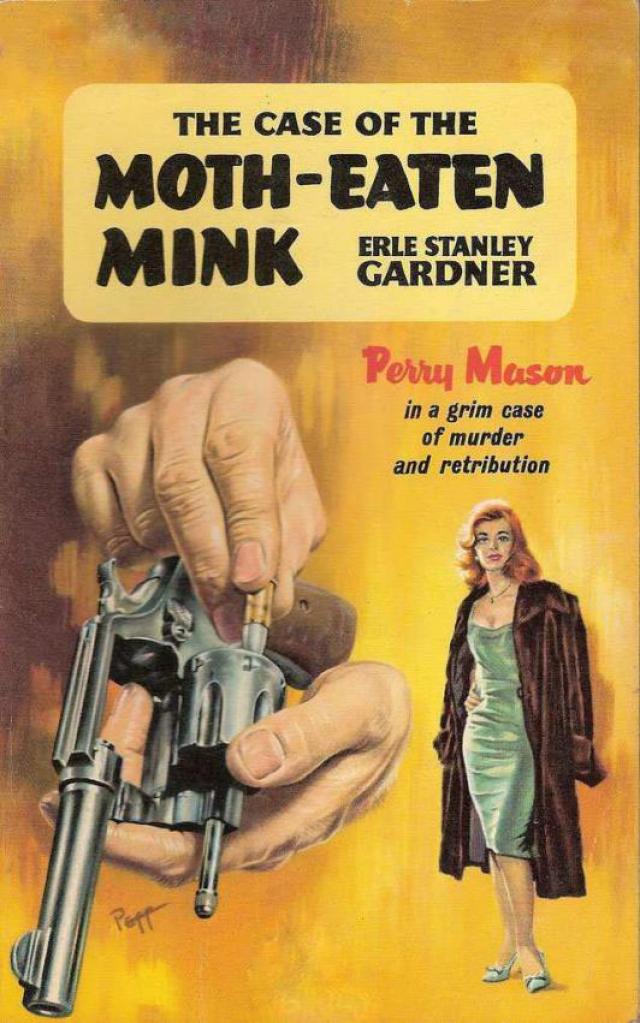
The case of the moth eat.., p.2
The Case of the Moth-Eaten Mink,
p.2


“Coffee?” he asked.
Mason held up two fingers.
Alburg nodded, withdrew, and returned with a big pot of coffee and two cups and saucers, cream and sugar.
For a few minutes he busied himself, seeing that water glasses were filled, that there was plenty of butter. He seemed reluctant to leave. Mason glanced significantly at his secretary.
“I don’t get it,” Mason said. “Taking our order was a fine gesture of hospitality, Morris, but bringing it is gilding the lily.”
“I got troubles,” the proprietor said with a sigh. “I guess we all got troubles. These days nobody wants to work except the boss…. Skip it. You folks came here to forget troubles. Eat.”
The green curtain once more fell back into place.
It was as Mason was finishing the last of his steak that Alburg came back to the doorway.
Della Street said, “Oh-oh, Morris has a problem, Chief.”
Mason glanced up.
“Now ain’t that crazy,” Alburg commented.
“What’s crazy?” Mason asked.
“This waitress I’ve got—nuts, absolutely nuts.”
Della Street, watching him, said jokingly, “I think it’s a legal problem, Chief. Better watch out.”
“You’re damned right it’s a legal problem,” Morris Alburg exploded. “What are you going to do with a girl like that?”
“Like what?” Mason asked.
“She came to work five days ago. Today is the first of the month, so I’m going to pay her. I tell her so. I have the check ready. She looks like she sure needs the money. Then a little while after you two came in, she takes a powder.”
“What do you mean, a powder?” Mason asked.
“She walks out the back door. She doesn’t come back.”
“Perhaps her nose needed powder,” Della Street said.
“Not in the alley,” Morris Alburg said. “She went out through the alley door. She dropped her apron in the alley right after she got through the door, and she traveled. Mind you, no hat, no coat, and you know what it’s like outside, cold.”
“Perhaps she didn’t have a coat,” Della Street said.
“Sure she’s got a coat. She left it in the closet. Once upon a time it was one swanky coat. Now it’s moth-eaten.”
“Moth-eaten?” Perry Mason asked, puzzled. “What sort of a coat?”
“The best.”
“What’s that, Morris?” Della asked.
“Mink—the best—moth-eaten.”
“Go on,” Mason invited. “Get it off your chest, Morris.”
“Me,” Morris Alburg said, “I don’t like it. That girl, I’ll betcha, is wanted by the police.”
“What makes you think so?”
“The dishwasher watched her out of the alley window. She dropped the apron to the ground and then she started running. She ran like hell…. All right, here I am with her check for five days’ wages, her fur coat, a restaurant full of customers, and some of them mad like crazy. I thought she was waiting on some of the tables, and everything was all right. Then I heard the bell start to ring—you hear that bell ring, ring, ring?”
Della Street nodded.
“That bell,” Alburg said, “is what the cook rings when an order is ready to go on the table. He’s got stuff stacked out there for orders that this Dixie girl took and didn’t do anything about. I thought she was waiting on the table. She’s gone. So what? The food gets cold, the customers get sore, and this girl runs like an antelope down the alley. What kind of mess is that?”
“So what did you do?” Mason asked.
“I made each of the other girls take an extra table, then I got busy myself,” Alburg said. “But ain’t it something? Five days she works, and then she goes out like a jackrabbit.”
Mason pushed the dishes aside. Despite himself, interest showed in his eyes.
“You told her she had a check coming?”
“I told her. I wanted to give it to her half an hour ago. She was busy. She said she’d pick it up later on.”
“Then she didn’t intend to leave,” Mason said, “not then.”
Alburg shrugged his shoulders.
“So,” Mason went on, “when she left in a rush it must have been that someone came in who frightened her.”
“The police,” Alburg said. “She’s wanted. You must protect me.”
“Any detectives come in?” Mason asked.
“I don’t think so…. She just took a powder.”
Mason said, “I’d like to take a look at the coat, Morris.”
“The coat,” Morris repeated. “That’s what’s bothering me. What am I going to do with the coat? The money—well, that belongs to her. She can come and get it any time. But the coat—suppose it’s valuable? Who’s going to be responsible for it? What am I going to do?”
“Put it in storage someplace,” Mason said. “Let’s take a look at it.”
Alburg nodded, vanished once more.
Della Street said, “She must have seen someone coming in, perhaps a detective—perhaps …”
“Wait a minute,” Mason said. “Let’s not get the cart too far ahead of the horse, Della. We’ll take a look at the coat first.”
Alburg returned, carrying the coat.
Della Street gave an involuntary exclamation. “Oh, what a shame! What a terrible shame!”
It was quite evident, even from the doorway where Alburg held the coat, that it was moth-eaten. The fur had little ragged patches in the front which were plainly visible, places where smooth, glossy sheen became ragged pin points. The damage might not have been so noticeable upon a less expensive fur, but on the mantle of that rich coat, it stood out clearly.
Della Street arose from the table, pounced on the coat, turned it quickly back to look for the label, and said, “Gosh, Chief, it’s a Colton and Colfax guaranteed mink.”
“I suppose she picked it up cheap somewhere,” Alburg said.
“I don’t think so,” Mason told him. “I think a great deal can be done to recondition that fur. I think there are places where new skins could be sewed in…. Yes, look….”
“Why, certainly,” Della Street said. “It’s only moth-eaten in two or three places there in the front. New skins could be put in and the coat would be almost as good as new. No secondhand dealer would have sold a coat like that in that condition. He’d have fixed it up and sold it as a reconditioned coat.”
“The waitress owned this coat?” Mason asked.
“Owned it or stole it,” Alburg said. “Perhaps it’s hot and she didn’t know what to do with it so she left it in a closet for a few weeks, and the moths got into it.”
“Perhaps some boy friend gave it to her and then ducked out so that she got the idea it might have been stolen,” Mason observed thoughtfully. “In any event, it’s a mystery, and I like mysteries, Morris.”
“Well, I don’t,” Morris said.
Mason inspected the coat carefully, paying particular attention to the stitching on the side.
“Think the label’s phony?” Alburg asked.
“The label’s genuine,” Mason said. “It might have been taken from another coat and sewn in this one … Wait a minute, here’s something! This sewing is fresh. The stitches are a little different in color from those other stitches.”
His fingers explored the lining back of the place where he had found the fresh sewing. “There’s something in here, Morris.”
Mason looked at the restaurant proprietor, then hesitated.
“You’re the doctor,” Alburg said.
Mason suddenly became wary. “There are certain peculiar circumstances in connection with this case, Morris.”
“Are you telling me?”
Mason, said, “Let us assume that this coat was originally purchased by this young woman. That means at one time she was quite wealthy, comparatively speaking. Then she must have gone away hurriedly and left the fur coat behind. She wasn’t there to take care of it, there was no one else on whom she wanted to call or on whom she dared to call to take care of it.”
“And then?” Della asked.
“And then,” Mason went on, “after an interval, during which the moths got into the coat, she returned. At that time she was completely down on her luck. She was desperate. She went to the place where the fur coat was located. She put it on. She didn’t have money enough to go and have it restored, or repaired, or whatever you call fixing up a fur coat.”
“She was broke, all right,” Morris Alburg said.
“She came to this restaurant and got a job. She must have been hard up or she wouldn’t have taken that job. Yet when the pay check is all made out and she knows she has only to ask Morris for it, she suddenly gets panic-stricken and runs out, leaving the fur coat behind her, also the check for her wages.”
Morris Alburg’s eyes narrowed. “I get it now,” he said. “You’re putting it together so it’s just plain, like two and two. She’s been in prison. Maybe she poured lead into her boy friend during a quarrel. Maybe she beat the rap, but was afraid to be seen with her fur coat. She …”
“Then why didn’t she store it?” Della Street asked.
“She didn’t want anybody to know she was mixed up in this shooting. It was something that she did, and they never identified her … Wait a minute, she may have been picked up for drunk driving. She gave a phony name and wouldn’t let anybody know who she was. She drew a ninety-day sentence in the can, and she went and served it out—serving under some phony name. Take this name she gave me—Dixie Dayton. That’s phony-sounding right on the face of it…. She’s been in jail.”
Della Street laughed. “With an imagination like that, Morris, you should have been writing stories.”
“With an imagination like I’ve got,” Morris said ruefully, “I can see police walking in that door right now—the trouble I’m in—a crook working here. If she’s wanted they’ll claim I was hiding her…. Okay, so I’ve got friends at headquarters. So what?”
“Keep it up,” Della Street laughed. “You’re certainly dishing it out to yourself, Morris. You’ll be having yourself convicted of murder next—being strapped in the death chair in the gas cham …”
“Don’t!” Morris interposed so sharply that his voice was like the peremptory crack of a pistol. “Not even to joke, don’t say that.”
There was silence for a moment, then Alburg regained his self-control, nodded his head emphatically. “That’s the story,” he said. “At one time she was rich. She got tangled up. Maybe it was marijuana. That’s it. She went to a reefer party, and she was picked up. Six months she got, right in the can. That’s why the fur coat was there in the closet, neglected all the time she was in jail. Then, when she got out, the moths were in it…. ”
“And then,” Mason said, smiling, “when she went in she was wealthy, when she came out she was broke.”
Alburg gave that frowning consideration. “How come?” he asked.
“Don’t ask me,” Mason told him. “It’s your story. I’m just picking flaws. If she was a wealthy society dame who got picked up at a reefer party, and served six months, how does it happen that when she came out she had to get a job as a waitress?”
“Now,” Alburg said, “you’re really asking questions.”
“Tell us about how she left,” Mason invited. “Just what did happen, Morris? We want facts now, no more of your imaginative theories.”
Alburg said, “She simply walked out, just like I told you. I heard the bell ring a couple of times, the bell the cook rings when food is taken off the stove and ready to be picked up. You don’t like to hear that bell ring because it means the waitresses are falling down on the job.”
“How many waitresses?” Mason asked.
“Five waitresses, and I have a man who handles the trade in the booths on this side. He’s been with me a long time. The booth trade is the best because you get the biggest tips.”
“All right, go on, what about the waitress?”
“Well, after I heard the bell ring a couple of times I went back to investigate. There was this stuff on the shelf by the stove—food that was getting cold. I start for the waitresses to bawl them out. Then one of the customers asked me what was taking so long. I asked him who was waiting on him; he tells me what she looked like. I knew it was Dixie. I went around looking for her. She’s nowhere. All the food on the shelf was for Dixie’s tables.
“I sent one of the girls to the powder room. ‘Drag her out,’ I say. ‘Sick or not, drag her out.’ She wasn’t there. Then the dishwasher told me he’d seen her. She went out the back door and ran down the alley.
“Well, you know how things are. When an emergency comes up you have to take care of the customers first, so I started the girls getting the food out to the tables, made them take an extra table apiece, and … well, then I came in here to pass my troubles on to you.”
“Did this waitress make friends with the other girls?”
“Not a friend. She kept her lip buttoned.”
“No friends?”
“Didn’t want to mingle around. The other waitresses thought she was snooty—that and the mink coat.”
“Well,” Mason said, “I gather that …”
A waiter pulled aside the green curtain, tapped Alburg on the shoulder, and said, “Beg your pardon, Boss, but the police are here.”
“Oh-oh,” Alburg said, and glanced helplessly over his shoulder. “Put ’em in one of the booths, Tony. I can’t have people around the restaurant seeing me being questioned by the police…. I knew it all along, Mason, she’s a crook, and …”
“The other booths are all full,” the waiter said.
Alburg groaned.
“Tell them to come on in here,” Mason said.
Alburg’s face lit up. “You won’t mind?”
“We’ve gone this far with it, and we may as well see it through,” Mason said.
Alburg turned to the waiter. “Plain-clothes or uniform?”
“Plain-clothes.”
“Bring ’em in,” Alburg said. “Bring in a couple of extra chairs, Tony. Bring in coffee and cigars, the good cigars—the best.”
The waiter withdrew. Alburg turned to Mason and said, “That’s awfully nice of you, Mr. Mason.”
“Glad to do it,” Mason said. “In fact, I’m curious now. What do you suppose they want?”
“What do they want? What do they want?” Alburg said. “They want that dame, of course, and they want the mink coat. Even if it isn’t hot they’ll take it as evidence. Two weeks from now the cop’s sweetie will be wearing it. What’ll I do with it? I…”
“Here,” Della Street said, “put it over the back of my, chair. They’ll think it’s mine.”
Alburg hastily draped the mink coat over the back of Della Street’s chair. “I wouldn’t want to hold out on them,” he muttered, “but I don’t want them finding that mink coat here. You know how that’d look in the paper. ‘Police find a stolen mink coat in the possession of a waitress at Alburg’s restaurant,’ and everyone immediately thinks it was stolen from a customer. I…”
The curtains were pulled back. The waiter said, “Right in here.”
Two plain-clothes men entered the booth. One of them jerked his finger at Alburg and said, “This is the fellow.”
“Hello,” the other one said.
“Sit down, boys, sit down,” Alburg said. “The booths were all crowded and I was just talking with my friend in here, so he said …”
“That’s Mason, the lawyer,” one of the plain-clothes men said.
“That’s right. That’s right. Perry Mason, the lawyer. Now what seems to be the trouble, boys? What can I do for you?”
Mason said, “Miss Street, my secretary, gentlemen.”
The officers grunted an acknowledgment of the introduction. Neither one offered his name. The smaller of the two men did the talking.
The waiter brought two extra chairs, coffee and cigars.
“Anything else I can get for you?” Alburg asked. “Anything—?”
“This is okay,” the officer who was doing the talking said. “Tell him to bring in a big pot of coffee. I like lots of cream and sugar. My partner drinks it black. Okay, Alburg, what’s the pitch?”
“What pitch?”
“You know, the waitress.”
“What about her?”
“The one that took a powder,” the officer said. “Come on, don’t waste time stalling around. What the hell’s the idea? You in on this?”
“I don’t get it,” Alburg said. “Why should you come to me? She was working here. You fellows spotted her, and she spotted you, so she ran out.”
The officers exchanged glances. The spokesman said, “What do you mean, spotted us?”
“She did, didn’t she?”
“Hell, no.”
“Then why did she leave?” Alburg asked.
“That’s what we came to see you about.”
“Well, then, how did you know she left?”
“Because somebody tried to make her get in a car that was parked down the alley. She wouldn’t do it. The guy had a gun. He took two shots at her. She started to run, got as far as the street, and was hit by a car that was trying to beat the light. The guy who was in the car that struck her wasn’t to blame. The signal light at the corner was green. The man in the other car, who pulled the gun, backed the length of the alley and drove away fast.”
Morris Alburg ran his hand over the top of his head. “Well, I’ll be damned.”
“So we want to know what about her, what happened. She had her purse with her. It shows her name is Dixie Dayton, and she works here. She’s been identified as a waitress who came running out of the alley. We found a waitress’s apron lying in the alley outside the back door. The dishwasher says she took it on the lam. She grabbed her purse as she went by, but didn’t even stop to take off her apron until she got outside…. Now, tell us about her.”
Morris Alburg shook his head. “I just told Mr. Mason all I know about her,” he said. “She came to work. She seemed to need the money. I had her pay check ready. She …”
“What’s her real name?”
“Dixie Dayton—that’s the name she gave me.”
“Sounds phony.”