

The case of the moth eat.., p.15
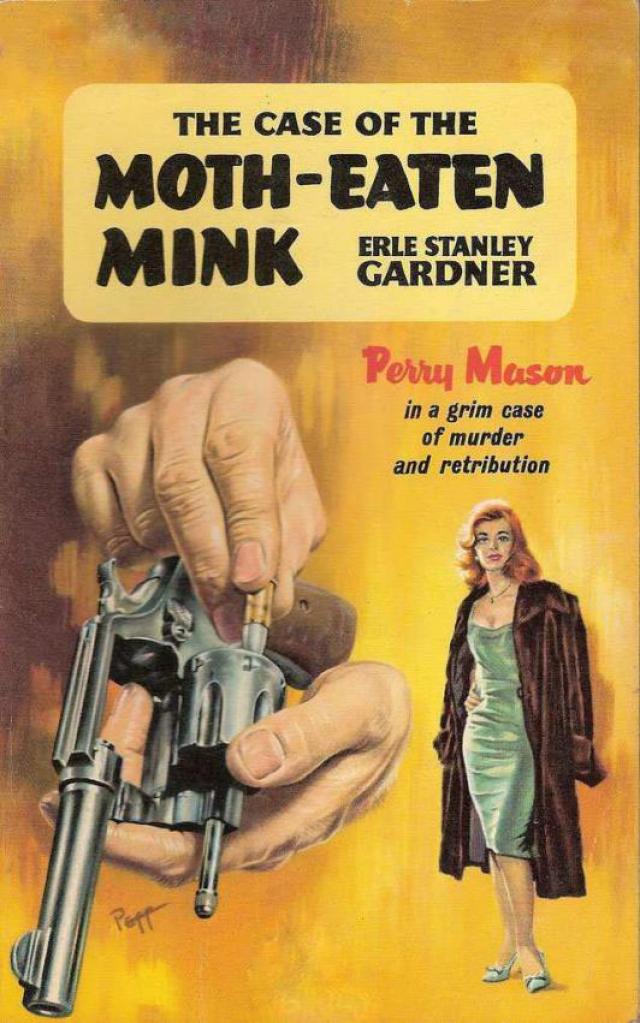
The Case of the Moth-Eaten Mink,
p.15


“Not early, late. Has Paul Drake gone up?”
“About five or ten minutes ago.”
“That’s fine,” Mason said. “Take me up.”
“You must be working on something big,” the janitor said hopefully.
“Could be,” Mason told him, signing the register in the elevator.
When the elevator came to a stop, Mason stopped at the door of the Drake Detective Agency, pushed open the door of the reception room and saw Paul Drake standing, with a rather puzzled expression, looking down at Minerva Hamlin, who was sitting rigidly, her mouth an angry straight line.
Drake looked up and said, “Hello, Perry. I’m not doing so good.”
“Is the purpose of your visit,” Minerva Hamlin asked acidly, “to influence me in my testimony? Am I supposed to commit perjury as part of the routine duties of this office?”
“Wait a minute,” Mason said. “Take it easy. No one wants you to commit perjury.”
“Well, Mr. Drake seems to challenge my identification.”
“Now, wait a minute,” Mason said, “let’s not get off on the wrong track. The identification of the woman who came out of room 721 may be a matter of the greatest importance.”
“I’m not entirely dumb, Mr. Mason. I think I understand that.”
Mason said, “That woman told me that she was Dixie Dayton.”
“Well, she certainly should know who she is.”
“But,” Mason went on, “there were reasons why it might have been to the advantage of certain people to run in a ringer.”
Minerva Hamlin sat in front of the switchboard, coldly erect and determinedly silent.
“Now, then,” Mason went on, “you did a very good job. You stepped in on an emergency in a marvelous manner, and …”
“You may spare the flattery, Mr. Mason.”
“I’m not flattering you. I’m telling you that you got on the job, and did a swell job, but the fact remains that you had to be masquerading as a maid in order to pick up the trail of the woman who came from room 721. You didn’t dare to do anything that would make you look too conspicuous. Your whole plan of operation was to try to look inconspicuous.”
“I will agree with you that far.”
“So,” Mason said, “you weren’t in a position to stare at the woman who came out of the room.”
“I didn’t have to stare.”
“You followed her down the corridor.”
“That’s right.”
“You must have had only a momentary glimpse of her face.”
“I saw her face.”
“But it was necessarily a momentary glimpse.”
“Mr. Mason, are you trying to make me out a fool or a liar, or both?”
“I’m simply pointing out certain obvious facts,” Mason said. “Therefore it’s difficult for you to make an identification of that face from a photograph. If you saw the person herself it might be different, but …”
“I am quite certain that the woman whose photograph I saw was the woman who left room 721. Moreover, she went directly to room 815 and took a key from her purse. You have heard the testimony of the night clerk, who is very positive that the woman is the one who rented room 815.”
“That’s just the point,” Mason said. “They had you in a position where they brought a lot of subtle influence to bear on you. They had the clerk identify the photograph as being that of the woman who rented room 815. Therefore it was only natural that you’d assume …”
“I am not that easily influenced, Mr. Mason. I think I able to do my own thinking, and I think I am rather efficient in that thinking. May I say that I don’t like this attempt to make me change my testimony?”
“Good Lord,” Mason said with exasperation, “I’m not trying to make you change your testimony. I’m only trying to point out to you the importance of being certain, and the fact that it was exceedingly difficult for you to have had a good enough look at the face of that woman to make a positive identification.”
“I am quite capable of making my own decisions, Mr. Mason. I am a very determined person, Mr. Mason.”
“Damned if you aren’t!” Mason said, and turned on his heel. “Come on, Paul, we’re going places.”
“Where?”
“I’ll tell you when we get started.”
Drake said, “I have some long-distance calls coming in from the East …”
“Forget them.”
“I gather,” Minerva Hamlin said icily, “that you don’t care to tell me where Mr. Drake can be reached in case those calls come through.”
“I don’t know where he can be reached,” Mason said.
She turned back to the switchboard with an aggressive shrug of her shoulders.
Drake followed Mason out into the corridor.
“Good Lord, what a girl,” Mason said. “Where the hell did you get her, Paul?”
“Through an employment agent. She’s certainly efficient, Perry.”
“She thinks she’s efficient,” Mason said. “She’s a woman who wants to do her own thinking for herself, and then wants to do your thinking for you…. Come on, Paul, we’re going down to Morris Alburg’s.”
“There won’t be anyone there this early in the morning.”
“Forget it,” Mason said. “Della Street is down there checking over the books. If Alburg was responsible for having room 721 wired I think we can find something. I’d like to beat the police to it for once in this case.”
“Of course,” Drake said, “so far you don’t have any positive evidence that the room was wired, and …”
“That’s evidence I’m going after,” Mason said. “Come on, you can ride with me.”
“Why don’t you ride with me, Perry?”
“I can’t take that long. Come on, we’re going places.”
Drake groaned. “At least, Perry, have some decent regard for safety even if you don’t for the speed laws. At this hour of the morning traffic is beginning to pick up and—well, it’s dangerous.”
“I know,” Mason said. “Get in.”
Mason whipped his car out of the parking lot, swung it down the street and gathered speed. Paul Drake, rigidly bracing himself, glanced apprehensively at each intersection as Mason snaked the car through the early morning traffic, and finally braked it to a stop in front of Alburg’s restaurant.
He banged on the door and Della Street opened it.
“Getting anywhere, Della?” he asked.
“We’ve just struck pay dirt, Chief,” she said. “A check for a hundred and twenty-five dollars was made a year and a half ago to an Arthur Leroy Fulda, who is listed as a private detec …”
“Know him?” Mason asked, turning to Paul Drake.
“Sure, I know him,” Drake said.
“What sort of a fellow is he?”
“All right. I think he’s on the square. He’s—Gosh, Perry, I bet that’s it, all right.”
“What is?”
“Fulda just recently put in a line of ultramodern sound equipment. He was telling me about it. Some of this latest automatic stuff, too.”
“Where does he live?” Mason asked.
Drake said, “His office is …”
“Where does he live?”
“I’ve checked the telephone directory,” Della Street said, “and he has an address on East Colter Avenue—1325. I don’t know whether it’s an apartment house or …”
“East Colter,” Mason said musingly. “That probably will be a residence…. Telephone his office, Della, just to make certain he isn’t there and— No, he won’t be. He’ll be at home if the police haven’t picked him up as a witness, and, of course, we have no way of knowing that until we can get out there. Come on, Paul, let’s go.”
“Do you want me to wait here?” Della Street asked.
Mason shook his head. “That’s the information we want. Close up the place, send the cashier home, turn out the lights, and forget about the whole thing, Della. Take the cashier out for a cup of coffee and some ham and eggs if she wants them. Get her to keep her mouth shut.”
“She’s a good girl. I think she will. She …”
“Okay,” Mason said, “we’re going out to round up Fulda. Thanks a lot, Della.”
“I hope he’s the one you want, Chief.”
“He has to be,” Mason said. “The whole thing checks in. Get the books back in the safe and close the place up, Della. The police may be around here before too very long. Come on, Paul, let’s go.”
Chapter 12
Traffic signals on the through boulevard changed from the static amber warning signals to synchronized stop-and-go lights when they were half a mile from East Colter Avenue. Mason slowed down in order to ease his way through the signals, then turned on East Colter Avenue and found the number.
“Doesn’t look as though anyone’s up,” Drake said.
Mason parked the car at the curb, ran up the steps to press the front doorbell.
After he had rung for the third time, slippered feet sounded in the corridor, and a sleepy-eyed man in dressing gown, pajamas and slippers, opened the door and blinked at his visitors.
“What’s the trouble?” he asked.
Paul Drake said, “You know me. Fulda. I’ve met you a couple of times and …”
“Oh, yes, Mr. Drake. How are you?”
“This is Perry Mason,” Drake introduced.
“I’m very glad to know you, Mr. Mason. You’ll pardon my appearance…. What seems to be the matter? Is there something I can do for you?”
“We want to talk,” Mason told him.
“Now?” he asked.
“Now’s the best we can do,” Mason said. “I’d have preferred an hour ago.”
Fulda raised inquiring eyebrows, started to say something, checked himself, and said, “Come in.”
A woman’s voice called anxiously from a bedroom, “What is it, Arthur?”
“It’s all right, honey,” Fulda said, his voice edged with impatience. “Go back to sleep. Just a couple of men to …”
“What are they?”
“A detective I know and …”
Bare feet hit the floor. There was a shuffling sound, then a moment later a woman, in housecoat and mules, stood in the doorway.
Fulda’s voice held savage rebuke. “I’m sorry it bothered you, honey. Go back to bed.”
She continued to stand there in the doorway.
“My wife,” Fulda said. “This is Mr. Mason and Paul Drake, honey. Paul Drake’s a detective who has an office …”
“Oh, a private detective.”
“Yes,” Fulda said. “Don’t worry. Just go back to bed.”
She hesitated a moment, then smiled, and said, “Make yourself at home. Can I fix you some coffee?”
“You don’t need to get up, honey.”
“No, it’s all right. I’ll fix some coffee. Just a few minutes. Do sit down.”
Fulda pressed a button which turned on a gas furnace, said, “Sit down, gentlemen. I take it this is something urgent?”
“That’s right,” Mason said. “We haven’t got a lot of time.”
“How much time?”
“I don’t know. Tell me all you know about that job at the Keymont Hotel.”
Fulda, who had been lighting a cigarette, paused, and held the match near the end of the cigarette. “The Keymont Hotel?” he asked.
“Room 721,” Mason said. “Come on, make it snappy.”
“I don’t know what the devil you’re talking about, Mr. Mason.”
Mrs. Fulda, who had started for the kitchen, stopped at the swinging door, holding it partially open, waiting and listening.
Mason said, “Don’t be a sap, Fulda. You were in on that job. You wired the rooms. Now I want to know how long you stayed there. I want to know whether you were there personally, or whether you had somebody on the job, or …”
“Good Lord,” Fulda said. “Do you mean to say you two have come barging out here and pulled me out of bed in order to ask me a fool question like this?”
“Exactly.”
Fulda made a show of anger. “Well, I resent that! I have absolutely nothing to say to you gentlemen. If you want to ask me questions about routine business, you can come to the office after nine o’clock. Furthermore, I see no reason for being questioned. Now, since you gentlemen seem to be in a hurry and working on an urgent matter, I’m not going to detain you any further.”
Mason said, “That’s your position?”
“That’s my position.”
“Want to change it?”
“No.”
Mason said, “I think you’re covering up, Fulda. I have an idea you were in on that job. If you were, it’s pretty important that we find out just what …”
“I know you, Mr. Mason, and I know your reputation, and I don’t intend to be browbeaten in my own home. I’ve given you my answer and that’s final. Now, do you gentlemen want to come to my office at nine o’clock?”
“No,” Mason said.
“All right, you don’t have to.”
“We’re going to talk right here.”
“We’ve already talked.”
“Sure we have,” Mason said. “We’ve said about one-half of what we’re going to say.”
“It seems to me I have already expressed myself clearly. I’ve said everything I care to say.”
Mason said, “All right, now I’ll tell you something.”
“You don’t need to tell me a thing, Mr. Mason.”
“I know,” Mason said. “You’re one of these smart fellows, you know it all.”
“Mr. Mason, I resent that.”
“Go right ahead,” Mason said, “resent it. If you were really smart you’d at least listen until you knew what the score was.”
“I know what the score is right now.”
“Like hell you do,” Mason said. “There was a murder committed in the Keymont Hotel.”
Fulda made an elaborate gesture of shrugging his shoulders. “I guess those things happen even in the best of hotels.”
“And the Keymont isn’t the best,” Mason reminded him.
Fulda said nothing.
“The Homicide Squad went into action,” Mason went on. “They found that room 721 had been wired. The wires ran into another room. Presumably there was a lot of high-priced equipment in use; equipment that recorded conversations, automatic stuff that would switch on and off …”
“And simply on the strength of that you come to see me?”
“And,” Mason continued, without apparently noticing the interruption, “Lieutenant Tragg of Homicide is very anxious to find out who had done the wiring.”
“Naturally he would be.”
“Now, Lieutenant Tragg didn’t say anything to me,” Mason said, “but my best guess is that he’s starting to trace this equipment, and that shouldn’t be too hard. I would gather that it’s very modern, very recent, very expensive, and right up to the minute. Whoever bought that equipment probably didn’t pay all cash for it. It’s probably being purchased under contract. There are serial numbers on the machines. Lieutenant Tragg will get those serial numbers. He’ll call up the manufacturers. They’ll refer him to their local agency. The local agency will get out its contract and …
“Oh, my God!” Fulda said, and sat down in the chair as though somebody had knocked the props out from under him.
Mason nodded to Mrs. Fulda. “I think,” he said, “your husband is going to want some of that coffee.”
She continued to stand in the doorway for a moment, then silently glided into the kitchen. The swinging door closed, then, after a moment, was pulled open and left open.
“I’d never thought of the serial numbers,” Fulda said.
“You should have,” Mason told him. “You should have thought of that the first thing.”
“I felt—felt I could— Well, I didn’t realize they’d trace me that ay or that soon.”
“What’s your story?”
“I want time to think.”
“I know,” Mason said, “you came home, got out of your clothes, mussed up your hair a little bit and decided you’d bluff it out. You scared your wife half to death, and you’re pretty badly frightened yourself now. What happened to frighten you?”
“I—I don’t know.”
“All right, let’s find out. Tell us your story and tell it fast. There’s just a chance we can help you.”
“I—I don’t know what to do.”
“Start talking.”
“I specialize in sound equipment—”
“Yes, I know.”
“In recording conversations—blackmail and things of that sort in the criminal field, and recording speeches and depositions, courtroom proceedings and so forth in the noncriminal field.”
“Tell us about the Keymont Hotel,” Mason said.
“Not so long ago,” Fulda said, “I did a job for Morris Alburg. It was—well, it was confidential.”
“It won’t be,” Mason said.
“Well, it is now.”
“By the time the district attorney starts asking questions—”
“That’s different.”
“I’ll read about it in the papers then.”
“All right,” Fulda said, “you’ll read about it in the papers, but until you do, it’s confidential. All I can say is it was a blackmailing job, and it was carried through very successfully.”
“How long ago?”
“A little over a year ago.”
“Then what?”
“So yesterday afternoon Morris Alburg came to me. He wanted me to fix a setup in the Keymont Hotel, and—well, of course, it had to be very confidential and …”
“Go on,” Mason said, “that isn’t what’s worrying you. Tell us what’s worrying you.”
“Well,” Fulda said, “the damn fool told me that he was wanted by the police and that put me in a spot.”
“Did he say what he was wanted for?”
“He said they were looking for him and he was keeping under cover.”
“And you took the job on that basis?”
Fulda nodded morosely.
“All right,” Mason said, “you don’t need to tell the police all the conversation you had with your client. So far as you were concerned it was a routine job. What did you do?”
“I got my sound equipment together, went up to the hotel, told the clerk my sister was coming on an evening plane and I wanted two rooms, preferably adjoining.”















