The case of the moth eat.., p.17
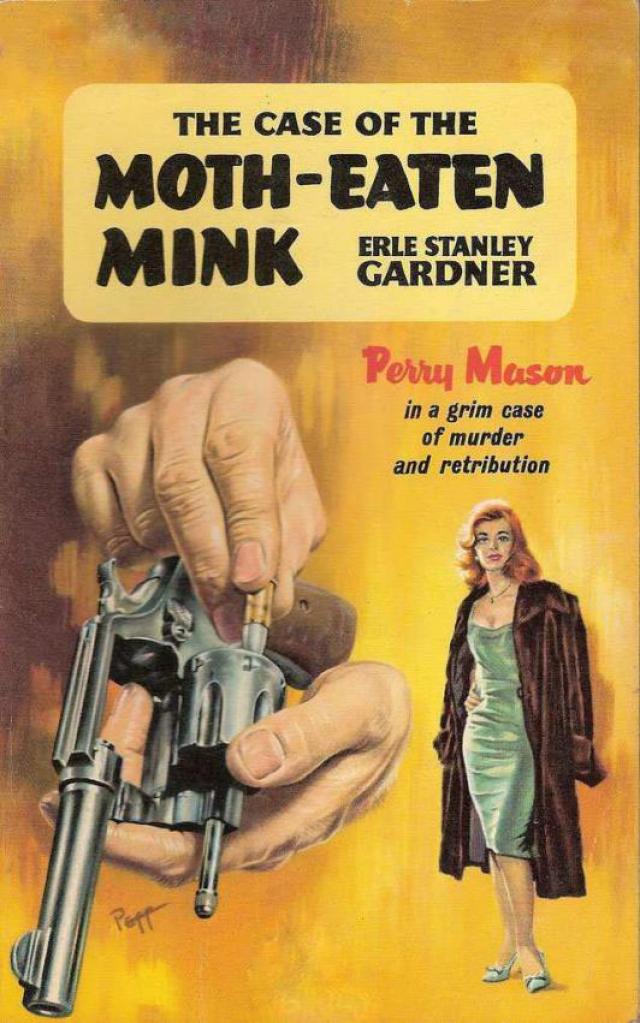
The Case of the Moth-Eaten Mink,
p.17


“Now, Minerva has been working on that stuff, and apparently she’s made some bad boners. For instance, there has been trouble with the files, and probably it goes back to mistakes Minerva made. Then, again, some of those reports are pretty juicy, you know, Perry, and sometimes the fellows, when they happen to be working nights and come in to make a report before they go off duty, will kid along about the cases. The girls usually hand it right back—just the usual good-natured stuff that goes on around an office…. Well, Minerva doesn’t stand for any of that. She’s Madam Queen as far as the operatives are concerned. She’s all efficiency and ice water.”
Mason said, “I suppose in the long run a girl gets so damn tired of hearing some of those near-smutty stories over and over and over again….”
“Oh, I know,” Drake said, “but a girl who’s really human will manage to laugh as though it’s a new joke—just so things don’t go too far…. What the heck, Perry, you know what I’m trying to tell you. We may have some trouble with this girl. It bothers me that she didn’t call me to tip me off.”
“What did you ring her up for?” Mason asked.
“I made up my mind I was going to fire her,” Drake said.
“For heaven’s sake, don’t do that. Not right now, anyway.”
“Why not?”
“It will look as though we’re taking it out on her because she made that identification of the photograph. That would antagonize a jury.”
“Of course,” Paul Drake pointed out, “the girl could really have been Dixie.”
“Yes,” Mason admitted dubiously. “She could have been.”
The telephone rang sharply.
“See who it is,” Mason said.
Della Street picked up the telephone, answered, said “Yes, Gertie…. Why, what … Just a moment.”
She motioned to Perry Mason with excitement. “Morris Alburg on the line.”
“Well, thank heavens,” Mason said. “It’s about time that boy made a report.”
Mason picked up the telephone, said, “Hello, Morris. What the devil is all this about and where are you?”
“I’m in jail,” Morris Alburg said.
“What?”
“In jail.”
“The devil you are! How long have you been there?”
“Since nine o’clock this morning.”
“Oh-oh,” Mason said, and then added, “Why didn’t you telephone me?”
“They wouldn’t let me.”
“Did you tell them you wanted to talk with your lawyer?”
“I told them everything. I haven’t been in this jail very long. They’ve been shunting me around, keeping me traveling in an automobile, taking me from one precinct to another …”
“You’re down at—?”
“That’s right. I’m at the Central Precinct now.”
“I’ll be there,” Mason said.
Mason hung up the telephone, dashed over to the closet and grabbed his hat.
“What is it?” Drake asked, as Mason made for the door.
“Same old run-around,” Mason said. “They’ve had Morris Alburg since nine o’clock this morning and they’ve been keeping him buried. Just now they’re letting him call his attorney. That means they’ve squeezed everything out of him they can possibly get…. Stick around, Paul, so I can get you if I need you. I’ll be wanting you, and don’t fire Minerva—not yet.”
Chapter 14
“All right,” Mason said, as he settled himself in the straight-backed chair in the visitors’ room, “tell me what happened.”
Alburg put his head in his hands. “Honestly, Mr. Mason, I’m in a mess, one hell of a mess…. You got my letter with the check?”
“Yes, I got your letter with the check,” Mason said, “and I knew just as much when I finished reading it as I knew before. How did you get picked up?”
“I was on my way up to your office.”
“My office?”
“That’s right.”
“What happened?”
“I get to the entrance of your building. A plain-clothes man jumps out of the crowd. He grabs me. They shove me into an automobile. I’m away from there before I even have a chance to know what’s going on.”
Mason said angrily, “Why didn’t you stop someplace and telephone me? I’d have told you to keep away from the office. You might have known they’d have a man planted there. That and your restaurant were the first places they’d look…. Now, what happened? Go on, tell me the story.”
“The worst part you haven’t even heard yet.”
“All right,” Mason said, “give me the worst part.”
“I had the gun.”
“The gun?”
“That’s right.”
“What gun?”
“The gun the police say killed Fayette.”
Mason regarded him with frowning disapproval.
“It’s not what you think, Mr. Mason. It’s a long story and …”
“Well, tell it and make it short,” Mason said. “What’s Dixie Dayton to you?”
“She’s sort of related by marriage.”
“How come?”
“Thomas E. Sedgwick is my half-brother. Does that mean anything to you?”
“That means a lot,” Mason said.
“Sedgwick was making book. He was one of these smart boys. I warned him. He was in love with Dixie Dayton. She warned him. We kept trying to straighten that boy out. It’s no use.
“He thought he was smart. Sure, there was a payoff. So what? He thought he had a license. You don’t get a license from a payoff. You get trouble. You get money for a while, sure. Then you get trouble.
“All right. Tom gets trouble. He won’t listen. A new cop gets on the job. He gets a tip on Tom. He don’t make a pinch. Tom could square a pinch. He wants to get Tom so he can maybe prove a payoff. That’s hell.”
“Claremont had the goods?”
“On Tom I guess, yes.”
“On the payoff, I mean.”
“On the payoff he has suspicion only. That’s why he wants Tom. He wants it Tom should squeal, should sing to a grand jury. What a mess! Tom don’t get it at first. This cop gets the goods. He has Tom dead to rights. And he don’t do a thing. Tom thought he wanted a cut. He don’t want no cut. He wants Tom should squeal.
“Tom is dumb. Like I tell you, Mr. Mason, that boy thinks a payoff is a license. But the payoff ain’t dumb. He gets the tip. He tells Tom to sell out, to get out until things blow over. This cop is smart. He’s traced the payoff.”
“Who was the payoff?”
“Fayette. He’s the first step.”
“What happened?”
“Tom, he can’t stand any subpoena. You know what happens if he gets a subpoena to the grand jury. Tom sells out. He takes it on the lam.”
“Then what?”
“They say this cop was smart. He was watching for Tom to do that. Once Tom pulled that sell-out-and-run stuff, the cop had him. They say Tom bumped him off. I don’t know. Tom swears he didn’t. Dixie believes in him.”
“Oh, yes?” Mason said. “And how did Dixie explain to you the fact that Tom had Claremont’s service revolver among his cherished possessions?”
Alburg jumped up as though his chair had been wired. “Had what?” he shouted.
“Pipe down,” Mason said. “She had Claremont’s gun.”
Alburg put his head in his hands. “That does it! Now we’re in a jam right. Then Tom did kill him.”
“It sure looks like it,” Mason said.
“Oh, what a mess! And what the hell, I’m in it right with Tom and Dixie.”
“Damned if you aren’t,” Mason said. “And you might as well include me while you’re taking inventory.”
“Oh, what a mess!” Morris said.
“Never mind feeling sorry for yourself now, Morris. There isn’t time for that. How about Fayette? Did you kill him?”
“No, no, of course not. Me, I don’t kill anyone!”
“You say the police found the gun on you?”
“Yes.”
“How do you know that was the gun that killed Fayette?”
“The police said so.”
“When?”
“About fifteen minutes ago. That’s why I’m here. They wanted a ballistics test. When they got it, they booked me and then let me call you.”
“How long have you had that gun?”
“That’s just it. I only had it—since the shooting.”
“Tell me the whole story.”
“Where do I start?” Alburg asked.
“Start at the beginning, and be sure it is the beginning.”
“I’ve already told you about Tom Sedgwick …”
“Never mind him. Tell me about Dixie, all about her.”
“Tom and Dixie …”
“Are they married?”
“That’s one of those things, Mr. Mason. Tom had been married. There was difficulty over the divorce. You can’t blame him and Dixie …”
Mason said, “Don’t be a fool. The last thing I’m interested in right now is their morals. If they’re married they can’t testify one against the other. If they’re not—”
“They’re not.”
“All right then, tell me about Dixie; about when she came back.”
“Well, I haven’t heard anything from Tom or Dixie. I’m scared stiff I will! A cop killing, Mr. Mason! You know what that is. Then all of a sudden Dixie walks into the place. I have to grab a table. My knees go no good. She gives me a cold eye as a tip-off that I am to treat her as a stranger. Then she says she wants a job.”
“What did you do?”
“I gave her a job. I had to. Tom was broke and sick. He’s hot. The police didn’t know about Dixie.”
“Dixie Dayton’s not her real name?”
“Dixie, yes, her first name. The other, no, of course not.”
“And her Social Security number was faked?”
“Yes.”
“What about the fur coat?”
“I am terribly sorry about that. She leaves that with me, and I wrap it up and store it in a closet. I don’t think about moths. I think about me. She is hot and I am scared. I keep it back out of the way where no one can see it. She comes back. She wants her coat. I bring it out…. Well. You saw it.”
“What did she say?”
“She says nothing. She starts wearing it. She cries like hell when she thinks I don’t see her.”
“Why did she come back here?”
“I tell you, Tom has the T.B. They are up in Seattle. In the winter it rains and it’s cold. Tom could take it no more. Dixie says they had to come back. They might beat the rap here, but he’d have died sure like hell if he’d stayed up there. Dixie has ideas. When she gets one you can’t talk her out of it. My doctor tells me Seattle is damp in winter but people up there live long as hell. Dixie thinks Tom dies if he stays another winter. Maybe she’s right. Maybe she’s wrong. She think she’s right. I don’t know.
“Dixie thinks everything is fixed, she can come back, no one knows. Tom she has hid—but good. Dixie’s smart as hell, one smart woman—the best!”
“She wasn’t clever enough to keep from having …”
“Oh, sure, Fayette. He knew about Dixie. The police didn’t. Fayette must have kept a watch on my place—the police, no—Fayette, yes.”
“Just who is Fayette?” Mason asked.
“Fayette,” Alburg said, “handled the payoff. I don’t know him from a lamp post. The name I know, nothing else. Dixie comes out to wait on customers. She sees him sitting there at a table by himself. She damn near falls over…. Fayette would kill. He’d told Tom if Tom ever come back, or ever got a subpoena for a grand jury, it’s curtains, and …”
“So Dixie ran out the back.”
Alburg nodded. “Sure. She thought they’d torture her to make her tell where Tom was.”
“I’m damned if I get it,” Mason said. “If there was a payoff there must have been hundreds of bookies paying off, and …”
“But there’s only one cop murder, Mr. Mason. I can’t prove nothing. Dixie can’t prove nothing. But we both think Fayette kills that cop. If Tom comes back and maybe gets a good lawyer…. What the hell?”
“All right,” Mason said, “go on and tell me what happened.”
“What happened?” Alburg exclaimed. “Everything happened. First, I am sitting pretty, then the roof caves in. Dixie says no one knows Tom is back. No one is ever going to find where he is. Then they walk in on her. She runs out; she almost gets killed. The cops come in. The cops don’t know Tom is my half-brother, but they know there is something. They don’t know who Dixie is, but they’re going to find out. I start getting under cover. There’s a bar where I have a friend. He’d protect me every time. Dixie knows that place. She calls me up. I tell her to stay under cover. I’m under cover. It’s hell.”
“Go on,” Mason said.
“Then some woman calls the place. She tells the cashier, who I can trust, that she has to get a message to me. The cashier is smart. She says give her the message. So the girl tells her to have me call a certain number and ask for Mildred.”
“You did?”
“Sure. I go to a pay station. I call the number. I say, ‘Who the hell’s Mildred?’ ”
“And what happened?”
“I’m thinking it’s a trap. Maybe cops are coming in the door. I am at a pay station where I can get out quick.”
“Go ahead.”
“This girl Mildred, she wants to talk. I tell her forget it. I’ve got no time to talk. Quick, what do we do?
“She says, ‘Don’t be a dumbbell. You’re hot. Dixie’s hot. I know who killed the cop.’
“I think it’s a trap. I say, ‘Yes. You are smart. Who killed the cop?’ She says, ‘George Fayette.’ I ask her how she knows. What’s it to her? She says Fayette sold her out. He two-times with another woman. She won’t stand for it. To hell with Fayette. If I meet her at the Keymont Hotel she tells me the story. She gives me the evidence. What the hell would you do?”
“What would I have done?” Mason said. “I’d have telephoned my lawyer quick.”
“Not that quick,” Alburg said. “I have been at the phone long enough. I don’t want them to trace the call. I say, ‘All right. You stay at that number. I’ll call you back.’ So what do I do? A while ago a waitress tries to blackmail me. I get a smart detective. He gets the whole proposition on tape recording. That waitress she is out of luck quick, like that. So I say to myself, ‘I will be smart. I will get a sound recording. I will get Mr. Mason.’ ”
Mason frowned. “Suppose it had been a police trap?”
“What the hell? I have to take a chance. I’m hot. I can’t go back to my restaurant. The restaurant is my business. If I don’t go back I lose my business. I have to do something. One thing else you don’t know. That Dixie can take a look at a number and flash, like that, it’s in her mind. When Dixie works for me I never need a telephone book. I show her a number once. She remembers it. Always for numbers that girl is smart. Anything with figures.”
“Go ahead,” Mason said.
“When she runs out the back door of the restaurant, running from Fayette, she sees the car come. It’s coming toward her. She looks at the car. She sees the number on the front license plate. Then there is a man with a gun. She runs and he shoots, but she remembers the license number.”
“Go ahead,” Mason said.
“She tells it to me. I am smart; I have connections. I look it up. It is a car registered to Herbert Granton. Dixie remembers Granton is a name Fayette uses sometimes when he is being respectable. All right, we have an ace in the hole. Maybe a smart lawyer can do us some good if he finds that automobile and it has a bullet hole.”
“Go ahead,” Mason said.
“So I get the detective to go first to the Keymont Hotel. He sizes the place up. He gets the room all wired. He says he will be where he can listen. Everything is fixed. I wait until after midnight, then I ring this girl. I tell her, ‘All right, Mildred, you come to the Keymont. Room 721.’ ”
“The girl had first told you about the Keymont Hotel?”
“That’s right.”
“Weren’t you suspicious about going there?”
“Sure, I’m suspicious, but what are you going to do? I told her, ‘Not the Keymont. Someplace else.’ She said, ‘No, I am hot. Fayette will kill me. If he thinks I would give him a double-cross we would be rubbed out. I am at the Keymont and I don’t dare to go out. You get a room in the Keymont. You tell me where that room is. I will come to you. I will give you evidence.’ So I get this room 815. I get it for Dixie. I register her as Mrs. Madison Kerby and I pay in cash.”
“Now I begin to get the picture,” Mason said, “but why … Well, never mind. Tell me what happened.”
“So, I call you. I get you. I have the room wired. I make a date with the girl. We go to the room.”
“Did you have a gun?” Mason asked.
“Sure I had a gun. What the hell?”
“All right, go ahead.”
“I want you there all the time. If it is the police, you can be the smart lawyer. If it is a witness and she really has evidence, you can sew the thing up.”
“What happened?” Mason asked.
“I am worried. All the time I worry. The older I get the more I worry. I think about this; I think about that. Always I am worried. Too many taxes. Too many responsibilities. Too much labor trouble. Costs of running the business too high. Worry, worry, worry. All the time worry.”
“Go ahead.”
“So I am worried you get my call and go back to sleep. That would be the bad thing. After we are in the Keymont, I tell Dixie to call that number where we get you. Be sure Mr. Mason don’t go to sleep.”
“You gave Dixie the number?”
“Sure Dixie has the number. She was with me. I tell you she remembers numbers like a flash.”
“Go ahead.”
“So Dixie is at the telephone. She just gets the night clerk. She is ready to give the number when the door opens. Two men and a woman walk in and I know the minute I look I am licked. I reach for my gun. Dixie is smart. She says on the telephone, ‘Call the police.’ That’s to the clerk.”