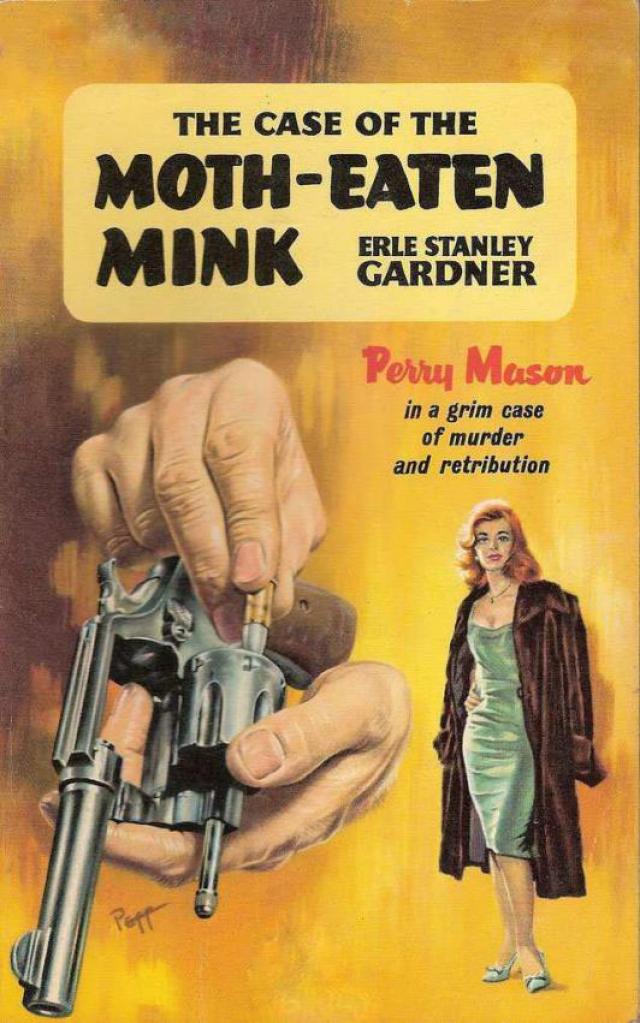
The case of the moth eat.., p.4
The Case of the Moth-Eaten Mink,
p.4


“Sit down,” Mason invited, “and tell me about it.”
“Well,” Della Street said, crestfallen, “I guess I’m one heck of a detective.”
“What happened, Della?”
“He went out to the street, started walking down the sidewalk, suddenly hailed a cruising taxicab and jumped in.
“I pretended to show no interest until he had got well under way, but I got the cab’s number. Then I ran out and desperately tried to flag down a taxi.”
“Any luck?”
“None whatever. You see, he had walked for about half a block and picked up a cruising taxi. He had all the luck. Of course, he timed it so that he would.”
Mason nodded.
“When I tried it, the luck was all bad. Some people came out of the restaurant and wanted a cab, and the doorman ran out with his whistle. Naturally the next cruising cab passed me up in order to do a favor to the doorman. Your car was in the parking lot.”
“Did you lose him?” Mason asked.
“Wait a minute,” she said, “you haven’t heard anything yet. I ran to the corner so I’d have a chance on cabs going in two directions. I waited and waited, and finally a cab came down the cross street. I flagged it and jumped in.
“I told the driver, ‘A cab just went down Eighth Street and turned right at the corner. I want to try and catch it. I don’t know where it went after it turned right, but give this bus everything you have and let’s keep going straight on Eighth Street in the hope we can overtake him.’
“The cab driver gave it the gun. We went tearing down the street, slued to the right at the corner, took off up the cross street, and the cab driver said to me, ‘Do you know this cab when you see it?’ and I said, ‘I got a look at the number. It’s 863.’”
“Then what happened?” Mason asked, as Della Street stopped talking.
Della Street made a little gesture of disgust. “I was in cab 863.”
“What?” Mason exclaimed.
“That’s right. What that man had done was to pick up the taxicab, go to the corner, turn the corner, go about two-thirds of a block, pay off the cab and get in his own car that had been parked there at the curb all the time.”
“Oh-oh,” Mason said, “then he must have known you were following him.”
“I don’t think he did, Chief. I think it was just a blanket precaution he was taking to make certain that he wouldn’t be followed. Of course, when he got in the cab he was able to watch the street behind him. That’s why he walked in the opposite direction from that in which he wanted to go. In that way he was able to make certain that anyone who was following him would have had to follow by car.”
Mason chuckled. “At least we have to hand it to him for being clever, and the fact that you tried to follow the cab you were already in gives it an interesting, artistic touch.”
“I hate to have him make a monkey out of me,” Della Street said.
“He didn’t necessarily make a monkey out of you,” Mason said. “He made one out of himself.”
“How come?”
Mason said, “This waitress ran out because she was frightened by someone or of someone. We had no way of knowing what it was that frightened her, or who the person was who frightened her. Now we know.”
“You mean he’s given himself away?”
“Sure. The fact that he resorted to all that subterfuge proves that he’s the man we want.”
Mason stepped to the door of the booth and motioned to Morris Alburg.
“How many of your customers are regulars, Morris? What percentage?”
“Quite a few repeats.”
Mason said, “Now, as I gather, a man and a woman, or a foursome, might straggle in here on the prowl. They’d either have heard the place recommended or they might have been just looking for someplace to eat, and came on in.”
“That’s right.”
“On the other hand,” Mason went on, “a lone diner, a man who came in here and ate by himself, would be pretty apt to be a regular customer.”
“Yes, I’d say so.”
“I wonder if you could tell me the name of that chunky man with the rather heavy eyebrows, who sat over at that table right over there, the one that’s vacant now.”
“Oh, him? I noticed him,” Alburg said hastily. “I can’t tell you; I don’t know. I don’t think he ate here before.”
“Take a good look at him?”
“Not so much. Not his face. I look at the way he acts. You have to be careful about a man by himself: maybe he tries to make a pick-up and gets in bad. If he don’t make trouble we do nothing; if he’s drinking, if he paws women, we do something. That’s why we watch single men. This one I watch—he minds his own business. I wish the police would mind theirs.”
Mason nodded.
“Why did you ask?” Alburg asked suddenly.
“I was just wondering,” Mason said, “just trying to figure out who he was.”
“Why?”
“I thought I’d seen him someplace.”
Morris Alburg studied Mason’s face for a few seconds. “The hell of it is,” he said solemnly, “you and me try to fool each other. We don’t either one get to first base. We both of us know too damn much about human nature. It is what you call no percentage…. Good night.”
Chapter 2
Mason stopped at a public telephone within a block of Morris Alburg’s restaurant and rang Lieutenant Tragg on the Homicide Squad.
“Perry Mason, Lieutenant. Would you do something for me?”
“Hell, no,” Tragg said.
“Why not?”
“Because it’d get me in trouble.”
“You don’t even know what it is yet.”
“The devil I don’t. If it wasn’t something that was so hot you didn’t dare to touch it with a ten-foot pole, you’d never call on …”
“Now wait a minute,” Mason said. “Keep your shirt on. This is doing a good turn for a girl, a girl who was struck by a motorist who probably wasn’t to blame. The girl was running from a man who was trying to make her get into the car with him. Some witnesses say he had a gun, and …”
“That the one out by Alburg’s restaurant?”
“That’s the one.”
“What’s she to you?”
“Probably nothing,” Mason said, “but I have a feeling that girl may be in danger. Now here’s what I want. She’s probably at the Receiving Hospital. I don’t know how serious her injuries are, but I’m willing to pay for a private room and special nurses.”
“The hell you are.”
“That’s right.”
“Why all the philanthropy?”
“I’m trying to give the girl a break.”
“Why?”
“Because I have a feeling that if she goes into a ward in a general hospital she’ll get herself killed.”
“Oh, come now, Mason. Once a patient gets in a hospi …”
“I know,” Mason interrupted, “it’s purely a screwy notion on my part. I’m dumb. I have a distorted idea of what goes on. I’ve seen too many contracts lead to lawsuits. I’ve seen too many marriages terminate in divorce courts. I’ve seen too many differences of opinion that have resulted in murder…. A lawyer never gets to hear the details of a normal, happy marriage. He never gets to see a contract that terminates without a difference of opinion, and with both sides absolutely satisfied. So what? He becomes a cynic…. Now, the question is, will you help me see that this girl is taken out of the Receiving Hospital and placed in a room where no one, absolutely no one, except an attending physician, knows where she’s located?”
“What else?” Tragg asked.
“That’s all.”
“Why?”
“Because I feel uneasy about her.”
“You know who she is?”
“I’ve never seen her in my life. That is, not to recognize her. I may have had a brief glimpse of her when I entered Morris Alburg’s restaurant. I just happened to be there when the thing happened.”
“She’s not your client? You don’t have any interest in her?”
“None whatever. I did tell Morris Alburg that I’d take care of any matters pertaining to her affairs that might come up, and told him to refer anyone to me who …”
“Okay,” Tragg said. “It’s a deal. I’ll handle it privately and send the bill to you.”
“Thanks,” Mason told him, and hung up.
Back in Mason’s car, the lawyer said, “Now, Della, if I can get you out of that mink coat long enough, I want to explore the place where there was fresh sewing in the lining. I felt there was something under there.”
“I’m certain it’s just a little padding.” Della Street laughed. “Tailors sometimes have to help out a girl’s figure.”
“This didn’t feel like figure help to me,” Mason told her. “Out of that coat, girl, and let’s have at the Morris Alburg mink-coat mystery.”
She wriggled out of the coat.
Mason parked the car, turned on the dome light, and with his penknife clipped away at the stitches in the coat, opening up a fold in the lining of the garment.
Mason inserted his index and second finger in its opening and scissored out a small piece of pasteboard.
“Now what in the world is that?” Della Street asked.
“That,” Mason said, “seems to be a pawn ticket on a Seattle pawn shop, pledge number 6384-J, which can be redeemed at any time within ninety days on paying the amount of an eighteen-dollar loan, a handling charge, a storage charge and one percent per month interest.”
“How dreadfully unexciting,” Della Street said. “The poor girl had to hock her family jewels to get out of Seattle and she chose that method of making certain she didn’t lose the pawn ticket.”
Mason said, “Eighteen dollars’ worth of jewels, Della? You wrong the family. We’ll drive up to the Drake Detective Agency, and ask Paul Drake for the name of his Seattle correspondent. We’ll rush the ticket up there by air mail and redeem the pawned article. That will at least give us eighteen dollars’ worth of something and a few hundred dollars’ worth of information. Then we can sell the article even if we can’t sell the information.”
“Suppose the information turns out to be something you don’t want?” Della Street asked.
“Then I’m stuck with it,” Mason said, “but by that time we’ll know a lot more about Morris Alburg.”
Chapter 3
It was around nine-thirty when Perry Mason unlocked the hall door to his private office, and found Della Street arranging piles of freshly opened mail on his desk.
“Hi, Della, what’s new?” Mason asked, crossing over to the hat closet and placing his hat on the shelf.
“Morris Alburg telephoned.”
“What did he want?”
“An insurance agent wanted to see the waitress.”
“You mean Dixie?”
“That’s right. He represents the company that carried insurance on the car that hit Dixie as she ran out of the alley.”
“Fast work,” Mason said. “Too fast.”
“What do you mean by that?”
“They want to rush through a settlement, getting proper releases, and … No, they don’t either.”
“It would certainly look like it.”
Mason paused, standing by the corner of his desk. He ran the tips of his fingers over his clean-shaven jaw, frowned down at the papers on the desk without seeming to see them, and said, “That’s a new one.”
“I don’t get it. I thought insurance companies always did that.”
“They used to,” Mason said. “Some of them still do, but for the most part insurance companies are pretty ethical now. If there’s a claim against them they want to see that a reasonable and fair compensation is paid.
“But here’s a case where a girl runs out of the back door of a restaurant and into an alley, dashes right in front of an oncoming car, which, of course, hit her.”
Della Street said, “I still don’t see what you’re getting at.”
“Simply this,” Mason said. “The driver of the car that hit her couldn’t have been negligent unless there’s something we don’t know anything about. He was driving his car along the road, apparently going at a reasonable rate of speed. He was probably intent on making the traffic signal at the corner, but he had the right to expect that everyone on the street would be using it in a safe and prudent manner. All of a sudden this girl darts out from the curb, running in blind terror, and jumps right in front of him.”
“Perhaps he had been drinking.”
“The records indicate that he stopped his car almost at once. There’s nothing to show that he had been drinking, yet within a few hours here comes a man from the insurance company wanting a settlement…. What did Morris Alburg tell him?”
“Told him to come up and see you, that you were taking care of everything pertaining to Dixie Dayton’s affairs.”
Mason laughed and said, “I’ll bet that answer gave the fellow something to think of.”
“You don’t think he’ll come up here?”
Mason laughed and said. “I hardly think he wants to deal with an attorney. He—Wait a minute, Della. There’s just a chance that this is simply an attempt to find out where the girl is. That man may be simply—Did he give Morris Alburg a name?”
Della Street nodded. “George Fayette.”
“How long ago did Morris call?”
“A little after nine.”
The phone on Della Street’s desk gave a jingle. Della Street picked up the receiver, said, “Yes, hello, Gertie…. Who is it? … Just a moment.”
She cupped her hand over the transmitter and said to Mason, “He’s here.”
“Who?”
“George Fayette.”
Mason grinned. “Go on out and bring him in, Della. Let’s not let him have a change of heart and get away. I want to see what he looks like, and I want to ask him a few questions.”
Della said into the telephone, “I’ll be right out, Gertie,” and hung up.
Mason settled himself in the chair behind his desk, and Della Street walked out to the reception room to escort George Fayette into Mason’s private office.
A moment later she was back alone.
“What happened?” Mason asked sharply. “Did he leave?”
Della Street carefully closed the door, said, “Chief, it’s the same one.”
“What do you mean?”
“The man I was trying to follow last night, the man who sat alone at the table….”
“You mean he’s out there now, supposed to be representing an insurance company that carried insurance on the car that hit Dixie Dayton?”
“That’s right.”
Mason grabbed the telephone. “Get the Drake Detective Agency on the line right away, Gertie. Get Paul Drake if you can. Tell Mr. Fayette I’ll see him in just a minute. Don’t let him hear you. Tell him I’m on a long-distance call.”
Mason looked at his wrist watch. “Telephoning may be a waste of time, Della. Paul’s office is just down the corridor. Perhaps you’d better go and …”
“Wait a minute…. Gertie says Paul’s on the line.”
Mason said, “Hello, Paul, Perry Mason.”
“Well, well, well, how are you …”
“Hold it, Paul, this is a rush job.”
“What is it?”
“There’s a man in my office. He has given his name as George Fayette. I don’t know whether that’s his real name or not. I doubt very much if it is. I want that man shadowed. I want to know who he is, I want to know where he goes, I want to know what he does.”
“Okay, how much time do I have?”
Mason said, “I’ll stall him along as much as possible, but I have an idea that five or ten minutes is all I can count on. Now, Paul, he’s about thirty-five years old, he’s about five feet seven inches tall, but he must weigh pretty close to a hundred and eighty-five. He’s dark and has bushy eyebrows—and he may fool you. He’ll seem to be completely engrossed in his own affairs, and yet he’ll be wary as the devil.”
“I know the type,” Drake said. “We’ll handle him.”
“I’m very much interested in getting the license number of his automobile,” Mason said, “and finding out who he is, all of that stuff.”
“Okay. You think I’ll have ten minutes?”
“Better figure on five,” Mason said. “I feel quite certain I can hold him here for ten minutes, but he may not like the looks of the thing, figure on stalling, and start out.”
Drake said, “I’ll have a man waiting to ride down in the elevator with him. Be sure I have at least five minutes, Perry.”
Mason hung up, said to Della Street, “Now, Della, go out and stall him for a minute. Smile sweetly at him, tell him that I’m talking long distance on a call that just came in from the East; that you’ll let him know as soon as I’ve finished. Then go over to Gertie’s desk and tell her to wait until you cough. When she hears you cough she can say that I’m finished with my call. Get it?”
“Uh-huh. When do I cough?”
“When he begins to get restless. Hold him as long as you can. We want time. If you see he’s getting nervous, cough.”
“I’m on my way,” she said, and glided out through the door to the outer office.
The door had hardly closed before Della Street jerked it open once more.
“Chief, he’s gone!”
“What? When?”
“Gertie says the minute she started to put through your call to Paul Drake’s office, he got up, smiled reassuringly at her, said, ‘Be back in a second,’ and stepped out in the corridor. He …”
Mason jumped up so violently that his desk swivel chair was hurled back against the wall. He rounded the desk, jerked open the door of his private office, said, “Come on, Della. Tell Paul! Let’s go!”
Mason sprinted to turn in the corridor, looked down toward the elevator. There was no one in sight.
He dashed to the elevator and frantically jabbed at the bell button.
Della Street, running on tiptoes behind him, detoured into the office of the Drake Detective Agency.