The case of the moth eat.., p.22
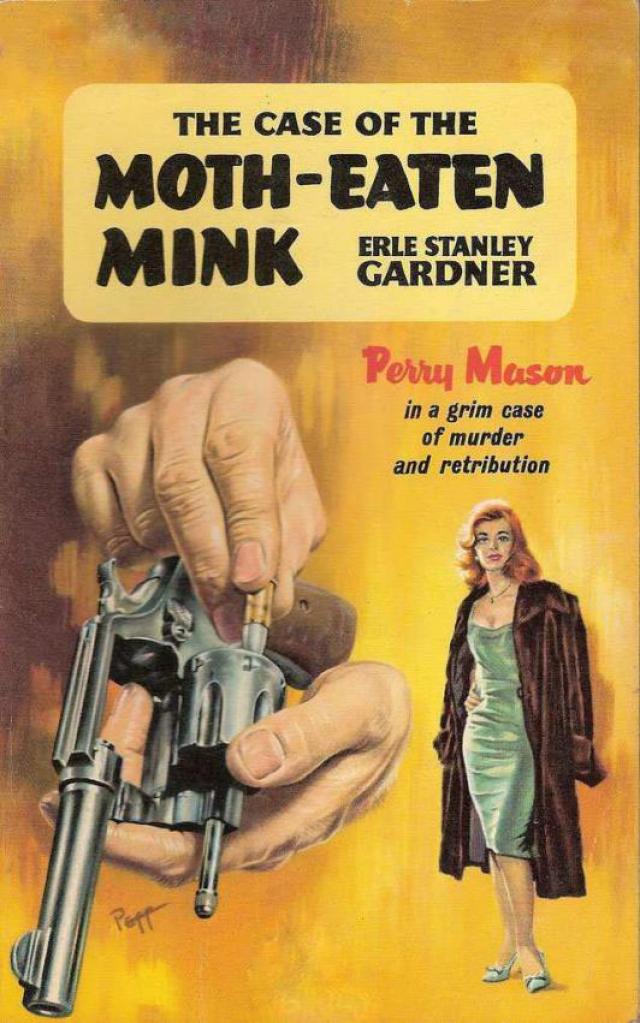
The Case of the Moth-Eaten Mink,
p.22


Mason said, “Thank you, Your Honor.”
He turned to the witness and said, “This police sergeant who befriended you has kept an eye on you?”
“Oh, yes. He’s the head of the Vice Squad.”
“He checks up on you?”
“Yes.”
“Frequently?”
“Sure. They keep an eye on the hotel. Things happen there. We can’t help it, but the management doesn’t take part in any of that stuff. We don’t ask to see the marriage license when a couple registers, but neither do the high-class hotels. We try to keep the bellboys from furnishing call girls, and we don’t rent rooms to known dope peddlers.
“That’s where my knowledge of faces comes in handy. The hotel was in bad and the D.A. was threatening to close the place up. The owners had to clean up or lose their investment.”
And the witness made a little bow to Hamilton Burger, who tried to look virtuously disdainful.
“And because of that the management is anxious to cater to the district attorney?” Mason asked.
“Objected to as calling for a conclusion of the witness,” Burger said.
“Sustained.”
“How about you yourself?” Mason asked. “Do you wish to cater to the district attorney?”
“I don’t want him as an enemy. Any time the authorities turn thumbs down on me, I’m out. But that hasn’t made me tell any lies. I’m telling exactly what happened.”
“Yet you were glad of a chance to be of assistance to the district attorney?”
“I’m sorry I was ever called as a witness.”
“But you welcomed a chance to be of service to the district attorney?”
“I felt it might come in handy sometime, if you want to put it that way.”
Mason turned to Hamilton Burger and, “I think it is only fair at this time, Mr. District Attorney, to acquaint the Court with what I understand is the general background of your case.”
“I’ll handle my case in my own way,” Hamilton Burger said.
“However, as I understand it generally,” Mason said to the judge, “the police have in their possession a revolver which had been pawned in Seattle. The pawnbroker is here in court and he will presently identify the defendant Dixie Dayton as the person who pawned that weapon. And that weapon was, according to the evidence of the ballistics department, as will be presently brought out by Mr. Mott, the weapon which was used in the murder of one Robert Claremont, a murder which took place something over a year ago here in this city, and, as I understand it, it is the contention of the prosecution that it was because of an attempt to cover up that murder that Morris Alburg and Dixie Dayton planned the murder of George Fayette.”
Hamilton Burger’s face showed complete, utter surprise.
“Is that generally the background of the prosecution’s case?” Mason asked him.
“We’ll put on our own case,” Hamilton Burger said.
Judge Lennox said, “You may put on your case, Mr. Burger, but the Court is entitled to know generally whether this outline of the background of the case as given by the defendants’ Counsel is correct.”
“It is substantially correct, Your Honor,” Burger said sullenly. “I had assumed Counsel for the defendants would try to keep out this evidence. His statement comes as a surprise.”
Judge Lennox frowned. “I can now appreciate the reason for the comments of the District Attorney concerning testimony regarding other crimes which might furnish in some way a motive for the crime charged in this case.”
Mason sat in the mahogany counsel chair, his long legs crossed in front of him, his eyes thoughtful, speculative, regarding the young man on the witness stand.
“Now on the night in question you were acting both as night clerk and switchboard operator?”
“Yes.”
“And there was a call from room 721—a woman saying, ‘Call the police’?”
“Yes.”
“Yet you did nothing about that?”
“Certainly I did. The woman hung up. I immediately called back on the phone, and asked what was the trouble. She laughed at me and said to be my age, that it was a gag.”
“You did nothing else?”
“Certainly not. I assumed her boy friend had become a little too wolfish and so she decided she’d throw a scare into him. But she obviously wasn’t worried.”
“Did it occur to you that another woman had answered your ring?”
“Not at the time. In the Keymont you don’t call the police for anything short of a riot. You handle trouble yourself.”
“Yet you did call the police later?”
“When a revolver shot was reported, yes. You can’t overlook a revolver shot.”
Once more Mason regarded the witness with thoughtful speculation.
“Your employers know about your criminal record, Mr. Hoxie?”
“I’ve told you they did.”
“And it’s brought up to you once in a while?”
“What do you mean by that?”
“Whenever you are called upon to do something that might be perhaps a little bit irregular?”
“You have no right to examine me about anything except the facts in this case,” the witness retorted.
“Quite right,” Mason said, and, without turning his head, said over his shoulder, “Is Lieutenant Tragg in court?”
“Here,” Lieutenant Tragg said.
Mason said, “Lieutenant, you have a photograph of Robert Claremont, the rookie cop who was murdered in this city something over a year ago. Would you mind stepping forward and showing that photograph to the witness?”
“What does all this have to do with the present case?” Hamilton Burger asked irritably.
“It may have a great deal to do with it,” Mason said, without even turning toward the source of the interruption, but keeping his eyes fixed on the witness. “I take it you gentlemen would really like to solve the Claremont murder?”
“I would,” Lieutenant Tragg said, striding toward the witness stand.
Lieutenant Tragg extended a photograph to Perry Mason.
“Show it to the witness,” Mason said.
Lieutenant Tragg moved up to stand by the witness, holding out the photograph.
The witness looked at the photograph, started to shake his head, then extended his hand, took the photograph, looked at it and held it for a moment.
It was quite obvious that his hand was shaking.
“You say you never forget a face you have once seen,” Mason said, “and therefore you are a valuable asset to the Keymont Hotel. Have you ever seen the face of the man in the photograph?”
“If the Court please,” Hamilton Burger said, “this isn’t proper cross-examination. If Counsel wants to make this man his own witness he …”
“He certainly has a right to test the memory of the witness,” Judge Lennox said. “Any witness who makes the unusual statement that he never forgets a face he has once seen is testifying that he has a memory which is far better than average. Therefore, under the circumstances, Counsel is entitled to test that memory. The witness will answer the question.”
“I can’t …”
“Careful,” Mason cautioned sternly. “Remember you’re under oath.”
The witness once more held up the photograph. This time the trembling of his hand was so obvious that he lowered the hand hastily to his lap.
“Well?” Mason asked. “What’s the answer? Yes or no?”
“Yes,” Hoxie said in an all but inaudible voice.
“When did you see him?”
“Oh, Your Honor,” Hamilton Burger said, “that is asking too much …”
Lieutenant Tragg whirled to glare angrily at the district attorney.
“I’ll withdraw the objection,” Hamilton Burger said.
“When?” Mason asked.
“If that’s really Claremont’s picture, I guess it was the night I left for Mexico.”
“What time during the night?”
“Early in the evening. There was a little trouble.”
“What sort of trouble?”
“He went up to see a tenant. There was a complaint about a quarrel. I phoned up to the tenant in the room. The noise quieted down.”
“Then what happened?”
“Nothing.”
“Were there telephone calls from that room?”
“I can’t remember.”
“You have said you never forget a face. Who was the occupant of that room?”
“A regular tenant.”
“Who?”
“George Fayette, the man who was murdered on the third of this month.”
Perry Mason got up, pushed back his chair, and said, “Thank you, Mr. Hoxie,” then to the bewildered court, “Those are all the questions I have.”
“You mean you’re quitting now?” Judge Lennox demanded incredulously.
“Now,” Mason said, and then added with a smile, “and I think if Court will take a thirty-minute adjournment the examination can best be completed by Lieutenant Tragg and in private.”
Judge Lennox hesitated, frowned, then reached for his gavel. “I think I get your point, Mr. Mason. Court will take a thirty-minute recess. The defendants are remanded to custody.”
And Judge Lennox, with a significant glance at Lieutenant Tragg, promptly left the courtroom for his chambers.
Chapter 18
Mason faced Dixie Dayton and Morris Alburg in a witness room opening off the courtroom.
“All right,” he said, “I want some facts. Where can I find Thomas E. Sedgwick?”
Alburg glanced at Dixie Dayton.
She shook her head. “I wouldn’t tell anybody—”
“You’re going to tell me,” Mason said. “We’re going to be able to produce him as soon as Lieutenant Tragg finishes with Frank Hoxie.”
“Mr. Mason, do you know what you’re saying?” Dixie Dayton demanded angrily. “This is a cop murder. The police wouldn’t give him a leg to stand on. He wouldn’t have a ghost of a chance. They’d railroad him to the death house so fast that he wouldn’t know what had happened.”
“Why?” Mason asked.
“Why?” Morris Alburg demanded. “What are you talking about? Are you dumb?”
“I’m not dumb and I’m not deaf,” Mason said. “Why would they railroad him to the death house?”
“Because that’s the way the police are. When you kill a cop the police are all on your neck.”
“Why?”
“Because they want revenge, of course, and because I suppose they want to let people know that you can’t kill cops and get away with it. That’s for their own protection.”
“Against whom do they want this revenge?”
“Against anybody that they think is guilty.”
“Exactly,” Mason said. “They used to think Tom Sedgwick was guilty. I don’t think they’ll feel that he’s guilty now.”
Dixie Dayton said, “He has tuberculosis. He can’t do ordinary work. He needs rest. He is having a long, slow fight trying to get better. That’s why he did the things he did. That’s why he got mixed up in bookmaking. He felt that if he could get funds enough, he could take it easy for a while. He’s not bad, Mr. Mason, he—he’s human. He did the things that lots of other people were doing, and then—then they framed this cop killing on him just because that rookie cop was concentrating on him, giving him the works.”
“You’ve been protecting him?” Mason said to Dixie Dayton.
She nodded.
“You’ve been living with him, washing for him, cooking for him, sewing for him, trying to give him a chance?”
She nodded, then said, “I’d give him my life.”
“All right,” Mason told her. “Give me his address, the place where he can be found right now, and you may save his life and yours, too.”
Morris Alburg suddenly turned to face Dixie. “Give it to him, Dixie.”
Chapter 19
Mason, Della Street and Paul Drake were in Mason’s office when Gertie, the switchboard operator, rang three frantic signals on the telephone.
“That,” Mason said, “will be Lieutenant Tragg.”
He had no sooner spoken the words than Tragg unceremoniously jerked open the office door, nodded briefly, said, “Hello, folks,” and walked over to sit down opposite Mason’s desk.
“Well?” Mason asked.
“It’s okay,” Tragg said.
“Going to tell us about it?”
“I’d rather not.”
“We’re entitled to it.”
“I know. That’s why I came here. Give me a little time.”
Tragg fished a cigar from his pocket, clipped off the end, lit the cigar, looked at Mason searchingly through the first blue wisps of cigar smoke and said, “What gave you your hunch on this thing, Mason?”
Mason said, “I was faced with clients who had an impossible story. No jury would ever have believed that story. Yet I began to think it might be the truth.”
“I don’t see how that gives you anything,” Tragg said.
“Anyone who can force an attorney to put on evidence that is going to convict his client, yet which he feels is the truth, must be someone who knows something about evidence. The story that each defendant had to tell was so completely phony that if those stories had been told on the witness stand the defendants would have been convicted.
“In one case that might have been an accident. In two cases it showed design. And then I suddenly realized that I was dealing with a pattern. Thomas E. Sedgwick had been placed in such a position. Any story that he could have told would have eternally damned him before a jury. Therefore his only alternative was to take refuge in flight.
“Well, Lieutenant, I simply used an ordinary police method. You catch many of your criminals because of a file you have entitled Modus Operandi. It is predicated upon the assumption that a criminal, having once committed a successful crime, will thereafter follow a pattern in everything he does.
“In Sedgwick’s case he had an utterly implausible story to tell, and he had possession of a murder weapon. Morris Alburg had an utterly impossible story and a murder weapon.
“It occurred to me that since it was quite apparent Claremont was gunning for the people higher up, he might have made contact.
“There was one feature of the case in my favor. The night clerk never forgot a face. I decided I’d try the case by floundering around with a lot of cross-examination and then slip in a casual question to find out if Hoxie could remember having seen Claremont in the hotel on the night he was murdered.
“When Hoxie told about that sudden trip to Mexico City I understood just what had happened. There was one more question which might have cleared up the case. I thought it would be better for you to ask it privately than for me to ask it in court.
“When I saw Hoxie’s hand begin to shake I thought I knew the answer…. The question, of course, was whether Fayette had any other visitor in his room when Claremont went up.
“Now, tell me, how far did I miss it?”
“You didn’t miss it a damn bit,” Tragg said. “I wish you had. The hell of it is that people get a feeling the police are all crooked simply because now and then some big shot starts a shakedown and piles up an individual fortune. That’s the way it was in this case. Hell, the guy owned the Keymont Hotel. What do you know about that?”
“I was satisfied he did,” Mason said, “also the Bonsal Apartments, and probably one other apartment house where the captives were taken and where they saw the towels.”
There was a moment’s silence. Tragg puffed on the cigar, then said, “Bob Claremont wasn’t as dumb and as naïve as lots of people thought. He knew that Sedgwick was making book, but he also knew Sedgwick was paying protection. He knew Fayette was the go-between. Claremont was after the sources of protection. He found them, too. The trail led to the Keymont Hotel. And then presumably Bob Claremont got quite a jolt. He found out the real identity of the man he was after. He never left the hotel alive. They took him down in the freight elevator and put him in the car. Then they sent for Sedgwick.”
“Who did?”
“Who do you think? The man who had been taking his protection money. He told Sedgwick he was hotter than a firecracker, that people were wise to the fact that he had been paying for protection. He told Sedgwick he had a twelve-hour head start to get out of town, to sell everything he had for what he could get, and get out.”
“That’s the way I had it figured,” Mason said.
“You know what happened after that. Sedgwick did what he was supposed to do, and by doing it he irrevocably put his neck in the noose.”
“How about the gun?” Mason asked.
“That was a cinch,” Tragg said. “Sedgwick was given to understand that his only chance was to stay out of the state until things cooled off, but to let this one person know where he was all the time. Sedgwick had a gun. It was a Smith and Wesson, but it wasn’t the gun Dixie pawned. That was Claremont’s gun. Somehow they managed to switch guns on Sedgwick after the murder. Sedgwick and Dixie must have had a visitor whom they thought was a trusted friend who made the substitution.”
“Why?” Mason asked.
“Because that’s the gang’s life insurance. They didn’t know that Dixie Dayton would ever come back, but they thought she might. I’d a lot rather not talk about it.”
“I know,” Mason said, “but you have to do it, Tragg. You owe that much to us.”
“I know,” Tragg said, moodily. “Why the hell do you think I’m here?”
“You got a statement from Hoxie?”
“Of course I got a statement from Hoxie. You did everything except wrap the damn case up in a cellophane envelope and hand it to me on a silver platter. I knew right from the start that there was something fishy about Bob Claremont’s murder. I knew that he wouldn’t get into a car. I knew that he wouldn’t let anybody draw his own gun. The thing was screwy. It had to be. But I couldn’t figure out what was wrong with it.
“And then, of course, when you cross-examined Hoxie the thing stuck out like a sore thumb. The Keymont Hotel was in the gambling racket. The D.A. was about to make an investigation. A new manager had been put in. A kid went in as night clerk who had a record. He had a memory for faces. If he’d stayed in town he’d have seen the newspapers the next morning with Bob Claremont’s picture. He’d have recognized him as the cop who came to the hotel in plain clothes following a hot lead. Then the tables would have been turned. Hoxie would have been able to control the owners…. So they rigged up a deal with the man who was the lead of the dope ring in Mexico. They rushed Hoxie onto a plane, and the Mexican end gave Hoxie a run-around until the Claremont story and picture was out of the papers, and then Hoxie was permitted to come back.