

The case of the moth eat.., p.9
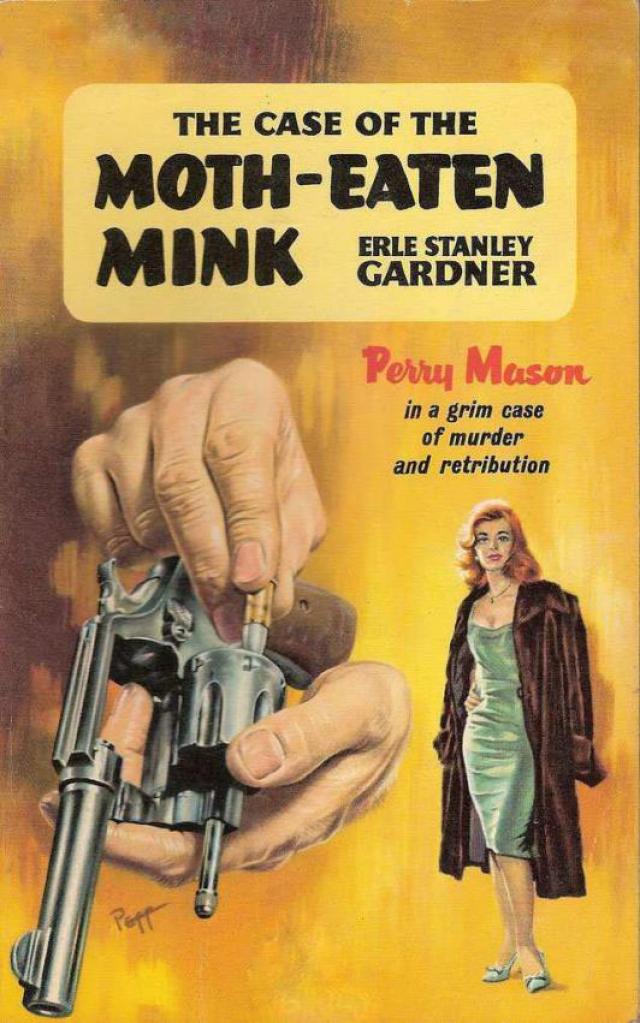
The Case of the Moth-Eaten Mink,
p.9


“I’m hot.”
“Why can’t it wait until I get to my office in the morning?”
“Tomorrow maybe I am not around any more.”
“All right,” Mason said wearily, “if you’d played fair with me and given me the low-down on this thing, perhaps you wouldn’t have been in such a jam.”
“I’m in a jam before I ever see you, Mason.”
“Where are you?”
“The Keymont Hotel, room 721. The place is not high-class. It’s a joint. Don’t stop at the desk. Walk by the desk like you had a room. Don’t speak to anybody. Take the elevator, come up to the seventh floor, go to 721. The door is unlocked. I’m there.”
“All right.”
“And, Mason—”
“Yes?”
“Make it snappy, yes?”
“All right,” Mason said. “I’ll be there.” He hung up the telephone, kicked the covers off, telephoned the garage to have his car brought out in front and left with the motor running, rubbed exploratory fingers over the slight stubble on the angle of his jaw, jumped into his clothes, hastily knotted his tie, started for the door, then returned to pick up his overcoat, paused to ring the desk and make certain his car was waiting outside, then dashed for the elevator.
The night clerk looked at him curiously, said, “Must be something of an emergency, Mr. Mason.”
“Must be,” Mason said, and glanced at the clock over the desk. It was two-fifteen.
The lawyer glanced at his wrist watch to verify the hour shown by the clock on the wall, walked over to the revolving door, and out into the crisp, cold air of early morning.
The night garageman was seated in Mason’s car at the curb. He nodded to the lawyer, opened the door and got out.
Mason slid in behind the steering wheel, noticed that the heater was already warming up the interior of the cold car.
“Thanks a lot, Jake,” he said.
“Yes, sir.”
He glanced at the dial on the gas tank.
“I filled it up when you brought it in last night,” the night man said. “You instructed me to see that it’s always kept full and …”
“That’s fine,” Mason told him. “I never know when I may have to go someplace in a hurry.”
“This looks like one of those times.”
“It does for a fact,” Mason admitted. He slammed the door and sent the car purring smoothly away from the curb.
It took Mason about fifteen minutes to reach the Keymont Hotel. At that hour of the morning there were plenty of parking spaces and Mason parked his car, locked it and entered the lobby.
It was a shabby lobby with well-worn chairs and a musty atmosphere. Entering the place after his brief sojourn in the crisp night air, Mason was all the more conscious of the stale odor of decay. The empty chairs arranged in an orderly row seemed hopelessly incongruous. In keeping with the atmosphere of the place, they should have been occupied by seedy men sitting quietly, reading newspapers, or just staring off into space.
The clerk looked up as Mason entered the lobby, followed the lawyer with his eyes, until Mason had reached the elevator shaft.
“Someone you wanted to see?” the clerk asked, as Mason jabbed the button on the elevator.
“Me,” Mason told him.
“You mean …”
“That’s right.”
“You’re registered here?”
Mason said, “Sure. And you’d better call me at seven-thirty in the morning … No, wait a minute, I’ve got to make a couple of calls first. I’ll wait until I get to the room and then give you a ring when I find out what time I want to be called. I may be able to sleep later than seven-thirty.”
The elevator rattled to a stop. Mason pushed back the door. It was, at this hour of the night, on automatic, and Mason jabbed the last button, which was for the eighth floor. He waited what seemed an interminable interval until the elevator, swaying and rattling, came to a hesitant stop.
Mason slid back the door, closed it and walked down the corridor to a red light which marked the location of the staircase. He took the stairs down to the seventh floor, located room 721 and tapped gently on the door.
There was no answer.
Mason waited a few moments, then tapped again, this time more insistently.
There was still no answer, no slightest sound from within the room.
Mason tried to doorknob. It turned and he opened the door a crack. The light was on.
Mason, standing in the hallway, pushed the door with his foot, swinging it wide open.
The room was empty, but seemed to have been recently occupied since there was a distinct odor of fresh cigarette smoke.
Mason cautiously crossed the threshold.
It was the standardized room of a cheap hotel. The thin carpet was worn through the pattern in a well-defined trail from the door around the bed to the window. There was a washstand and mirror over in the corner, and the carpet in front had been worn through almost to the floor.
Mason’s eyes made swift inventory.
He saw the imitation-leather-bottomed rocking chair, the two straight kitchen chairs with cane bottoms, the square table which looked as though it had been primarily designed to hold a white glass pitcher and bowl before running water had been installed in the room.
Mason left the door open, and took two swift but cautious steps to the door, pulling it toward him to make sure no one was standing behind it. He walked over to another door and disclosed a narrow closet. The next door showed a toilet and a shower jammed together in a room scarcely the size of a good-sized closet.
Having satisfied himself there was no one there, Mason went back and closed the door. This time he gave the room a more careful survey.
It was illuminated with a reddish glow from a glass bowl which hung from the center of the room and was supported by a chain of brass-colored links, through which ran electric wires down to the single bulb.
The bed was an iron bedstead with a thin mattress, carefully covered, however, with a smooth but somewhat threadbare white bedspread. A reading lamp was clamped to the head of the bed.
Mason noticed the indentation near the head of the bed where someone had evidently been sitting. Then he noticed another indentation near the center of the bed.
The lawyer stooped so that he could see this indentation to better advantage.
It looked very much as though someone had thrown a gun onto the bed. The gun had been picked up, but it had left an imprint in the white spread.
Something the color of gold, glittering in the light, caught Mason’s eye. He stooped and picked up a lipstick.
The lipstick was worn flat, and from little ridges at the edges looked as though it might have been drawn across some hard surface.
The lawyer searched the room carefully, studied the lipstick once more, then turned up the small square table. On the underside had been lettered in lipstick, “Mason Help 262 V 3 L 15 left.”
Mason was standing looking at the lipstick and the message on the bottom of the table when he heard a faint squeaking noise from across the room. The knob of the door was slowly turning.
Hastily thrusting the lipstick into the side pocket of his coat, Mason put the table back into position, and was standing poised thoughtfully, one foot on the chair, in the act of taking a cigarette from a cigarette case as the door slowly, cautiously opened.
The woman who stood in the doorway was about twenty-five years of age, with a good figure, raven-dark hair, large dark eyes, and olive skin, against which the vivid red of her mouth was a splash of crimson.
She drew back with a quick intake of breath, half a scream.
Mason, regarding her with calm, steady eyes, said nothing.
The woman hesitated in the doorway, then slowly entered the room. “You—Who are you?”
“Is this your room?” Mason asked.
“I—I came here to meet someone. Who are you?”
“I came here to meet someone. Who are you?”
“I—I don’t have to give you my name.”
Mason, watching her, said slowly, “My name is Perry Mason. I am an attorney. I came here to meet a client. The client told me he was registered in this room. Now, tell me whom you expected to meet.”
“Oh, thank heaven! You’re Mr. Mason. Where’s Morris? I’m Dixie Dayton. I came here to meet Morris Alburg. He telephoned me that you were coming, but he said he’d be here with us. He said he was going to have you represent me, so I want to tell you frankly …”
Mason seated himself, gestured her to a chair. “Now, wait a minute,” he said, “it may not be that simple.”
“What do you mean?”
“In the first place, you may have had a wrong impression of what Mr. Alburg wanted to say to me.”
“No, I didn’t, Mr. Mason. I know it was that, honestly it was.”
“In the second place,” Mason said, “regardless of what anyone might say, I might not want to represent you.”
“Why? Morris—Mr. Alburg will pay you whatever it’s worth.”
“What makes you think he will?”
“He promised me he would.”
“You might be guilty of something.”
“Mr. Mason, don’t let them pull the wool over your eyes.”
“I’ll try not to,” Mason said, “but after all, I have to pick and choose my cases. I can’t possibly take all the work that’s offered to me. I have to know a good deal about the facts in any given case before I commit myself. And I frequently turn down cases.”
She dropped down to the floor at his feet. “Mr. Mason, if you only knew what it meant; if you only knew what I’m up against.”
Mason said nothing.
“Mr. Mason, tell me, how much do you know? How much has Mr. Alburg told you?”
“Not very much,” he said.
She said, “All right, I’ll tell you the truth, Mr. Mason. I’ll tell you the facts in the case.”
“I may not be free to listen,” Mason told her. “At the moment I’m not free to receive any confidential communication from you. If you tell me anything I can’t treat it as a professional confidence.”
“Oh, don’t be so cagey,” she said. “After all, why should you and I sit here and spar with each other? Let’s get down to brass tacks.”
She quickly reached up and took his hand in hers. “I suppose I’m being terribly impulsive and you must think I’m a ninny, but I’m in an awful jam, Mr. Mason, and you’re going to have to get me out.”
“I’ve already explained to you,” Mason said, “that I can’t talk with you, and I’d prefer not to listen until after I’ve seen Morris Alburg. I have to know where I stand before I …”
“Oh, Mr. Mason,” she wailed. “Please—I’m going to put my cards on the table for you, Mr. Mason.”
“I can’t even let you do that at the moment,” Mason said.
She sat silent for a few minutes, thinking. She still held onto his hand. Gripping it, she said, “You mean so much to me, Mr. Mason. I can’t begin to tell you what it means to have you working on the case.”
“I’m not working on it.”
She met his eyes with laughing challenge and said, “Yet.”
“Yet,” Mason told her, half-smiling.
“And you certainly are one cautious lawyer.”
“I have to be.”
She lightly kissed the back of his hand. “For the moment that will have to serve as a retainer,” she said. “You stay right there. I’m going to see if I can’t get a line on Morris Alburg. You just wait here and I’ll bring him within fifteen minutes, and then we’ll get started right.”
She walked quickly across the room, opened the door and vanished.
Mason came out of the chair almost at once, hurried to the telephone, and gave Paul Drake’s private, unlisted number.
It seemed minutes before Mason heard Drake’s sleepy voice.
“Wake up, Paul,” Mason said. “This is important. Get it, and get it fast.”
“Oh, Lord, you again,” Drake said thickly. “Every time I try to get a little sleep …”
“Forget the sleep,” Mason barked into the telephone. “Snap out of it. I’m up here in the Keymont Hotel, room 721. There’s a brunette girl, about five feet two, who weighs one hundred and fifteen, age twenty-five or twenty-six, olive skin, large round eyes, a vivid red mouth, up here with me—that is, she will be here inside of a minute or two, and …”
“Well, congratulations,” Drake said. “You sure do get around!”
“Can the wise stuff,” Mason snapped. “Get hold of some operatives and send them up here…. First, I want a woman, if you can find one, to make the original contact. Try and have her in the corridor when this girl leaves the room. You’ll have to work fast, Paul. The woman can put her finger on this girl and identify her so that the men who are on the outside can pick her up when she leaves. I want her tailed and I want to find out where she goes.”
“Have a heart, Perry,” Drake begged. “It’s three o’clock in the morning. Good Lord, I can’t pull people out of a hat. It’ll take me an hour or two to get anybody on the job. I’ll have to get someone out of bed, get him dressed, give him time to get down there …”
“Who’s at your office?” Mason asked.
“Just a skeleton crew. I keep a night switchboard operator, a night manager, and there’s usually one man available …”
“The switchboard operator,” Mason interrupted, “man or woman?”
“Woman.”
“Competent?”
“Very.”
“Get her.” Mason said. “Shut off the switchboard for an hour. It’s a slack time in the morning so you won’t miss any business. Get that woman up here. Do it now. You only have a few minutes, so get busy. Close up your office for an hour if you have to, but be prepared to shadow this girl the minute she leaves the hotel.”
Mason didn’t wait to hear Drake’s expostulations. He slammed up the receiver and went back to the chair where he had been sitting.
Taking a white handkerchief from his pocket, he used a corner to wipe off the stain of lipstick from the back of his right hand. Then, moving the table to an inverted position, he used another corner of the handkerchief to wipe off a small sample of the lipstick from the bottom of the table.
Restoring the table to its original position, he took the gold-plated lipstick container from his pocket and very carefully touched the end of the lipstick to still another portion of the handkerchief. With his fountain pen he made marks on the handkerchief opposite each of the stains—1, 2 and 3. Then he folded the handkerchief, put it back in his pocket and settled back once more in the chair to wait.
It was a long wait.
At first Mason, watching the minute hand on his wrist watch, counting the minutes, kept hoping that time would elapse before the young woman returned so that Drake’s operatives could get on the job. Then after fifteen minutes he frowned impatiently, and began to pace the floor. There was, of course, the possibility that he was being stood up, being put in a position of complete inactivity at a critical period by a deliberate ruse.
He had been certain that it was Morris Alburg who had called him. He was at the place Alburg had designated as a rendezvous. There was nothing to do except await further developments—or go home.
Abruptly and without warning the doorknob turned. The door opened with careless haste, and the brunette girl appeared on the threshold. Her cheeks were flushed, her eyes shining with excitement. It was apparent that she had been hurrying as fast as she could.
At the sight of Mason she abruptly relaxed. “Oh, thank heavens you’re still here! I was so terribly afraid you wouldn’t have had enough confidence in me to wait.”
Mason raised his eyebrows.
“I didn’t intend to be so long. I was afraid you’d walk out on me.”
“I wasn’t going to wait much longer at that. What was the idea?”
“I had to see Morris. That was all there was to it. I simply had to see him. I knew that.”
“And you’ve seen him?” Mason asked.
“Yes. I have a note for you.”
She thrust her hand down the front of her blouse, pulled out a note, crossed the room rapidly and pushed it into Mason’s hands. “Here, read this.”
The note was typewritten.
MR. MASON:
Dixie tells me that you came to the room in the hotel all right, but won’t talk with her and are waiting for me to give you an okay.
I gave you an okay over the telephone. I told you I had sent you a letter with a check in it for a retainer, and that I wanted you to represent me and represent Dixie. It’s a bad mess. Dixie will tell you all about it.
I want you to consider Dixie, the bearer of this note, just the same as you consider me. She is your client. I have turned to you for help because I need help. I need it bad and I need it right now. I was hoping I could wait in that room until you arrived, but I simply had to go out on this angle of the case that I’m working on. I don’t dare to tell you what it is because I don’t want to put you in an embarrassing position.
Now please go ahead and help us out of this mess. You’ll be paid and well paid.
Yours, MORRIS
The body of the note had been typewritten, the signature was a scrawl in pencil. It could have been Morris Alburg’s signature. Mason tried to recall whether he had ever seen Alburg’s signature and couldn’t remember any specific instance.
The young woman radiated assurance. “Now we can talk,” she said.
Mason said nothing.
“Well—can’t we?”
“I want to know why Morris Alburg isn’t here,” Mason said. “He promised to meet me here.”
“But he had to change his plans.”
“Why?”
“Because he’s busy doing something that’s terribly important.”
“What?”
“Protecting me—and also himself.”
She drew up a chair, sat down, said, “Mr. Mason, when can one person kill another person—and be justified?”
“In self-defense,” Mason said.
“Does a person have to wait until the other one is shooting at him?”
“He has to wait until he is attacked, or until a reasonable man under similar circumstances would think that he was in great bodily danger or threatened with death.”















