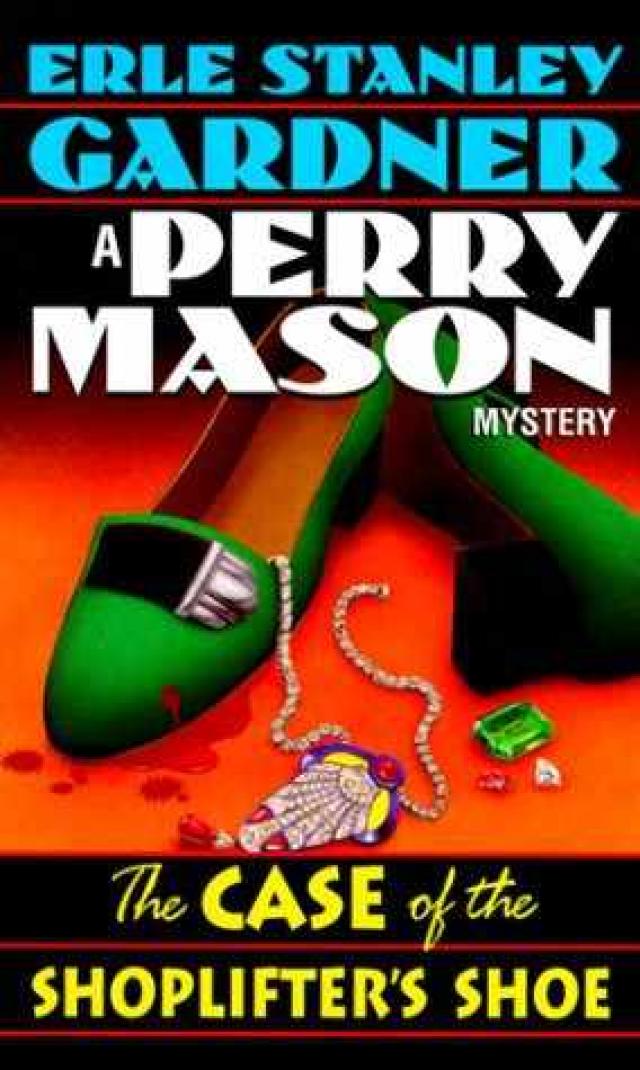
The case of the shoplift.., p.15
The Case of the Shoplifter's Shoe,
p.15


She nodded. “And all you know is it was a thirty-eight caliber revolver?”
“It was the same make,” she said, “as the one I’d been shooting, I know that.”
“But there’s nothing about it which will enable you absolutely to identify it, is there?”
“No,” she said slowly, “there isn’t.”
“Now then, at eight o’clock Saturday night, you returned to the office and put that gun which was in your purse in the drawer, didn’t you?”
“Yes.”
“Was there any other gun in the drawer at that time?”
“No.”
“How were you dressed when you returned that gun to the office?”
“What do you mean?” she asked. “I had on street clothes.”
“Were you wearing gloves?”
She frowned for a moment and said, “I was wearing gloves when I came to the office, but I … No, I wasn’t, either. I wasn’t wearing gloves.”
“The gun was in your purse?”
“Yes.”
“And you took it out and put it in the drawer?”
“Yes.”
“Did you handle it at all—that is, did you make any investigation to make certain it was loaded?”
“I opened the cylinder and looked at it to make certain it was loaded, yes. I always do that before I put it in the drawer.”
Sergeant Holcomb said triumphantly, “All right, Miss Trent, that proves my point. You didn’t have the gun which killed George Trent.”
Her silence showed her complete lack of conviction.
“What makes you think she didn’t?” Mason asked.
“Because,” Holcomb said, “our examination of that gun shows that the last person who handled it had been wearing gloves. Any latent finger-prints which were on it were smudged so they were virtually valueless, and from the manner in which the prints were smudged, our expert figured the gun was last handled by someone with gloves. And it had been handled quite a bit.”
Mason flashed a quick glance at Virginia Trent, then turned back to Sergeant Holcomb. “Go ahead, Sergeant, let’s hear the rest of it.”
Sergeant Holcomb said, “I think you can co-operate with us in this, Mason. You see what happened. Someone removed George Trent’s gun and put another one in its place. Some time Monday morning, that person returned George Trent’s gun to the drawer and took out the one which had been left there.”
“Why do you say Monday morning?” Mason asked.
“Because no one went to the office after six-thirty Saturday night, until eight o’clock Monday morning, with the exception of Miss Trent Saturday evening, and Mrs. Breel Sunday.”
“I see,” Mason said, “and just what do you want us to do?”
Sergeant Holcomb’s tone was almost pleading. “Newspaper reporters are going to be talking with this young woman,” he said. “I don’t want her to say anything about the gun.”
Mason turned to Virginia Trent. “Under the advice of your counsel,” he said, “you’re not to discuss this case with anyone. Do you understand?”
She nodded. Sergeant Holcomb gave Mason his hand. “That,” he said, “is damned white of you, Mason.”
Mason grinned. “Not at all, Sergeant. It’s always a pleasure to co-operate with you.”
Chapter 11
Mason was grinning gleefully as he entered his office. Della Street said, “Why the cat-swallowed-the-canary expression, Chief?”
Mason said, “I was thinking of the logic and beauty of an old bit of philosophy.”
“Tell me the philosophy first,” she said, “and then I’ll tell you whether I agree with you.”
“The philosophy,” Mason said, “is a quotation having to do with an engineer.”
She knitted her brow. “An engineer?” she asked.
Mason, scaling his hat at the hat rack, said, “Uh-huh, and it goes like this: ‘For ’tis sport to see the engineer, hoist by his own petard.’”
“Something seems to me,” she said, “that it’s going to get us into trouble.”
“On the contrary,” Mason told her, “it’s going to get us out of trouble. And, by the way, Della, do you know that one of the greatest troubles with police officers is that they lack imagination?”
“Just what in particular are you referring to?” she asked.
“I was thinking,” he said, “about the historical background leading up to the identification of bullets by comparison and micro-photography. You know, Della, it’s only within the last few years that it’s been demonstrated that little marks and blemishes in the barrel of a revolver automatically finger-print a bullet which is discharged from it.”
“Sure,” she said, “it’s only during the last few years that the radio has been perfected. And think of the strides we’ve made in sales and income taxes, Chief.”
He grinned. “Getting serious for the moment, Baggage, where a man is utilizing some scientific invention, you’d think he’d want to know something of the history back of that invention.”
“Well,” she said, “I hate to distract you from your philosophical contemplation of crime, but it occurs to me that while you’re being serious I’d better dissipate your mood of joyous hilarity by telling you the worst.”
“What,” he asked, “is the worst?”
“One of Drake’s detectives is looking for you with blood in his eye.”
Mason, still grinning, said, “Did you say blood in his eye or on his eye, or, perhaps, around his eye?”
“How did you know, Chief?”
“More deductive reasoning,” he said.
“If the man ever heard you make that crack he’d …”
She broke off as Paul Drake knocked his peculiar code sequence on the door. Mason strode over to open it. Drake walked in and said, “Our friend Chennery believes in direct methods, Perry.”
“What happened?” Mason asked.
Drake said, “About five minutes after we left Chennery’s place, Chennery came out, walked over to the roadster where my operative was sitting and said, ‘Your lawyer friend told me I was being shadowed, and you look like the shadow.’”
“Then what?” Mason asked.
“My operative doesn’t remember,” Drake said, grinning. “He says a building fell on him, but he’s probably exaggerating. About ten minutes later, when the extra men I’d telephoned for showed up, they found this bird tied up in the bottom of the car, with adhesive tape pasted over his eyes and lips.”
“Chennery?” Mason asked.
“Gone,” Drake said. “Slipped through our fingers. But we’re tailing his wife, and she’ll lead us to him sooner or later.”
“She didn’t get away?”
“No. Chennery beat up my operative and skipped out. She waited to pack up, and must have left about ten or fifteen minutes after he did. My men showed up just as she was pulling out.”
“Where is she now?” Mason asked.
“Out at the Monadnock Hotel, registered as Mrs. Charles Peabody of New Orleans.”
“Okay,” Mason said. “Sew her up tight. Try and get a dictograph planted in her room. Plant operatives in the adjoining rooms, and keep your eye peeled for Mister Charles Peabody.”
“That,” Drake said with a grin, “has already been done.”
Mason said, “You know, Paul, that’s a professional trick, taping a man’s eyes and mouth.”
“I’ll say it is,” Drake agreed.
“I also noticed that Chennery seemed to know the ropes. As soon as I told him you were a detective, he wanted to know whether you were from headquarters. When he found out you weren’t, he started getting tough.” Drake nodded. “And,” Mason went on, “according to the homicide squad, the light fuse in Austin Cullens’ residence blew out because someone unscrewed a lamp globe, slipped a copper penny into the socket, and then screwed the light back. As soon as the lights were turned on, it blew the fuse. That’s also a professional trick.”
Drake nodded thoughtfully. “You have something there, Perry. Mrs. Breel would never have done that.”
Mason said, “A person who would short-circuit a fuse that way would be inclined to use adhesive tape on a man’s eyes and lips. There’s a certain similarity in the technique, Paul, an efficiency in obtaining maximum results with minimum effort.”
Drake said, “Therefore, I take it, Perry, you want my operative to make a complaint to the police and …”
“No,” Mason said, “I don’t. I’m simply mentioning the point for your own information, Paul—in case you meet up with Mr. Charles Peabody of New Orleans.”
“I get you,” the detective said. “Here’s something else, Perry. Bill Golding is driving a new maroon-colored sedan.”
Mason’s eyes narrowed. “I’m interested in the adjective, Paul,” he said.
“Maroon-colored?” Drake asked. Mason shook his head. Drake said, “I get you, Perry … but I doubt if it’s that new.”
“Find out,” Mason told him.
“Okay. Now here’s the big thing, Perry. I’ve identified the Bedford diamonds. Your hunch was one hundred percent right. The stones found in that bag, and being held at police headquarters, were taken in a gem theft in New Orleans six months ago. A bunch of antique jewelry was picked up by professional cracksmen and the insurance companies have been moving heaven and earth, trying to get some trace of them.”
“You’ve notified the insurance company?”
“That’s what I wanted to ask you about,” Drake said. “The question is, can I go ahead with it? There’s a reward of two thousand dollars which we could split and …”
“No rewards,” Mason said. Then as he saw the detective’s face fall, went on, “That is, for me. You take all the rewards…. But do you know, Paul, it might not be a bad idea to make a split with Sergeant Holcomb.”
“That stuffed shirt!” Drake exclaimed. “Why should I split with him?”
“He might be more willing to co-operate on the other stuff,” Mason said.
“What other stuff?”
“I think you’ll find plenty of it,” Mason told him. “By the time you go through the stones which Cullens had on consignment with George Trent, and in safety deposit boxes, you might find some more rewards.”
“You think Cullens has stuff salted away?” Drake asked.
“I think he was a big fence,” Mason told him. “If you collect your two thousand dollars’ reward on this, you’ll have a fight on your hands. You won’t get any other reward. Holcomb will move in and sew everything up. Moreover, he’ll claim the stones are in the possession of the police department and …”
“I see your point,” Drake said. “Is it all right for me to take him into my confidence?”
“First get a definite agreement out of him,” Mason said. “Holcomb and I are co-operating on this case.”
“You’re what!”
Mason grinned. “Co-operating.”
“Since when?” Drake asked.
“Since Holcomb asked me to,” Mason said.
“Isn’t that rather unusual?” Drake inquired.
“That,” Mason grinned, “is more than unusual. It’s unique.”
Drake said, “The district attorney wants to rush that Cullens murder before the grand jury. I’ve got a complete signed statement from Diggers…. This business about the gems being stolen is going to make quite a splash.”
“I presume,” Mason said, “Sergeant Holcomb will be moving heaven and earth to get Pete Chennery and his wife.”
“He would if he knew what we do,” Drake said.
“Well,” Mason remarked, “Sergeant Holcomb and I are cooperating on the case.”
“You mean to tell Sergeant Holcomb all about Mrs. Chennery’s story?”
“Oh, I wouldn’t go that far,” Mason said. “After all, the Sergeant is a bit touchy and he might resent having the whole case worked out for him, but Mrs. Ione Bedford went to headquarters with me last night to identify the stones in that bag. She couldn’t do it. I told her that Austin Cullens had been murdered, and she left in something of a hurry. She picked up a taxicab and went directly to Pete Chennery’s apartment. You know, if you dropped a hint to Sergeant Holcomb, he’d probably start tracing the taxicabs in order to find where Mrs. Bedford went. That would give him pretty much of a line on the entire situation, and he wouldn’t feel he’d received too much help from us.”
Drake shook his head and said, “Perry, if you’re pulling a fast one, I …”
Mason looked hurt. “Good Lord, Paul, be reasonable. First you jump on me because I’m asking you to do things which may get the officers down on you, and then when I give you a chance to do something which will get you in strong with the homicide squad, you start crabbing about it.”
Drake said, “I know there’s a catch in it somewhere, but I haven’t time to find out where. I’m on my way.”
“And, by the way,” Mason said, “you might suggest to Sergeant Holcomb after he’s found the Chennery apartment that it would be a good plan for the two of you to get some finger-prints out of it. There’s just a chance this man Chennery might have a record. You know, he seems rather professional.”
“I get you,” Drake said, starting for the door. “I’m on my way to see Holcomb.”
“And there’s one thing I’d like to have you get,” Mason said.
“What’s that?”
“A photograph of the cylinder of the gun which killed George Trent.”
“You mean the one which killed Cullens, don’t you?” Drake asked. “That’s the one which was in Mrs. Breel’s bag.”
Mason said sternly, “Don’t refer to it as Mrs. Breel’s bag, Paul. It hasn’t been identified as hers. No, I mean the gun which killed George Trent. I’m interested in that.”
“And you want a photograph of the cylinder?”
“Yes,” Mason said, “an enlargement if possible. And I want it just the way it appears now, that is, with the shells in it.”
“That should be a cinch,” Drake told him, “after the way I’m going to co-operate with the homicide squad.”
“On your way,” Mason told him. “Start co-operating.”
When Drake had left, Mason turned to face Della Street, a smile twitching at the corners of his lips. She studied him thoughtfully for a moment, then said, “You know, if you were a little boy and I were your mother, I’d make a rush for the jam closet … and find I’d got there too late. You, Mr. Perry Mason, have been up to mischief. Now, come over here and tell Mamma what it is.”
He pushed his hands down deep in his trousers pockets. His eyes twinkled with enjoyment. “I have a surprise for you,” he said.
“How much of a surprise?”
“A humdinger of a surprise.”
“Tell me.”
“Our wallflower,” he said, “is a hibiscus in disguise.”
“A hibiscus!”
“Well, perhaps an orchid.”
“You wouldn’t, by any chance, be letting anyone kid you, would you, Chief?”
He shook his head and lowered his voice as though imparting a deep and mysterious secret. “Of course,” he said, “I’m no gossip, and I wouldn’t say this to anyone but you, and I don’t want you to repeat it. Of course, I can’t be certain myself because I got it from that snooty old Mrs. Blank, and she’s the worst gossip on earth, but her brother-in-law works for a Broadway columnist and his secretary told …”
She laughed and said, “Come on, Chief, back to normal, and give me the low-down. My heart’s going pitty-pat.”
Mason said, “Virginia Trent has a boy-friend.”
“Oh-oh,” Della Street exclaimed, clapping her right hand over her heart and fanning herself with her left hand. “Air! Give me air! … My poor heart! … You wouldn’t kid a working girl, would you, Chief?”
Mason said, “She went for a walk with him Saturday afternoon, Della—a walk out into the secluded canyons and glades of the hill country back of the city.”
“Accompanied, I suppose, by two chaperons and a book on the psychology of courtship,” Della Street said.
“No,” Mason told her. “But evidently he isn’t the ordinary sort of boy-friend. He’s an earnest, sober, industrious individual who studies psychology in night school.”
“Well,” Della Street said, contemplating the problem with an elaborately puckered forehead, “he has possibilities anyway. He didn’t take her to the public library, and that’s something.”
“No,” Mason said. “They went out into the wooded pathways—but they do the quaintest things.”
“Don’t tell me,” she said. “Let me guess…. They pitch horseshoes … no, they study astronomy … no. Ah, wait a minute, I’m getting hot, Chief. It’s botany! Or zoology! They go after the flora and fauna with magnifying glasses, and a sober, earnest attitude toward life. If his hand accidentally brushes hers in reaching for a gilded butterfly, he promptly apologizes, and she’s so broad-minded she thinks nothing more of it.”
“Almost,” he told her, “but not quite. The man’s a lieutenant in the army, who studies psychology in his spare time, and he and Virginia take these delightful strolls for the purpose of practicing revolver shooting.”
Della Street said, “You’d think any man who read the newspapers and realizes that, so far, the legislatures haven’t seen fit to put closed seasons on husbands, would know better than to teach a prospective wife how to shoot a revolver.”
“You don’t need to teach ’em,” Mason said. “They never miss. Study the newspaper accounts for yourself.”
“Well,” she observed, “I see that it’s time for me to shed my air of persiflage. Something seems to tell me you are about to get serious, Chief. You didn’t bring this up just to give me a thrill over the love-life of a wall-flower, did you?”
“No,” he said. “The man’s name is Ogilby—Lieutenant Ogilby. She met him at night school, where she’s been studying psychology. That’ll give you a line on him. I want you to find him.”
“Then what do I do?”
“Then,” he said, “you win his confidence.”
“Am I supposed to encourage him to make forward passes,” she asked, “or do I imbue him with the idea of gently but firmly taking Virginia Trent by the hand and …”