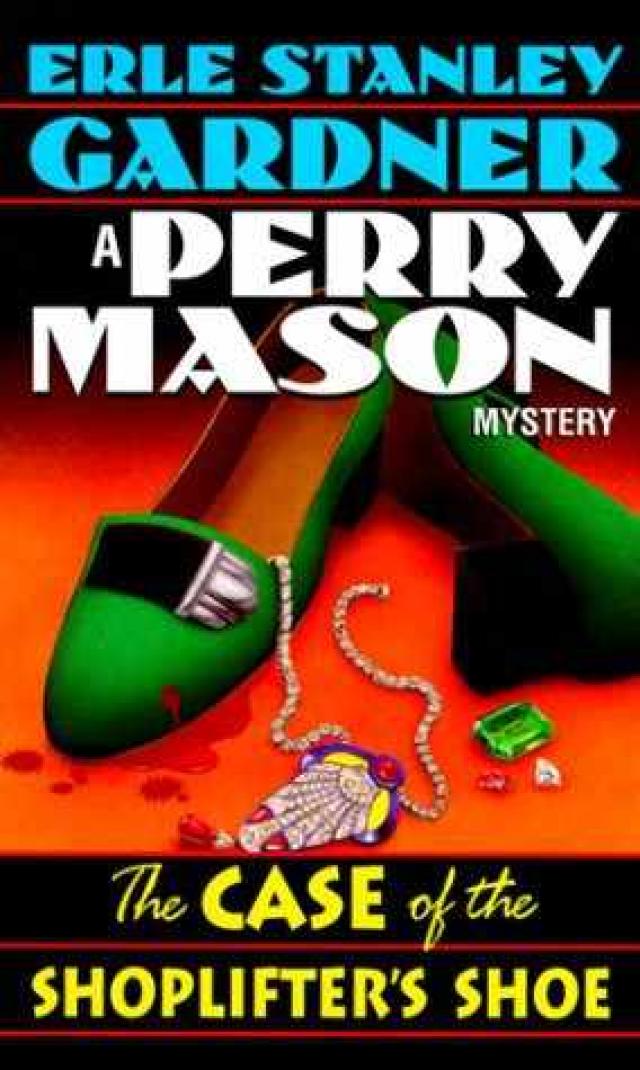
The case of the shoplift.., p.18
The Case of the Shoplifter's Shoe,
p.18


Drake, staring at the unbroken expanse of plaster, said, “Do you suppose it’s somewhere else?”
“No,” Mason told him. “They’ve pulled it out, lock, stock, and barrel.”
“Why? Because it served its purpose?”
“No,” Mason said, “because they knew we were wise to it.”
“How did they know that?”
Mason said, “It’s my fault, Paul. I didn’t realize it until afterwards.”
“Realize what, Perry?”
“You remember that after I discovered the microphone, I went out to the typewriter and typed out a message.”
“Yes.”
“The sound of that typewriter,” Mason said, “sounded plainly over the dictograph. They could tell from the uneven tempo and the ragged touch that I was writing something on the machine. They knew you were in the room, and they knew Della Street was in the room. The only reason I’d have typed anything under those circumstances would have been for the purpose of giving you a silent message.”
“And so they pulled the dictograph out?”
“Exactly,” Mason said. “They were afraid I’d try to bring them in for contempt of court, or make a squawk which would get public sentiment in my favor.”
“You mean that now they’ll deny there was ever a dictograph in there?”
“Probably they won’t go that far,” Mason said, “but they’ll certainly deny they knew anything about it or had anything to do with it.”
Drake said bitterly, “They talk about the tricks of criminal lawyers, but you know and I know that if we tried to pull the stuff the police pull, we’d be in jail before night.”
Mason shrugged his shoulders. “That’s neither here nor there, Drake. I had a chance to make a squawk on that dictograph and chase down the wires, find where they led, and do something about it. I passed up that chance. Now, I won’t have another one.”
“How long do you suppose it has been in, Perry?”
“I don’t know.”
“And the prosecution knows pretty generally what we’ve found out and what lines we’re working on?”
“Yes.”
“What,” Drake asked, “are you going to do about it?”
“I’m going to ignore it,” Mason told him. “When you can’t prove anything, it’s foolish to get all worked up over it…. Now here’s what I want, Paul: I want you to concentrate on this man Diggers. It’s becoming exceedingly important to find out about that bag.
“In the first place, I’m not so certain they can identify that bag as having belonged to Sarah Breel. In the second place, I don’t think the gun was in the bag. The gun was found lying on the pavement where it looked as though it had fallen from the bag, or had been knocked out of Mrs. Breel’s hand. I think when Diggers mentioned that the gun was in the bag, he wasn’t referring to the fact that he found the gun in the bag, but that he assumed it must have …”
“I’m afraid you’re barking up the wrong tree on that, Perry,” Drake told him.
“How so?” Mason asked.
“They’ve been working on Diggers themselves, and they have him sewed up. Did you see the papers tonight, Perry?”
“You mean the statement of the D.A. that Golding and Eva Tannis have both identified Sarah Breel as having been at the scene of the murder at the time it was committed?”
“Yes.”
Mason nodded and said, “That’s what I wanted to see you about, Paul. I want you to dig into their records. I want you to uncover everything you can which has been suspected but hasn’t been proven. And I want them to know you’re doing it. In other words, don’t be too secretive about it. Be just a little crude. Let word get back to them of what’s happening.”
Drake nodded and said, “O.K. You want to frighten them so they’ll skip out, Perry. Is that the idea?”
Mason said, “I’d hardly want them to disobey a subpoena which had been served on them. Of course, if they get frightened and pull out of their own accord, that’s something else again. Now that their statement has been played up in the newspapers and in interviews issued by the district attorney’s office, it’s going to look like the devil if they don’t show up at the time of trial.”
“You mean you’d make them the goats?”
“I’d insinuate they committed the murder, yes,” Mason said.
“And planted the gun?”
“Naturally.”
“I’m afraid,” Drake warned, “you’re underestimating the sincerity and ability of this chap Diggers. Personally, I think the D.A. has hypnotized him into thinking a lot of things happened which just didn’t happen. You know how it is on something like that. A person runs directly in front of an automobile. The automobile comes to a stop very shortly after the impact. The driver’s naturally pretty much excited. I’ve seen quite a few of them so jittery they couldn’t write their own names at the bottom of a traffic ticket. Naturally, a person has a confused recollection of what happened. Usually, if you get the straight of it, it’s a series of images which are burnt in on the brain. Later on, as a man tells the story over and over, those images gradually assume sharper details—but those details are usually supplied by some clever lawyer…. It’s not perjury, it’s simply a question of exerting legitimate influence…. Incidentally, Perry, I don’t think you’ll get anywhere arguing with Diggers on the witness stand. He’s so absolutely sincere.”
Mason said, “The D.A., by the way, is rushing through an indictment, and wants to try Mrs. Breel while public emotion is at its height.”
“Why?” Drake asked.
“Publicity for one thing, and for another, he thinks it’s a good chance to get a conviction.”
“Just what do I do?” Drake asked.
“You,” Mason told him, “dig up everything you can. I have my back to the wall. I can’t afford to overlook any bet. When I walk into that courtroom, I want to know more about the case than the D.A. does.”
“How soon will they come to trial?” Drake asked.
“Perhaps within a week,” Mason told him, “as soon as they can get Mrs. Breel into court in a wheel chair.”
“I can dig up a lot in a week, Perry.”
Mason grinned with his lips. His eyes showed the strain under which he was working. “Get plenty,” he said, “because I may need it.”
Chapter 15
Larry Sampson, the deputy district attorney who was selected to try the case of the People vs. Sarah Breel, looked across his desk at the somewhat apprehensive features of Harry Diggers. “Now, all I want you to do,” Sampson said, “is to tell the truth, the whole truth, and nothing but the truth; but I don’t want you to lean over backwards. Do you understand?” Diggers nodded.
“Perry Mason is a clever lawyer. He has all sorts of tricks for breaking people down on cross-examination. You’ve got to watch out for him.” Again Diggers nodded.
“Now, I want you to remember one thing,” Larry Sampson went on. “When the district attorney of this county goes into court and asks for a verdict of first-degree murder, the defendant is guilty. The district attorney’s office would never ask for a first-degree verdict against a defendant about whose guilt there was the slightest doubt. Unfortunately, murderers are able to secure tricky criminal lawyers to represent them. The percentage of acquittals in this country is a national disgrace. Now, I want you to remember that when you get on the witness stand, you’re engaging in a public duty; you cease to be an individual, you become a witness in a murder trial; you become a person who is testifying to certain facts, and it becomes your duty to see that the jury understands those facts, and comprehends them. Now, we have a perfect case against Mrs. Breel. She’s committed cold-blooded deliberate murder. We can prove that she committed that murder, and bring her to justice, if you keep your head. If you get rattled on cross-examination, we can’t do it. Now, let me run over the facts, briefly, as I understand them. You were going along about twenty or twenty-five miles an hour, weren’t you?”
“Well, I wasn’t looking at the speedometer.”
“But,” Sampson said, “you were in a twenty-five-mile-an-hour zone. You’re a law-abiding citizen, aren’t you, Mr. Diggers?”
“Well, yes.”
“And you’re not a speeder?”
“No.”
“Therefore, you would assume that you were keeping within the legal speed limit, isn’t that right?”
“Yes, I guess it is.”
“All right, remember that,” Sampson said. “You don’t need to give the process of reasoning by which you arrive at that conclusion. Simply state positively that you were going not faster than twenty-five miles an hour, and stay with that statement. Now then, the defendant stepped out right in front of your headlights, didn’t she?”
“Yes, that’s right,” Diggers said positively.
“And before you could bring your car to a stop, you’d struck her. Is that right?”
“Yes.”
“And, as you struck her, she fell to the pavement?”
“I swerved my car, and pretty near missed her,” Diggers said. “I couldn’t quite make it. The edge of one of the fenders brushed against her, and she went down.”
“I understand,” Sampson said. “Now, let’s pay particular attention to what happened after that. You stopped your car almost instantly, didn’t you?”
“Yes, I’d started to stop, of course, before I hit her.”
“And you jumped out of your car, and ran around to where she was lying?”
“Yes.”
“And she was lying face down on the pavement?”
“Well, sort of on one side—more face down, I guess, than on the side.”
“She was carrying this bag when you struck her, wasn’t she?”
“Well … I guess …”
Larry Sampson interrupted positively, “Now that’s just the thing I want to warn you against, Mr. Diggers. I know that you’re an honest man, I know that you’re trying to be fair; I know that whenever you hesitate in answering a question, you’re trying to reconstruct in your mind the sequence of events; but, a jury won’t understand that. The minute you start hesitating on the witness stand, the jury will say, ‘Here’s a man who doesn’t remember very clearly what happened.’ You see, Mr. Diggers, all witnesses that get on the stand know that they’re going to be subjected to cross-examination. Therefore, they think things out pretty carefully, so the attorney on the other side can’t make fools out of them. Jurors are accustomed to hearing witnesses speak right up. Now, you know whether she was carrying that bag. You don’t want Perry Mason to get you out in public and make you look ridiculous, do you?”
“No, I don’t, but I …”
“And you don’t want to appear in the position of being a careless driver?”
“I wasn’t careless,” Diggers said. “There was nothing any human being could do. She ran out right in front of the headlights and …”
“Yes, but you don’t want the public to think you didn’t see her when she ran out in front of the car, do you?”
“Why, of course not, I saw her. I saw her the minute she stepped off the curb, but it was too late to do anything about it.”
“And how far did she run from the curb before she got in front of your car?”
“I don’t know, four or five steps, probably.”
“And you saw her all of that time?”
“Yes.”
“You saw her face, you saw her hands, you saw her feet, didn’t you?”
“Well, yes, if you put it that way.”
“Now, she must have been carrying that bag in her hand. She certainly didn’t stand on the curb and throw it out in the middle of the road, did she?”
“No, of course not.”
“Then she must have been carrying it in her hand?”
“Yes, I guess that’s right.”
“Don’t guess,” Sampson said. “Of course, I know that’s just a figure of speech, Mr. Diggers, but you can see what would happen if you got on the witness stand and made a statement like that. Perry Mason would level his forehead at you, and say, ‘Oh, you’re guessing, are you?’ And then he’d have you on the defensive, and the first thing you knew everybody in the courtroom would be laughing at you.”
Diggers fidgeted uneasily, and said, “I don’t see why I just can’t tell what I saw, and let it go at that.”
“You can,” Sampson said. “That’s exactly what I want you to do, Mr. Diggers. But in justice to you, and in justice to me, and in justice to the people of this State, I want you to be sure to tell what you saw in such a clear-cut, positive manner, that you can’t be trapped, on cross-examination, into being made to appear foolish. Now, do you see what I’m driving at?”
Diggers nodded.
“Now, then,” Sampson went on, “if you saw her hands, you must have seen her bag, because she must have been carrying the bag in her hand. Perhaps you’ve never thought of it in exactly that way before. Perhaps you haven’t reconstructed the scene in all of its details, but after you leave the office I want you to go over the thing in your mind’s eye, so that you can see exactly what happened, in just the way it happened. Now, in regard to the contents of that bag—you had the ambulance driver check on the contents, didn’t you?”
“I certainly did,” Diggers said, “and it’s a good thing I did, too; with all those diamonds in the bag, she might have claimed there was a shortage; she might have claimed I not only hit her, but swiped a diamond or two …”
“Exactly,” Sampson said, “that’s just the point I’m going to make in front of the jury, that your action in having the inventory of that bag made, was the action of a careful man, it was the action of a thoughtful man; it was the action of a law-abiding citizen; it was the action of a man who doesn’t lose his head in an emergency. It shows that you were cool, that you were calm and collected; that you saw exactly what was taking place, and that your testimony is to be trusted…. Now, you found the gun in the bag, didn’t you?”
“Well, the gun was just outside the bag, lying on the pavement.”
“Not outside of the bag,” Sampson said, “the gun could hardly have been entirely out of the bag. You must have seen just a part of the gun protruding from the bag. You see, that’s one of the things the lawyers will try to trap you on. They’ll try to make you swear that these things weren’t in the bag when you first saw them. Now, there’s a distinction between being in the bag, and being visible through an opening in the bag, and I want you to be careful to remember that. In other words, Mr. Diggers, you haven’t anything to fear if you get on the stand and tell the truth, the whole truth, and nothing but the truth; but I want you, in justice to yourself, and in justice to me, to be sure it’s the truth you’re telling and I don’t want you to guess; and I don’t want you to hedge. I don’t want you to testify to what happened as though it was a conclusion on your part, but I want you to testify to facts, in a manner which shows they are facts. And above all, I don’t want you to let Perry Mason make a fool of you. Remember that when he starts cross-examining you, he may appear to be friendly. He may appear to be just trying to help you get your testimony straight; but regardless of the way he starts out, what he’s really doing is trying to trap you; he’s trying to get you off guard, trying to lull you into a sense of security, so he can trick you into making some indefinite statement; so he can get you to say, ‘I think,’ or ‘I guess,’ or ‘It seems to me,’ or something of that sort. Now, you’re a reasonably intelligent man, Mr. Diggers. Do you think that I can depend on you to hold your own when you get on the witness stand, and not be trapped into telling some lie?”
“I won’t lie,” Diggers said. “I’m going to tell the truth.”
“That’s exactly what I want,” Sampson told him. “That’s your duty to yourself and as a citizen. Now, I want you to go home and keep thinking over and over in your mind what happened until you can see it clearly. I want you to visualize everything which took place, just as though you were looking at a motion picture. Sarah Breel ran out from the curb. You saw her for four or five steps; you saw her hands plainly; you saw the bag in her hand; you saw her run in front of the automobile; you swerved the automobile and put on the brakes; you struck her; you got out and ran around the car; she was lying there, partially on her side, her face down; the bag was lying in front of her where it had been dropped. You looked down at the bag, and the first thing you saw was a gun, partially protruding from the bag; you stopped a passing motorist for help; you summoned an ambulance, and you checked the contents of the bag with the motorist and with the ambulance driver; you found these diamonds when you made that inventory.
“Now, you testify to those facts, and don’t let anyone rattle you. And remember, Mr. Diggers, I’m depending on you. The district attorney’s office is depending on you.
“Now, I have an appointment, which I’ll have to keep, so I’ll let you out through this door. The trial comes up day after tomorrow. We’re rushing it through. We had the Grand Jury indict Mrs. Breel, so we could dispense with a preliminary examination. We’re not going to waste any time. Remember, Mr. Diggers, we’re going to depend on you.”
And Sampson, with his hand on Diggers’ arm, escorted him to the door, pumped his arm up and down effusively, closed the door behind his departing visitor, and rubbed his hands together with a gesture of smug satisfaction.
Chapter 16
Judge Barnes, taking his place on the bench, looked over the crowded courtroom with judicial gravity, glanced down at the lawyers seated at their tables, and said, “Before starting this case, the Court wishes to say a few words to the gentlemen of the press, who are assembled here. The court realizes that occasionally judges try to enforce a ruling that there will be no picture taking. The result is that some of the more ingenious members of the press manage to smuggle in concealed cameras with high speed lenses, and obtain surreptitious pictures.
“This Court has always felt that the public were entitled to know what goes on in important trials. The Court’s objection to photographs has been due to the interruption of proceedings, and the confusion incident to the exploding of flashlights. Therefore, gentlemen, I want it understood that there will be no flashlight pictures taken while Court is in session, nor are there to be any so-called candid-camera shots taken which will have a tendency to annoy the parties, distract the attention of the witnesses, or counsel. In other words, gentlemen, I am leaving the matter of photographs in your hands, and depending upon your good taste, and your ability to co-operate with the Court. In the event you abuse the privilege, it will be withdrawn.