The case of the shoplift.., p.2
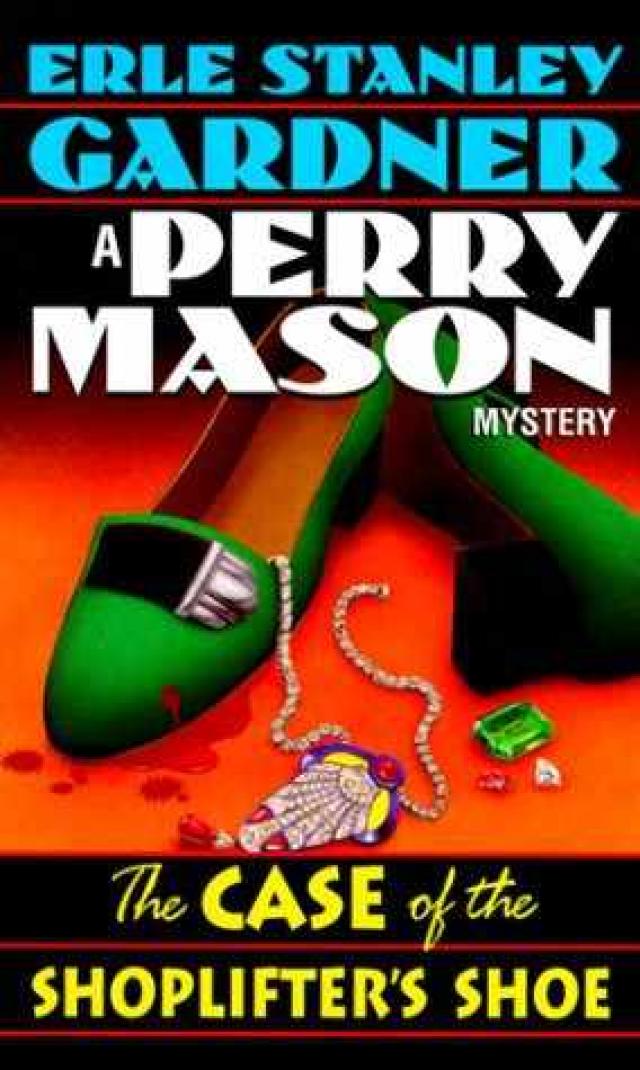
The Case of the Shoplifter's Shoe,
p.2


“I said come down to the office.”
Once more the girl indicated her open checkbook. “I’ve repeatedly tried to tell this man,” she said, “that my aunt has merely been shopping. If you’ll be so good as to give me the total amount of her purchases, I’ll gladly make out a check.”
The manager glanced from the placid face of the unperturbed woman to the girl, then to the urbane lawyer. He took a deep breath, accepted defeat, and bowed as he said, “I’ll have these purchases wrapped. Shall we deliver them, Madam, or would you prefer to take them with you?”
“Just wrap them and bring them here,” the white-haired woman said, “and if you’re the manager, will you kindly tell one of the waitresses to give this table some attention…. Ah, there you are, my dear. I think we’ll have two cream of tomato soups, and I want chicken croquettes. What would you like, Ginny?”
The young woman, her cheeks crimson, shook her head and said, “I can’t eat a thing, Aunt Sarah.”
“Nonsense, Ginny! You mustn’t let yourself be disturbed by little things. The man was clearly in error. He’s admitted his fault.” She raised her eyes to Perry Mason. “And I believe, young man, I’m somewhat obligated to you. I’ll take one of your cards, if you don’t mind.”
Mason smiled, glanced at Della Street as he passed over one of his cards. “I wonder,” he said, “if you wouldn’t care to join us at our table. We could make a foursome. And,” he added, lowering his voice, and glancing at the young woman, “you might feel less conspicuous.”
“We’ll be glad to,” the white-haired woman said, pushing back her chair. “Permit me to introduce myself. I’m Mrs. Sarah Breel. This is Miss Virginia Trent, my niece. You’re Perry Mason, the lawyer. I’ve read of you, Mr. Mason. I’m very glad to meet you.”
“Miss Della Street, my secretary,” Mason introduced.
Della extended her hand. “So glad to meet you,” she said.
Mason seated the women, apparently entirely oblivious of the curious eyes at surrounding tables. “Go right ahead with your soup,” Mrs. Breel said. “Don’t let it get cold. We’ll catch up with you on the rest of the lunch.”
“I can’t eat a thing,” Virginia Trent said.
“Nonsense, Ginny. Go ahead and relax.”
“Really,” Mason urged, “you’ll find the cream of tomato soup very delicious. It’ll make you forget—the rain.”
She glanced at Mason’s steaming cup of soup, met Della Street’s friendly eyes, and said dubiously, “Food should never be eaten when one’s upset.”
“Don’t be upset, then,” the aunt said.
“Two more cream of tomato soups,” Mason told the waitress. “Rush them up right away, please. And I believe there’s one order of chicken croquettes and …”
“Make it two orders,” Mrs. Breel said. “Ginny likes chicken croquettes. And two pots of tea, my dear, with lemon. And make the tea rather strong.”
She settled back in the chair with a sigh of complete satisfaction. “I always like to eat here,” she said, “they have such wonderful cooking. And, so far, the service has been excellent. This is the only time I’ve had occasion to make any complaint.”
Mason’s eyes twinkled to those of Della Street, then back to Mrs. Breel. “It is,” he said, “a shame that you were annoyed.”
“Oh, I wasn’t annoyed in the least,” Mrs. Breel remarked casually. “My niece, unfortunately, is sensitive about what people think. Perhaps super-sensitive. Personally, I don’t give a hoot. I live my life the way I want, and … Ah, here comes the man with the things. Just put the packages on that chair, young man.”
“How much does it amount to?” Virginia asked.
“Thirty-seven dollars and eighty-three cents, with the tax,” the assistant manager said with dignity.
Virginia wrote out a check. As she entered the figures on the stub and performed the subtraction, Mason’s eyes, actuated by a curiosity which was stronger than the conventions, glanced swiftly at the figures. He saw that after the check had been paid there was a balance of but twenty-two dollars and fifteen cents in the account.
Virginia Trent handed the manager the check.
“If you’ll kindly step down to the office,” he said, “and fill out a credit card.”
“That won’t be necessary,” Mrs. Breel interposed. “We’ll be right here, eating lunch for the next half hour. The bank is in the next block. You can send over and have the check cashed. … I hope you’ve wrapped the bundle securely, young man. It’s raining outside.”
The manager said suavely, “I believe you’ll find the wrapping is quite satisfactory.” He glanced at Perry Mason. “I notice,” he said with dignity, “that you have consolidated your party, Mr. Mason. May I inquire if there’s any intention on your part to file a suit against the store?”
Mrs. Breel answered the question. “No,” she said magnanimously, “I’m quite willing to let bygones be bygones. I think you were frightfully rude…. Here comes the waitress with my soup. If you’ll kindly step back so she can serve me…. Thank you.”
The manager bowed affably. There was the hint of a twinkle in his eyes. “If you find any of these things not entirely satisfactory, Mrs. Breel,” he said, “remember we’ll be glad to exchange them. Perhaps your shopping was somewhat hurried, and you didn’t get just the exact sizes required. …”
“Oh, but I did,” Mrs. Breel interrupted. “I was very careful to get just the sizes I wanted. I’m not exactly a young woman, but I’m not absent-minded. I’m quite certain the merchandise will be satisfactory. I picked the very best that was on display.”
The manager bowed and withdrew. Craning necks followed his progress across the lunch room, then heads came together as the hiss of sibilant whispers filled the room.
Mrs. Breel, apparently utterly oblivious of the interest she had aroused, smacked her lips over the soup and said to her niece, “There, dear, just taste that and see how nice it is. I told you they had wonderful cooking here.”
Virginia Trent showed no enthusiasm over her food, but Mrs. Breel ate her way through the menu with placid enjoyment. No one made any further mention of the shoplifting episode. There were no explanations offered on the one hand, nor, on the other, did Mason ask for any. He threw himself into the part of acting the perfect host, and Della Street, trained by years of experience to read his moods, followed his lead. Gradually, the air of restraint which had settled about the table disappeared. Mrs. Breel’s perfect poise, Mason’s urbane hospitality and Della Street’s sympathetic understanding conspired to make Virginia Trent lose her consciousness of the gaping interest displayed by the curious diners at adjoining tables.
Mason lingered over his demi-tasse, evidently reluctant to terminate the meeting. Finally, however, he summoned the waitress, announcing that a one-thirty appointment necessitated his departure. In the leave-taking, Virginia Trent showed once more a consciousness of the peculiar circumstances which had drawn them together, but none of this was apparent in her aunt’s demeanor.
Back on the street, where patches of blue sky showed between drifting clouds, Mason turned to Della Street. “That,” he announced, “was a break!”
“How did you size them up, Chief?”
“I couldn’t,” Mason admitted. “And, consequently, enjoyed myself immensely.”
“Do you suppose she’s a professional shoplifter?”
“I doubt it. The girl’s embarrassment was too natural.”
“Then why did she do it, Chief—I mean the aunt?”
Mason said, “Now you’ve got me, Della. She’s hardly the criminal type. Back of her somewhere is an interesting background of philosophy…. We’ll chalk it up as one of life’s adventures, an isolated chapter which we can’t understand without knowing what has gone before, yet interesting, nevertheless. It’s like picking up a magazine, getting interested in a serial installment, and reading about characters doing things which don’t make sense because we don’t know what’s gone before, yet getting interested in the people we’re reading about. That’s the way it is in this case: We don’t know what’s gone before and we don’t know what’s to follow.
“A while ago you asked me if learning to know people didn’t make me cynical and I told you it didn’t. The real handicap about knowing people too well is that it takes all the thrill out of life. People become hopelessly drab and monotonous as they become more obvious. Nothing is new. The people one meets become a procession of mediocrities hurrying down life’s pathway on petty errands. But every so often life makes amends by tossing out an experience which can’t be classified. So let’s chalk this up as one of life’s interesting interludes and let it go at that.
Chapter 2
But Perry Mason was wrong in supposing that he was not to know of that which followed. He had disposed of his appointment and was studying a recent case dealing with the admissibility of evidence obtained through wire tapping, when Della Street opened the door from her secretarial office and said, “Miss Trent is in the outer office, asking if she can see you without an appointment.”
“Virginia?” Mason asked. She nodded. “Didn’t say what she wanted, Della?”
“No.”
“And she’s alone?”
“Yes.”
“All right,” Mason said, “bring her in and let’s get it over with.”
He cleared a space on his desk by the simple expedient of pushing back the law books. He was lighting a cigarette when Della Street escorted Virginia Trent into the office. At his first meeting, he had devoted his attention to the aunt. Now he studied the niece thoughtfully as she walked across to seat herself in the big, black leather chair near the lefthand corner of his desk. She was, he saw, a tall, thin girl, with a mouth which showed too much determination and too little lipstick, large, moist gray eyes, clothes which were cut along severe lines, and the slender, slightly nervous hands of one who is very sensitive. “Was there,” Mason asked, “something I could do for you?” and his voice indicated that he had quite definitely ceased to be the genial host and had become the busy lawyer.
She nodded and said, “It’s about my Aunt Sarah.”
“Yes?” Mason asked.
“You saw what happened at lunch. Aunt Sarah didn’t fool me, and I’m quite certain she didn’t fool you. She was shoplifting.”
“Why shoplifting?” Mason asked.
“I’m sure I haven’t the faintest idea.”
“Did she need the things?”
“No.”
“Doesn’t she have enough money to buy what she wants?”
“Of course she does.”
Mason settled back in his chair. His eyes showed interest. “Go ahead,” he said, “I’m listening—but strip it down to essentials.”
Virginia Trent’s gloved hands smoothed the pleats of her gray skirt. She raised her eyes and said, “I’ll have to begin at the beginning and tell you the whole thing. My aunt,” she went on, “is a widow. Her husband died years ago. My uncle, George Trent, never married. He’s a gem expert, buying and selling stones on commission, cutting and polishing, and redesigning. He has an office and a shop in a loft building at nine thirteen South Marsh Street. He keeps from two to four gem cutters and polishers constantly employed…. Tell me, Mr. Mason, are you a student of psychology?”
“Practical psychology,” the lawyer said. “I don’t go much on theory.”
“You have to interpret facts in terms of theory in order to understand them,” she said didactically.
Mason grinned. “It’s been my experience that you have to interpret theories in terms of facts in order to understand theories. However, go ahead. What were you going to say?”
“It’s about Uncle George,” she said. “His father died when he was just a boy. George had to take on the support of the family. He did it wonderfully well, but he never had any boyhood. He never had a chance to play and never …”
“What does that have to do with your aunt?” Mason asked.
“I’m coming to it,” she said. “What I was trying to explain is that Uncle George has an innate repression, a subconscious rebellion against environment which …”
“Which does what?” Mason asked, as she hesitated.
“Makes him get drunk,” she said.
“All right, go ahead,” the lawyer told her. “Never mind the verbal embellishments. He gets drunk. So what?”
“He gets drunk,” she said, “periodically. That’s why I know it’s a subconscious rebellion against a routine environment which …” She checked herself as she saw the lawyer’s upraised hand, and hurried on to say, “Anyway, what I’m getting at is that he’ll be perfectly steady for several months at a time. Then something will happen and he’ll go on one of his benders. Poor Uncle George, he’s so methodical in everything that he’s even methodical about that. When he feels one of these spells coming on, he carefully locks up everything in the office vault, to which my aunt has the combination. Then he takes the ignition keys out of his car, puts them in a stamped envelope, addresses them to himself, puts the keys in the mail and then goes ahead and gets drunk. While he’s drinking, he gambles. Three days to a week later, he’ll show up, completely broke, his eyes bloodshot, usually he’s unshaven, and his clothes are a sight.”
“Then what does your aunt do?” Mason asked, with interest.
“Aunt Sarah takes it right in her stride,” she said. “There’s never a word of remonstrance. She bundles him off to a Turkish bath, takes his clothes, has them cleaned and pressed, sends another suit to the Turkish bath, and, when he’s thoroughly sobered and quite respectable, lets him go back to his office. In the meantime, Aunt Sarah has the combination to the vault. She gets out the stones the men are to work on, and sees that they keep busy.”
“Rather a nice arrangement all around, I’d say,” Mason observed. “They make a nice team.”
“Yes,” she said, “but you don’t realize what all of this is doing to Aunt Sarah. The strain on her nervous system must be terrific. All the more so, because she never gives any external evidences of it.”
“Bosh!” Mason said. “Your Aunt Sarah is a woman who’s looked the world in the face and isn’t afraid of it. She knows her way around, and doesn’t quarrel with life. I venture to say she doesn’t have a nerve in her body.”
“She gives one that impression,” Virginia Trent said austerely, “but I feel quite certain, Mr. Mason, that if we are to account for this peculiar shoplifting complex, we will find that it’s due to a reflex subconscious disturbance.”
“Perhaps,” Mason said. “How long’s this shoplifting been going on?”
“Today was the first intimation I’ve had.”
“And what explanation did your aunt make?” Mason asked, his voice showing his interest.
“That’s just it. She didn’t make any. She managed to avoid me almost as soon as we left the department store. I don’t know where she’s gone. I’m afraid she’s still emotionally upset. I’m afraid her psychic balance has been affected by …”
“In other words, you mean you’re afraid she’s shoplifting again, is that it?”
“Yes.”
“And you think she’s been arrested, and want me to find out. Is that what you’re leading up to?”
“No,” she said, “not exactly.”
“Well,” Mason told her, “let’s make it exact. Just what do you want?”
She shifted her eyes uneasily, then took a deep breath and said, “Very well, Mr. Mason, specifically, I’m afraid that Aunt Sarah has stolen the Bedford diamonds.”
The lawyer leaned forward. “Tell me about the Bedford diamonds.”
“They’re some diamonds belonging to a Mrs. Bedford. They were left with Uncle George to be completely redesigned, placed in more modem settings and brought up to date. There was some recutting to be done. I don’t know all of the details of the order.”
“Am I to gather that your Uncle George is on one of his sprees?” Mason asked.
“Yes. He didn’t come home Saturday night. We knew what that meant. Of course, there was no mail delivery on Sunday, but Aunt Sarah went up to the office and got things all ready for Monday morning.”
“Opened the vault?” Mason asked.
“I believe so, yes. Then, this morning, she went up to the office early, got in touch with the foreman, and they planned out the day’s work. Sure enough, the keys to Uncle George’s car were in the first mail delivery. But there was nothing to indicate where the car was. It wasn’t until shortly before noon the traffic department rang up to tell us it was parked in a thirty-minute zone…. You see, it had been left there Saturday night after the parking restrictions had been removed, and then, of course, Sunday didn’t count. But this morning, the traffic tickets started piling up on the car.”
“So you went and moved the car?” Mason asked.
“Yes. Aunty and I went together. We picked up the parking tickets, and moved the car into a garage. Aunt Sarah had some shopping she wanted to do, and I wanted to get a pair of shoes. We went into the department store, and I was getting my shoes and thought Aunt Sarah was standing right behind me. Then suddenly I missed her…. You know what happened after that.”
“And you found her up in the tea room?” Mason asked.
“Yes, I’d been looking all over the store for her. I found her up there just before … well, you know.”
“All right,” Mason said, “tell me some more about the Bedford diamonds.”
“The Bedford diamonds,” she said, “came to us through Austin Cullens.”
“Who’s he?”
“He’s an old-time friend of the family. He’s known George and Sarah for years. He does a great deal of traveling, is quite a gem collector, and knows lots of interesting people. Uncle George does work quite well and very cheaply, and Mr. Cullens is frequently able to get him some very lucrative business. You see, Mr. Cullens spends a lot of time on shipboard, gets to talk with people about gems, knows a good many gem collectors, and, all in all, is a very valuable business connection for Uncle George.”
“When did the Bedford diamonds come in?” Mason asked.