The case of the worried.., p.15
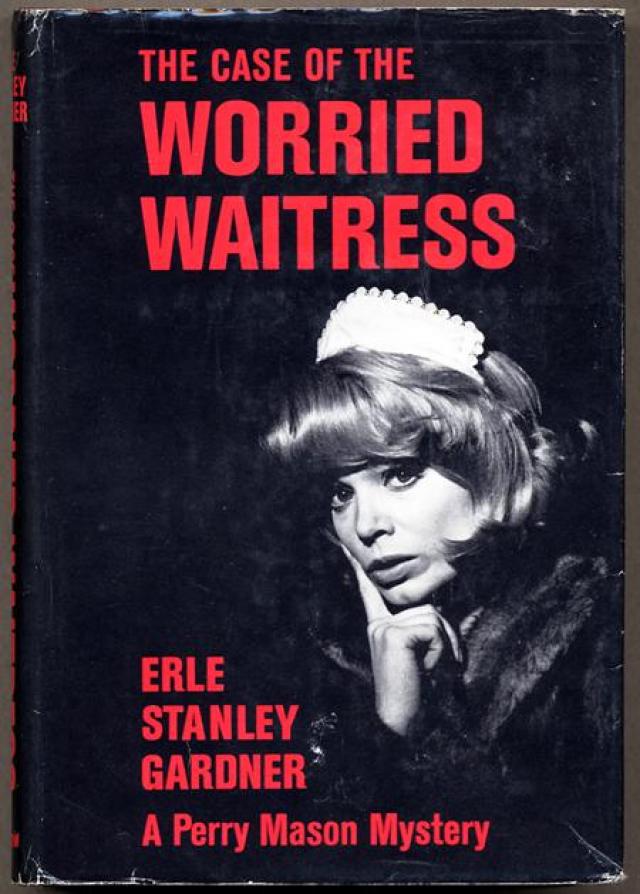
The Case of the Worried Waitress,
p.15


“You’re going to make this discovery public?”
“When we discover a cash deposit of this size,” Lt. Tragg said, “we don’t cut any corners. We put our cards on the table face up. Hamilton Burger will know about this within the next twenty minutes. And in the meantime, gentlemen, there’s no reason for us to detain you any longer. Your services as bird dogs are very much appreciated. You’ll probably be hearing from the District Attorney before the day is out. In the meantime, and at least temporarily, you are free to leave, and that is what I want you to do.”
As Mason and Paul Drake were escorted to the head of the stairs by the officers and went slowly down the stairs, Drake turned to Mason. “All right, Perry,” he said, “this is your party. What do we do next?”
“I’ll tell you what we do next,” Mason said, “but I won’t tell you until we get out of the house.”
After they had left the house and were starting down the walk toward the car, Mason said, “We’ll have a blank subpoena issued on behalf of the defense in the case of People versus Katherine Ellis and we’ll serve the subpoena on the blind woman. And that is going to be one hell of a job, Paul.
“You’re going to have to have operatives watching the front and back of that house. You’re going to have to put someone on duty at the Gillco Manufacturing Company, and you’re going to have to serve a subpoena on Mrs. Gooding.”
“The manager of the flats?” Drake asked in surprise.
“The manager of the flats,” Mason said.
“Why her?”
“Because,” Mason said, “we’ve been taken in by a monumental hoax. When we were ringing Mrs. Gillman’s doorbell, trying to get in touch with the blind lady, she was telephoning Mrs. Gooding, asking her to find out what it was all about. And when it appeared that we were determined to either get in the blind woman’s apartment or make trouble, Mrs. Gooding let the blind woman slip down the back stairs and into her apartment while we went up and searched the apartments on the second and third floor.
“That whole second-floor flat or apartment is just a big showcase. The blind woman is really living with Mrs. Gooding. By the time we get done we’ll find that Mrs. Gooding does the cooking, does the cleaning, and that upstairs apartment is a show place.”
“What makes you think so?” Drake asked.
“The place didn’t have the feeling of having been lived in,” Mason said. “It had a musty, stale atmosphere. What’s more, there was no one in the apartment or flat on the third floor. I wouldn’t be too surprised if the blind woman doesn’t own the whole building and Mrs. Gooding is just a front.”
“Well, don’t you want to talk with her before you put her on the stand?” Drake asked.
Mason smiled and shook his head. “We’re going to have the whole thing come out in court,” he said. “When I talk with that woman, she’s going to be under oath and she’s going to know that any further cover-up will do her no good.
“If I rip the masquerade off and drag her into court, she’s going to resent it and the Court will be suspicious. But if I serve a subpoena on her, drag her into court as a witness, and talk with her for the first time in court and she then has to tell the truth, some good may come of it.”
“And in the meantime?” Drake asked.
“Oh, in the meantime,” Mason said wearily, “Hamilton Burger will let the newspapers in on the secret of the big cache of money-Radio, television and newspapers will blazon the fact that three hundred thousand dollars in cash was found in the house of the woman who was assaulted and is lying at the door of death that this large sum of cash furnishes the motivation which the police had only suspected but were unable to prove until brilliant detective work on the part of Lieutenant Tragg of the Homicide Squad brought the secret to light, much to the embarrassment of Perry Mason and a private detective who had plans of their own.”
“And you’re going to take a chance on this whole case on what the testimony of the blind woman will be?”
“I’m going to do just that,” Mason said. “Sophia Atwood, with a hatbox in her closet full of hundred-dollar bills, a hidden receptacle in the house with packages of hundred dollar bills Stuart Baxley, a friend of the family Bernice Atwood, the legal widow of Gerald Atwood the fact that the blind woman is at least going under the name of Gillman the fact that there’s a fight on for control of the Gillman Manufacturing Company the fact that when Sophia Atwood realized Katherine Ellis had uncovered the hatboxes full of hundred-dollar bills in the closet, she went to all those elaborate pains to lose a single hundred-dollar bill under such circumstances that she could ask the assistance of Stuart Baxley, the fact that Hubert Deering, the son of Bernice Atwood, is pussyfooting around the Gillco Manufacturing Company, and the fact that the blind woman has someone in the company who’s feeding out information, and when the blind woman can’t be there to get the information, Sophia Atwood would take a turn at selling pencils.”
“That pencil selling was a cloak for industrial espionage?” Drake asked.
Mason nodded.
“But why couldn’t whoever was giving the information tc the blind woman simply mail her a letter or call her on the phone?”
“Because he was also getting instructions at the same time he was giving the information,” Mason said. “And the blind woman wanted to give her orders in person.”
“A blind woman giving orders?” Drake asked.
“Exactly,” Mason said.
Chapter 18
Judge Churchill said, “Am I to understand, Mr. District Attorney, there have been rather dramatic developments in connection with this case during the last twenty-four hours?”
“That is right, Your Honor. I would like to put Lieutenant Tragg on the stand.”
“Very well.”
Tragg took the witness stand, testified to the fact that he and an officer had had a stake-out in the Sophia Atwood house that they felt the attorney for Katherine Ellis had received information from his client which would cause him to return to the house that while they had been waiting, Mason and Paul Drake had entered the house, had climbed the stairs, gone to a room where a water cooler had been upset, had found a secret hiding place, and that when Mason and Drake were preparing to leave the officers had confronted them, had taken an inventory of the cash in the hiding place and found that it amounted to three hundred thousand dollars in hundred-dollar bills.
“Cross-examine,” Hamilton Burger said.
Mason, in a bored, listless tone, said, “No questions.”
Hamilton Burger put on witnesses showing that the flashlight, which had evidently been used as a weapon to club Sophia Atwood, had the unmistakable fingerprints of the defendant.
When he had finished with the fingerprint expert and said, “Cross-examine,” Mason asked just one question. “You can’t tell when those fingerprints were made, can you?” he asked.
“No,” the expert admitted. “They could have been made at the time of the assault, or they could have been made sometime previously.”
“No further questions,” Mason said.
The neighbor testified to the surreptitious midnight visit by the defendant. Again there were no questions on cross examination.
Hamilton Burger called the taxi driver, who testified to having been called to make the trip to Sophia Atwood’s house, had been cautioned against making unnecessary noise.
Judge Churchill from time to time regarded Mason thoughtfully, apparently convinced that the lawyer’s attitude of almost bored indifference was due to the fact that Mason had surrendered to the inevitable and considered that the startling developments of the last twenty-four hours would result in an order binding the defendant over.
When Hamilton Burger rested his case, Judge Churchill showed the direction of his thoughts.
“It now appears,” he said, “that there is certainly sufficient prima facie evidence to justify an order binding the defendant over. I didn’t feel that way yesterday, but the present evidence is … “ The judge broke off as Mason rose to his feet and stood, quite apparently waiting for an opportunity to get in a word.
“If the Court please,” Mason said, “I desire to put on a defense. I have subpoenaed a witness who is, I believe, totally blind. Her name—or at least the name under which she is going—is Mrs. Gillman. The subpoena has been duly served, and in the event Mrs. Gillman is not here in court, I would like to have a bench warrant issued to bring her in.”
A woman on one of the back seats arose and said, “Mrs. Gillman is here in response to the subpoena. I will bring her in.”
Mason nodded and seated himself.
“Well,” Judge Churchill said in the silence which followed, “you certainly have a right to put on witnesses for the defense. Of course you understand, Mr. Mason, this is not a case where we usually try the credibility of the various witnesses. The Court takes the testimony of the prosecution at it face value, and if it makes a prima facie case, the defendant is bound over for trial in the Superior Court regardless of any conflicts in testimony.”
“I understand,” Mason said.
The door at the rear of the courtroom opened and Minerva Gooding entered. On her arm was a woman wearing heavy dark glasses, singularly erect, holding a black-and-white striped cane, walking with a certain assurance and clothed with a regal dignity.
The woman was guided to the witness chair, held up her right hand and was sworn, giving her name as Sophia Gillman.
Mason approached the witness stand. “Mrs. Gillman,” he said, “have you ever seen me in your life?”
“I haven’t seen anyone for the last ten years,” she said.
“Have I ever talked with you?”
“No. I have, however, heard your voice.”
‘When?”
“When you were talking with Minerva Gooding about me and about getting into my flat and about my connection with Sophia Atwood. I don’t know how you found out as much as you did, but I felt then the fat was in the fire.”
Hamilton Burger exchanged puzzled glances with Lt. Tragg, then arose and said, “Is this at all pertinent, Your Honor?”
“It’s going to be connected up,” Mason said.
“Well, I think we should have the connection first,” Hamilton Burger said.
“Very well,” Mason said, and turned to the blind witness. “What is your relationship to the defendant, Katherine Ellis?” he asked.
“I am her aunt Sophia,” the woman said with dignity.
“What?” Hamilton Burger exclaimed incredulously and then after a moment sat down, all the fight gone out of him.
“And who is the woman who lived in the house and who is known as Sophia Atwood?” Mason asked.
“That was my one-time nurse, Mildred Addie.”
“And Mildred Addie impersonated you with your consent?” Mason asked.
“That is correct.”
“Would you please tell us the story?”
The witness said wearily, “I guess there’s no use trying to hold out anything more now. I am Sophia Ellis Gillman. I had no family except my brother, who was a nice individual but a spendthrift. He worshiped success and had no time to waste on poor relatives.
“The only living soul who took any interest in me was Katherine Ellis. She is, I believe, the defendant in this action. I am sorry I cannot see her.
“Mildred Addie had a rather remarkable resemblance to me in many ways. She worked for me as housekeeper, and then, when I became blind, I had her assume my identity. However, I’m getting ahead of my story.”
“Please go on,” Mason said.
The courtroom was completely silent, spectators leaning forward to hear better, Judge Churchill regarding the witness in wide-eyed amazement.
“I entirely lost track of my family for some time,” the witness went on.
“Then I realized I was going blind. In the meantime, however, I had amassed a considerable fortune.
“I didn’t want sympathy because of my affliction, or for any other reason, and I didn’t care to have my brother, who had asserted his independence as far as a poor relative was concerned, coming honeying around me with any of his wild-eyed promotional schemes.
“I had married Jerome Gillman, who had founded the Gillco Manufacturing Company. He died and left me considerable property. Among the things that he left was a big block of stock in the Gillco Manufacturing Company. He also left a son by another marriage, a worthless, no-good nincompoop—Spencer Gillman, now head of the company.
“It is inconvenient for a blind woman to have a bank account, and it is highly inadvisable for one to let it appear that she has any great amount of worldly wealth. I therefore arranged with Mildred Addie—who was posing as me—to build a place of concealment in the house. From time to time I would visit the place and leave money or securities— mostly money. Because I had lived in the house for years, I knew every foot of it and could walk around at any hour of the day or night with complete assurance.
“Then Mildred—still posing as me—fell in love with Gerald Atwood, a married man who had separated from his wife but who had neglected to go through the formalities of a regular divorce.
“That complicated the situation tremendously. I was forced to write to my brother that I had married Gerald Atwood. I didn’t like to do this, but otherwise I would have jeopardized the entire structure.
“Then my brother and his wife were killed in an auto accident, and shortly afterward Gerald Atwood dropped dead on the golf course. Atwood’s grasping wife grabbed everything she could get her hands on. Katherine, the defendant in this case, was wiped out financially and left all alone.
“I told Mildred Addie to write Katherine, as Sophia Atwood, and ask her to come and visit. I wanted an opportunity to size up the young woman and to see whether she was a spendthrift like her father or whether she had a good sound basis of common sense.
“I instructed Mildred how to act, and everything was proceeding beautifully until somehow word got around that there was cash being stored in the house. That caused trouble.
“I suppose things would have come to a head anyway, because there was a battle on for proxy control of the Gillco Manufacturing Company. And Spencer, whom I detest— the son of Jerome Gillman by an earlier marriage—knew that his father had left me this stock, that it had been transferred to me and stood in my name, but he didn’t know where I was. He began, however, to think that Mildred Addie, who was living as Sophia Atwood, was actually the woman who had his stock.
“By posing as a blind woman, I kept in touch with people in the company who know what a crook Spencer is and want him out of there. But Spencer is smart. He got Stuart Baxley to enter the picture. He was to cultivate Mildred and get the run of the house. I warned Mildred about him, but she wouldn’t listen. She was self-willed at times.
“Well, that’s what she got for it. She got clubbed over the head.”
“Do you,” Mason asked, “know who hit her with the flashlight?”
“I do not. All I know is it must have been someone who moved that water cooler and left it where I’d upset it. I was never so frightened in all my life. I was moving just as I had always moved, and suddenly I collided with this water cooler and sent it crashing to the floor. Then I heard a man running and men’s voices. I had to go down the back stairs and out the back door—which was all right because Minerva Gooding was waiting for me in the alley in her car.
“But as to the night of the assault, I never went near the place. I don’t know a thing about it.”
“Thank you, Mrs. Gillman,” Mason said. “That is all.”
The blind woman arose and waited for her escort to pilot her back to her seat.
As she passed the table where Mason was sitting, Katherine Ellis said in a choked voice, “Aunt Sophia!”
“Kit,” the woman said, groping her way toward the sound of Katherine Ellis’s voice.
The two women embraced.
Judge Churchill waited for a long moment before he tapped gently with his pencil.
“It’ll be over shortly,” Mason said in a low voice to the blind woman, and then turned to the Court. “If the Court please,” he said, “I would like to recall Lieutenant Tragg as my witness.”
The Judge, now frankly curious, said, “Lieutenant Tragg to the stand.”
“Lieutenant,” Mason asked, “did it occur to you that the person who moved that glass water cooler must have left fingerprints all over the glass container?”
“Well, not all over it,” Lt. Tragg said. “And I admit that I fell down on the job there at first, but the glass was still in place and we did dust it for latents.”
“And did you uncover some latents?”
“We did a very good set of fingerprints and, moreover, palm prints—undoubtedly the prints of the person who had half lifted, half dragged the water cooler away from the corner where it had been located.”
“And did any of the fingerprints you recovered match fingerprints found on the five-cell flashlight which had been apparently used as a weapon?”
“Two or three of the prints were the same, yes—but we don’t know whose fingerprints they are.”
“You do know definitely they are not those of the defendant?”
“Yes, sir.”
Mason said, “That’s all, Lieutenant. Thank you.”
Tragg exchanged a puzzled glance with Hamilton Burger.
Burger started to make some remark to the Court, then, after he had got to his feet, thought better of it and slowly sat down.
Mason said, “My next witness, if the Court please, is going to be a hostile witness. I ask the privilege of asking leading questions.”
“Who is this witness?”
“Hubert Deering.”
“Very well,” Judge Churchill said. “We will reserve ruling on the hostility of the witness until that hostility has been established.”
“I notice that Mr. Deering is in court,” Mason said. “I would like to have him take the stand.”
Hubert Deering, the same lightly built individual whom Mason had encountered at the office of the Gillco Manufacturing Company, arose and strode to the stand, his manner aggressively self-confident. He held up his hand, was sworn, and turned to Mason with animosity apparent on his face.