The case of the worried.., p.16
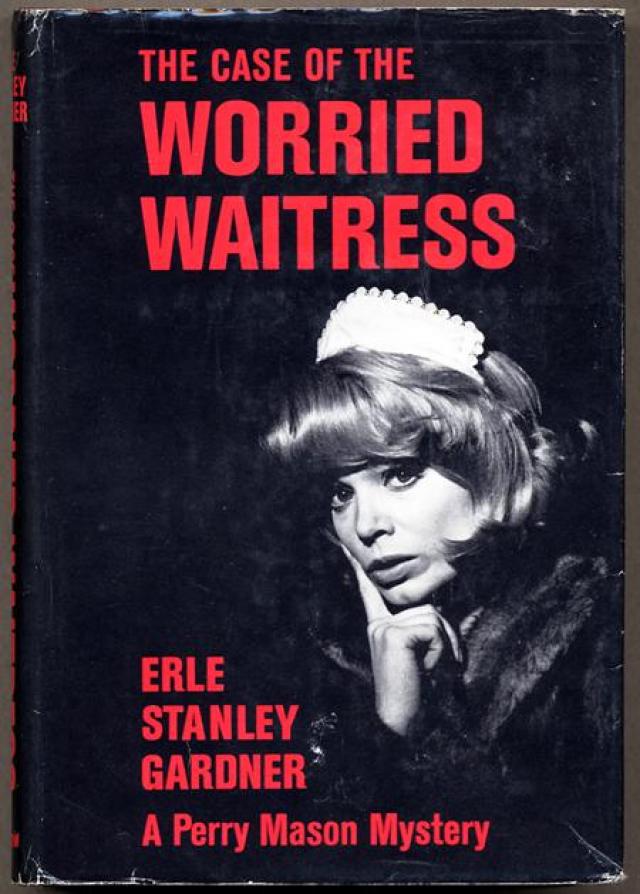
The Case of the Worried Waitress,
p.16


“You are the son of Bernice Atwood?” Mason asked.
“I am,” the witness snapped.
“You are having some business dealings with Spencer Gillman?”
“That is none of your business.”
“I am not asking as to the nature of the business in detail,” Mason said. “I am simply asking you a question which can be answered ‘yes’ or ‘no’ as to whether you have any business dealings with Spencer Gillman or have been having any business negotiations with him.”
“That is none of your business.”
Mason crossed to the defense table where Della Street handed him a polished metal clipboard containing a sheet of paper.
The lawyer, holding the clipboard by its edges, approached the witness stand, extended the clipboard to the witness.
“Attached to this clipboard,” he said, “is a carbon copy of a letter to Gerald Atwood about a will. I am going to ask you to study this carbon copy carefully and tell me whether you have ever seen the original letter of which that is a carbon copy.”
Mason pushed the metal clipboard into the hands of the witness.
The witness took the metal clipboard, glanced at the carbon copy of the letter, said, “What’s all this got to do with this case?”
“I am asking you,” Mason said, “if you ever saw the original letter of which that purports to be a carbon?”
“I understand the question. I’m asking you what that has to do with this case?”
“I’m going to connect it up,” Mason said.
“Have you seen that letter?”
The witness hesitated, then said defiantly, “All right, I saw that letter. My mother showed it to me. She was all excited about it. I told her it was a plant—something that you had devised as a trap and I still say it’s a trap. I don’t think you ever knew Gerald Atwood in his lifetime. I don’t think you ever gave him any advice. I think this whole thing is a phony.”
The witness literally threw the metal clipboard and the letter back at Perry Mason.
Mason said very courteously, “Thank you, Mr. Deering.”
He turned and, holding the clipboard by its edges, went to the prosecution’s table where Lt. Tragg was sitting with Hamilton Burger.
“Now then, Lieutenant,” Mason said, “if you’ll develop the latent fingerprints which this witness has left all over the polished surface of this metal clipboard and compare them with the latent fingerprints which you developed on the glass of the water container and with the unidentified fingerprints on the flashlight, I think you’ll have a solution to the problem.”
Mason walked back to the counsel table and sat down.
It needed but one look at the expression on the face of the witness for Hamilton Burger to get the point and, veteran trial lawyer that he was, he adjusted himself instantaneously to the situation.
“May the Court please,” he asked, arising, “this comparison is going to take a little time. May we ask the Court for a half hour recess?”
“Very well,” Judge Churchill said. “Court will recess for thirty minutes.”
There was a pandemonium of action in the courtroom, spectators commenting on the dramatic developments.
Hubert Deering pushed his way to the door.
Hamilton Burger cocked an inquisitive eyebrow at Perry Mason.
Mason shook his head. “Flight in this state,” he said in a low voice, “is evidence of guilt. The guy’s mentality is such that he’ll run. He’ll start running and keep running. You can pick him up around the Mexican border somewhere and have an even stronger case than we have now.”
The blind woman and Katherine Ellis were standing together, talking excitedly in low voices.
Hamilton Burger, looking at them, turned back to Perry Mason. “Perry,” he said, “if you’re right on this one, I won’t begrudge you the victory.”
Mason grinned. “I’m right,” he said.
Chapter 19
Judge Churchill returned to court at the end of half an hour.
“Have you finished with the witness Deering?” he asked Perry Mason when court had been reconvened.
“No, I hadn’t finished with him, but he doesn’t seem to be present. However, Lieutenant Tragg is present, and I would like to ask him a few questions.”
Tragg returned to the stand.
“Have you made a comparison of the fingerprints?” Mason asked.
“Yes.”
“Did you find a match?”
“I found a series of perfect matches. Hubert Deering left his fingerprints on the flashlight which was used as a weapon, on the glass bottle which held the drinking water.”
“Do you know where Mr. Deering is now?” Mason asked.
Lt. Tragg grinned. “I know exactly where he is.”
“Where?” Mason asked.
“He left court, went down in the elevator, went to the parking lot, got his car, and started driving south.
“Under my orders, a police plainclothes detective in a plain car with no police markings is following him. That car has a radio-telephone and the officer is making reports to my office here at headquarters and to the offices of various, sheriffs along the road.
“Hubert Deering is, at the moment, apparently headed for the Mexican border.”
Hamilton Burger arose. “If the Court please, may I make a statement?” he asked.
“Certainly,” Judge Churchill said.
“In the last half hour there have been surprising developments.
“The smooth metal surface of that clipboard gave a perfect set of latent fingerprints which are positively identified as those of the same person who left fingerprints on the flashlight and on the water cooler.
“More important, however, is the fact that the woman who is in the hospital as Sophia Atwood, but whose real name apparently is Mildred Addie, has regained consciousness enough to state that her assailant was a man. She saw him briefly before she was clubbed into unconsciousness.
“The doctors do not want her to make any detailed statement at this time, but she is now apparently on the road to recovery. The operation to remove the clot on the brain has been a success.”
Judge Churchill frowned thoughtfully. “Have you uncovered motivation?” he asked.
“Apparently,” Hamilton Burger said, “Deering, in some way, was made aware that there was a place of concealment in the house. He evidently had reason to believe that shares of stock in the Gillco Manufacturing Company which he wanted to locate had been endorsed to Gerald Atwood and thought the shares were in the possession of Sophia Atwood. He thought he could prove Bernice had the real title if he could find the certificates so endorsed. He felt Sophia had turned these shares of stock as well as all of her other property over to Gerald.
“He was also seeking to find and, if possible, destroy any will which had been made by Gerald Atwood. We are not as yet certain of all of the motivation, but if Deering could have proven that that stock was any part of the Gerald Atwood estate, and his mother could have claimed the stock, there was a handsome bonus to be paid him from the Gillco people.”
“Under the circumstances,” Judge Churchill said, “it would seem to me that there is only one thing for you to do.”
“I do it with good grace,” Hamilton Burger said. “I now move the dismissal of the case of the People versus Katherine Ellis.”
“So ordered,” Judge Churchill said. “Court is going to take a recess, but before I do I’m going to suggest that the witness room be left vacant by all persons except the defendant, her counsel, Mr. Mason’s secretary, and the blind woman who has shown herself to be such an interesting figure. I think a family reunion is in order.
“The defendant is released from custody. The case is dismissed. Court’s adjourned.”
Katherine Ellis, with a glad little cry, placed her hand on Mason’s shoulder to give her a boost as she jumped to her feet and fairly flew across the courtroom into the arms of the blind woman.
Mason grinned at Hamilton Burger and took the District Attorney’s outstretched hand.
The End.
Erle Stanley Gardner, The Case of the Worried Waitress