The case of the worried.., p.9
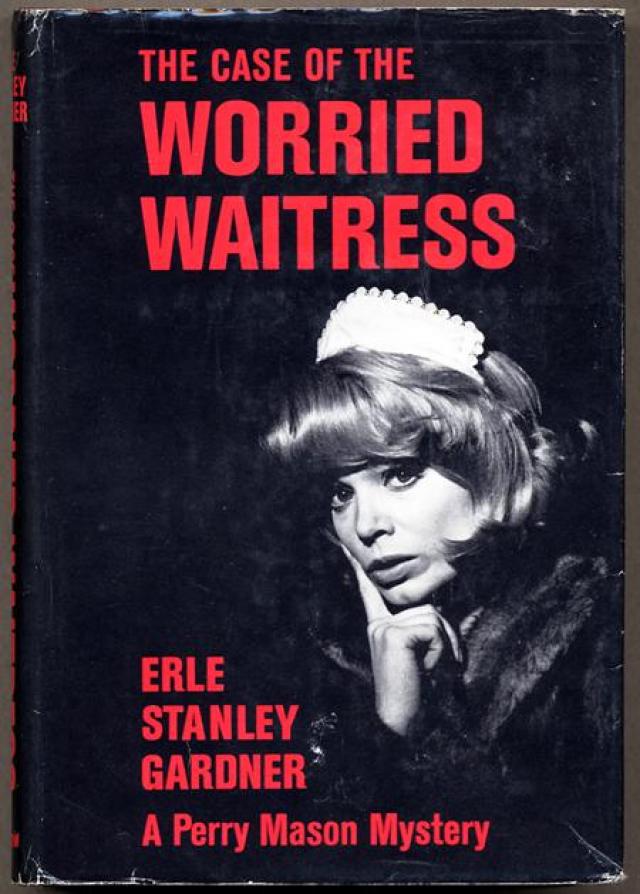
The Case of the Worried Waitress,
p.9


Both Mason and Drake showed evidences of a relatively sleepless night.
“Well, Paul?” Mason asked, when the detective had settled down with a cup of coffee which Della Street poured from the electric percolator.
Drake shook his head. “Absolutely nothing. I’ve checked with the men on the job.”
“They’re still on the job?”
“Not the same men—a new shift went on at five o’clock in the morning. They’ll work until one this afternoon, provided you still want to foot the bill.”
“I want to foot the bill,” Mason said. “I just can’t understand why nothing happened.”
Mason’s phone rang. Della Street answered it, nodded her head to Drake. “It’s for you, Paul,” she said. “Your office reporting … says it’s important.”
Drake deposited the coffee mug on a newspaper on the corner of Mason’s desk, picked up the telephone, said eagerly, “Yes, what is it?”
He was silent for nearly a minute, then he said, slowly and thoughtfully, “Well, I’ll be damned.” Again there was a moment of silence then he said, “No, nothing. Tell them to stay on the job.”
Drake hung up the telephone and said, “The blind woman is back on the job.”
“Where?”
“At the Gillco Manufacturing Company.”
Mason said, “Then it must be Mrs. Bunion. There’s only one blind woman today. How did you find out, Paul? Your men were shadowing the flat, weren’t they?”
Drake said, “That’s right. Mrs. Bunion came down the front steps from her flat, poking her cane in front of her. A taxicab drove up, the cabdriver jumped out, helped her into the cab, then they drove directly to the Gillco Manufacturing Company.”
Mason said, “She came out of the front door of her own flat?”
“That’s right.”
“She couldn’t have,” Mason said. “You had men watching the place?”
“We had men watching the place all night,” Drake said, “but there’s one way she could have done it.”
“How?”
“Through the back door.”
“But didn’t you have a man in the alley watching the back door?”
“After we got back from our visit I put men out,’ Drake said.
“Now there’s no question in my mind but what this blind woman went in her flat, climbed the stairs, walked right on through the flat, went down the backstairs, had someone pick her up and take her out somewhere. Then she came back shortly after we had finished searching the flat but before my second man got on the job watching the alley. She was taken to the back door. She climbed the stairs, went in through the back door, locked it, spent the night in her flat without knowing anything was wrong, and then went out this morning with the taxicab.
“That’s the only way it could have happened, Perry. And I just want to warn you that while I’m billing you at cost prices, you’re running up altogether too big a bill here. Your client can never pay off and… ”
Mason interrupted to say, “I don’t expect my client to pay off, Paul. I’m doing this to satisfy my own curiosity. I simply have to know what’s back of it all.”
“But you’ve got too many men on the job. You’re trying to cover every angle, plug every loophole, and …”
“And in that way we’ll get prompt results,” Mason said. “We won’t be stringing it out over a long period of time. I’ll have a big bill, but I’ll know the answer within twenty-four hours.”
“I wish I could share your optimism,” Drake said. “At least now that we know where Mrs. Bunion lives, you don’t need two men on the job at the Gillco Manufacturing Company.”
“No,” Mason agreed, “I don’t think we need more than one man there now, but when she goes to her flat I want two men on the job. I want to find out who it is that comes in the alley and picks her up. It can’t be Sophia Atwood now and in case it’s someone who says he is acting for Sophia Atwood, some officious … ”
“You mean Stuart Baxley?” Drake interposed.
Mason’s eyes twinkled. “I was thinking of Stuart Baxley.”
Drake returned to his coffee, held out the mug to Della Street, who filled it up to the brim with fresh, hot coffee.
Mason sat thoughtfully silent.
Suddenly he said, “I’ve got it, Paul!”
“Got what?” Drake asked.
Mason grinned. “You and I have set a trap,” he said.
“Well?” Drake asked.
“And so far we’ve caught nothing,” Mason said.
Drake nodded.
“Because,” Mason said, “we haven’t baited the trap. We’ve just been waiting for something to walk in, and that’s no good.”
“Not at the rate you’re paying private detectives per them, it isn’t good,” Drake said. And then after sipping his coffee he asked, “What’s the bait, Perry?”
Mason nodded to Della Street. “Take a shorthand notebook, Della,” he said. “I’m going to give you some dictation.”
Della Street settled herself at her secretarial desk, knees crossed, notebook in front of her, pencil poised.
Mason said, “Della, address this letter to Gerald Atwood at the Hollywood address. Now, look up the date of his death. I want this letter dated just four days before his death, and I want the letter addressed to him. And start it out Dear Mr. Atwood.”
Drake put down his coffee mug. “What’s the idea, Perry?” he asked.
“A letter to a dead man?”
“A letter to a dead man,” Mason said.
“I don’t get it,” Drake commented.
“You will,” Mason said.
The lawyer turned to Della Street and resumed his dictation.
“In response to your inquiry as to what constitutes a valid handwritten will, I wish to advise that the State of California recognizes a holographic will. This will is one which is entirely written, dated and signed in the handwriting of the testator.
“Such a will requires no witnesses.
“Certain things must be kept in mind, however. First, the will must be entirely in the handwriting of the testator. That means that there must be no other words appearing on the will other than those in the handwriting of the testator. In other words, if you were writing it on a letterhead, tear off the printed matter appearing at the top of the letterhead, particularly any printed matter which may have a part of the date connected with it, such as sometimes appears on bank checks where the figures ‘19’ appear followed by a blank.
“Next the document should state that it purports to be a last will and testament. Be sure to provide that all former wills are revoked that by this will you propose to distribute all of your property. And, as to the person you wish to disinherit, be sure you mention her by name, stating that you intentionally make no provision for her, or that you leave her a nominal sum, such as one dollar or one hundred dollars.
“Then sign the document at the end, and be sure it is all in your own handwriting.
“I trust this will answer your inquiry.
“With kindest personal regards. Sincerely yours.
“Now then,” Mason said, “type that out, Della, and I’ll sign it.”
“I still don’t get it,” Drake said.
“Suppose you’re searching for something,” Mason said.
“What do you do when you find it?”
“You quit searching,” Drake said.
“Then suppose something makes you think you haven’t found it?”
“Then you start searching all over again,” Drake said.
“Okay, Perry, I get it now.”
Mason said, “If Bernice Atwood got into that Palm Springs house and found a will dated perhaps a year ago, leaving everything to Sophia Atwood, all she had to do was to put that will in a fireplace, be sure it was completely consumed, and that left her sitting pretty. But suppose she thinks that Gerald was going to make a new will entirely in his own handwriting, and that that will was made within a few days of his death that by that will he revoked all prior wills, disposed of his entire estate and left Bernice out in the cold?”
Drake grinned. “The thing is diabolical in its simplicity. Now then, how are you going to get this letter to her attention without making her suspicious? She already knows that you’re interested in the case.”
Mason grinned. “I’m going to take a golf lesson,” he said.
“A golf lesson?”
Mason nodded. “You’ve been checking on Bernice,” he said. “You say the golf club notified her when Gerald dropped dead. What was the golf club?”
“The Four Palms Country Club,” Drake said.
Mason nodded to Della Street. “Ring up the Four Palms Country Club in Palm Springs and ask for the club pro, Della.”
Della Street put through the call, then after a few moments nodded to Perry Mason.
Mason picked up the phone. “Hello,” he said. “Is this the golf pro at the Four Palms Country Club?”
“That’s right,” a hearty masculine voice said. “This is Nevin Cortland. May I ask who’s talking, please?”
Mason said, without giving his name, “I’m an attorney in Los Angeles, Mr. Cortland. I’m wondering if you are permitted to give golf lessons to persons who are not members of the club.”
“Oh yes. I can give lessons to anyone. If you want to play on the course, you need either a membership or a visitor’s card. But under ordinary circumstances, when the course isn’t crowded, that can be arranged. You wish to take lessons?”
“I wanted to take one lesson today,” Mason said. “I am playing in a foursome tomorrow and my swing is way off. I haven’t been playing golf for years and I don’t want to put up too poor a fight tomorrow. My only consolation is that the other men are just as much out of condition as I am.
“What I want is to get just enough of a lesson so that I will get a little of my touch back. I know that my drives aren’t going to be much over seventy-five or a-hundred yards on the fly, but that’s all I want.”
“That shouldn’t be too hard,” Cortland said. “What was the name, please?”
“Mason,” the lawyer told him. “What time today do you have open?”
“I’m pretty well filled up, but I have time right after four o’clock, only I’m afraid that would be rather awkward for you.”
“That’ll be fine,” Mason said. “Put me down and I’ll be there at five minutes to four. And thank you very much. Good-by.”
The lawyer hung up before Cortland could ask any more questions.
“This I want to see,” Drake said. “You swinging a golf club, then bounding blithely over the green to hit the ball again.”
“I’ll be good.” Mason grinned. “I’ll bet I get all of sixty yards on my drives and sink every putt that is under eighteen inches.”
“I’ll take the other end of that bet.” Drake grinned. “Then what do you expect to do?”
Mason said, “When a man drops dead on a golf course, what happens?”
“I don’t know,” Drake said thoughtfully. “I’ve never dropped dead on a golf course.”
“I don’t know either,” Mason confessed, “but I have an idea.”
“What’s your idea?”
“Golfers come running out. They try to revive the man. They can’t do it. They pick him up and carry him off the course and into the shade. Somebody calls for a doctor. There’s probably a doctor on the course somewhere. The word is passed. The doctor comes and checks the man and says, ‘This man is dead. Notify the relatives and get the county coroner.’
“There are people playing on the golf course. They don’t want to leave a dead man hanging around on the edge of the fairway. Somebody brings a stretcher. They carry him into the clubhouse. Some caddy picks up the man’s golf bag and carries it into the clubhouse.
“Now then, the golf bag with the clubs in it is either put in the man’s locker, if he has one, or is put in the shop of the golf pro.
“However, after the nearest relative and an undertaker is notified and the coroner has released the body for burial after an investigation, the so-called widow goes out and takes a look through the locker. She particularly goes through the pockets of the clothes in the locker.
“Now, the widow doesn’t play golf with a set of men’s clubs, nor does she want to continue to pay the rental on a locker at the club.”
“Go on,” Drake said. “You interest me.”
“I thought I would,” Mason told him, and then went on. “The widow cleans the things out of the locker. She gives the bag of golf clubs to the pro and tells him to sell them. So Gerald Atwood’s golf clubs are probably reposing in the shop of the golf pro at the country club with a price tag on them and an understanding that the pro will get a commission if he sells them.”
“I think,” Drake said, “from the look in your eye, I’m going to Palm Springs.”
“You’re going to leave at once for Palm Springs,” Mason said. “And you’re going to have an operative with you who can pose as a caddy looking for a job.”
“And when we get there?” Drake asked.
“When you get there, Paul, you’re going to plant this letter in Atwood’s bag of golf clubs. We’ll rumple the letter up and make it look as though Atwood had received it just before he went out on the golf course. He threw the envelope away, folded the letter and pushed it down in the pocket on the side of the bag where a golfer keeps his golf balls.”
“I’ll be damned,” Drake said, and then added after a moment, “you can’t get away with it, Perry. There’s no way you can let this letter be discovered now without letting Bernice Atwood know it’s been planted.”
“You want to bet?” Mason asked.
Drake hesitated for a matter of seconds, then answered the question. “No,” he said.
Chapter 12
Promptly at five minutes to four Mason presented himself at the tour Palms Country Club, a scenic course running back through a long valley, bordered by the white stucco of luxurious desert homes nestled against slopes which stretched back to shadow-filled mountains. “I haven’t my clubs with me,” Mason told the golf pro. “In fact, I haven’t played for a long time and I don’t know just where my clubs are. I couldn’t locate them.”
“The woods would have probably dried out,” Nevin Cortland said, sizing Mason up with shrewd gray eyes.
“Possibly,” Mason said.
“You should play more,” Cortland told him. “You need exercise.”
“I intend to.”
Cortland, medium height, wiry, bronzed, said, “Well, we can fix you up all right, Mr. Mason. You’re going out in a game tomorrow?”
Mason grinned. “This is something of a gag,” he said.
“Some of us who hadn’t played golf for a while were talking, and first thing anybody knew there was a foursome fixed up with all sorts of crazy prizes on each hole. I don’t want to look like too much of a dub.”
“How much playing have you done?”
“Not very much,” Mason confessed. “I’ve been too darn busy.”
Cortland said, “I recognize you now from your pictures. You’ve been in the papers quite a lot.”
Mason smiled. “I’ve had a few spectacular cases.”
“Well, let’s go out on the practice tee and see what sort of a swing you have,” Cortland said.
“I’ll want to buy a set of clubs,” Mason told him. “I don’t think I’ll bother trying to find my old ones, and even if I could find them they’d be in pretty poor shape.”
“We can fix that up very nicely,” Cortland said, laughing. “Selling new clubs is something I’m always glad to do. You won’t have to twist my arm at all, Mr. Mason. Now, let me see, you’re tall and have powerful wrists. Let’s see.”
The pro picked out a couple of drivers from a rack, then a Number Five iron.
“Actually, Mr. Mason,” he said, “games are won and lost within fifty to a hundred yards of the green, but I suppose you’re more interested in your drive.”
“A long ball,” Mason said, “will demoralize my opponents, and I’d rather demoralize my opponents than anything I can think of right now.”
“I see,” Cortland said, leading the way out to the practice tee.
“Let me see you take a couple of swings, Mr. Mason.”
Mason obediently swung the driver.
“Try to keep your left arm a little straighter on the back-swing. Don’t break your wrist quite so quick. Shift your weight on the follow through, but never before. Now, let’s try a swing with a ball.”
Mason swung and hit the ball.
“Not bad,” Cortland said. “Let’s try some more. I want to get your swing grooved.”
For some twenty minutes the golf pro worked with Mason and then said, “You’re coming along nicely, Mr. Mason. I think you’ll do all right tomorrow. How would you like to practice your short game a little?”
“I would,” Mason said.
They went to the pitch and putting green and Mason put in another twenty minutes.
“That’s about enough for today,” Cortland said.
“Now, how about clubs?” Mason asked.
“Oh, sure thing,” Cortland said. “I’ve had that in mind. I have a very nice set I can make up for you.”
“Do you have any sets that are already matched up and for sale—any secondhand sets?”
“A few of them,” Cortland said. “But I’d rather fix you up with some new clubs that are designed for a man of your height and build, Mr. Mason.”
They went into the pro’s shop and Cortland picked out a golf bag, went over to the club rack and selected a wood.
“Now, I think this will be just about what you want,” he said.
Mason looked at half a dozen well-filled bags which were hanging up on the wall. “What are those?” he asked.
“Oh, some of those are clubs I’m working over,” the pro said, “and some of them are for sale.”
“How come?” Mason asked.
“Well, one of them, the owner, had a heart attack and has had to give up the game. He could have been playing for years if he’d only followed my advice. But he was a little overweight. He wanted to take off weight fast and he played too hard and too long. Got himself too tired. Now he’s had to quit the game for good.”