

The case of the worried.., p.8
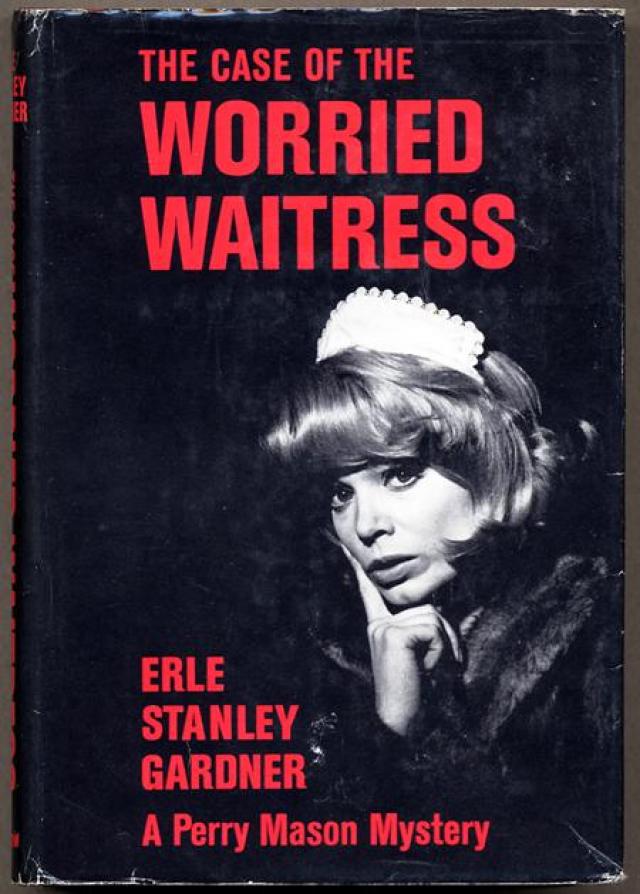
The Case of the Worried Waitress,
p.8


Mason was silent.
“Put yourself in her shoes,” the woman went on. “She’s completely blind, living in total darkness in a big city, and you two come along and tell her she’s in danger. What good does a warning like that do? If she’s in danger, go to the police.”
“We may be in a position to help her,” Mason said.
“We might be in a position to post a guard.”
“And who’s going to pay for all that?”
“We would.”
“I see,” the woman said thoughtfully.
“Now, then,” Mason went on, with his most disarming smile, “how is the best way for us to reach her?”
“I’ll reach her for you,” the woman said.
“That’s fine. I take it you have a passkey?”
“I don’t need a passkey. I’ll call her on the telephone.”
“She has a phone?” Mason asked.
“Of course she has a telephone. A blind woman, living by herself, couldn’t get along without a telephone. But it’s an unlisted number and I’m about the only one who has that unlisted number. Now, you just wait right there and I’ll go and call her and ask her if she’ll see Mr. Perry Mason and—what’s that other name?”
“Paul Drake.”
“All right, I’ll go and see if she’ll talk with you.” The woman paused a moment, then added, “My name is Minerva Gooding. I’m the manager of these flats. I live in the lower flat and rent out the two upper flats. They aren’t very swank, but it’s a nice, comfortable house. Now, you wait right there where you are and I’ll go talk with her.”
Mrs. Gooding was gone some three minutes, then returned to the door.
“I’m sorry,” she said, “but Mrs. Gillman doesn’t answer the telephone.”
“She doesn’t answer!” Mason repeated.
Mrs. Gooding shook her head.
“Well, she isn’t answering the doorbell either,” Mason said.
“That’s customary, but she always answers the telephone when she’s in because she knows that I’m about the only one who has the unlisted number. She has one other woman who I think calls her, but I don’t know who she is.”
“Would it be a Mrs. Atwood?” Mason asked.
“Atwood … Atwood … Now, that name sounds kind of familiar. I’ve heard her talk about an Atwood. Would her first name be Sophia?”
Mason nodded.
“Well, I’ve heard her talk a lot about a Sophia—but whether it’s Sophia Atwood or not, I don’t know. But anyway, she isn’t answering the telephone.”
“Then something is wrong,” Mason said, “because she’s home.”
“How do you know she’s home?”
“We’re pretty certain. That man sitting in the automobile across the street has been keeping an eye on the place,” Mason said, and then added hastily, “to see that she wasn’t in any danger until we could warn her.”
“What sort of danger?” Mrs. Gooding snapped.
“Frankly,” Mason said, “we don’t know, but we do have reason to believe that she may have something someone wants—someone who is unscrupulous and who would be willing to break into a house in order to get it.”
Mrs. Gooding thought that over.
“Well,” she said at length, “I’ll take the passkey and run up there and see if she’s all right. You’ll wait right here.”
“We’d like to go with you,” Mason said. “If anything has happened, it would be a very good idea for you to have witnesses.”
“Witnesses to what?”
“Witnesses to what you found.”
“All right,” Mrs. Gooding said after a moment’s hesitation, “come along, but don’t touch anything, and I don’t want you folks making any criticism.
“Land sakes, you just figure that you’re blind and living all alone. You have your own cooking to do and have your own dishes to wash, your own clothes to put away, your own bed to make, and you have to get around by yourself. It’s a job just to keep yourself lined up with things so you know where you are and don’t get mixed up on directions.
“You can’t keep a neat, orderly house working like that. You just have to live from hand to mouth and take things the way they come. Now, I want you to understand that and not make any criticisms.”
“We understand,” Mason said. “We’re not interested in her housekeeping or her neatness.”
“And,” Mrs. Gooding went on, “when you talk with her, I don’t want her alarmed, you understand? You can tell me about her being in danger, but I don’t want her frightened to death. Think what it’s like to be living in perpetual night all the time. You can’t tell if a person is crawling toward your bed with a knife in his hand when you wake up at night. There are lots of things you can get yourself adjusted to, but you can’t get yourself adjusted to terror.
“Now, you come with me and stay right behind me. I don’t want you wandering around at all, and I want you to remember the circumstances under which Edith Gillman has to live.
“Once in a while I come in and help her clean up and shovel out some of the stuff, but you can’t—well, for instance, take sweeping. When you’re blind, you can’t sweep a room, pick up the dirt in a dustpan, put it anywhere, and do a neat job. You just have to live with things the way they are.
“Now, you both come along with me, and stay behind me.”
She opened the front door of the lower flat, took a passkey from her purse, fitted it to the door leading to the second-story flat, and Mason and Paul Drake followed her up the stairs.
The place had a stale, musty smell which assailed their nostrils as they climbed the stairs. They paused at a central reception hallway at the top of the stairs. Mrs. Gooding said, “Heaven knows whether these lights are on or not.
“She keeps the electricity on because she uses it to cook with, but electric lights don’t mean anything to her, so they’re just as apt as not to be all burned out.”
She clicked a switch as she talked. Lights turned on to show a bedroom arranged with Spartan simplicity. There was a dresser and there were no ornaments on the dresser. The chairs were pushed back against the wall so the center of the room was free of obstructions. The bed was at the far side of the room by the window. The bed had not been made. The sheets were rumpled the pillows were in a compact group at the corner of the bed.
“You see what I mean,” Mrs. Gooding said. “She didn’t have time to make her bed.”
She raised her voice. “Oh, Edith, yoo-hoo! This is Minerva. Where are you?”
She paused and waited for an answer. Then, when there was no answer, she frowned and repeated the call in a louder voice.
“Edith, yoo-hoo! Yoo-hoo!”
Mrs. Gooding said, “You folks stay right here. I’m going to look around.”
“Can’t we help you?” Mason asked.
“You can not. This place is in no condition for visitors, and Edith is going to be good and mad at me for bringing you up here. You get out of this bedroom. Come in here and sit down and stay put.”
She led the way into a sitting room in which there was one comfortable chair with a radio on a table by the chair.
“Poor dear has nothing to do except sit here and listen to the radio,” Mrs. Gooding said. “She knows all the voices, all the actors. And the way that woman keeps up with the news—you’d really be surprised.
“Now, don’t touch anything,” Mrs. Gooding warned again.
Drake and Mason stood in the center of the room. They heard Mrs. Gooding moving through the flat, calling from time to time, “Edith, yoo-hoo, this is Minerva. Where are you, Edith? Are you all right?”
After some two or three minutes Mrs. Gooding came back to the living room. “Well,” she said, “she isn’t here. She must have gone out.”
“I’m sorry,” Mason said, “she couldn’t have gone out. We’ve had this man on duty out front.”
“Does he know her when he sees her?” Mrs. Gooding asked.
“Yes.”
“How does that happen?”
“He has seen her several times before,” Mason explained noncommittally. “Tell me, is there a back door?”
“Of course there’s a back door. I wouldn’t let any person live in a flat which only had one exit. What would a body do in case of fire?”
“Where’s the back exit?” Mason asked.
“It goes down a flight of stairs to the alley. There’s a little service porch in back.”
“Did you look on the service porch?” Mason asked.
“No,” she said, “I didn’t, but I will. You wait right there.”
She hurried through the flat after a few moments she came back and said, “Well, I’ll say this—the back door was unlocked. Apparently she went out the back door down the steps to the alley.”
“And then what?” Mason asked.
“Well,” Mrs. Gooding said, and hesitated.
“Yes?” Mason prompted.
“Sometimes,” Mrs. Gooding said, “she telephones her friend—this one she calls Sophia—and Sophia will come and get her in the alley.”
“Why in the alley?” Mason asked.
“You can search me,” Mrs. Gooding said. “I’m not inclined to inquire into other people’s business. I just happened one time to go out on my back porch to put some stuff in the garbage pail and I saw Edith Gillman coming down the back stairs, feeling her way along, and this Cadillac automobile was there in the alley with the motor running and a chauffeur. I think it was a hired car, if you know what I mean and this woman was halfway up the steps ready to assist Edith down. And I heard Edith say, ‘How are you today, Sophia?’ And, believe me, that was all I heard.
“I made certain I didn’t hear any more. If she wanted to be secretive about some of her friends, it was all right with me.”
“I see,” Mason said. And then after a moment he added, “You’re absolutely certain she’s not in the flat now?”
“I’ve looked everywhere except under the bed.”
“Then,” Mason said gravely, “let’s look under the bed.”
“Why in the world would she be under the bed?”
“I don’t know,” Mason said. “But why should she come home, enter the flat by the front door, go down the rear stairs to the alley and be whisked off in a rented car?”
“Well, if she did, it’s her business, not ours.”
“Nevertheless,” Mason said, “it’s up to us to make certain she isn’t here.”
“She wouldn’t have crawled under any bed.”
“Someone might have hit her over the head and pushed the body under the bed,” Mason said.
“Bosh and nonsense!”
“For your information,” Mason said, “her friend, Sophia Atwood, was also living alone, and last night someone entered the house, hit Mrs. Atwood over the head, and went away and left her lying there on the floor.”
Mrs. Gooding stood looking at them with startled, incredulous eyes. “You mean Edith Gillman’s friend?”
“I don’t know,” Mason said. “I’m trying to find out. But we had reason to believe that Mrs. Gillman was friendly with Sophia Atwood.”
“Well, I’ll declare,” Mrs. Gooding said in a subdued tone.
“You found the back door unlocked?” Mason asked.
“Yes, there’s a key lock on the door. It’s not a spring lock. You have to turn a key to lock the door. Now, she must have been in a hurry when she left because she didn’t take the backdoor key with her. The backdoor key is on the inside of the door, and the door’s unlocked.”
“That’s not usually the case?” Mason asked.
She looked at him and said, “If you were blind, would you be living in a place with the doors unlocked?”
“No,” Mason said shortly.
Paul Drake said, “Of course, someone could have been waiting and hustled her out through the back door in a hurry, telling her it was important—someone she knew.”
“Or,” Mason added dryly, “someone she didn’t know. Who has the third-story flat, Mrs. Gooding?”
“It’s vacant at the moment.”
“Would you mind if we looked at it?” Mason asked.
“Not at all. But you’ll have to go all the way back down the stairs to the front door, then climb two more flights of stairs.”
“I’d like to take a look,” Mason said. “It’s unfurnished?”
“That’s right.”
“I’d like to get an idea of the way it’s laid out. It has the same floor plan as this one?”
“Yes.”
“May we look?”
Mrs. Gooding said, “Just follow me, please,” and led the way down the stairs. She held the front door of the flat open for them, then closed it as they left, inserted the passkey into the door leading to the third-floor flat, opened it and said, “Here’s where we start climbing stairs. You don’t mind?”
“Not at all,” Mason said.
The trio climbed the two flights of stairs, and again Mrs. Gooding brought a passkey into play as she opened a locked door at the head of the stairs.
Mason and Drake moved through the empty flat, then nodded to Mrs. Gooding. “Thank you very much, Mrs. Gooding,” Mason said. “We’ll be leaving. If Mrs. Gillman should return, would you mind calling Paul Drake at the Drake Detective Agency?”
“I’ll do nothing of the sort,” Mrs. Gooding snapped. “I’m not going to spy on any of my tenants for … ”
“I didn’t mean it that way,” Mason said. “The woman is blind. Quite obviously it wouldn’t do any good to leave a card for her and ask her to call the Drake Detective Agency.”
“Oh, I see,” Mrs. Gooding said. “I’ll tell you what I’ll do. I’ll give her the number when she comes. I’ll tell her that you gentlemen were looking for her—but I’m not going to alarm the poor soul—and I’ll ask her to call you. I’ll give her the number.”
“Could she remember the number,” Mason asked, “if you gave it to her … ?”
“Could she remember it!” Mrs. Gooding exclaimed. “You should see the memory that woman has. She can remember telephone numbers for weeks. She has the most phenomenal ability to recall—and the way she’s posted on current events, on news and things, is absolutely startling.”
“Very well,” Mason said, “we’ll leave it at that.”
“Understand now, I’m not going to alarm her.”
“We don’t want you to. And thank you very much indeed for your cooperation.”
“I think perhaps,” Mrs. Gooding said, “I should be thanking you—on behalf of Edith Gillman—but I’ll wait until I know more than I do now.”
Mason and Paul Drake left the flat building, moved across the street to their automobile.
“Well?” Drake asked.
“Either something has happened to her,” Mason said, “or she’s playing a pretty deep game.”
“What’s our next move, Perry?”
“I want two operatives,” Mason said, “one watching the front, and one watching the rear, and notify me just as soon as she returns to the flat. While we were looking around upstairs I managed to get the unlisted number of the telephone by copying the number shown in the circular window and …”
Drake laughed. “We’d better get our signals together, Perry. I, too, was busy copying that number.”
“All right,” Mason said, “we both have it. Now, then, if she comes home we’ll call her on her unlisted telephone and see if we can arrange an interview. In any event, we’ll be able to warn her.”
“And in the meantime?” Drake asked.
“In the meantime,” Mason said, “we are one jump ahead of the police as far as the two blind beggars are concerned. We’ll try and stay one jump ahead of the police.
“If the blind woman with the bunion, Mrs. Gillman, is in any danger, someone is going to come to her house looking for her.”
“Unless someone was waiting in the house when she got home and spirited her out of the back door,” Drake said.
“That,” Mason said, “is always the possibility. But if so, why did they do it?”
Drake shrugged. “You’ve got me.”
Mason said, “If they had just wanted to kill her, they’d have slugged her and left her body there in the flat. If anyone had wanted to kill Sophia Atwood, the killer would have made a good job of it.
“As matters now stand, Sophia Atwood is fighting for her life. She’s lying in a state of unconsciousness. Someone hit her with a flashlight.
“Now, why use a flashlight and why only one blow?”
“Go on,” Drake said. “You evidently have something in mind.”
“The reason the flashlight was used as a weapon was because it was the handiest weapon to hand. That means someone was holding the flashlight, making a search of the place when Sophia Atwood caught him or her at it, and the result was the intruder swung the flashlight, a single blow which knocked Sophia Atwood down unconscious and enabled the intruder to escape.
“Therefore the intruder wasn’t looking for Sophia Atwood. He was looking for something else.
“Now, if Mrs. Gillman has been abducted, it’s because someone wants to come back and search the flat without any possibility of being interrupted. That is, that’s a safe assumption.
“Therefore, Paul, someone is searching for something —someone who doesn’t know where the object of the search is hidden.
“I’m going to go all out on this case. I want two men on the job at Mrs. Gillman’s flat tonight. I want to know if anyone goes to that flat. If anyone should try to search the place, I want to know who it is. I want the license number of the automobile and I want your men to telephone for reinforcements. Then I want to catch the searchers red-handed.
“If anyone should come to Sophia Atwood’s house tonight, and I rather think they will, I want to know who it is. And when the prowler gets in, I want your man to telephone for reinforcements, and then you and I are going in and interview him.”
“That means four men, to say nothing of reinforcements,” Drake said.
“That,” Mason agreed, “means four men, to say nothing of reinforcements.”
Drake grinned. “It’s your party,” he pointed out.
Chapter 11
Perry Mason, Paul Drake and Della Street met in the lawyer’s office at a few minutes after nine o’clock in the morning.















