

The jeffersonians, p.1
The Jeffersonians,
p.1
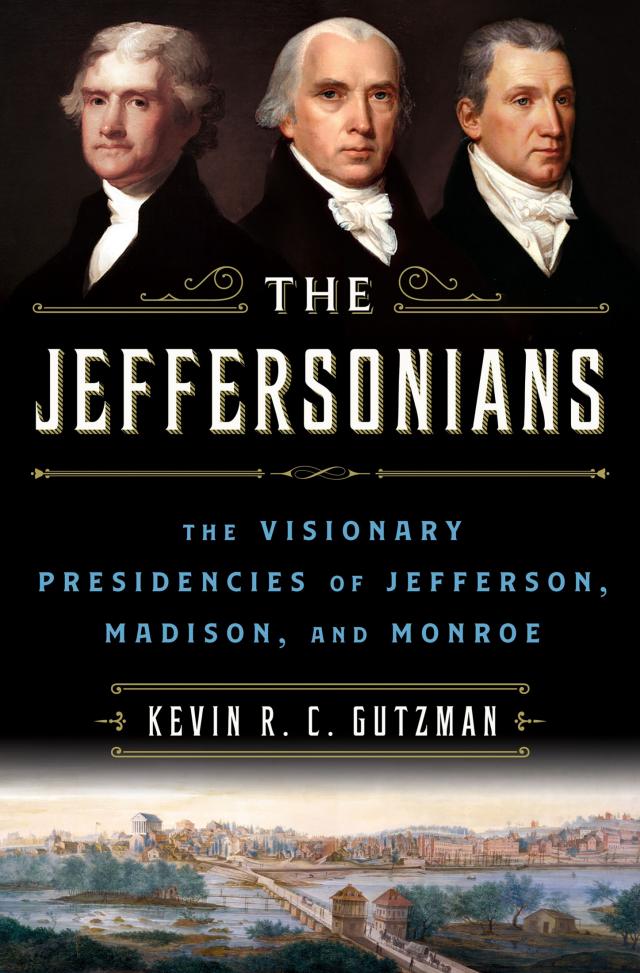


Begin Reading
Table of Contents
About the Author
Copyright Page
Thank you for buying this
St. Martin’s Publishing Group ebook.
To receive special offers, bonus content,
and info on new releases and other great reads,
sign up for our newsletters.
Or visit us online at
us.macmillan.com/newslettersignup
For email updates on the author, click here.
The author and publisher have provided this e-book to you for your personal use only. You may not make this e-book publicly available in any way. Copyright infringement is against the law. If you believe the copy of this e-book you are reading infringes on the author’s copyright, please notify the publisher at: us.macmillanusa.com/piracy.
For Cyril
A NOTE FROM THE AUTHOR
The Jeffersonians lived before standardization of capitalization, punctuation, and spelling. I have left their English as I found it.
PART I
THE BEGINNING
1
A House committee headed by Chairman Thomas Pinckney, Federalist of South Carolina, informed Vice President Thomas Jefferson that the House had at last elected him president.1 One might have thought the Virginian would exult in his triumph, but that would be to mistake Jefferson. “In deciding between the candidates…,” he said, “I am sensible that age has been respected rather than more active and useful qualifications.”
Only after several weeks’ acrimonious dispute had the House at last broken the Electoral College deadlock between Jefferson and his running mate, New York’s Senator Aaron Burr, by opting for the man all knew to be the Republican presidential candidate. Rumors held that Burr would make a deal with the outgoing House’s Federalist majority: make me president, and I will maintain some of your measures my fellow Republicans find obnoxious. (Some leading Federalists took for granted that Burr would deal.)2 Those rumors were false. Burr had refused any suggestion of switching party allegiances, as prominent Federalists told it, though this marked the death of any presidential aspirations Burr may have had.3 One Federalist congressman said Burr’s insistence that he would not come into the presidency as a Federalist would make it necessary for a President Burr to remove all Federalist appointees from office, and “I have direct information that Mr. Jefferson will not pursue that plan.”4
Another possible result of the deadlock was that House Federalists would block any decision past Inauguration Day, thus reserving the position for some Federalist—perhaps the Senate president pro tempore. Unbeknownst to the public, radical steps might have been taken to prevent any such thing from happening. Jefferson’s chief ally, James Madison, counseled his chieftain that Jefferson and Burr ought, if that happened, jointly to call for an early meeting of the new Republican Congress—which otherwise would not meet until December. The new House could then anoint Jefferson chief executive.5 Not only did Madison advise Jefferson how he should act, but two Republican governors, including Jefferson’s onetime law student James Monroe in neighboring Virginia, mulled sending their militiamen to Washington to install “the people’s choice,” Jefferson.6 Federalists had better not try to thwart the popular will. (Left unclear in this plotting was how it could be illegitimate for Federalist representatives to vote against Jefferson in the House, as the Constitution empowered them to do.)
Also without the public’s knowing it, Jefferson had told Madison in 1796 that in case of an Electoral College tie, his rival candidate John Adams should be given the presidency. After all, Jefferson then reasoned, Adams had always been his senior in politics. Far from demure, then, Jefferson may have been candid in concluding that his more advanced age accounted for his victory over Burr in early 1801.
May have been. We cannot be certain. Jefferson has not been called the “American Sphinx” for nothing.7
Jefferson’s explanation of his election to Madison the day after the decisive February 17th vote reflected Jefferson’s honest appraisal of the situation.8 Federalists in the House had at last concluded, the vice president wrote, that they could not elect Burr, that any attempt to dispose of the presidency in some other way than by an election in the House “would be resisted by arms,” and that “a Convention to reorganize & amend the government” would follow, and so they had caucused regarding what to do next. They might all have continued to oppose Jefferson, and they might all have joined the Republicans in electing Jefferson, but instead they had done neither. The Federalist representatives’ behavior had disgusted all the Federalists outside the House, with even Alexander Hamilton and prominent Massachusetts Federalist Stephen Higginson Sr. acting, in Jefferson’s words, as “zealous partisans for us.”9
President John Adams endeavored till the end of his tenure to thwart the Republicans’ hopes for a congenial transition. As Jefferson told it, “Mr A. embarrasses us. He keeps the offices of State & War vacant, has named Bayard M[inister] P[lenipotentiary] to France, and has called an unorganized Senate on the 4th. of March [inauguration day].” For his part, close observer Madison—never an Adams admirer—held, “The conduct of Mr. A. is not such as was to have been wished or perhaps expected. Instead of smoothing the path for his successor, he plays into the hands of those who are endeavoring to strew it with as many difficulties as possible; and with this view does not manifest a very squeamish regard to the Const[titutio]n.”10
Jefferson’s election a mere fifteen days prior to his inauguration had left him so pressed that he sent a letter to his intended secretary of war, Henry Dearborn, offering him the job the same day that he wrote informing Madison of the result.11 The following day, Jefferson wrote imploring Meriwether Lewis to serve as his private secretary.12 The young army captain’s “knolege of the Western country, of the army and of all it’s interests & relations” had made him especially fit for this post—which, Jefferson hastened to add, several other men had requested. While it would not pay well, it would put Lewis in contact with men whose acquaintance would help him later in his career (not least of them, it went without saying, Jefferson himself). A few days later, the president-elect informed Chancellor Robert Livingston of New York, who with Jefferson had been one of the five members of the congressional committee that drafted the Declaration of Independence, that he chose him to be minister plenipotentiary to France. Livingston soon accepted, and he would fill the post to momentous effect.13
About the same time, Jefferson repeated his observation about the popular effect of Federalist congressmen’s machinations during the House proceedings. He then noted that Adams’s calling the Senate, “imperfect as it will be on the 4th. of March,” into session could lead to rejection of Jefferson’s leading appointments. “This to be sure,” he concluded, “would dismast our ship, before leaving port.”14
Jefferson assured Representative Pinckney’s delegation,
I know the difficulties of the station to which I am called and feel and acknowledge my incompetence to them. But whatsoever of understanding, whatsoever of diligence, whatsoever of justice or of affectionate concern for the happiness of man, it has pleased Providence to place within the compass of my faculties shall be called forth for the discharge of the duties confided to me, and for procuring to my fellow-citizens all the benefits which our Constitution has placed under the guardianship of the General Government. Guided by the wisdom and patriotism of those to whom it belongs to express the legislative will of the nation, I will give to that will a faithful execution.
On February 28, 1801, Vice President Jefferson resigned his office to make way for the Senate to select a new president pro tempore. Jefferson bade that body farewell in his characteristic way, noting that he “no doubt” had erred in his role as the Senate’s president and holding that “for honest errors however indulgence may be hoped.”15
Thus spoke Jefferson on February 28th. Due to the prolonged standoff in the House, if he put off writing it until certain of his election, Jefferson had only twelve days to prepare his First Inaugural Address for delivery on March 4th. Every indication is that he had not waited to begin writing it.
Jefferson’s First Inaugural Address is one of only a handful of such speeches that repay a reading. Despite its sparkling eloquence and striking economy of expression, however, the mere text tells only part of the story. “The Revolution of 1800,” as Jefferson later dubbed his party’s electoral conquest, began before the new president laid his manuscript on the lectern.16
Part of that Revolution was a sharp shift in manners. The occasion of George Washington’s first inauguration had become one extended celebration of the Continental Army’s only commander-in-chief. En route from Mt. Vernon on the Potomac to Manhattan on the Hudson, Washington progressed from one festivity to the next.17 Local militia detachments escorted him, young ladies fêted him, and leading citizens of towns through which he passed held celebratory balls in his honor.
It was Washington who decided, without prompting from the Constitution, that there ought to be a presidential speech in conjunction with the prescribed oath. With help from Representative James Madison, President Washington prepared and delivered a classic Virginian inauguration address.18 It began with an avowal that he had not wanted nor felt qualified for the job, proceeded through a lengthy observation about an unnamed god’s essential aid in winning the Revolution and establishing the Constitution, rested for a while on the idea that the success of the federal republic would depend on the morality of officeholders and of the
people in general, stopped briefly upon a call for constitutional amendments to buttress individual rights, added a disavowal of any desire for a salary, and concluded with a prayer to “the benign Parent of the Human Race” to superintend the new government’s activity. The whole ceremony took place before a crowd of onlookers on Wall Street—again at Washington’s instigation.
Washington’s Second Inaugural Address was four sentences long. It said that he was called again to enter upon the presidential office, that he someday would express his “high sense of … [that] distinguished honor,” that the Constitution required that he take the oath prior to entering into the presidential office, and that witnesses to his taking it would be able to reprimand him in case he violated it.19
Washington’s successor, John Adams, was already in the federal capital as vice president, so he could not have made a great progress akin to Washington’s 1789 journey. He would not have been celebrated similarly anyway. Still he did his best to emulate the general, buying a $1,500 carriage with his new $25,000 presidential salary for the short trek to the Capitol. The powder in his scant hair was offset by his pearl suit, and he wore a sword at his hip. Liveried servants—whose fancy clothes Adams had purchased—accompanied him. When the president-elect entered the chamber, Vice President Jefferson had already been seated. Yet, perhaps for the only time, not the incoming president but his predecessor was the star of the show.20
Adams’s address took a markedly different tack from Washington’s First Inaugural.21 He began by recounting the genesis of the Revolution and the supposed sources of the Articles of Confederation, which he said had been known to be inadequate early in their life. He then gave a stock Federalist account of the symptoms of the Articles’ failure and a happy summary of the creation of the United States Constitution.
Adams noted that he had been absent—in England, as it happens—when the Constitution was written, and he (falsely) said that he had always praised it, in public as in private. (Vice President Jefferson, listening to this address, might well have recalled that Adams’s first evaluation of it to Jefferson had taken the form of a list of its positive and negative attributes.)22 In response to what had come to be common Republican criticisms of him, Adams took pains to say repeatedly that he had never advocated life terms for any Executive Branch or Legislative Branch official. He then described his policy aims in a general way and asked that the All-Powerful continue “His blessing upon this nation.”
Thomas Jefferson’s First Inaugural Address would be notably different from his predecessors’ addresses.23 He had several aims in mind. They shaped both his performance throughout the Inauguration Day and his First Inaugural Address itself.
In marked contrast to his predecessors, President-Elect Jefferson walked from his boardinghouse on Capitol Hill to the Capitol. Though he was preceded by a contingent of local militiamen with swords drawn, a few D.C. marshals, and a couple of Adams Cabinet members, Jefferson’s procession struck contemporaries as calculated not to display the “pomp and pageantry” of the Washington and Adams inaugurations.24 (Jefferson was to make a habit of his informality, often riding about the town unaccompanied. Although he kept a carriage at the White House stable, it was only used when his daughters came to Washington to visit. Not only did Jefferson ride around town on various errands, but the locals noticed him “fastening his horse’s bridle himself to the shop doors.” President Jefferson enjoyed local diversions including a tightrope act, horse races, plays, and scientific lectures.)25 A description of the same setting early the previous October has it marked by hovels and “[a]ll the materials for building, bricks, planks, stone, & c. [sic]” The U.S. Capitol was then “a large square, ungraceful, white building.”26 As only one wing of the Capitol, the Senate wing, had been completed, Jefferson would speak there. When he entered the room, the audience would have noticed that though certainly able to afford impressive clothing, Jefferson showed up at the big event dressed notably downscale, with no ceremonial sword in sight.
An eyewitness and a Jefferson acquaintance, Mrs. Margaret B. Smith, described the event this way:
I have this morning witnessed one of the most interesting scenes, a free people can ever witness. The changes of administration, which in every government and in every age have most generally been epochs of confusion, villainy and bloodshed, in this our happy country take place without any species of distraction, or disorder.… I cannot describe the agitation I felt, while I looked around on the various multitude and while I listened to an address, containing principles the most correct, sentiments the most liberal, and wishes the most benevolent, conveyed in the most appropriate and elegant language and in a manner mild as it was firm.… The Senate chamber was so crowded that I believe not another creature could enter.… The speech was delivered in so low a tone that few heard it.… 27
The party change in control of the Federal Government—a novelty in world history—stood out. It had occasioned no “confusion, villainy [or] bloodshed, in this our happy country.”
Smith undoubtedly had not been alone in thinking that this was just the way things would work in America, thank God. In this she erred: the election of 1800–01 was a near-run thing. Though the Republican tandem of Jefferson and Aaron Burr outstripped its Federalist opponents, President John Adams’s challengers tied each other in the Electoral College. Who would succeed Adams, no one knew.
Nowadays, according to the terms of the Twelfth Amendment, members of the Electoral College cast one vote for president and another for vice president. The Twelfth Amendment corrected a problem highlighted by the election of 1800. Under the Constitution as it came out of the Philadelphia Convention that framed it, each elector cast two undifferentiated votes. The Framers did not foresee the advent of political parties, and so they did not envision a scenario in which running mates each received votes from all of their party’s electors—and thus had the same number of electoral votes.
In 1796 when Jefferson won the vice presidency by coming in second to John Adams, he edged out Aaron Burr.28 A few Virginian Republican electors’ decision not to vote for Burr so that their man Jefferson would beat him accounted for the margin. Burr remembered his fellow Republicans’ 1796 betrayal in November 1800. If some Republicans thought Burr ought to announce to the world that Jefferson ought to be the House of Representatives’ choice, why should Burr have been among them? Through the entire thirty-six-ballot contest, Burr issued no public statement. Rumors circulated concerning supposed negotiations for Federalist support of a Burr presidency, but from what we can tell, Burr rejected any consideration of turning coat.
Meanwhile former treasury secretary Alexander Hamilton encouraged Federalist representatives to opt for Jefferson. “If there was a man in the world I ought to hate,” Hamilton confided, “it is Jefferson. With Burr I have always been personally well.”29 He said more:
Jefferson or Burr?—the former without all doubt. The latter in my judgment has no principle public or private—could be bound by no agreement—will listen to no monitor but his ambition; & for this purpose will use the worst part of the community as a ladder to climb to perman[en]t power & an instrument to crush the better part. He is bankrupt beyond redemption except by the resources that grow out of war and disorder or by a sale to a foreign power or by great peculation. War with Great Brita[i]n would be the immediate instrument. He is sanguine enough to hope every thing—daring enough to attempt every thing—wicked enough to scruple nothing. From the elevation of such a man heaven preserve the Country!30
The Republicans did not have to be told that, however. They ought to be allowed the outcome they preferred after some kind of bargain was struck. So, Hamilton counseled, “Let our situation be improved to obtain from Jefferson assurances on certain points—the maintenance of the present system especially on the cardinal articles of public Credit, a Navy, Neutrality.” When the House finally did elect Jefferson, the public did not know why. In later years the Delaware congressman whose switch from Burr to abstention had proven decisive gave an account of the bargain he had driven remarkably similar to Hamilton’s suggestion. That congressman’s version of history receives substantial support from the reality that President Jefferson ultimately provided all three items on Hamilton’s wish list. Jefferson always denied having made a bargain.


