

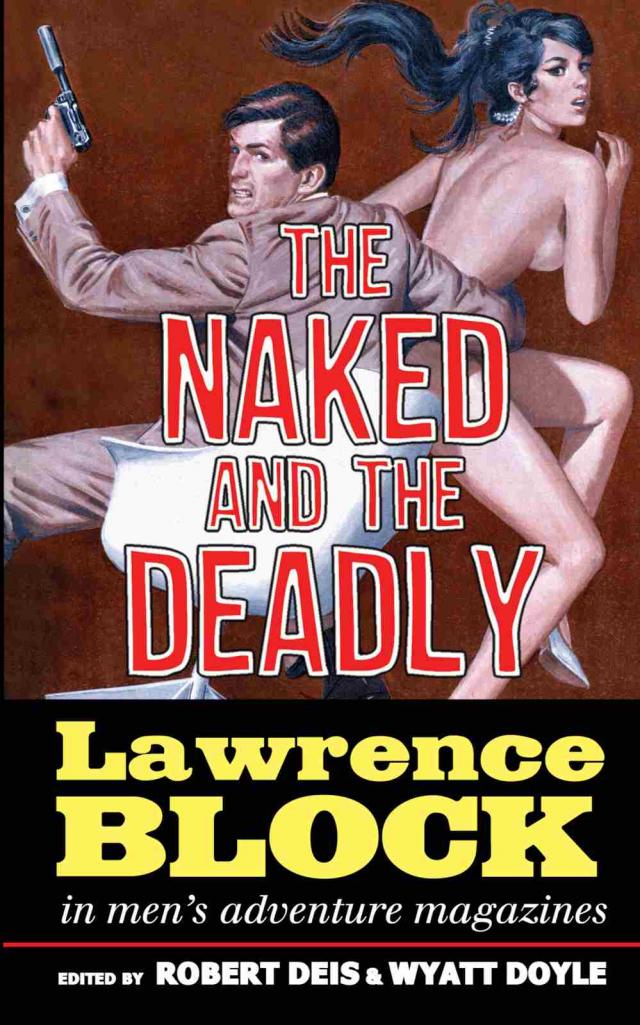
The naked and the deadly, p.10
The Naked and the Deadly,
p.10


“I’d better get going,” I said.
“Wait a few minutes, Ed.”
The voice was soft as a pillow. Her eyes were moist. She took a short step toward me, stopped. I put out my hands and caught her shoulders and she pressed against me, hard.
“Ed—”
I kissed her. Her mouth tasted of Rob Roys and cigarettes and she put her arms around me and clung to me like a morning glory on a wire fence. Her body was on fire. I kissed her eyes, her cheeks, her throat.
“I’m all alone,” she said. “All alone and afraid. Stay with me, Ed.”
“Sure,” I said, leading her into the bedroom, decorated in various shades of green. She stood there like a statue, but who likes statues dressed? I took off her clothes and ran my hands over her body. She vibrated like a tuning fork, purred like a kitten.
The mattress was firm. I put a pillow under her head and spread that ash blond hair over it. I touched her, kissed her. She breathed jaggedly and her eyes were wild.
“Ed—”
To hell with Klugsman. He was dead. He could wait awhile…
I left her in bed face pressed to pillow, eyes closed, body curled like a fetus. I told her not to leave the apartment, not to answer the door, not to pick up the telephone unless it rang once, stopped, then rang again. That would be my signal.
“One if by land,” she mumbled. “Two if by sea.”
I kissed her cheek. She smiled like a Cheshire cat, happy and contented. I dressed and left her apartment.
THE FIRST stop was my own apartment. I got on the phone, cursed myself once, quietly, and called the Continental Detective Agency in Cleveland. The voice that answered sounded two years out of an expensive college. I told him to run a brief check on a man named Jack Blake, supposed to be a homicide victim within the past couple of months, and to ring me back on it.
It was simple stuff and it only took him half an hour. Jack Blake, he revealed, was a card sharp who ran a magic shop on Euclid Avenue, got beaten to death in his own home, and had a daughter named Rhona. It was she who reported all this to the police. So far it was unsolved. Did I want to know more?
I didn’t. I told him to bill me and got off the phone. I’m sorry, Rhona, I said softly. This time I should have believed you. I’m sorry.
Then I got out of there and headed for the Senator, a cafeteria on Broadway at 96th, downstairs from Manny Hess’s pool hall and across the street from a Ping-Pong emporium. They serve good food and run a clean place, and every small-time operator on Upper Broadway drops in for coffee-and. I went inside and got a cup of coffee and carried it to the table where Herbie Wills was sitting.
Wills, a small, gray man of forty-five, was eating yogurt and buttered whole wheat toast. There was a glass of milk standing on the table.
“Ulcers,” he said. “I went to this doctor because of my stomach, he said I have ulcers. I have this very sensitive stomach, Mr. London. There are certain foods I can’t eat. They disagree with me, you know.”
“Sure,” I said.
“Now,” he said, spooning in a teaspoon of yogurt. “Can I help you, Mr. London?”
“I need some information.”
“Sure, Mr. London.”
Information was Herbie’s livelihood. He wasn’t exactly a stool pigeon, just a little man who kept his ears open and filed away everything into separate compartments of his mind. When the information market was weak he ran errands for bookies. He was a hanger-on, living in a clean but shabby room in a 98th Street hotel.
“Milton Klugsman,” I said.
Herbie pursed his bloodless lips, tapped three times on the table with his index finger. “So far,” he said, “nothing. More?”
I gave him a quick description. “I make him in Canarsie, Herbie. At least he’s familiar with the area out there. A Brooklyn or Queens boy, then. Any help?”
“Miltie,” he said. I looked at him. “Miltie Klugsman, Mr. London. This is what throws me for a moment; you said Milton Klugsman, I start thinking in terms of Milton or Milt. But I knew a Miltie Klugsman. This is all he gets called. Miltie.”
“Go on.”
Another spoon of yogurt, bite of toast, deliberate sip of milk. I watched him and hoped I would never get ulcers. He wiped his mouth again and shrugged.
“I do not know much,” he said carefully. “Miltie Klugsman. I think he works for himself, Mr. London. I think maybe selling things, like a fence. But this is just a guess because I hardly know him at all.”
“Who are his friends?”
HERBIE shrugged. “This I don’t know. As a matter of fact, I hardly know Miltie Klugsman at all. You were right about Brooklyn. He lives somewhere in East New York near the Queens line.”
“Married?”
“He could be. I see him once with a dark-haired girl. She was wearing a mink stole. But this doesn’t mean she is his wife, Mr. London.”
That sounded logical enough. “I have to find Miltie,” I said. “Where does he hang out?”
He thought about it, through another spoon of yogurt, bites of toast, two sips of milk. “Now wait a minute,” he said. “Sure.”
“What?”
“A diner in Brooklyn!” he said. “On Livonia Avenue near Avenue K. I don’t know Brooklyn too well. The diner is one of those old trolley cars but like remodeled. I don’t know the name.”
“Probably something like Diner.”
“That might be it,” he said seriously. “Try there, ask around. You might even find Miltie himself.”
I doubted it. Miltie Klugsman wouldn’t be there unless they had plastered him under the basement floor. But I didn’t tell this to Herbie.
He was a stool pigeon with a conscience. He wouldn’t take the ten I gave him, insisting it was too much for the sort of information he had given me. I gave him a five finally and got out of there.
I went back to the Chevy. Some juvenile delinquent had relieved me of my radio aerial—in the morning he would go to shop class and make a zip gun out of it. Deprived of music, I headed dolefully for Brooklyn.
I went back to the Chevy. Some juvenile delinquent had relieved me of my radio aerial—in the morning he would go to shop class and make a zip gun out of it. Deprived of music, I headed dolefully for Brooklyn.
SIX
LIVONIA Avenue was filled with people. I parked two blocks from the diner—which was named Diner after all—and stopped in a drugstore to see if Miltie Klugsman had had a phone. He did, plus an address on Ashford Street. The pharmacist told me how to get to Ashford Street. I started in that direction, then decided to try the diner first.
It wasn’t much. A ferret-faced counterman was pressing a hamburger down on a greasy grill. He turned to look at me when I walked in. An antique whore sat at the counter near the door drinking coffee with cream.
I took a stool halfway between the old girl and a trio of young punks in snap-brim hats, all of them trying to look like latter-day Kid Twists. I was in Reles country, Murder Inc.’s old stamping grounds not far from the heart of Brownsville.
The counterman decided that the hamburger was cooked enough to kill the taste. He surrounded it with a stale roll, slapped it onto a chipped saucer, slid it down the counter to the snap-brim set. He came over to me and leaned on the counter. His face didn’t change expression when he saw the bulge the .38 made in my jacket. He looked at me, deadpan, and waited.
“Black coffee,” I said.
“No trouble. Not in here.”
He talked without moving his lips. It’s a trick they teach you in Dannemora and other institutions of higher learning. I asked him if I looked like a troublemaker. He shrugged.
“I just want coffee,” I said. The counterman nodded. He gave me the coffee and I handed him a dime for it. He walked away to trade a story or two with the old hooker. I waited for the coffee to cool. The snap-brim triplets were looking me over.
The coffee tasted like lukewarm dishwater that some fool had rinsed a coffee cup in. I left it alone. The counterman came back, leaned over me like the Tower of Pisa.
“You want anything else besides coffee?”
“A plain doughnut.” He gave me one. “That all?”
“Maybe not.”
“What else?”
I sat for a moment or two trying to look like a hood trying to think. My eyes were as wary as I could make them.
“I’m looking for a guy,” I said. “I was told I could find him here.”
“Who is he?”
“A guy named Klugsman,” I said. “Miltie Klugsman. You know him?”
Not a flicker of expression. Just a nod.
“You know where I can find him?”
“He ain’t around much. What do you want with him?”
“It’s private.”
“Yeah?”
I pretended to do some more thinking. “I hear he buys things. I got a thing or two for sale.”
“Like what?”
I shook my head. “No,” I said.
“You might get a better price from somebody else,” the counterman said. “Depending on what you got to sell. Miltie, now he can be cheap. You got something for sale, you want all you can get.”
“I was given orders to see Miltie,” I said. The hell with it—let him think I was only a hired hand. I didn’t care that much about the prestige value of the bit.
“Miltie,” he said. “Miltie Klugsman.”
“Yeah.”
“You hang on a minute,” he said. “I think that guy there wants more coffee. You just hang on.”
He filled a cup with coffee and took it over to the young punks. The one he gave it to had his hat halfway over his eyes. The counterman said something unintelligible without moving his lips. The kid answered.
The counterman came back. He asked me my name. I told him it didn’t matter. He asked me who I worked for and I said that didn’t matter either.
“I’ll tell it to Klugsman,” I said.
“He could be hard to find.”
“So maybe I came to the wrong place.” I started to slide off the stool, got one foot on the floor before his hand settled on my shoulder. I stood up and turned to face him again.
“Don’t be in a hurry,” he said.
“I got things to do.”
“Miltie used to come in a lot. He ain’t been around much. I was talking to a guy”—he nodded toward the triplets—“over there.”
“I figured.”
“One of ’em hangs with Miltie now and then. He says maybe he can help. If you want.”
“Sure.”
“Danny,” he said, “c’mere.”
DANNY c’mered. He was almost my height but his posture concealed the fact neatly. His fingers were yellow from too many cigarettes and not enough soap. His suit must have been fairly expensive and his shoes had a high shine on them, but nothing he wore could take the slob look away from him. It came shining through.
“You want Miltie,” he said.
“That’s the idea.”
“He’s a little hot right now,” Danny said. “He’s holed up a few blocks from here. I could show you.”
We left the diner. Danny lit a cigarette in the doorway. He didn’t offer me one. We turned right and walked to the corner, turned right again and left Livonia for a side street. The block was darker, more residential than commercial. We walked the length of the block in silence and took another right turn.
“You ever meet Miltie?”
“No,” I said.
“You from New York?”
“The Bronx. Throg’s Neck.”
“Long way from home,” he said.
I didn’t answer him. We kept walking. At the corner we made another right turn.
“This is a hell of a way to go,” I said.
“Yeah?”
“We just go around the block,” I said. “There must be a shorter way to do it.”
“This is easier.”
“Yeah?”
“It gives ’em time,” he said.
It took a minute. Time? Time to make a phone call, time to take the short route and come around the block to meet us. I went for my gun. I was too slow. Danny was on my left, a foot or so behind me. His gun dug into my rib cage and the muzzle felt colder than death.
“Easy,” he said.
My hand was three or four inches from the .38. It stopped in midair and stayed there.
“Take out the piece,” he said. “Do it slow. Very slow. Don’t point it at me. I’d just as soon shoot you now and find out later who the hell you are.”
I took out the gun and I did it slowly. There was a warehouse across the street, dark and silent. On our side was a row of brownstones filled with people who didn’t report gunshots to the police. I let the gun point at the ground.
“Drop it.”
I dropped it. It bounced once on the pavement and lay still.
“Kick it.”
“Where?”
“Just kick it.”
I kicked it. The .38 skidded twenty feet, bounced into the gutter. His gun was still on my ribs and he kept poking me as a reminder.
“Now we wait,” he said. “It shouldn’t be long.”
IT WASN’T long at all. They came down the block from Livonia, walking fast but not quite running. They had their hands in their pockets and their hats down over their foreheads. They were in uniform. I stood there with Danny’s gun in my ribs and waited for them.
“He’s a cop,” one of them said.
Danny dug at me. “A cop?”
“A private cop. His name is London and he’s sticking his nose into things he shouldn’t. They tried to buy him off but he wouldn’t be bought.”
“It’s good we checked.”
“Well,” the punk said. “They said anybody comes nosing for Miltie, we should call. So I called.”
I looked at my gun. It was three miles away from me in the gutter. I wanted it in my hand.
“What’s the word, man?”
“The word is we got a contract.”
“At what price?”
“Three yards apiece,” the punk said. He was thinner than Danny, maybe a year or two older. His face was pockmarked and his eyes bulged when he stared, as though he needed glasses but he was afraid they wouldn’t fit the hard-guy image.
“Cheap,” Danny said.
“Hell, it’s an easy hit. We just take him and dump him. Nothing to it, Danny.”
“Yeah.”
“It’s three quick bills. And it sets us up, man. It makes us look good and it gives us an in.”
They would need all the ins they could get. Danny was sloppy, strictly an amateur. You don’t stand next to a person when you’re holding a gun on him. You get as far away as you can. The gun’s advantage increases with distance. The closer you are, the less of an edge you’ve got.
“We take him for a ride,” Danny was saying. “Take him the same place they gave it to Miltie. Ride him around Canarsie, hit him in the head, then drive back.”
“Sure, Danny.”
“We use his car,” he went on. “Which is your car, buster?”
“The Chevy.”
“The red convertible?”
“That’s the one.”
“Gimme the keys.”
He was much too close. He should have backed off four or five steps, more if he was a good enough shot. He was making my play too easy for me.
“The keys.”
The other two were in front of us. They both had their hands in their pockets. They were heeled, but one had his jacket buttoned and the other looked slow and stupid.
“The keys!”
I let him nudge me with the gun. I felt the muzzle poke into me, then relax.
I dropped. I fell down and I fell toward him, and I snapped his arm behind his back and took the gun right out of his hand. One punk was trying to reach through his jacket button to his own gun. I gave the trigger a squeeze and the bullet hit him in the throat. He took two steps, clapped both hands to his neck, fell over, and died.
The other one—the slow-looking one—wasn’t so slow after all. He drew in a hurry and he shot in a hurry, but he didn’t stop to remember that I was using Danny as a shield. He had time to get off two shots. One went wide. The other caught Danny in the chest. The punk was getting ready for a third shot when I snapped off a pair that caught him in the center of the chest. Danny’s gun was a .45. The holes it made were big enough to step in.
I dropped Danny just as he was starting to bleed on me. He was still alive but didn’t figure to last more than a few seconds. He blacked out immediately.
I wiped my prints off his .45 and tossed it next to him on the pavement. I ran over to the curb, scooped my .38 out of the gutter, and wedged it into my shoulder rig. That made it easy for the cops. Three punks had a fight and killed each other, and to hell with all of them. Nobody would shed tears for them. They weren’t worth it.
The gunshots were still echoing in the empty streets. I looked at three corpses for a second or two, then ran like hell. I kept going for two blocks, turned a corner, slowed down. I was digging a pipe out of a pocket when the sirens started up.
I filled the pipe, lit it. I walked down the street smoking and taking long breaths and telling my nerves they could unwind now.
But my nerves didn’t believe it…I couldn’t blame them.
Brooklyn was cool, quiet, and dark, with only the police siren cutting through the night. I got back on Livonia, skirted the diner, got into the Chevy.
Behind the wheel, I dumped out my pipe, put it away. Then I drove along, trying to remember the directions to Ashford Street. I got lost once, but I found the place—Klugsman’s address.
The building was like all the others. He must have been small-time, I thought. Otherwise he would have found a better place to live. I walked into the front hallway. A kid, twelve or thirteen, was sprawled on the stairs with a Pepsi in one hand and a cigarette in the other. He watched me lean on Klugsman’s bell.
“The bell don’t work,” he said. “You looking for Mrs. Klugsman?”


