

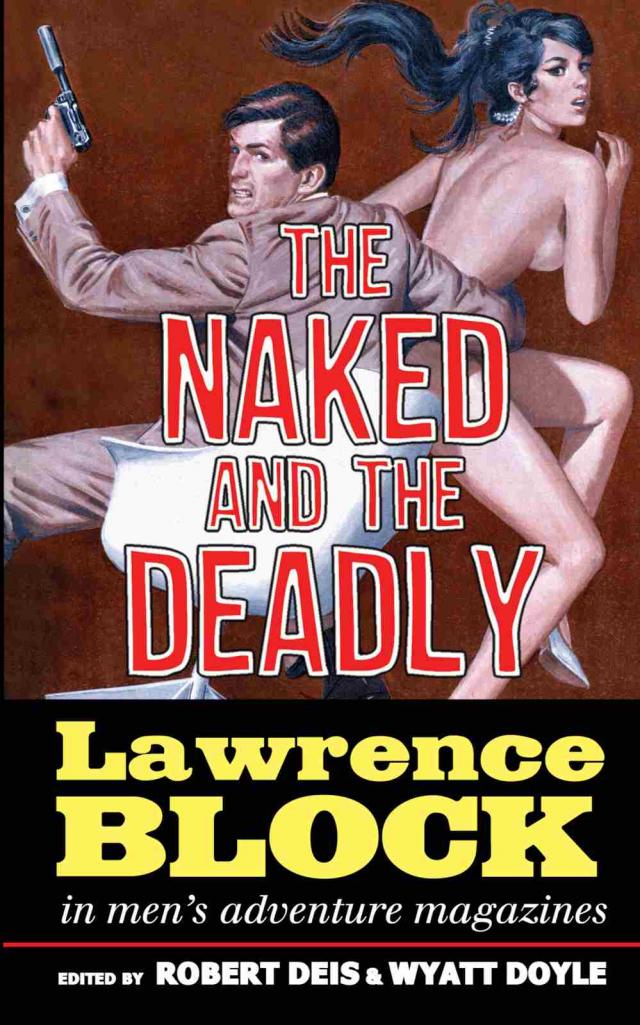
The naked and the deadly, p.26
The Naked and the Deadly,
p.26


“I knew you wouldn’t, Ed.”
“The hell you did. You hoped I wouldn’t but you had it all figured out if I did. I was lucky I stayed downstairs.”
Her eyes went innocently wide.
“Because you would have killed me. You would have used your gun on me and then you would have used my gun on Traynor to make it look as though we shot each other. That would have been a little tricky to pull off but you would have done it if necessary. Then with both of us dead you could try your story on the police.
“It might have worked too. But it wasn’t as sure a thing as it could have been, and that was why you wanted me to stay downstairs to back you up. However, you would have made your play either way.”
“Oh, no, Ed. That’s not true!” She put her heart into it. “I never could have killed you, Ed.”
“No?”
“Ed, I—”
I told her to save it. “You went upstairs and let yourself in,” I continued. “Traynor came over to kiss you and you screamed your head off. His face must have been something to see just then. You had him running around in circles anyway, and a good loud scream must have rattled the hell out of him. But he didn’t have much time to worry about it. You took out the gun and shot him. Then you gave out with another scream.
“This afternoon I thought about that part of it. The door was locked when I got upstairs. I had to shoot it off. Why would you lock the door when you were ducking into the apartment for a minute? When would you get a chance to close the door with Traynor waiting to kill you?
“You did it to stall. It gave you a few extra seconds to tear your dress and build the scene. By the time I shot my way through the door you were into your act, and from then on everything was set up. It couldn’t miss, could it?”
She didn’t answer.
“The gun checked out, the same weapon used for both killings. I backed your story every step of the way. You ran one hell of a lot of risks but things broke right for you each time. And by the time you left Headquarters you were clear. There would be a coroner’s inquest, maybe a few more questions that you could answer with your eyes closed. Then Jill’s body would be buried with your name on the headstone. You’d be Jill, with no debts and whatever money she had had, plus $50,000 worth of insurance money.”
She didn’t answer. Her hands moved down over her own naked flesh in a calculated movement that was supposed to look unconscious and automatic. I remembered making love to her, the flavor of her embrace, the touch of her body.
“You almost made it,” I said.
“What tipped you off, Ed? The birthmark?”
“Partly. That clinched it, of course. As soon as I got the idea that it was you in the photographs, I knew you had lied to me. And that was the trouble with the whole gambit, Jackie. It was all built on a pyramid of lies. As soon as one of them broke down, the whole thing collapsed. All the little inconsistencies that I had glossed over came back in spades. Every loophole showed up bright and clear.”
“Then I should have gotten those pictures back. I could have said I wanted to bum them—”
“I would have figured it anyway.”
“How?”
I thought for a second. “It was too pat,” I said. “You timed everything so perfectly, Jackie. So damned perfectly. Traynor was always at the right place just at the right time. Somebody had to be calling his signals.
“And another thing—the powder bums on Jill’s forehead. That was too neat and cute. If she knew Traynor was after her, she wouldn’t have let him get that close. She would have run or tried to fight or something. The death scene looked as though it had been the handiwork of someone she knew, someone she wasn’t afraid of.” I frowned. “Someone like her sister.”
“I… I wanted to make it fast.”
“Uh-huh. You should have walked away and fired three or four shots into her. It would have looked better that way.”
“I wanted Jill to die quickly. I didn’t want it to hurt her.”
“Sure. You’re an angel of mercy and an angel of death all rolled into one. There was a little whore and she had a little bore right in the middle of her forehead. You should have stuck to the other nursery rhyme.”
“What rhyme?”
“The one about Jackie and Jill going over the hill,” I said. “Get dressed.”
“You’re turning me in?”
“What do you think?”
But she wasn’t through yet. Her lush body flexed and her lips curled in a sensual smile. “Look at me,” she said.
I looked.
“I’m well off now financially, Ed. I’m not good at arithmetic but I’m sure you can figure it out. I’ll bet it’s a lot of money, right?”
“It’s a lot of money.”
“And there would be more than money, Ed.” Her hands touched her breasts. “I have a good clientele.”
I wonder if she thought it would work. Probably not. But it was all she had left and it didn’t hurt to try.
I stood up. She swung her legs over the side of the bed, got to her feet and came toward me. “Get dressed,” I sneered. “I can’t stand the sight of you.”
She blinked. Maybe no one had ever told her that before. She stood still. I pushed her aside, walked past her and picked up the phone. I started dialing. I was making more work for Jerry Gunther, but I had a hunch he wouldn’t mind.
“Great Istanbul Gold Grab”
The Turks have dreary jails. The plural might be inaccurate, for all I truly knew, there might be but one jail in all of Turkey. Or there could be others, but they need not be dreary places at all.
But, whatever the case, there was at least one dreary jail in Turkey. It was in Istanbul, it was dank and dirty and desolate, and I was in it. The floor of my cell could have been covered by a nine-by-twelve rug, but that would have hidden the decades of filth that had left their stamp upon the wooden floor. There was one small barred window, too small to let very much air in or out, too high to afford more than a glimpse of the sky. When the window turned dark, it was presumably night; when it grew blue again, I guessed that morning had come. But, of course, I could not be certain that the window even opened to the outside. For all I knew, some idiot Turk alternately lit and extinguished a lamp outside that window to provide me with this illusion.
I never saw another prisoner, never heard a human sound except for the Turkish guard who seemed to be assigned to me. He came morning, noon, and night with food. Breakfast was always a slab of cold black toast and a cup of thick black coffee. Lunch and dinner were always the same—a tin plate piled with a suspicious pilaf, mostly rice with occasional bits of lamb and shreds of vegetable matter of indeterminate origin. Incredibly enough, the pilaf was delicious.
It was the boredom that was stifling. I had been arrested on a Tuesday. I’d flown to Istanbul from Athens, arriving around ten in the morning, and I knew something had gone wrong when the customs officer took far too much time pawing through my suitcase. When he sighed at last and closed the bag, I said, “Are you quite through?”
“Yes. You are Evan Tanner?”
“Yes.”
“Evan Michael Tanner?”
“Yes.”
“American?”
“Yes.”
“You flew from New York to London, from London to Athens, and from Athens to Istanbul?”
“Yes.”
“You have business in Istanbul?”
“Yes.”
He smiled. “You are under arrest,” he said.
“Why?”
“I am sorry,” he said, “but I am not at liberty to say.”
MY CRIME seemed destined to remain a secret forever. Three uniformed Turks drove me to jail in a jeep. A clerk took my watch, my belt, my passport, my suitcase, my necktie, my shoelaces, my pocket comb and my wallet. He wanted my ring, but it wouldn’t leave my finger, so he let me keep it. My uniformed bodyguard led me down a flight of stairs, through a catacombic maze of corridors, and ushered me into a cell.
There was nothing much to do in that cell. I don’t sleep, have not slept in sixteen years—more of that later—so I had the special joy of being bored, not sixteen hours a day, like the normal prisoner, but a full twenty-four. I ached for something to read, anything at all. Wednesday night I asked my guard if he could bring me some books or magazines.
“I don’t speak English,” he said in Turkish.
I do speak Turkish, but I thought it might be worthwhile to keep this a secret.
The pattern changed, finally, on my ninth day in jail, a Wednesday. I had my usual breakfast, and performed a brief regimen of setting-up exercises. An hour or so after breakfast I heard footsteps in the hallway. My guard unlocked my door, and two uniformed men came into my cell. One was very tall, very thin, very much the officer. The other was shorter, fatter, sweaty, and moustached1 and possessed an abundance of gold teeth.
Both carried clipboards and wore sidearms. The tall one studied his clipboard for a moment, then looked at me. “You are Evan Tanner,” he said.
“Yes.”
He smiled. “I believe we will be able to release you very shortly, Mr. Tanner,” he said. “I regret the need to have dealt so unpleasantly with you, but I’m sure you can understand.”
“No, I can’t, frankly.”
He studied me. “Why, there were so many points to be checked, and naturally it was necessary to keep you in a safe place while these checks were made. And then you acted in such a strange manner, you know. You never questioned your confinement, you never banged furiously on the bars of your cell, you never slept—”
“I don’t sleep.”
“But we did not know that then, don’t you see?” he smiled again. “You did not demand to see the American ambassador. Every American invariably demands to see the ambassador. If an American is overcharged in a restaurant, he wants to bring the matter at once to his ambassador’s attention. But you seemed to accept everything—”
I said, “When rape is inevitable, lie back and enjoy it.”
“What? Oh I see. But that is a sophisticated reaction, you understand, and it called for explanation. We contacted Washington and learned quite a great deal about you. Not everything, I am quite certain, but a great deal.” He looked around the cell. “Perhaps you’ve tired of your surroundings. Let us find more comfortable quarters. I must ask you several questions, and then you will be free to go.”
In an airy cleaner room a floor above, the taller man sat beneath a flattering portrait of Ataturk and smiled benevolently at me. He asked if I knew why they had arrested me so promptly. I said that I did not.
“You are a member”—he consulted the clipboard—“of a fascinating array of organizations, Mr. Tanner. We did not know just how many causes had caught your interest, but when your name appeared on the incoming passenger list it did line up with our membership rosters for two rather interesting organizations. You belong, it would seem, to the Pan-Hellenic Friendship Society. True?”
“Yes.”
“And to the League for the Restoration of Cilician Armenia?”
“Yes.”
He stroked his chin. “Neither of these two organizations is particularly friendly to Turkish interests, Mr. Tanner. Each is composed of a scattering of—how would you say it? Fanatics? Yes, fanatics. The Pan-Hellenic Friendship Society has been extremely vocal lately. We suspect they’re peripherally involved in some acts of minor terrorism over Cyprus. The Armenian fanatics have been dormant since the close of the war. Most people would probably be surprised to know that they even exist, and we’ve had no trouble from them for a very long time. But suddenly you appear in Istanbul and are recognized as a member of not one but both of these organizations.” He paused significantly. “It might interest you to know that our records indicate you are the only man on earth to hold membership in both organizations.”
“Is that so?”
“Yes.”
“That’s very interesting,” I said. “Would you care to explain these memberships, Mr. Tanner?”
I thought this over. “I’m a joiner,” I said finally.
“Yes, I’m sure you are.”
“I’m a member of…many groups.”
“Indeed.” He referred to the clipboard once more. “Our list may not be complete, but you may fill in any significant omissions. You belong to the two groups I mentioned. You. also belong to the Irish Republican Brotherhood and the Clann-na-Gaille. You are a member of the Flat Earth Society of England, the Macedonian Friendship League, the Industrial Workers of the World, the Libertarian League, the Society for a Free Croatia, the Confederacion Nacional del Irabajadores de Espana, the Committee Allied Against Fluoridation, the Serbian Brotherhood, the Nazdoya Federovka, and the Lithuanian Army-in-Exile,” He looked up and signed. “This list goes on and on. Need I read more?”
“I’m impressed with your research.”
“A simple call to Washington, Mr. Tanner. They have a lengthy file on you, did you know that?”
“Yes.”
“Why on earth do you belong to all these groups? According to Washington, you don’t seem to do anything. You attend an occasional meeting, you receive an extraordinary quantity of pamphlets, you associate with subversives of every conceivable persuasion, but you don’t do much of anything. Can you explain yourself?”
“Lost causes interest me.”
“Pardon?”
There seemed no need for a reply.
“It seemed quite obvious to us that you were an agent provocateur,” he continued. “We contacted your American Central Intelligence Agency, and they denied any knowledge of you, which made us all the more certain you were one of their agents. We’re still not certain that you’re not. But you don’t fit any of the standard molds. You don’t make any sense.”
“That’s true,” I said.
“You don’t sleep. You’re thirty-four years old and lost the power to sleep when you were eighteen. Is that correct?”
“Yes.”
“In the war?”
“Korea.”
“You were shot through the head? Is that what happened?”
“More or less. A piece of shrapnel. Nothing seemed damaged—it was just a fleck of shrapnel, actually—so they patched me up and gave me my gun and sent me back into battle. Then I just wasn’t sleeping, not at all. I didn’t know why. They thought it was mental—something like that.”
“I see. Continue.”
“Well, they kept knocking me out with shots, and I would stay out until the shot wore off and then wake up again. They couldn’t even induce normal sleep. They decided finally that the sleep center of my brain was destroyed. They’re not sure just what the sleep center is or just how it works, but evidently I don’t have one any more. So I don’t sleep.”
“Not at all?”
“Not at all.”
“You are in good health, Mr. Tanner?”
“Yes.”
“Is it not a strain on your heart, this endless wakefulness?”
“It doesn’t seem to be.”
“And you’ll live as long as anyone else?”
“Not quite as long, according to the doctors. Their statistics indicate that I’ll live three-fourths of my natural life span, barring accidents, of course. But I don’t trust their figures.”
He frowned. “How do you live?” he asked.
“I receive a disability pension from the Army. For my loss of sleep.”
“They pay you one hundred twelve dollars per month. Is that correct?”
It was. I’ve no idea how the Defense Department had arrived at that sum. I’m certain there’s no precedent.
“You do not live on one hundred twelve dollars per month.” He narrowed his eyes at me. “Why are you in Turkey, Mr. Tanner?”
“I’m a tourist.”
“Don’t be absurd. You’ve never left the United States since Korea, according to Washington. You applied for a passport less than three months ago. You came at once to Istanbul. Why?”
I hesitated.
“For whom are you spying, Mr. Tanner? The CIA? One of your little organizations? Tell me.”
“I’m not spying at all.”
“Then why are you here?”
I hesitated. Then I said, “There is a man in Antakya who makes counterfeit gold coins. He’s noted for his counterfeit Armenian pieces, but he does other work as well. Marvelous work. According to Turkish law, he’s able to do this with impunity. He never counterfeits Turkish coins, so it’s all perfectly legal.”
“Continue.”
“I plan to see him, buy an assortment of coins, smuggle them back into the United States, and sell them as genuine.”
The man looked at me for a long time. Finally he said, “One moment, please.” He used a phone on his desk and called someone. I looked up at Ataturk’s portrait and listened to his conversation. He was asking some bureaucrat somewhere if there was in fact a counterfeiter in Antakya and what sort of things the man produced. He was not overly surprised to find out that my story checked out.
To me he said, “If you are lying, you have built your lie on true foundations. I find it frankly inconceivable that you would travel to Istanbul for such a purpose. There is a profit in it?”
“I could buy a thousand dollars worth of rare forgeries and sell them for thirty thousand dollars by passing them as genuine.”
He was silent for a moment. “I still do not believe you,” he said at length. “You are a spy or a saboteur of one sort or another. I am convinced of it. But it makes no matter. Whatever you are, whatever your intentions, you must leave Turkey. You are unwelcome in our country, and there are men in your own country who are very much interested in speaking with you.
“Mustafa will see that you get a bath and a chance to change your clothes. At three-fifteen this afternoon you will board a Pan American flight for Shannon Airport. Mustafa will be with you. You will have two hours between planes and you will then board another Pan American flight for Washington, where Mustafa will turn you over to agents of your own government.” Mustafa, who was to do all of this, was the grubby little man who had brought my pilaf twice a day and my toast each morning.


