

The naked and the deadly, p.29
The Naked and the Deadly,
p.29
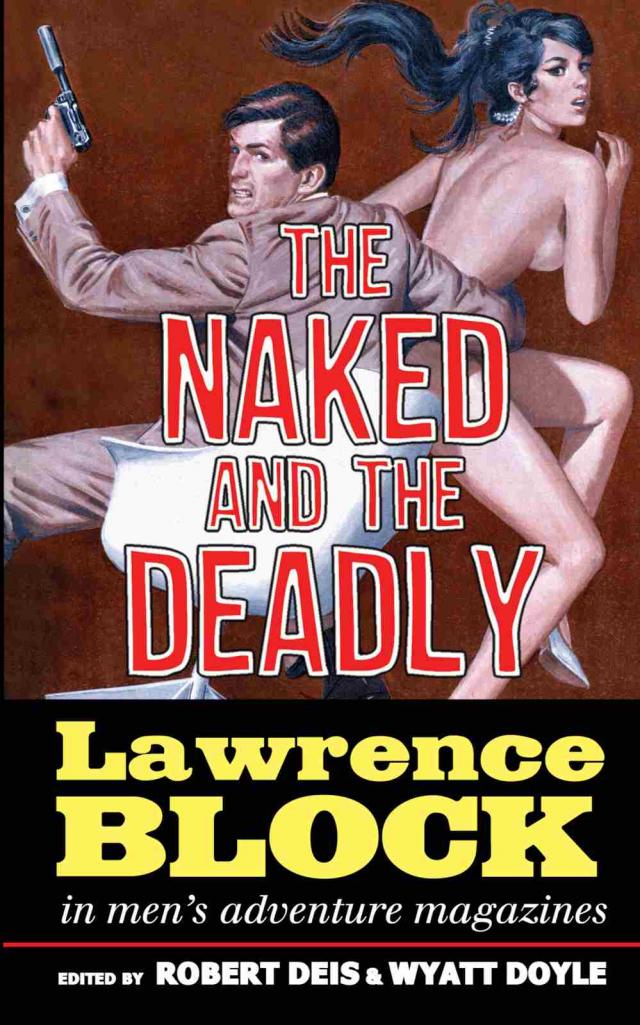


I took him by the shoulders and shoved. He bounced across the room, and I threw myself through the opening in the floor, like a paratrooper leaping from a plane. Between my feet, as I fell, I saw the upraised uncomprehending face of the other garda.
“Up the Republic!” someone was shouting. It was days later when I realized that it was my voice I had heard.
It was neither as easy nor as glorious as the assault upon Mustafa, but it had its points. The garda dodged to one side at the last possible moment. Otherwise my feet would have landed on his shoulders, and he would have fallen like a steer. Instead, I hit him going away, caromed into the side of him, and he and I went sprawling in opposite directions. I scrambled to my feet and rushed at him. He was clawing at his revolver, but he had buttoned the holster and couldn’t open it. He had white hair and child-blue eyes. I swung at him and missed. He lunged toward me, and Tom kicked him in the stomach just as Nora brought her shoe down on the base of his skull. That did it; he went down and out.
I barely remembered the trapdoor in time. I rushed to it, threw the rope ladder upward and saw the end of its strike the upstairs garda hard enough to put him off stride. I swung the panel back into place. He got his balance and lunged for it, and his fingers got in the way. He roared as the panel snapped on them. I opened it, and he drew out his fingers, howling like a gelded camel, and I closed the panel again and held it while Tom fastened the catch in place.
“It won’t hold him,” Nora said.
“I know.”
“If he jumps on it—”
“I know.”
But he wasn’t jumping on it. Not yet. The prostrate policeman was starting to stir, and the one in the attic room was kicking at the panel. Sooner or later he would leap on it with both feet and come through on top of us. I raced down the stairs and out the door. Their car, a gray Vauxhall sedan with a siren mounted on the front fender, was in front of the cottage. They had left the keys in the ignition, reasoning, perhaps, that no one would be such a damned fool as to steal a police car.
I wrenched open the door, hopped behind where the wheel should have been. It was the wrong side, of course. I got behind the wheel and turned the ignition key, and the car coughed and stalled. I tried again, and the motor caught.
I put the accelerator pedal on the floor and went away.
I had no particular idea where I was going until a road sign indicated I was headed for a town called Rath Luire. I had never heard of it and didn’t know whether it lay north, south, east, or west of Croom. When I reached the town and passed through it I found the same road went on to Mallow and ultimately to Cork. This was better than returning to Limerick, but it wouldn’t get me to Dublin, or to London, or to Balikesir. I was driving a stolen police car in hazardous fashion with no real destination in mind, and somehow this struck me as a distinctly imperfect way to proceed.
A few miles past Mallow I took a dirt road to the right, drove for a mile or so, and pulled off to the side of the road.
I got out of the car. A trio of black-faced sheep, their sides daubed with blue paint, wandered over to the heaped-stone fence and regarded me with interest. I walked around the car and got back inside. There was a road map of Ireland in the glove compartment. I opened it and found out approximately where I was. I was approximately lost.
I walked back to the main road. My side road had also been headed toward Cork, with a branch cutting off toward Killarney and points west. Thus, whoever found the car might conclude that I was headed in that direction, had car trouble, and continued toward either Cork or Killarney on foot. I didn’t know how well this would throw them off the trail or for how long, but it was something. For my part, I started walking toward Mallow. I’d gone less than a mile when a car stopped, and a youngish priest gave me a lift the rest of the way.
I mailed about half of my letters in Mallow. A copy of Cork Examiner had my picture on the front page. I pulled my cap farther down on my forehead and hurried to the bus station. There was a bus leaving for Dublin in a little over an hour, the ticket clerk told me.
It was almost nine o’clock when the bus reached the terminal in Dublin. The whole trip was only 150 miles or so, but we’d had many stops and several waits. I left the bus and found the terminal crawling with gardai. Several of them looked right at me without recognizing me.
A pair of James Bond movies were playing in a theater a few doors down from the remains of the Nelson monument. The IRA had dynamited the top of the monument a few months earlier, and the city had blown up the rest of it but hadn’t yet put anything in its place. A tall man with glasses and a black attaché case was looking at the monument, then glanced at me, then looked at the monument again. I went into the cinema and sat in the back row for two and a half hours, hoping that Sean Connery could give me some sort of clue as to what I might do next. I had a pocketful of American money that I didn’t dare spend, a handful of English and Irish pounds; I did not have a passport, or a way of getting out of Ireland, or the slightest notion of what to do next.
James Bond was no help. Near the end of the second picture, just as Bond was heaving the girl into the pot of molten lead, I saw a man walking slowly and purposefully up and down the aisle, as if looking for an empty seat. But the theater was half empty. I looked at him again and saw that he was the same man who had looked alternately at the Nelson monument and at me. There was something familiar about him. I had the feeling I’d seen him before at the bus station.
I sank down into my seat and lowered my head. He made another grand tour of the cinema, walking to the front and back again, his eyes passing over me with no flicker of recognition. I couldn’t breathe. I waited for him to see me, and then he walked on and out of the theater while I struggled for breath and wiped cold perspiration from my forehead.
But he was there when I came out. I knew he would be.
I tried to melt into the shadows and slip away to the left, and at first I thought I had lost him. When I looked over my shoulder, he was still there. I walked very slowly to the corner, turned it, and took off at a dead run. I ran straight for two blocks while people stared at me as if I had gone mad, then turned another corner and slowed down again. A cab came by. I hailed it, and it stopped for me.
“Just drive,” I said.
“Where, sir?”
I couldn’t think of the answer to that. “A pub,” I managed to say. “Someplace where I can get a good dinner.”
The cab still had not moved. “There’s a fine restaurant just across the street, sir. And quite reasonable, as well.”
My man came around the comer. He didn’t have his attaché case now, I noticed. I tried to hide myself, but he saw me.
I said, “I had a row with my wife. I think she’s following me. Drive around the block a few times and then drop me off at that restaurant, can you?”
Ten minutes later he dropped me in back of the restaurant. As I opened the door I glanced over my shoulder and saw the tall man with glasses. He was still trying to catch a cab. He saw me, and our eyes met, and I felt dizzy. I pushed open the door of the restaurant and went inside. When I looked back, I saw him crossing the street after me.
The headwaiter showed me to a table, I ordered a brandy and sat facing the door. I had never before felt so utterly stupid. I had escaped and then, brainlessly, I had returned to precisely the place where the tall man was waiting.
The door opened. The tall man came in, looked my way, then glanced out the door again. His face clouded for a moment and he seemed to hesitate. Perhaps, I thought, he was afraid to attempt to capture me by himself. No doubt I was presumed armed and dangerous.
Could I make a break for it? Surprise had worked twice before, with Mustafa and the two gardai. But I couldn’t avoid the feeling that the third time might be the charm. This man was prepared. He was walking toward my table—
Still, it seemed worth a try. I looked past him as though I did not see him, my hands gripping the table from below. When he was close enough I would heave it at him, then run.
Then over his shoulder I saw the gardai—three of them, in uniform—coming through the doorway. If I got past him, I would only succeed in running into their arms.
The tall man with the glasses stumbled, fell forward toward me. His right hand broke his fall, his left brushed against my right side. He said, “Mooney’s, Talbot Street,” then got to his feet and swept past me.
And the gardai, solemn as priests, walked on by my table and surrounded him. One took his right arm, the other his left, and the third marched behind with a drawn pistol. They marched him out of the restaurant and left me there alone.
I could only stare after them, I and all the other patrons of the restaurant. It was late, and most of the other diners were about half-lit. At the doorway the tall man made his move. He kicked backward at the garda with the pistol, wrenched himself free from the grasp of the other two, and broke into a run.
Along with other diners, I pressed forward. I heard two short blasts on a police whistle, then a brace of gunshots. I reached the door and saw the tall man rushing across the street. A garda was shooting at him. The tall man spun around, gun in hand, and began firing wildly. A bullet shattered the restaurant window, and I dropped to the floor. A fresh fusillade of shots rang out. I peered over the window ledge and saw the tall man lying in a heap in the middle of the street. There were sirens wailing in the distance. One of the gardai had taken a bullet through one hand and was bleeding fiercely.
And no one was paying any attention to me.
Mooney’s, Talbot Street, he had said. I didn’t know what he meant, or who he was, or who he thought me to be. Why had he followed me? If the police were following him, why should he follow me? What was Mooney’s? Was I supposed to meet him there? It seemed unlikely that he would ever keep the appointment.
Then I found in my right coat pocket, where he must have placed it when he fell, a metal brass-colored disc perhaps an inch and a half across. Stamped upon it were the numerals 249.
At that point it was easy enough to figure out the what, if not the why. I worked my way back to O’Connell Street and found Talbot Street, just around the corner from the cinema. Mooney’s was a crowded pub halfway down the block. I found the checkroom and presented the brass disc. As I had expected, the attendant handed over the black attaché case, and I left a shilling on the saucer. I closed myself in a cubicle in the men’s room and propped the attaché case upon my lap. It was not locked. I opened it.
On top was an envelope with my name on it. I drew a single sheet of hotel stationery from it. The message was in pencil, written in a hurried scrawl:
Tanner—
I just hope you’re who I think you are. Deliver the goods to the right people and they’ll take care of you. The passports are clean. Big trouble for everybody if delivery isn’t made.
SIX HOURS later I was in Madrid. Esteban Robles lived on Calle de la Sangre—Blood Street—a dim, narrow two-block lane in the student quarter south of the university .
I found Robles on the third floor of a drab tenement permeated with cooking smells. His room resembled the cell of a slovenly monk—a desk piled high with books and newspaper clippings and cigarette stubs, another heap of books in a corner, four empty wine bottles, a pan of leftover beans and rice, and a narrow cot that sagged in the middle. The floor was incompletely covered with linoleum, its pattern obscured by years of dirt. Robles himself was a young fellow with the body of a matador and the bearded face of a protest marcher. I knew him as a fellow member of the Federation of Iberian Anarchists. It was a dangerous thing to be in Spain, and I had trouble convincing him that I was not an agent of the Civil Guard.
“But what do you want here?” he kept demanding. “But why do you come to me?”
“I have to go to Turkey,” I explained.
“Am I an airplane? This is not safe. You must go.”
“I need your help.”
“My help?” He glanced again at the door. “I cannot help you. The police are everywhere. And I have nowhere for you to stay. Nowhere. One small bed is all I own, and I sleep in it myself. You cannot stay here.”
“I want to get out of Spain.”
“So do I. So does everyone. I could make a grand fortune in America. I could become a hairdresser. Jackie Kennedy.”
“Pardon me?”
“I would set her hair and make a fortune.”
“I don’t think I—”
“Instead, I rot in Madrid.” He fingered his beard. “I could set Jackie Kennedy’s hair and make a fortune. Lady Bird Johnson. Are you a hairdresser?”
“No.”
“I have had no breakfast. There is a cafe downstairs, but you cannot go. They will shoot you in the street like a dog. Can you speak Spanish?”
We had been speaking Spanish all along. I was beginning to suspect that Robles was mad.
“There is a cafe,” he said. “They know me there. So they will give me credit.” He glanced at the door again. His fear was so genuine that I was beginning to share it.
“I have no money,” he said.
I gave him some Spanish money and told him to get breakfast for both of us. He snatched the notes from me, glanced again at the door, lit a cigarette, smoked furiously, dropped ashes on the floor, and was gone like a shot.
I closed the door and wished that it had a functioning lock on it. I went to the window and drew the shade. It was badly torn. Through the hole in the shade I looked into a room in the building next door. A rather plump girl with long black hair was dressing. I watched her for a few moments, then left the window and sat on Esteban’s bed and opened my black attaché case. A gift of Providence, I thought. An ideal survival kit for a hunted man. It had everything I might need—money, passports, and documents so secret I had no idea what they were.
Along with the unsigned and unintelligible note, the attaché case had contained a heavy cardigan sweater with a London label, a change of underwear, a pair of dreadful Argyle socks, a safety razor with no blades, a toothbrush, a can of toothpowder made in Liverpool, and a Japanese rayon tie with a fake Countess Mara crest. There was also a Manila envelope holding banded packages of British, American, and Swiss currency—two hundred pounds, one hundred fifty dollars, and just over two thousand Swiss franks. Another larger envelope contained three passports. The American passport was in the name of William Alan Traynor, the British in the name of R. Kenneth Leyden, and the Swiss for Henri Boehm. Each showed a rather poor photograph of the tall man.
A third Manila envelope, carefully sealed with heavy tape, held the mysterious documents. These, evidently, were the “goods” that I was to deliver to “the right people.” I had attempted to slit the tape with my thumbnail in the manner of James Bond opening a packet of cigarettes. This proved impossible, so I had laboriously peeled off the tape in the privacy of the Dublin lavatory and had a look at the contents of the parcel. It had made no particular sense to me then; now, in the equally dismal atmosphere of Esteban Robles’ dirty little room, it remained as impenetrable as ever.
Half a dozen sheets of photocopied blueprints. Blueprints for what? I had no idea. A dozen sheets of ruled notebook paper covered with either the mental doodling of a mathematician or some esoteric code. A batch of carefully drawn diagrams. A whole packet of confidential information, no doubt stolen from someone and destined for someone else. But stolen from whom? And destined for whom? And indicating what?
When I first opened the case it had scarcely mattered. I had packed everything away and taken a taxi to the Dublin airport. I used the American passport to buy a ticket to Madrid and paid for it with American money.
By flight time I took my attaché case from the locker, lodged the envelope of unidentifiable secret papers between my shirt and my skin, and incorporated the currency with my own small fund of money. I tucked my two extra passports (and Mustafa lbn Ali’s) into a pocket, combed my hair to conform to Traynor’s passport photo.
At the time, never having met Esteban Robles, I had no idea he was a lunatic.
The packet of secret papers bothered me. If I had known just what they were, I might have had some idea what to do with them. Knowing neither their source nor their destination nor their nature, I was wholly in the dark.
In a sense, I felt a sort of debt to my anonymous benefactor, the tall man who had been shot down by the Irish police. However invalid his assumptions of my identity, however suspect his motives, he had done me a good turn. He had provided me with three passports to spirit me out of Ireland and away from the manhunt that sooner or later would have caught up with me. He had endowed me with a supply of capital that would help me on my way to Balikesir. But who was he? And which side was he on?
He was not on the Irish side; that much was obvious. All right, then, suppose he was an enemy of Ireland. Why would he be spying on Ireland? What precious information could the Irish possibly have that he or his employers would want? And who could his employers be? The British? The Russians? The CIA? The answer was unattainable without a knowledge of the nature of the documents, and they remained as impenetrable as ever.
I was getting nowhere. I gave it up, put everything back in the attaché case, closed it, and stretched out on Esteban’s unsanitary bed until its owner returned.
“Ah.” He scratched at his beard. “It is not safe for you here. It is not safe for either of us. We must leave.”
“We?”
“Both of us!” He spread his arms wide as if to embrace the beauty of the idea. “We will go to France. This afternoon we rush to the border. Tonight, under the cloak of darkness, we slip across the border like sardines. Who will see us?”
“Who?”
“No one!” He clapped his hands. “I know the way, my friend. One goes to the border, one talks to the right people, and like that”—he snapped his fingers soundlessly—“it is arranged. In no time at all we are across the border and into France. I will go to Paris. Can you imagine me in Paris? I shall become the most famous hairdresser in all of Paris.”
“I don’t know,” I said. “I’m not sure it sounds like the best of all possible plans. It might be dangerous for us to travel together.”


