

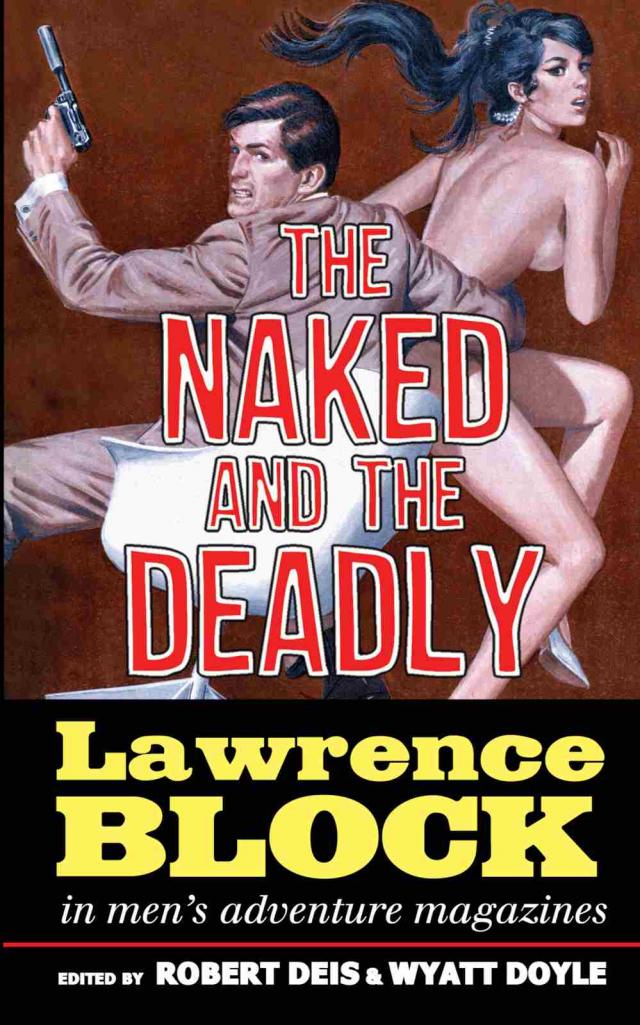
The naked and the deadly, p.20
The Naked and the Deadly,
p.20


“That’s a damned lie.”
“It is like hell. And about that time you managed to have your cake and eat it, too. You kept on thinking of her as the unattainable ideal. But that didn’t stop you from taking her virginity, did it? You ruined her, Powell!”
He was getting closer to the edge. His face was white and his hands were hard little fists. The muscles in his neck were drum-tight.
“I never touched her!”
“Liar!” I was shouting now. “You ruined that girl, Powell!”
“Damn you, I never touched her! Nobody did, damn you! She’s still a virgin! She’s still a virgin!”
I took a breath. “The hell she is,” I yelled. “I had her last night, Powell. She came to my room all hot to trot and I bedded her until she couldn’t see straight.”
His eyes were wild.
“Did you hear me, Powell? I had your girl last night. I had Lynn, Powell!”
And that cracked him.
He charged me like a wild man, his whole body coordinated in the spring. I stepped back, swung aside. He tried to turn and come toward me but his momentum kept him from pulling it off. By the time he got back on the right track, my hand had gone up and come down. The barrel of the gun caught him just behind the left ear. He took two more little steps, carried along by the sheer force of his rush. Then he folded up and went out like an ebbing tide.
He wasn’t out long. By the time Jerry Gunther got there, flanked by a pair of uniformed cops, Powell was babbling away a mile a minute, spending half the time confessing to the three murders and the other half telling anyone who would listen that Lynn Farwell was a saint.
They started to put handcuffs on him. Then they changed their minds and bundled him up in a straitjacket.
ELEVEN
“I GUESS I missed my calling,” Ceil said. “I should have been a detective. I probably would have flopped there, too, but the end might have been different. We all know what girls become when they don’t make it as actresses. What do lousy detectives turn to?”
“Cognac,” I said. “Pass the bottle.”
She passed and I poured. We were in her apartment on Sullivan Street. It was Tuesday night, Ray Powell had long since finished confessing, and Ceil Gorski had just proved to me that she could cook a good meal.
“You figured it out beautifully,” she said. “But do I get an assist on the play?”
“Easily.” I tucked tobacco into my pipe, lit up. “You managed to get my mind working. Powell was a genius at murder. A certifiable psychotic, but also a genius. He set things up beautifully. First of all, the frame couldn’t have been neater. He very carefully set up Donahue with means, motive and opportunity. Then he shot the girl and left Donahue on the hook.”
I worked on the cognac. “The neat thing was this—if Donahue managed to have an alibi, if by some chance somebody was watching him when the shot was fired, Powell was still in the clear. He himself was one of the few men in the room with no conceivable motive for wanting Karen Price dead.”
Ceil moved a little closer on the couch. I put an arm around her. “Then the way he got rid of Donahue was sheer perfection,” I continued. “He made it look enough like suicide to close the case as far as the police were concerned. And Jerry Gunther isn’t an easy man to bulldoze. He’s thorough. But Powell made it look good.”
“You didn’t swallow it.”
“That’s because I play hunches. Even so, I was up a tree by then. Because the murder had a double edge to it. Even if he muffed it somehow, even if it didn’t go over as suicide, Donahue would be dead and he would be in the clear. Because there was only one way to interpret it—Donahue had been killed by the man who killed Karen Price, obviously, and had been killed so that the original killing would go unsolved. That made me suspect Joe Conn and never let me guess at Powell, not even on speculation. Even with the second killing he hid the fact that Donahue and not Karen was the real target.”
“And that’s where I came in,” she said happily.
“That’s exactly where you came in,” I agreed. “You and your active imagination. You thought how grim it would be if Karen had only been playing a joke with those phone calls. And that was the only explanation in the world for the calls. I had to believe Donahue was getting the calls, and that Karen was making them. A disguised voice might work once, but she’d called him a few times.
“That left two possibilities, really. She could be jealous—which seemed contrary to everything I had learned about her. Or it could be a gag. But if she was jealous, then why in hell would she take the job popping out of the cake? So it had to be a gag, and once it was a gag, I had to guess why someone would put her up to it. And from that point—”
“It was easy.”
“Uh-huh. It was easy.”
She snuggled closer. I liked her perfume. I liked the feel of her body beside me.
“It wasn’t that easy,” she said. “You know what? I think you’re a hell of a good detective. And you know what else?”
“What?”
“I also think you’re a rotten businessman.”
I smiled. “Why?”
“Because you did all that work and didn’t make a dime out of it. You got a retainer from Donahue, but that didn’t even cover all the time you spent before Karen was killed, let alone the time since then. And you probably will never collect.”
“I’m satisfied.”
“Because justice has been done?”
“Partly. Also because I’ll be rewarded.”
She upped her eyebrows. “How? You won’t make another nickel out of the case, will you?”
“No.”
“Then—”
“I’ll make something more important than money.”
“What?”
She was soft and warm beside me. And it was our third evening together. Not even an amateur tramp could mind a pass on a third date.
“What are you going to make?” she asked, innocently.
I took her face between my hands and kissed her. She closed her eyes and purred like a happy cat.
“You,” I said.
“Twin Call Girls”
Somewhere a phone was ringing. I reached out and touched something warm and soft. The something flowed into my arms like hot lava and purred Oh, Ed and drew itself against me from head to toe. Mouths kissed and hands fluttered urgently.
Somewhere a phone was ringing. The girl in my arms sighed lustily and made preliminary movements. I kissed the side of her face and her throat. A bedspring complained with a metallic whine. It was the world’s best way to wake up except for that damned phone.
Somewhere a phone was ringing. The girl in my arms sighed a sigh pregnant with thoughts of what might have been. Her mouth stopped kissing, her hands stopped fluttering and, reluctantly, she drew herself away.
“Ed, the phone is ringing,” she said.
Lust coughed and died. I blinked cobwebs from disappointed eyes, swung my legs over the side of the bed and picked up the damn phone.
A female voice said, “No names. Please listen carefully—this is urgent. I need help. Are you listening to me?”
“Yes.”
“I can’t talk now, but I want you to call me this afternoon. At two. Have you got that?”
“At two this afternoon.”
“From a pay phone. Not from your apartment. Call me at TRafalgar 3-0520. Do you have the number?”
“TRafalgar 3-0520,” I said. “Whom do I ask for?”
“Don’t worry,” she said. “I’ll answer.”
The phone clicked. The girl in my bed wanted to know who had called. I told her I didn’t know. She said well now, what the hell was this, anyway? That I didn’t know either. I got out of bed and found a magazine and a pencil. On the magazine cover was a painting of a general. He had a high forehead. Across it I printed ‘TRafalgar 3-0520’ and under that ‘2 PM’
The girl in my bed yawned, a wide, open-mouthed yawn. No prelude to love making. The damned phone had ended that. She got out of bed and started putting on clothes.
“It’s morning, all right,” she noted. “Make some coffee, Ed. I’ve got a head that’s two sizes too big for me.”
Ceil Gorski had other things that were pretty big, too; she was a dark-roots blonde of equally good company in and out of the hay. Somebody had killed her roommate about a year ago, and Ceil had helped me crack the case. Last night she had helped me crack a bottle of cognac.
I made a pot of coffee which we drank in the living room. She asked about the phone call.
“Probably some crank,” I said. “All cloak and dagger. That’s one trouble with being a detective. You get a lot of idiot phone calls.”
“And all at the wrong time, Ed. You’re supposed to call her back. You going to?”
“Probably.”
“And the number’ll tum out to be the YWCA, or something. You lead a rough life.”
I told her it had its moments.
“Like last night,” she said, grinning seductively. “Last night was fun. I got pretty smashed, though. Did I do anything silly?”
“You said we ought to get married.”
“Well that’s not so silly.” She finished her coffee. “I better get out of here. I’ve got a job lined up at one, and I have to look erotic by then. A photographer wants to take pictures of me in the nude.”
“I don’t blame him.”
She was that kind of model—a little cheesecake…sometimes things that were a little rougher.
I walked her down a flight of stairs and out into the morning sun. Then I put her into a cab. A fine woman, Ceil Gorski. A little soiled around the edges, a little tarnished, but still smooth and sweet inside. Enough so that I was still angry with the voice on the telephone.
AT 2 PM I called TRafalgar 3-0520. It wasn’t the YWCA. The same voice answered on the first ring, saying, “Ed London?”
“Yes. Who is this?”
A sigh of relief. “I’m in terrible trouble,” she said. “Somebody is trying to kill me. I need your help. I’m scared.”
I started to tell her to come to my place, but she cut me off. “I can’t go there,” she said.
“Why not?”
“It’s not safe. Listen, I’ll meet you in Central Park. Is that all right?”
“It’s a pretty big place. Want to narrow it down a little?”
“There’s an entrance to the park at 94th Street and Fifth Avenue. There are two paths. Take the one that bears uptown. A little ways up there’s a pond, and the path divides to go around the pond. I’ll be sitting on one of the benches on the uptown side of the pond.”
“How do I recognize you?”
“I’m blonde. Not too tall. Don’t worry, just come. It never gets crowded there. I’ll be alone. I’ll…I’ll recognize you, Mr. London.”
“What time?”
“Four-thirty. Please be on time. I’m very scared.”
I HAD A sandwich in the restaurant where I’d made the phone call, then walked back to my apartment. It’s on 83rd Street near Third Avenue, not too far from the part of the park where I was supposed to meet my mystery woman. She still hadn’t told me her name. I smoked a pipe on the way back to my place and thought about Central Park and all the wildlife that call it home… Yes, New York is a summer festival.
Any other time the setup would have worried me a little. If I had been on a case, say, the meet-me-in-the-park approach would look an awful lot like a perfect way to turn one Edward London into a sitting duck.
But I wasn’t working on anything at the moment. It’s a funny business—you can have six or seven clients one week and then no clients for a month. There’s nothing to do but take an occasional farm-out job from one of the big agencies or sit around on your tail and improve your mind.
I had been sitting on my tail for two weeks running. Any work at all looked good by now. There might be a client on that bench in Central Park, but I would just have to go and see for myself.
I sat in my apartment until four, thumbing through Sutherland’s text on criminology and listening to a stack of Vivaldi records. The reading was dull but the music sounded cool and crisp. At four I stuffed tobacco into a pipe and went outside into the dry heat of a New York summer afternoon, looking for a wench on a bench.
She had picked a quiet part of the park. I walked in through the 94th Street entrance and passed a covey of maids pushing carriages. They milled around near the entrance and gossiped about their employers. I took the path that led uptown and walked toward the pond.
The sun shined brightly now and the sky was as clear as it gets over Manhattan, a sort of steely gray with occasional hints of blue. I knocked the dottle out of my pipe and stuck the mature man’s pacifier in a jacket pocket. I patted the front of my jacket. There was another pacifier there, a .38 snug in a shoulder rig. The bulk of the gun was reassuring in the loneliness of Central Park.
The pond came into view, flat, calm and stagnant. Three beer cans and two ducks floated on the water. I thought of sitting ducks. I started walking around the uptown side of the pond and then I saw her, sitting alone on a bench and not looking at me. I wanted to call her name but she had never gotten around to telling me what it was.
“Hello there,” I called.
No answer and no glance. I looked at my watch. It was 4:30, I was right on time and she was the only person around. She was blonde, young and dressed nicely. I walked faster. She still did not look at me. I hurried along, worried now, and I reached her and looked at her and saw, finally, why she had not moved.
I was on time. But someone had gotten to her first, had found her before me.
Her hair was done page boy style and it framed her face in gold. She had red lips, a button nose and skin that was cool and would grow colder—because she had a little round hole in the middle of her forehead with powder bums around it.
Once she had been pretty, and once she had been frightened…and now she was dead.
TWO
I LOOKED around. The park was as still as the girl. I went through the inane formality of holding her cool and limp wrist and feeling for a pulse. There was none. There is rarely a pulse in the wrist of a girl who has been shot through the middle of the forehead. She had been dead 15 or 20 minutes. I let go of her wrist and it flopped into her lap.
If she had a purse, someone had snatched it. No identification. I did not know her name, who had scared her, who had followed her, who had killed her or why. She had wanted help, my help, but I did not get to her in time.
I didn’t want to leave her on the bench. There is something ineffably discordant about a lone corpse left to cool and stiffen on a park bench. But I turned and walked back around the edge of the pond and down the path. I stopped once to look back at her. She did not look dead from a distance. She looked like a young girl sitting quietly, waiting to meet a suitor.
I walked to Fifth Avenue, down to 86th Street, east toward home. There was a bar on Madison. I stopped there to use the phone booth. I dialed Centre Street police Headquarters. Some sergeant answered the phone.
“There’s a body in Central Park, a dead girl,” I said, and quickly gave him the location. He kept trying to interrupt, to get my name, to find out more. But I had said everything I wanted to say. So I put the phone on the hook, had a slug of cognac at the bar and left for home…
IT WAS no time for music or for books. I put the records away and found a bottle of Courvoisier sitting silent on a shelf. I poured a short drink and swallowed it down, poured a long drink and sat with it. I lit a pipe and smoked and drank.
The day had started off with an unreal quality to it. Private detectives do not get mysterious phone calls from anonymous people. They do not keep unexplained rendezvous with nameless voices in secluded parts of Central Park. It had all seemed a game staged by some more or less harmless lunatic, and I had gone through the paces like a dutiful clown.
The corpse changed all of that. The girl, so neatly shot, poised so unobtrusively on the park bench, was a jarring coda to the symphony of annoyance that began with a phone call’s interruption of romance. I had made my call to the police without giving my name and, consequently, was not involved. I had gone through the motions and had stumbled on the death of a prospective client who had not lived long enough to pay me a retainer. I had gone to her aid without believing she really existed, and when I had found her she was dead, and I never had the chance to become involved.
But I still felt involved.
The cognac disappeared steadily from my glass. I filled it again, sat down with it again, thought again.
The phone rang. I picked it up and Ceil said, “You’re hard to get hold of. Was it the YWCA?”
“No.”
“Oh, you really met the girl? What was she like?”
“I met her.”
“And it wasn’t a gag?”
‘’No,” I said, tired. “No gag.”
“She’s there now. In your apartment.”
“No.”
“You don’t talk much, do you? We had a dinner date tonight, I think. Is it still on?”
“I’ll have to take a raincheck.”
“That’s damned nice of you,” she exploded. “You’re one swell guy, Ed London.”
I didn’t feel like explaining. But I started to anyway, and got nowhere. The phone made a sharp little click and all at once I was talking to myself.
Well, Ceil would have to understand—later, when I was ready to explain that you never get used to death. You can meet it a thousand times in a thousand places, you can see it happen and you can cause it to happen and you can stumble upon its ultimate results, and still it’s a menacing stranger—twice your size—on a dark, deserted street.
My friend on the police force have never gotten used to it. Sure, they can look at tom-up bodies without getting sick, and they can see an array of bodies after a catastrophe without waking up in the night. But this does not make them used to it.
I knew an obstetrician once who loved his work. He told me he got a kick every time he delivered a baby, as though part of himself were reborn with every birth. The thrill never wore off for him. And it is that way with death, the other end of the spectrum. The chill never wears off. Each time it is as if a part of you dies.


