

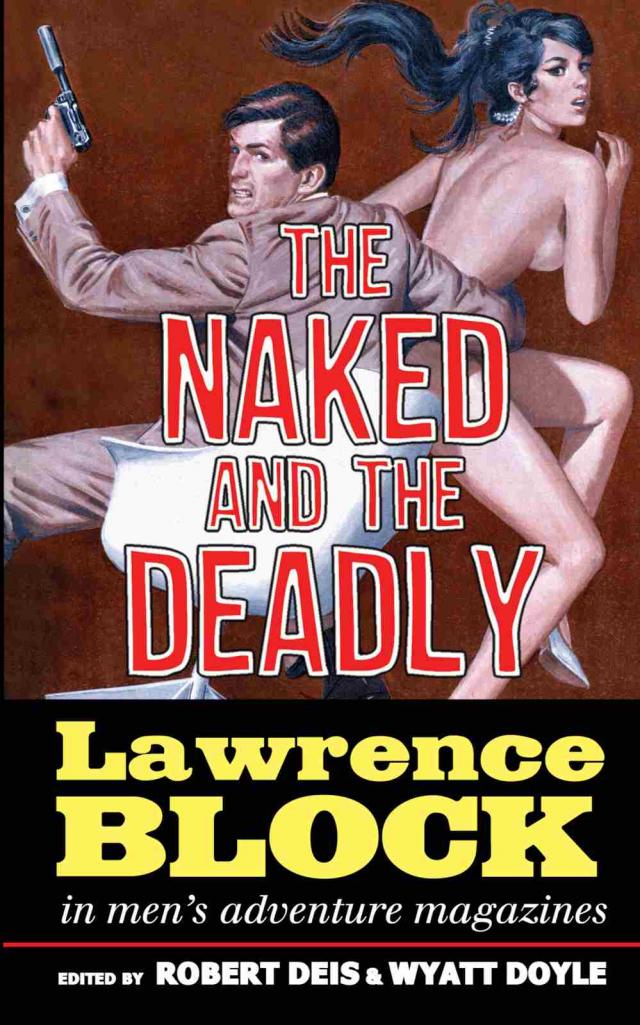
The naked and the deadly, p.28
The Naked and the Deadly,
p.28


He barely moved at all. At the last moment he turned lazily around just in time to see me hurtling through the air at him. His mouth fell open, and he started to take a small step backward, and I sailed into him, my head ramming him in the pit of his soft stomach, and down we went.
I was ready for a war. I had visions of us bouncing one another off plumbing fixtures, hurling karate chops at one another, fighting furiously until one of managed to turn the tide. But this was not to be. I had never realized just how great an advantage surprise can provide. Mustafa collapsed like a blown tire. We fell in a heap, and I landed on top, and he did nothing but gape at me.
“You are doomed,” I said. “I’m a secret agent working for the establishment of a free and independent Kurdistan. I’ve poisoned the entire water supply of Istanbul. Within a month everyone in Turkey will perish of cholera.”
His eyes rolled in his head.
“Sleep well,” I said, and I slammed his head against the floor again, but infinitely harder this time. His eyes went glassy, and their lids flopped shut, and for a moment I was afraid that I had actually gone and killed him. I checked his pulse. He was still alive.
I dragged him back into the stall where I’d left my shoes and jacket and I stripped off all his clothes and used strips of his shirt to tie him up and gag him.
I took my passport arid Mustafa’s passport from his pants and put them both m my pocket. I stuffed his clothes in a trash can and poked them down to the bottom. I kept expecting him to emerge from the men’s room and chase after me, but he stayed where he was, and I hurried through a pair of big glass doors to the outside.
There were taxis, but I didn’t dare take one. Someone might remember me. I wouldn’t leave a trail. I asked a stewardess where I could get a bus to Limerick. She pointed at an oldish double-decker bus, and I headed toward it.
When the bus reached Limerick, I jumped off, walked to the nearest clothing shop and ducked inside. Fifteen minutes later I was outside again, wearing a pair of gray, woolen trousers, a bulky tweed sport coat and a black wool sweater. Tucked under my arm was a package containing my American suit.
I stopped inside a pub and asked if I could take a bus to Croom. The pubkeeper said there wasn’t one until the following morning, but that I could rent a bicycle at a shop named Mulready’s down the street and ride to Croom myself in less than an hour. Mr. Mulready, the proprietor would even give me proper directions on how to get there.
I couldn’t stay any long in Limerick—it was becoming too dangerous. A rented bicycle at Mulready’s was the only answer.
It was dark and raining when I pedaled into Croom. I parked my cycle in front of a pub and went inside. l asked the bartender if he knew where PP Dolan lived.
I followed the tortuous directions, made all the correct turns, and found the house. It was a small cottage, gray in the dim light. A television antenna perched on the thatched roof, and smoke trickled upward from the chimney.
I staggered to the door, hesitated, tried to catch my breath, failed, and rapped on the door. I heard footsteps, and the door was drawn open. I looked at the little man in the doorway: he was more a leprechaun, short, gnarled, with piercingly blue eyes.
“PP Dolan?”
“I am.”
“Padraic Pearse Dolan?”
He seemed to straighten up. “Himself.”
“You’ve got to help me,’ I said. The words flowed in a torrent. “I’m from America, from New York, I’m a member of the Brotherhood—the Irish Republican Brotherhood—and they’re after me. I was in jail. I escaped when we reached Ireland. You have to hide me.” And, gasping for breath, I dug out my passport and handed it to him.
He took it, opened it, looked at it, at me, at it again. “I don’t understand,” he said gently. “The picture’s no likeness of you at all. And it says that your name is…let me see”—he squinted in the half light—“Mustafa lbn Ali. Did I say that properly? Nora, do make Mr. Mustafa Ali some tea.”
I had made two mistakes, it seemed. When I changed my summer suit for proper Irish clothing. I had transferred only one passport and the wrong one at that. My own passport remained in my suit. And my suit, had somehow been separated from me. I had carried the parcel into the pub, but I hadn’t had it with me when I left Mulready’s cycle shop. I’d left it either at the pub or with Mulready, suit and passport and all.
“My name’s not Mr. Ali,” I said. “I took his passport by mistake. He’s a Turk. He was my jailer in Turkey. He was taking me back to America when I escaped.”
“You were a prisoner, then?”
“Yes.” His face seemed troubled by this, so I added, “It was political, my imprisonment.”
This eased his mind considerably. Nora, his daughter, came over to us with the tea. She was a slender thing, small-boned, almost dainty, with milk-white skin and glossy black hair and clear blue eyes.
“Your tea, Mr. Ali,” she said.
“It’s not his name after all,” her father said. “And what would your name be, sir?”
“Evan Tanner.”
“Tanner,” he said. “Forgive me if I seem to pry, Mr. Tanner, but what led you to come here? To Croom and to my house?”
I told him a bit of it. He became quite excited at the thought that I was an American member of the Brotherhood and that I had heard of him. “Do they know of me, then, in America?” he mused. “And who would have guessed it?”
But it was Nora who seized on my name. “Evan Tanner. Evan Michael Tanner, is it?”
“Yes, that’s right—”
“You know him, Nora?”
“If it’s the same,” she said. “And Mr. Tanner, is it you who writes articles in United Irishmen? Oh, you know him, Da. In last month’s paper, the article suggesting that honorary representatives of the Six Counties be given seats in the Dail. ‘Wanted: Representation for Our Northern Brethren,’ by Evan Michael Tanner, and wasn’t it the article you admired so much, and saying what a grand idea it was, and wouldn’t you like to shake the hand of the man that wrote it?”
He looked wide-eyed at me. “And was it you who wrote that article, Mr. Tanner?”
“It was.”
He took the tea from me. “Nora,” he said, “spill this out. Bring the jar of Power’s. And mind who you tell!” He shook his head sadly. “It’s a hell of a thing to say,” he explained, “but there are spies and informers everywhere.”
The four of us, Dolan, Nora, his son Tom and I, listened to the latest developments in the Evan Tanner case on the kitchen radio. It seemed that Mustafa had seen a good number of James Bond movies, and they had served to supplement his account of my escape. According to the radio report, I was a dangerous spy of unknown allegiance being returned to America after attempting to infect all of Turkey with a plague of cholera. In the Shannon lavatory I had crushed a small pellet between my fingers, liberating a gas that temporarily paralyzed Mustafa’s spinal column. Though he fought valiantly, he was in no condition to prevent my knocking him unconscious and trussing him up.
“It looks bad,” I said: “Sooner or later they’ll turn up the suit and spot the passport. Once they trace me to the bicycle shop, Mr. Mulready will be able to tell them that I went to Croom. And if they follow me this far, they’ll be sure to find me.”
“Don’t talk nonsense. And don’t be worrying about your suit, either. Most likely it’s still unwrapped in Mulready’s waiting for you to come back for it. If you left it there, it’s still there now. And if you left in the pub, sure they’ll take it to Mulready’s, knowing you’ll have to return a rented cycle to the cycle shop sooner or later. Tom can go for it tomorrow, and you’ll have it in your hands without the gardai ever knowing of it.”
“If they’re already there and see him—”
“Tom will be looking for them, and if they’re there, he will leave without being seen. Don’t bother yourself about it, Mr. Tanner. Tom Dolan showed me to my room. It was reached through a trapdoor in the second-floor ceiling. Tom stood on a chair, moved a lever, and a flap dropped from the ceiling, releasing a rope ladder. I followed Tom up the ladder and into a long, narrow room. The ceiling, less than four feet high in the center, sloped to meet the floor on either side. A mattress in the center of the room was piled generously high with quilts and blankets. Tom lit a candle at the side of it and said he hoped I wasn’t the sort who grew nervous in cramped quarters.
“To shut up tight,” he said, “you haul in the ladder and then catch hold of that ring in the panel with the stick. Draw it shut and fasten it, you see, and it cannot be opened from below. Will you be all right here?
“It seems comfortable.”
He clambered back down the rope ladder and tossed it up to me, then raised the panel so that I could catch it with the hooked stick. I locked myself in, blew out the candle, and stretched out on my mattress in the darkness. It was still raining, and I could hear the rain on the thatched roof.
AFTER about half an hour I yawned, stretched, and went downstairs. The turf fire still burned in the hearth. I sat in front of it and let myself think of the gold in Balikesir. My mind was clearer now, and I felt a good deal better physically, with the effects of the whiskey almost completely worn off.
The gold. Obviously I had gone about things the wrong way. It would now be necessary to approach the whole situation through the back door, so to speak. I would stay in Ireland just long enough for the manhunt for the notorious Evan Michael Tanner to cool down a bit. Then I would leave Ireland and work my way through continental Europe and slip into Turkey over the Bulgarian border. I would set up way stations along the route, men I could trust as I had trusted PP Dolan.
Europe was filled with such men. Little men with special schemes and secret dark hungers. And I knew these men. Without asking an eternity of questions, without demanding that I produce a host of documents, they would do what they had to do, slipping me across borders and through cities, easing me into Turkey and out again.
I was so lost in planning that I barely heard her footsteps on the stairs. I turned to her. She was wearing a white flannel wrapper and had white slippers upon her tiny feet.
“I knew you were down here,” she said. “Is it difficult for you to sleep up there?”
“I wasn’t tired. I hope I didn’t wake you?”
“I could not sleep myself.
“Not on my account.”
“Will you have tea?”
“Oh, don’t bother.”
“It’s no bother.” She made a fresh pot of tea which we drank in front of the fire.
“It must be grand to be able to go places, just to go and do things. I was going to take the bus to Dublin last spring, but I never did. It’s just stay home and cook for Da and Tom and care for the house. It’s only a few hours to Dublin by bus. Can you ever go back to your own country, Evan?”
“I don’t know,” I said slowly.
“You could stay in Ireland, though.” Her eyes were very serious. “I know you’re after gold now, but if you didn’t get back to America, you could always come to Ireland.”
I realized, suddenly, that she had put on perfume. She had not been wearing any scent earlier in the evening. It was a very innocent sort of perfume, the type a mother might buy her daughter when she wore her first brassiere.
She put her hand on mine. “You could come back to Ireland,” she said slowly, earnestly. “Not saying that you will or won’t, but you could.” Her cheeks were pink now, her eyes bluer than ever in the firelight.
We kissed. She sighed gratefully and set her head on my chest. I ran a hand through her black hair. She raised her head and our eyes met.
“Tell me lies, Evan.”
“Perhaps I’ll come back to Ireland, and to Croom.”
“You’re the sweetest liar. Now one more lie. Who do you love?”
“I love you Nora.”
We crawled through the trapdoor to my little crow’s nest between ceiling and roof. I retrieved the ladder and the panel and closed us in. No one would hear us, she assured me. Her father and brother slept like the dead, and sounds did not carry well in the cottage.
She would not let me light the candle. She took off her robe in a comer of the room, then crept to my side and joined me under all the quilts and blankets. We told each other lies of love and made them come true in the darkness.
She left me, found her robe, opened the trap door, and started down the ladder. “Now,” she said, “now you’ll sleep.”
The next morning after breakfast, I was alone again. I sat down with a pad of notepaper and a handful of envelopes and began writing a group of cryptic letters. It would be well, I felt, to leave as soon as possible and it would probably not be a bad idea If some of my perspective hosts on the continent had a vague idea that they were about to have a clandestine house guest on their hands. The intended recipients ranged as far geographically as Spain and Latvia, as far politically as a Portuguese anarcho-syridicalist and a brother and sister in Romania who hoped to restore the monarchy. I didn’t expect to see a quarter of them but one never knew.
I made the letters as carefully vague as I could. Some of my prospective hosts lived in countries where international mail was opened as a matter of course, and others in more open nations lived the sort of lives that made their governments inclined to deny them the customary rights of privacy. The usual form of my letters ran rather like this:
Dear Cousin Peder,
It is my task to tell you that my niece Kristin is celebrating the birth of her first child, a boy. While I must travel many miles to the christening, I have the courage to hope for a warm welcome and shelter for the night.
Faithfully,
Anton
The names and phrasing were changed, of course, to fit the nationality of the recipient and the language of each letter was the language of the person to whom it was sent.
I couldn’t mail the letters from Croom, of course, and wasn’t sure whether or not it would be safe to mail them all from the same city, anyway. But at least they were written.
When Nora came back to the cottage she kept blushing and turning from me. “I’m to have nothing to do with you,” she said.
“All right, then.”
“Must you accept it so readily?”
I laughed and reached for her. She danced away, blue eyes flashing merrily, and I lunged again and fell over my own feet. She hurried over to see if I was all right, and I caught her and drew her down and kissed her. She said I was a rascal and threw her arms around me. We broke apart suddenly when there was a noise outside, and the door flew suddenly open. It was Tom. His cycle—or mine, or Mr. Mulready’s—was in a heap at the doorstep.
He was out of breath, and his face was streaked with perspiration. “The old woman at the pub found your suit,” he said. “Went to the gardai. They traced you to Mulready, and the fool said you were bound for Croom, and there’s a car of them on the road from Limerick. I passed them coming back.”
“You passed them?”
“I did. They had a flat tire and called for me to help them change it. Help them!”
“I’ll leave the house.”
“And go where? In Limerick City they say that more are coming over from Dublin, and detectives from Cork as well. Go to your room and stay quiet. They’ll be on us in five minutes, but if you’re in your room they’ll never find you.”
PERHAPS IT was only five minutes that I crouched in the darkness by the side of the trapdoor. It seemed far longer. I heard the car drive up and then the knocking at the door. I caught snatches of conversation as the two policemen searched the little cottage. Then they were on the stairs, and I could hear the conversation more clearly. Nora was insisting that they were hiding no one, no one at all.
The other garda was tapping at the ceiling. “I stayed in a house just like this one,” he was saying. “Oh, it was years ago, when I was on the run myself. What’s the name here? Dolan?”
“It is.”
“Why, this is one I stayed in,” the garda said. “A hiding place in the ceiling, if I remember it. What’s this? Do you hear how hollow it sounds? He’s up there, I swear it.”
The garda was evidently working the catch to the panel. I had secured the hook on the inside, and although he opened it, the panel would not drop loose. Finally, he’d loosened the panel slightly, enough so that his fingers could almost get a purchase on it. He tugged at it, and I felt the hook straining. It was old wood. I didn’t know if it would hold.
“You’re wasting your time,” Nora said desperately.
“Oh, are we?”
“He was here, I’ll not deny it, but he left this morning.”
“And contrived to fasten the hook up there after himself, did he? I hope you don’t expect an honest Irish policeman to be taken in by a snare like that, child.”
“And did I ever meet one?”
“Meet what?”
“An honest Irish policeman—”
At that unfortunate moment the hook pulled out from the wood, and the panel swung open all the way, the garda following it and falling to the floor with the sudden momentum. The other reached upward, caught hold of an end of the rope ladder and pulled it free. I was in darkness at the side of the opening.
The policeman who had forced the panel was getting unsteadily to his feet. The other turned to him and drew a revolver from his holster. “Wait here,” he said. “I’ll go in there after him.”
“Take care, Liam. He’s a cool one.”
“No worry.”
I watched, silent, frozen, as the garda climbed purposefully up the rope ladder. He used one hand to steady himself and held the gun in the other. His eyes evidently didn’t accustom themselves to the dark very quickly, for he looked straight at me without seeing me.
I glanced downward. The other garda stood at the bottom of the ladder, gazing upward blindly. Tom was on his left, Nora a few feet away on the right, her jaw slack and her hands clutched together in despair. I glanced again at the climbing garda. He had reached the top now. He straightened up in the low-ceilinged room, and he roared as his head struck the beam overhead.


