

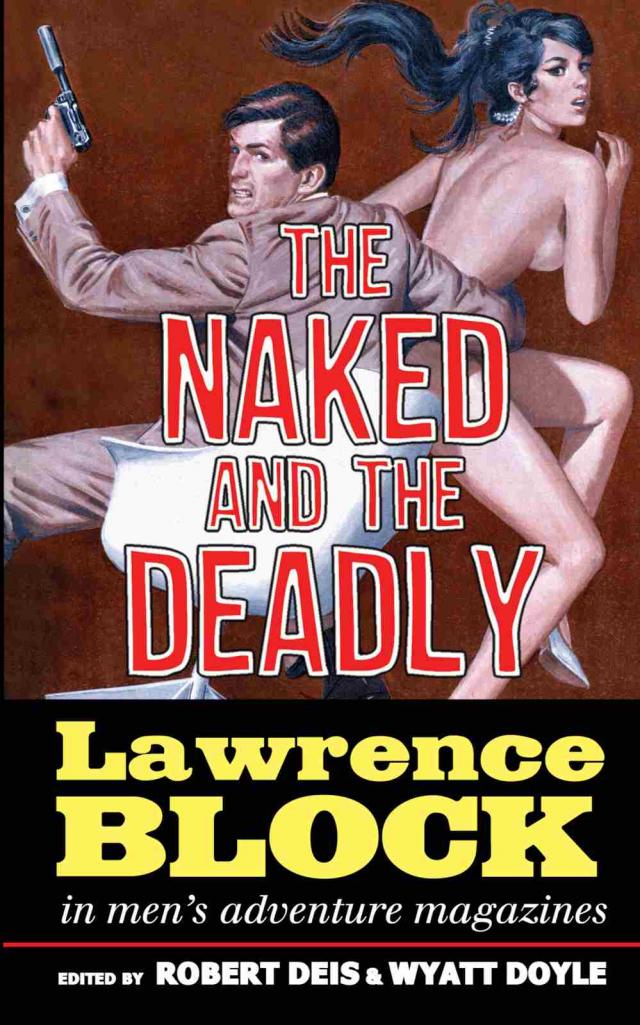
The naked and the deadly, p.11
The Naked and the Deadly,
p.11


I hadn’t known there was one, but I was looking for her now. I told the kid so.
“Upstairs,” he said. “Just walk right up. Third floor, apartment three-C.”
I thanked the kid, he shrugged, and I went up two flights of rickety stairs. The building smelled of age and stale beer. I stood in front of the door marked 3-C. The apartment was not empty. Gut-bucket jazz boomed through the door, records playing too loudly on a lo-fi player. I knocked on the door. Nothing happened. I knocked again.
“C’mon in, whoever in hell it is!”
The voice was loud. I turned the knob and went into the apartment where Miltie Klugsman had once lived. It was a railroad flat, three or four rooms tied together by grim little hallways. The furniture was old and the walls needed paint. The place had the general feel of a cheap apartment which someone had tried to hold together until, recently, that someone had stopped caring.
THE SOMEONE was sitting on a worn-out couch. She could have been beautiful once. She may have been attractive, still; it was hard to tell. There was a pint of blended rye in her hand. The pint was about three-quarters gone and she was about three-quarters drunk. She was a thirty-five-year-old brunette with lines at the corners of her eyes and mouth.
She was wearing a faded yellow housedress that was missing a button or two in front and had floppy slippers on her feet. She waved a hand at me and took another long drink that killed most of the pint of rye.
“Hiya,” she called. “Who in hell are you?”
I closed the door, walked over, sat on the couch.
“My name’s Shirley. Who’re you?”
“Ed,” I said.
“You lookin’ for Miltie? He doesn’t live here anymore. You know the song? ‘Annie Doesn’t Live Here Anymore’?” Her eyes rolled. “Miltie doesn’t live here anymore,” she said sadly. “Miltie’s dead, Ed. That rhymes. Dead, Ed.”
I walked over to the record player and turned off something raucous. I went back to the couch. She offered me a drink of the blend. I didn’t want any.
“Poor Miltie,” she said. “I loved him, you believe it? Oh, Miltie wasn’t much. Me and Miltie, just a couple of nothings.”
“Shirley—”
“That’s me,” she said. Her face clouded, and for a moment I thought she was going to start crying. She surprised me by laughing instead. She tossed her head back and her body shook with laughter. She couldn’t stop. I reached over and slapped her, not too hard, and she sat up and rubbed the side of her face and nodded her head vigorously.
“Shirley, Miltie was murdered,” I said. “You know that, don’t you?”
She looked at me and nodded. The tears were starting now. I wanted to go away and leave her alone. I couldn’t.
“Murdered, Shirley. He had some…evidence that some man wanted. Do you know where it is?”
She shook her head.
“He must have talked about it, Shirley. He must have told you something. Think.”
She looked away, then back at me, cupped her chin with one hand, closed her eyes, opened them. “Nope,” she said. “He never told me a thing. Not Miltie.”
“Are you sure?”
“Uh-huh.” She reached for the bottle again. I took it away from her. She came at me, sprawled across me, fingers scrabbling for the bottle. I gave it to her and she killed it. She held it at arm’s length, reading the label slowly and deliberately. Then she heaved it across the room. It bounced off the record player, took another wild bounce, and shattered.
“Poor Miltie,” she said.
“Shirley—”
“Jussa minute,” she said. “What’s your name again? Ed? I’m gonna tell you something. Ed, I’ll tell you about Miltie Klugsman. Okay?”
“Sure.”
“MILTIE was just a little guy,” she said. “Like me, see? Before I met him I used to work the clubs, you know, do a little stripping, get the customers to buy me drinks. I was never a hooker, Ed. You believe me?”
“I believe you.”
She nodded elaborately. “Well,” she said. “Lots of guys, you say you were a stripper, they figure you were a whore. Not me. Some girls, maybe. Not me.”
She was standing now, swaying a little but staying on her feet. She picked a pack of cigarettes from a table, shook one loose, and put it in her mouth. I scratched a match for her and she leaned forward to take the light. Her dress fell away from her body. She wasn’t wearing a bra. I looked away and she laughed hysterically.
“See something you shouldn’t, Ed?” I didn’t say anything. “Oh,” she said, continuing her story. “So I met Miltie at the club. He was a good guy, you know? Decent. Oh, he did some time. You live like this, this kind of life, you don’t care if a man did time. What’s the past, Ed? Huh? It’s the present, and what kind of guy a guy is, and all. Right?”
“Sure.”
“He wanted to marry me. Nobody else, they always wanted, oh, you know what they wanted. He wanted to marry me. So what the hell. Right, Ed?”
“Sure.”
“He was just a little guy. Nobody important. But we stuck with each other and we made it. We stuck together, we ate steady, we lived okay. This place is a mess now. When it’s fixed up it looks better.”
She pranced around the room like a hostess showing off her antiques. Something struck her funny and she started laughing again, reeling around the room and laughing hysterically. Her voice caught on a snag and the laughter changed abruptly to tears. She cried as she laughed, putting all of herself into it. I got up to catch her and she sagged against me, limp as a dishrag. I held on to her for a few seconds. Then she got hold of herself and pulled away from me.
“Poor, poor poor Miltie,” she said. “I was afraid, I knew he was getting in over his head. Listen, I was just a lousy dime-store stripper, you know? I knew enough not to try to play the big-time circuit. I stuck to my own league. You know what I mean?”
“Sure, Shirley.”
“But Miltie didn’t know this. He wanted to do something big. I was afraid, I knew he was getting mixed up, getting in over his head. He was all tangled up in something too big for him. He was a good guy but he wasn’t a big guy. I knew something like this was going to happen. I knew it.”
The cigarette burned her fingers. She dropped it and squashed it beneath one of the floppy slippers. She kicked off the slippers, first one and then the other. Her toenails were painted scarlet and the paint was chipped here and there.
“He was going to get out. He was going to stick to his own league. And then—”
SHE DIDN’T break. She came close, but she didn’t. The last of the liquor was taking hold of her now and she was staggering. She stepped into the center of the room, walked to the record player, put on something slow and jazzy. I stayed where I was.
“I’m still good-looking,” she said. “Aren’t I?”
I told her she was.
“Not a kid anymore,” she said. “But I’ll get by.”
The music was strip-club jazz. She took a few preliminary steps to it, tossing her hips at me in an almost comical bump-and-grind, and grinned.
Then, slowly, she went into her act. We weren’t in a strip joint and she wasn’t wearing a ball gown. She was wearing a faded yellow housedress that buttoned down the front, and she undid it a button at a time. Her fingers were clumsy with blended rye but she got the dress open and shrugged it away. It fell to the floor bunched around her long legs. She took a step and kicked the dress away.
No bra. Just thin black panties. She had a fine body, slender waist, trim hips, full breasts with just the slightest trace of age to them. She kept dancing, moving with the music, flinging her breasts at me, grinding her loins at me.
“Not bad, huh? Not bad for an old broad, huh, Ed? Still lively, huh?”
I didn’t answer her. I wanted to get up and go away but I couldn’t do that either. I watched while she peeled off the panties and tossed them away. She had trouble with them but she got them off and danced her wicked dance in blissful nudity.
“Ed,” she said.
She came at me, threw herself at me. Her flesh, warm with drink, was soft as butter in my arms. She looked into my eyes, her face a study in alcoholic passion mixed in equal parts with torment. She looked at me, and she squirmed against me, and then her eyes closed and she passed out cold.
There was a double bed in the bedroom. She had to sleep alone in it now. Some men with machine guns had killed the man who used to share it with her. I drew back the top sheet, put her down on the bed. I covered her with the sheet, tucked a pillow under her head.
Then I got out of there.
SEVEN
THE RIDE back to Manhattan was a long one. Every traffic light was red when I got to it.
I told myself that the picture was refusing to take shape, and then I changed my mind—it was taking shape, all right. It was taking a great many shapes, each conflicting with the other. Nothing made much sense.
Shirley Klugsman was a widow because her husband had tried to sell evidence to Rhona Blake. A man named Zucker wanted Rhona dead. He also wanted me dead, and three punks in East New York had tried to carry it off for him. And they were dead now.
I got the Chevy back into my garage and walked halfway home before I changed my mind. Then I jumped in a cab.
Rewards and punishments—Phillip Carr’s phrase. They were at the punishment stage now. They wanted me dead, and they had tried once already that night, and maybe my apartment wasn’t the safest place in the world.
Besides, Rhona was alone…
The doorman barely looked at me. I let the elevator whisk me up to her floor, went to her door, and jabbed at the bell. Nothing happened. I remembered our signal, rang once, waited a minute, then started ringing. Nothing happened. I called out to her, told her who it was. And nothing happened.
She was out, of course. At a show, having a drink, catching a bite to eat. I got halfway to the elevator and my mind filled with another picture, a less pleasant one in which she was lying face-down on the wall-to-wall carpet and bleeding. I went back to her door.
On television I would have given the door a good hard shoulder, wood would have splintered, and that would have been that. This is fine on television, where they have balsa doors. But every time I hit a door with my shoulder I wind up with a sore shoulder and an unimpaired door. In Manhattan, apartment doors are usually reinforced with steel plates. You just can’t trust television.
I took out the little gimcrack I use to clean my pipe. It had a penknife blade. I opened it and played with the lock. It opened. I went inside.
She wasn’t there. So I sat down in the living room to wait for her, first checking the bar to see if there was any cognac. There wasn’t. There was scotch, but cognac is all I drink.
Hell. This was a special sort of situation. I poured a lot of scotch into a glass and sat down to work on it.
After half an hour, I was worried. She was in too deep, playing way over her head, and she wasn’t around. The room was beginning to get to me. I kept smelling her perfume and the furniture kept glaring at me.
Where the hell was she?
I remembered the afternoon, and the green eyes warming very suddenly, and her body close to mine. Bed, and whispers, and passion, and the happy drowsiness afterwards. And now she was gone. It was the sort of magic trick Jack Blake would have gone wild over. You just make love to this girl, see, and she disappears.
After ten more minutes of this I was morbid. I started combing the apartment in a cockeyed search for help notes or struggle signs or bullet holes. I got down on hands and knees and peered owlishly under the bed. There was a single slipper there, and a pair of stockings that had run for their lives, and a respectable quantity of dust. I checked out the closet in the bedroom. Her clothes, and not many of them. A suitcase, streamlined and airplane-gray. She had been traveling light. She was Jack Blake’s daughter, coming from Cleveland with a single suitcase and a bellyful of determination, and that wasn’t going to be enough.
I WENT back to the living room. The bedroom closet had been a disappointment from an aesthetic standpoint. You’re supposed to open a closet door and watch a body fall out. That was how they did it on television. And all I got was a suitcase and some clothing.
There was still a closet in the front hall. I gave the knob a twist, yanked open the door, and stepped ceremoniously aside so that the body wouldn’t hit me when it fell.
No body fell.
Instead there was a noise like a shotgun blast at close quarters, and there was a wind like Hurricane Zelda, and I flew up in the air and bounced off one wall into another. Then the lights went out.
EIGHT
IT WAS timeless. There was the lifting sensation, the spinning, the impact, the blackness. Then I was on my back on that orange couch and my eyes were open. I saw ash blond hair, a red mouth.
Rhona.
She was saying: “Lie still, Ed. Relax, lie still, don’t try to move. My God, I came in and found you. I thought you were dead. The whole hallway was a mess. It looked as though someone fired a cannon in here. Are you all right, Ed?”
She was leaning over me, stroking my forehead with one soft hand. Her eyes were wide, concerned. Sensation was starting to come back now, with pain leading the procession. My whole body ached. I ran hands over myself to find out what was broken. Surprisingly, everything seemed to be intact. I started to sit up. There was dizziness, and I fell back on the couch and closed my eyes for a minute.
I must have blacked out again. Then I came back to life and she was lighting a cigarette for me, putting it between my lips. I smoked. I started to sit up, saw the worry in her eyes. I told her I was all right now.
“What happened, Ed?”
“A bomb.”
“Where?”
“In your closet,” I said. “I opened the door and it went off.”
“What were you doing in the closet?”
“Looking for bodies.”
“Huh?”
“Forget it.”
I closed my eyes, remembering the cute little sidestep I’d executed, a nutty bit of business designed to permit the mythical corpse to fall out of the closet without hitting me. Corny, but damn fortunate. The sidestep had taken me out of the way of the blast. If the full force had gotten me, I’d have found a body, all right.
My own.
“Ed—”
I took a breath. “Rhona, somebody had it set up for you. You were supposed to walk into the apartment and hang your coat in the front closet. They must have rigged it with a wire running to the door handle, something like that. Open the door and you yank the wire and the thing blows.”
“God.”
“Uh-huh. When did you leave, Rhona? Why the hell didn’t you stay put?”
She was chewing on her lower lip and her eyes were focused on the floor. She said: “I got a phone call.”
“You weren’t supposed to answer the phone.”
“I know. But it rang and rang and rang…I picked it up.”
“Who was it?”
“A man. He didn’t give me his name. He just said he was calling for you.”
“For me?”
She nodded. “I didn’t know whether to believe him or not. But he said you were in trouble and couldn’t call yourself, and I thought you were the only person who knew the telephone number here—”
“Klugsman knew it, didn’t he?”
“Oh,” she said. “I forgot that, Ed—”
“When did he call?”
“Around midnight.”
“And you left right away?”
“That’s right.” I put out the cigarette. “Then I missed you by less than half an hour,” I said. “They must have had a man stationed right out front, ready to drop up and install the bomb the minute you left the building. It’s easy enough to get into this place. The doorman is so busy being proper and distant that he doesn’t pay any attention to what’s going on. So the guy came in, set up shop, and left. Then I got here and waited for you.” I looked at her. “Where the hell were you, anyway?”
“Times Square.”
“Huh?”
“I took a taxi to Times Square, Ed. That’s what the man on the phone said I was supposed to do. I went to a place called Hector’s, a big cafeteria. I took a table and waited for you.”
“For how long?”
“A little over an hour, I guess. It was a bore and I was scared stiff and I didn’t know what was going to happen next. Then finally a man came over to me and handed me a note. He was gone almost before I knew what was going on. The note said you wouldn’t be able to meet me but everything was all right and I was supposed to go back to my apartment. I got here just in time to find you.”
I got up, dragged myself over to the front hall, what was left of it. There was a gaping hole in the wall directly opposite the closet door. If I hadn’t stepped aside, the blast would have made a similar hole in me.
It was something to think about.
I dropped to my hands and knees and poked around in the closet. There wasn’t much to look at, just enough to confirm my diagnosis of the blast. It was a simple sort of booby-trap, the kind even a child could put together. A few sticks of dynamite, evidently touched off with a blasting cap. A piece of thin copper wire was attached to the cap and to the doorknob. There was still a trace of the wire around the knob.
“God, Ed.”
I got up, put an arm around her. We walked to the kitchen. She put water on for coffee. While it cooked, I gave her a quick run-down on my part of the evening. I left out the call to the Continental agency in Cleveland. She didn’t have to know that I hadn’t trusted her.
SHE WAS smoking too many cigarettes too quickly. She was nervous and it showed. Why not? She had a lot to be nervous about. Half the world was trying to kill her. That sort of thing tends to get on your nerves.
“It doesn’t add,” I said.
“What doesn’t?”
“The whole thing. This morning they didn’t know where to find you, Rhona. Zucker’s lawyer was ready to pay ten thousand bucks just to get hold of you. A few hours later they know where you are and all they want to do is kill us both. They hand out contracts on the two of us. I’m supposed to get shot in East New York and you’re supposed to get blown up in your own apartment.”


