

The naked and the deadly, p.14
The Naked and the Deadly,
p.14
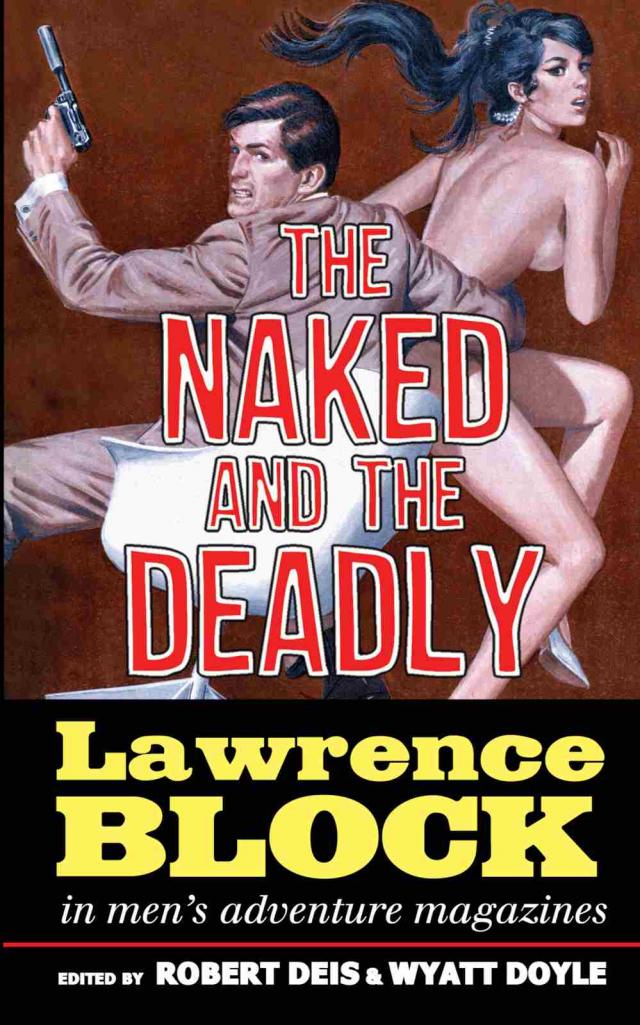


It was not exactly a dance. She moved like a burlesque dancer, but there was nothing crude about it. She knew how beautiful she was, and she moved in rhythm, making a symphony of her body and watching herself as she did. It was something to watch.
Finally she stopped dancing. She slipped on a housecoat and stepped through a door. I guessed that she was going to the bathroom, which meant it was the end of the show. I could have left then, but didn’t. I wanted to get another glimpse of her. She had to come back.
I stood silently at the window, waiting for her.
Suddenly a door opened. I whirled around to find her standing there, in the doorway, pointing a gun at me. “Don’t move,” she said. “Don’t move or I’ll shoot.”
I froze in terror, staring down the mouth of the gun, which looked like a cannon to me. “I wasn’t doing anything,” I stammered. “Just watching you. I didn’t hurt you.”
She didn’t say a word.
“Look,” I pleaded, “just let me go. I won’t bother you any more. I promise I’ll stay away from here.”
She ignored me. “I saw you in the mirror,” she said. “Saw you watching me. I danced for you. Did you like the way I danced?”
I nodded dumbly, unable to speak.
“IT WAS for you,” she said. “I liked your eyes on me. I liked the way you looked at me.” She smiled. “Come inside.”
I hesitated. Was this a trap? Had she called the police?
“Come here,” she said. “Come inside. Don’t be afraid.”
I followed her into the house, into the bedroom. “I want you,” she said. “I want you.” She slipped out of the housecoat and tossed it over a chair.
“Come on,” she said. “I know you want me. I could tell from the way you looked at me. Come here.” She set the gun on the dresser and motioned for me to step closer. “I want you to make love to me,” she said.
I walked over to her, and she threw her arms around me. “Take me,” she moaned.
I pushed her away. “No,” I said. “I don’t want that. I just wanted to watch you. I wouldn’t do that.”
She pressed against me again. “I want you,” she insisted. She opened her arms and I felt her hot breath on my face.
There was only one way to stop her. I picked up the gun from the dresser. “Don’t come any closer,” I warned. “Leave me alone.”
“Don’t be silly,” she smiled. “You want me and I want you.” She kept coming closer as I retreated.
That’s when it happened—when the gun went off. The noise resounded in the small bedroom, and she crumpled and fell.
“Why?” she moaned. Then she died.
The police beat me. They beat me harder than last time, and they called me a pervert. They think I tried to rape her, but that’s not true. I wouldn’t do a thing like that.
Written as SHELDON LORD
“Stag Party Girl”
Harold Merriman pushed his chair back and stood up, drink in hand. “Gentlemen,” he said solemnly, “to all the wives we love so well. May they continue to belong to us body and soul.” He paused theatrically. “And to their husbands—may they never find out!”
There was scattered laughter, most of it lost in the general hubbub. I had a glass of cognac on the table in front of me. I took a sip and looked at Mark Donahue. If he was nervous, it didn’t show. He looked like any man who was getting married in the morning—which is nervous enough, I suppose. He didn’t look like someone threatened with murder.
Phil Abeles—short, intense, brittle-voiced—stood. He started to read a sheaf of fake telegrams. “Mark,” he intoned, “don’t panic—marriage is the best life for a man. Signed, Tommy Manville” … He read more telegrams. Some funny, some mildly obscene, some dull.
We were in an upstairs dining room at McGraw’s, a venerable steakhouse in the East Forties. About a dozen of us. There was Mark Donahue, literally getting married in the morning, Sunday, tying the nuptial knot at 10:30. Also Harold Merriman, Phil Abeles, Ray Powell, Joe Conn, Jack Harris and a few others whose names I couldn’t remember, all fellow wage slaves with Donahue at Darcy & Bates, one of Madison Avenue’s rising young ad agencies.
And there was me. Ed London, private cop, the man at the party who didn’t belong. I was just a hired hand. It was my job to get Donahue to the church on time, and alive.
ON WEDNESDAY, Mark Donahue had come to my apartment. He cabbed over on a long lunch hour that coincided with the time I rolled out of bed. We sat in my living room. I was rumpled and ugly in a moth-eaten bathrobe. He was fresh and trim in a Tripler suit and expensive shoes. I drowned my sorrows with coffee while he told me his problems.
“I think I need a bodyguard,” he said.
In the storybooks and the movies, I show him the door at this point. I explain belligerently that I don’t do divorce or bodyguard work or handle corporation investigations—that I only rescue stacked blondes and play modern-day Robin Hood. That’s in the storybooks. I don’t play that way. I have an apartment in an East Side brownstone and I eat in good restaurants and drink expensive cognac. If you can pay my fee, friend, you can buy me.
I asked him what it was all about.
“I’m getting married Sunday morning,” he said.
“Congratulations.”
“Thanks.” He looked at the floor. “I’m marrying a…a very fine girl. Her name is Lynn Farwell.”
I waited.
“There was another girl I…used to see. A model, more or less. Karen Price.”
“And?”
He stood and started walking around on my Oriental rug. He was tall, slim and good-looking and the expensive suit looked as though it had been designed for him.
“Karen Price,” I prompted.
“She doesn’t want me to get married.”
“So?”
He fumbled for a cigarette. “She’s been calling me,” he said. “I was…well, fairly deeply involved with her. I never planned to marry her. I’m sure she knew that.”
“But you were sleeping with her?”
“That’s right.”
“And now you’re marrying someone else.”
He sighed at me. “It’s not as though I ruined the girl,” he said. “She’s…well, not a tramp, exactly, but close to it. She’s been around, London.”
“So what’s the problem?”
“I’ve been getting phone calls from her. Unpleasant ones, I’m afraid. She’s told me that I’m not going to marry Lynn. That she’ll see me dead first.”
“And you think she’ll try to kill you?”
“I don’t know.”
“That kind of threat is common, you know. It doesn’t usually lead to murder.”
He nodded hurriedly. “I know that,” he said. “I’m not terribly afraid she’ll kill me. I just want to make sure she doesn’t throw a monkey wrench into the wedding. Lynn comes from an excellent family. Long Island, society, money. Her parents wouldn’t appreciate a scene.”
“Probably not.”
He forced a little laugh. “And there’s always a chance that she really may try to kill me,” he said. “I’d like to avoid that.” I told him it was an understandable desire. “So I want a bodyguard. From now until the wedding. Four days. Will you take the job?”
I told him my fee ran a hundred a day plus expenses. This didn’t faze him. He gave me $300 for a retainer, and I had a client and he had a bodyguard.
From then on I stuck to him like perspiration. He had a bachelor apartment in an expensive building on Horatio Street in Greenwich Village. I slept on a couch in his living room. It wasn’t as comfortable as my big bed on 83rd Street. For a hundred a day plus, you expect a certain amount of discomfort.
Thursday and Friday were easy. We woke, had breakfast together, took a cab to his office. He went to work and I killed the morning and afternoon with a book or in a movie, and then I picked him up at his office and rode home with him. They were dull, quiet days. It was easy money.
Saturday, a little after noon, he got a phone call. We were playing two-handed pinochle in his living room. He was winning. The phone rang and he answered it. I only heard his end of the conversation. He went a little white and sputtered; then he stood for a long moment with the phone in his hand, and finally slammed the receiver on the hook and turned to me.
“Karen,” he said, ashen. “She’s going to kill me.”
I didn’t say anything. I watched the color come back into his face, saw the horror recede. He came up smiling. “I’m not really scared,” he said.
“Good.”
“Nothing’s going to happen,” he added. “Maybe it’s her idea of a joke…maybe she’s just being bitchy. But nothing’s going to happen.”
He didn’t entirely believe it. But I had to give him credit. I wasn’t too crazy about him—he cared too much about Money and Family and Doing The Right Thing to be the kind of buddy I would choose. But for a guy who was scared six shades of green he showed a lot of guts.
We went back to our pinochle game. The phone didn’t ring any more, but now he played lousy pinochle. I won eight dollars from him before it was time for us to get dressed and go to McGraw’s.
I don’t know who invented the bachelor dinner, or why he bothered. I’ve been to a few of them. Dirty jokes, dirty movies, dirty toasts, a line-up with a local whore—maybe I would appreciate them if l were married. But for a bachelor who makes out there is nothing duller than a bachelor dinner.
This one was par for the course. The steaks were good and there was a lot to drink, which was definitely on the plus side. The men busy making asses of themselves were not friends of mine, and that was also on the plus side—it kept me from getting embarrassed for them. But the jokes were still unfunny and the voices too drunkenly loud.
I looked at my watch. “Eleven-thirty,” I said to Donahue. “How much longer do you think this’ll go on?”
“Maybe half an hour.”
“And then ten hours until the wedding. Your ordeal’s just about over, Mark.”
“And you can relax and spend your fee.”
“Uh-huh.”
“I’m glad I hired you,” he said. “You haven’t had to do anything, but I’m glad anyway.” He grinned. “I carry life insurance, too. But that doesn’t mean I’m going to die. And you’ve even been good company, Ed. Thanks.”
I STARTED to search for an appropriate answer. Phil Abeles saved me. He was standing up again, pounding on the table with his fist and shouting for everyone to be quiet. They let him shout for a while, then quieted down.
“And now the grand finale,” Phil announced wickedly. “The part I knew you’ve all been waiting for.”
“The part Mark’s been waiting for,” someone said lewdly.
“Mark better watch this,” someone else added. “He has to learn about women so that Lynn isn’t disappointed.”
More feeble lines, one after the other. Phil Abeles pounded for order again and got it. “Lights,” he shouted.
The lights went out. The private dining room looked like a blackout in a coal mine.
“Music!”
Somewhere, a record player went on. The record was “Stripper,” played by David Rose’s orchestra.
“Action!”
A spotlight illuminated the pair of doors at the far end of the room. The doors opened. Two bored waiters wheeled in a large table on rollers. There was a cardboard cake on top of the table and, obviously, a girl inside the cake. Somebody made a joke about Mark cutting himself a piece. Someone else said they wanted to put a piece of this particular wedding cake under their pillow. “On the pillow would be better,” a voice corrected.
The two bored waiters wheeled the cake into position and left.
The doors closed. The spotlight stayed on the cake and the stripper music swelled.
There were two or three more lame jokes. Then the chatter died. Everyone seemed to be watching the cake. The music grew louder, deeper, fuller. The record stopped suddenly and another—Mendelsohn’s Wedding March—took its place.
Someone shouted, “Here comes the bride!”
And she leaped out of the cake like a nymph from the sea.
She was naked and beautiful. She sprang through the paper cake, arms wide, face filled with a lipstick smile. Her breasts were full and firm and her nipples had been reddened with lipstick. For a single moment she was outlined there, Nude Emerging From Cake, and she was almost lovely enough to override the coarseness of the entire evening.
Then, just as everyone was breathlessly silent, just as her arms spread and her lips parted and her eyes widened slightly, the whole room exploded like Hiroshima. We found out later that it was only a .38. It sounded more like a howitzer.
She clapped both hands to a spot between her breasts. Blood spurted forth like a flower opening. She gave a small gasp, swayed forward, then dipped backward and fell.
Lights went on. I raced forward. Her head was touching the floor and her legs were propped on what remained of the paper cake. Her eyes were open. But she was horribly dead.
And then I heard Mark Donahue next to me, his voice shrill. “Oh, no!” he murmured. “…It’s Karen, it’s Karen!”
I felt for a pulse; there was no point to it. There was a bullet in her heart.
Karen Price was dead.
TWO
LIEUTENANT Jerry Gunther got the call. He brought a clutch of Homicide men who went around measuring things, studying the position of the body, shooting off a hell of a lot of flashbulbs and taking statements. Jerry piloted me into a comer and started pumping.
He was as glad to see me as I was to see him. He’s a good cop—and this was one of those times when a good cop was handy to have around. He’s also a good friend. And he was happy to find out that there was someone in that dining room that he knew. As it stood, things were as chaotic as an anarchist’s Utopia. Every man in the room was Chicken Little, running around and shouting that the sky was falling. And it was.
I gave him the whole story, starting with Wednesday and ending with Saturday. He let me go all the way through once, then went over everything two or three times.
“Your client Donahue doesn’t look too good,” he said.
“You think he killed the girl?”
“That’s the way it reads.”
I shook my head. “Wrong customer.”
“Why?”
“Hell, he hired me to keep the girl off his neck. If he was going to shoot a hole in her, why would he want a detective along for company?”
“To make the alibi stand up, Ed. To make us reason just the way you’re reasoning now. How do you know he was scared of the girl?”
“Because he said so. But—”
“But he got a phone call?” Jerry smiled. “For all you know it was a wrong number. Or the call had been staged. You only heard his end of it. Remember?”
“I saw his face when he took a good look at the dead girl,” I said. “Mark Donahue was one surprised hombre, Jerry. He didn’t know who she was.”
“Or else he’s a good actor.”
“Not that good. I can’t believe it.”
He let that one pass. “Let’s go back to the shooting,” he said. “Were you watching him when the gun went off?”
“No.”
“What were you watching?”
“The girl,” I said. “And quit grinning, you fathead.”
HIS GRIN spread. “You old lecher. All right, you can’t alibi him for the shooting. And you can’t prove he was afraid of the girl. This is the way I make it, Ed. He was afraid of her, but not afraid she would kill him. He was afraid of something else. Call it blackmail, maybe. He’s getting set to make a good marriage to a rich doll and he’s got a mistress hanging around his neck. Say the rich girl doesn’t know about the mistress. Say the mistress wants hush money.”
“Go on.”
“Your Donahue finds out the Price doll is going to come out of the cake.”
“They kept it a secret from him, Jerry.”
“Sometimes people find out secrets. The Price kid could have told him herself. It might have been her idea of a joke. Say he finds out. He packs a gun—”
“He didn’t have a gun.”
“How do you know, Ed?”
I couldn’t answer that one. He might have had a gun. He might have tucked it into a pocket while he was getting dressed. I didn’t believe it, but I couldn’t disprove it either.
Jerry Gunther was thorough. He didn’t have to be thorough to turn up the gun. It was under a table in the middle of the room. The lab boys checked it for prints. None. It was a .38 police positive with five bullets left in it. The bullets didn’t have any prints on them, either.
“Donahue shot her, wiped the gun and threw it on the floor,” Jerry said.
“Anybody else could have done the same thing,” I interjected.
“Uh-huh. Sure.”
He grilled Phil Abeles, the man who had hired Karen Price to come out of the cake. Abeles was also the greenest, sickest man in the world at that particular moment.
Gunther asked him how he got hold of the girl. “I never knew anything about her,” Abeles insisted. “I didn’t even know her last name.”
“How’d you find her?”
“A guy gave me her name.”
“What guy?”
“I forget. Some guy gave me her name and number. When I…when we set up the dinner, the stag, we thought we would have a wedding cake with a girl jumping out of it. We thought it would be so…so corny that it might be cute. You know?”
No one said anything. Abeles was sweating up a storm. The dinner had been his show and it had not turned out as he had planned it, and he looked as though he wanted to go somewhere quiet and die. I couldn’t blame him.
“SO I ASKED around to find out where to get a girl,” he went on. “Honest, I asked a dozen guys, two dozen. I don’t know how many. I asked everybody in this room except Mark. I asked half the guys on Madison Avenue. Someone gave me a number, told me to call it and ask for Karen. So I did. She said she’d jump out of the cake for $100 and I said that was fine.”


