Call me joe, p.16
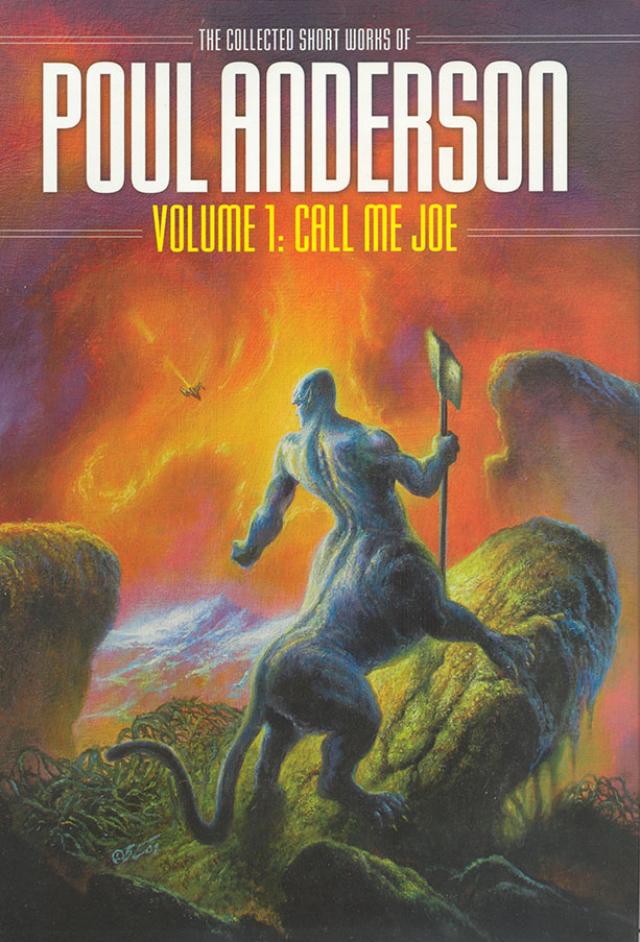
Call Me Joe,
p.16


He said, “Let’s put it this way. There are limits even to the right of self-defense. If a killer attacks me, I can fight back with anything I’ve got. But I wouldn’t be justified in grabbing some passing child for a shield.”
“So you wished to make sure that nothing you would consider illegitimate was in those boxes?” asked Symonds academically.
“I don’t know. What is illegitimate, these days? I was…I was disgusted. I liked Greenstein, and he died because Washington had decided we couldn’t have bombs or atomic shells. I just didn’t know how much more I could consent to. I had to find out.”
“I see.” The clerk nodded. “For your information, it is all agricultural equipment. Later shipments will include industrial and scientific material, a large reserve of canned food, and as much of the world’s culture as it proves possible to microfilm.”
Herries stopped working, turned around and rose. His knees would not hold him. He leaned against the crate and it was a minute before he could get out: “Why?”
Symonds did not respond at once. He reached forth a precise hand and took up the flashlight Herries had left on the barrel. Then he sat down there himself, with the two glowing tubes in his lap. The light from below ridged his face in shadows, and his glasses made blind circles. He said, as if ticking off the points of an agenda:
“You would have been informed of the facts in due course, when the next five hundred people arrive. Now you have brought on yourself the burden of knowing what you would otherwise have been ignorant of for months yet. I think it may safely be assumed that you will keep the secret and not be broken by it. At least, the assumption is necessary.”
Herries heard his own breath harsh in his throat. “Who are these people?”
The papery half-seen countenance did not look at him, but into the pit-like reaches of the shed. “You have committed a common error,” said Symonds, as if to a student. “You have assumed that because men are constrained by circumstances to act in certain ways, they must be evil or stupid. I assure you, Senator Wien and the few others responsible for this are neither. They must keep the truth even from those officials within the project whose reaction would be rage or panic instead of a sober attempt at salvage. Nor do they have unlimited powers. Therefore, rather than indulge in tantrums about the existing situation, they use it. The very compartmentalization of effort and knowledge enforced by Security helps conceal their purposes and mislead those who must be given some information.”
Symonds paused. A little frown crossed his forehead, and he tapped an impatient fingernail on a flashlight casing. “Do not misunderstand,” he went on. “Senator Wien and his associates have not forgotten their oaths of office, nor are they trying to play God. Their primary effort goes, as it must, to a straightforward dealing with the problems of the twentieth century. It is not they who are withholding the one significant datum—a datum which, incidentally, any informed person could reason out for himself if he cared to. It is properly constituted authority, using powers legally granted to stamp certain reports Top Secret. Of course, the Senator has used his considerable influence to bring about the present eventuality, but that is normal politics.”
Herries growled: “Get to the point, damn you! What are you talking about?”
Symonds shook his thin gray head. “You are afraid to know, are you not?” he asked quietly.
“I—” Herries turned about, faced the crate and beat it with his fist. The parched voice in the night continued to punish him:
“You know that a time-projector can go into the future about a hundred years at a jump, but can only go pastward in jumps of approximately one hundred megayears. You have spoken of a simple way to explore certain sections of the historical past, in spite of this handicap, by making enough century hops forward before the one long hop backward. But can you tell me how to predict the historical future? Say, a century hence? Come, come, you are an intelligent man. Answer me.”
“Yeah,” said Herries. “I get the idea. Leave me alone.”
“Team A, a group of well-equipped volunteers, went into the twenty-first century,” pursued Symonds. “They recorded what they observed and placed the data in a chemically inert box within a large block of reinforced concrete erected at an agreed-on location: one which a previous expedition to circa 100,000,000 A.D. had confirmed would remain stable. I presume they also mixed radioactive materials of long half-life into the concrete, to aid in finding the site. Of course, the bracketing of time jumps is such that they cannot now get back to the twentieth century. But Team B went a full hundred-megayear jump into the future, excavated the data, and returned home.”
Herries squared his body and faced back to the small man. He was drained, so weary that it was. all he could do to keep on his feet. “What did they find?” he asked. There was no tone in his voice or in him.
“There have actually been several expeditions to 100,000,000,” said Symonds. “Energy requirements for a visit to 200,000,000—A.D. or B.C.—were considered prohibitive. But in 100,000,000 life is re-evolving on Earth. However, as yet the plants have not liberated enough oxygen for the atmosphere to be breathable. You see, oxygen reacts with exposed rock, so that if no biological processes exist to replace it continuously—But you have a better technical education than I.”
“Okay,” said Herries, flat and hard. “Earth was sterile for a long time in the future. Including the twenty-first century?”
“Yes. The radioactivity had died down enough so that Team A reported no danger to itself, but some of the longer-lived isotopes were still measurably present. By making differential measurements of abundance, Team A was able to estimate rather closely when the bombs had gone off.”
“And?”
“Approximately one year from the twentieth-century base date we are presently using.”
“One year…from now.” Herries stared upward. Blackness met him. He heard the Jurassic rain on the iron roof, like drums.
“Possibly less,” Symonds told him. “There is a factor of uncertainty. This project must be completed well within the safety margin before the war comes.”
“The war comes,” Herries repeated…“Does it have to come? Fixed time line or not, does it have to come? Couldn’t the enemy leaders be shown the facts—couldn’t our side, even, capitulate—”
“Every effort is being made,” said Symonds like a machine. “Quite apart from the theory of rigid time, it seems unlikely that they will succeed. The situation is too unstable. One man, losing his head and pressing the wrong button, can write the end; and there are so many buttons. The very revelation of the truth, to a few chosen leaders or to the world public, would make some of them panicky. Who can tell what a man in panic will do? That is what I meant when I said that Senator Wien and his coworkers have not forgotten their oaths of office. They have no thought of taking refuge, they know they are old men. To the end, they will try to save the twentieth century. But they do not expect it; so they are also trying to save the human race.”
Herries pushed up from the crate he had been leaning against. “Those five hundred who’re coming,” he whispered. “Women?”
“Yes. If there is still time to rescue a few more, after the ones you are preparing for have gone through, it will be done. But there will be at least a thousand young, healthy adults here, in the Jurassic. You face a difficult time, when the truth must be told them; you can see why the secret must be kept until then. It is quite possible that someone here will lose his head. That is why no heavy weapons have been sent: a single deranged person must not be able to destroy everyone. But you will recover. You must.”
Herries jerked the door open and stared out into the roaring darkness. “But there are no traces of us…in the future,” he said, hearing his voice high and hurt like a child’s.
“How much trace do you expect would remain after geological eras?” answered Symonds. He was still the reproving schoolmaster; but he sat on the barrel and faced the great moving shadows in a corner. “It is assumed that you will remain here for several generations, until your numbers and resources have been expanded sufficiently. The Team A I spoke of will join you a century hence. It is also, I might add, composed of young men and women in equal numbers. But this planet in this age is not a good home. We trust that your descendants will perfect the spaceships we know to be possible, and take possession of the stars instead.”
Herries leaned in the doorway, sagging with tiredness and the monstrous duty to survive. A gust of wind threw rain into his eyes. He heard dragons calling in the night.
“And you?” he said, for no good reason.
“I shall convey any final messages you may wish to send home,” said the dried-out voice.
Neat little footsteps clicked across the floor until the clerk paused beside the engineer. There was silence, except for the rain.
“Surely I will deserve to go home,” said Symonds.
And suddenly the breath whistled inward between teeth which had snapped together. He raised his hands, claw-fingered and screamed aloud: “You can let me go home then!”
He began running toward the supervisors’ barge. The sound of him was soon lost. Herries stood for a time yet in the door.
Clausius’ Chaos
Entropy, Shmentropy,
Rudolph J. Clausius
Proved universally
Chaos will show
Increase in processes
Thermodynamical.
Something that housekeepers
Already know.
Journey’s End
—doctor bill & twinges in chest but must be all right maybe indigestion & dinner last night & wasn’t audrey giving me the glad eye & how the hell is a guy to know & maybe i can try and find out & what a fool i can look if she doesn’t—
—goddam idiot & they shouldn’t let some people drive & oh all right so the examiner was pretty lenient with me i haven’t had a bad accident yet & christ blood all over my blood let’s face it i’m scared to drive but the buses are no damn good & straight up three paces & man in a green hat & judas i ran that red light—
In fifteen years a man got used to it, more or less. He could walk down the street and hold his own thoughts to himself while the surf of unvoiced voices was a nearly ignored mumble in his brain. Now and then, of course, you got something very bad, it stood up in your skull and shrieked at you.
Norman Kane, who had come here because he was in love with a girl he had never seen, got to the corner of University and Shattuck just when the light turned against him. He paused, fetching out a cigarette with nicotine-yellowed fingers while traffic slithered in front of his eyes.
It was an unfavorable time, four-thirty in the afternoon, homeward rush of nervous systems jangled with weariness and hating everything else on feet or wheels. Maybe he should have stayed in the bar down on San Pablo. It had been pleasantly cool and dim, the bartender’s mind an amiable cud-chewing somnolence, and he could have suppressed awareness of the woman.
No, maybe not. When the city had scraped your nerves raw, they didn’t have much resistance to the slime in some heads.
Odd, he reflected how often the outwardly polite ones were the foully twisted inside. They wouldn’t dream of misbehaving in public, but just below the surface of consciousness…Better not think of it, better not remember. Berkeley was at least preferable to San Francisco or Oakland. The bigger the town, the more evil it seemed to hold, three centimeters under the frontal bone. New York was almost literally uninhabitable.
There was a young fellow waiting beside Kane. A girl came down the sidewalk, pretty, long yellow hair and a well-filled blouse. Kane focused idly on her: yes, she had an apartment of her own, which she had carefully picked for a tolerant superintendent. Lechery jumped in the young man’s nerves. His eyes followed the girl, Cobean-style, and she walked on…simple harmonic motion.
Too bad. They could have enjoyed each other. Kane chuckled to himself. He had nothing against honest lust, anyhow not in his liberated conscious mind; he couldn’t do much about a degree of subconscious puritanism. Lord, you can’t be a telepath and remain any kind of prude. People’s lives were their own business, If they didn’t hurt anyone else too badly.
—the trouble is, he thought, they hurt me. but i can’t tell them that. they’d rip me apart and dance on the pieces. the government / the military / wouldn’t like a man to be alive who could read secrets but their fear-inspired anger would be like a baby’s tantrum beside the red blind amok of the common man (thoughtful husband considerate father good honest worker earnest patriot) whose inward sins were known. you can talk to a priest or a psychiatrist because it is only talk & he does not live your failings with you—
The light changed and Kane started across. It was clear fall weather, not that this area had marked seasons, a cool sunny day with a small wind blowing up the street from the water. A few blocks ahead of him, the University campus was a splash of manicured green under brown hills.
—flayed & burningburningburning moldering rotted flesh & the bones the white hard clean bones coming out gwtjklfmx—
Kane stopped dead. Through the vertigo he felt how sweat was drenching into his shirt.
And it was such an ordinary-looking man!
“Hey, there, buster, wake up! Ya wanna get killed?”
Kane took a sharp hold on himself and finished the walk across the street. There was a bench at the bus stop and he sat down till the trembling was over.
Some thoughts were unendurable.
He had a trick of recovery. He went back to Father Schliemann. The priest’s mind had been like a well, a deep well under sun-speckled trees, its surface brightened with a few gold-colored autumn leaves…but there was nothing bland about the water, it had a sharp mineral tang, a smell of the living earth. He had often fled to Father Schliemann, in those days of puberty when the telepathic power had first wakened in him. He had found good minds since then, happy minds, but never one so serene, none with so much strength under the gentleness.
“I don’t want you hanging around that papist, boy, do you understand?” It was his father, the lean implacable man who always wore a black tie. “Next thing you know, you’ll be worshiping graven images just like him.”
“But they aren’t—”
His ears could still ring with the cuff. “Go up to your room! I don’t want to see you till tomorrow morning. And you’ll have two more chapters of Deuteronomy memorized by then. Maybe that’ll teach you the true Christian faith.”
Kane grinned wryly and lit another cigarette from the end of the previous one. He knew he smoked too much. And drank—but not heavily. Drunk, he was defenseless before the horrible tides of thinking.
He had had to run away from home at the age of fourteen. The only other possibility was conflict ending with reform school. It had meant running away from Father Schliemann too, but how in hell’s red fire could a sensitive adolescent dwell in the same house as his father’s brain? Were the psychologists now admitting the possibility of a sadistic masochist? Kane knew the type existed.
Give thanks for this much mercy, that the extreme telepathic range was only a few hundred yards. And a mind-reading boy was not altogether helpless; he could evade officialdom and the worst horrors of the underworld. He could find a decent elderly couple at the far end of the continent and talk himself into adoption.
Kane shook himself and got up again. He threw the cigarette to the ground and stubbed it out with his heel. A thousand examples told him what obscure sexual symbolism was involved in that act, but what the deuce…it was also a practical thing. Guns are phallic too, but at times you need a gun.
Weapons: he could not help wincing as he recalled dodging the draft in 1949. He’d traveled enough to know this country was worth defending. But it hadn’t been any trick at all to hoodwink a psychiatrist and get himself marked hopelessly psychoneurotic—which he would be after two years penned with frustrated men. There had been no choice, but he could not escape a sense of dishonor.
—haven’t we all sinned / everyone of us / is there a single human creature on earth without his burden of shame?—
A man was coming out of the drugstore beside him. Idly, Kane probed his mind. You could go quite deeply into anyone’s self if you cared to, in fact you couldn’t help doing so. It was impossible merely to scan verbalized thinking: the organism is too closely integrated. Memory is not a passive filing cabinet, but a continuous process beneath the level of consciousness; in a way, you are always reliving your entire past. And the more emotionally charged the recollection is, the more powerfully it radiates.
The stranger’s name was—no matter. His personality was as much an unchangeable signature as his fingerprints. Kane had gotten into the habit of thinking of people as such-and-such a multidimensional symbolic topography; the name was an arbitrary gabble.
The man was an assistant professor of English at the University. Age forty-two, married, three children, making payments on a house in Albany. Steady sober type, but convivial, popular with his colleagues, ready to help out most friends. He was thinking about tomorrow’s lectures, with overtones of a movie he wanted to see and an undercurrent of fear that he might have cancer after all, in spite of what the doctor said.
Below, the list of his hidden crimes. As a boy: tormenting a cat, well-buried Oedipean hungers, masturbation, petty theft…the usual. Later: cheating on a few exams, that ludicrous fumbling attempt with a girl which came to nothing because he was too nervous, the time he crashed a cafeteria line and had been shoved away with a cold remark (and praises be, Jim who had seen that was now living in Chicago)…still later: wincing memories of a stomach uncontrollably rumbling at a formal dinner, that woman in his hotel room the night he got drunk at the convention, standing by and letting old Carver be fired because he didn’t have the courage to protest to the dean…now: youngest child a nasty whining little snotnose, but you can’t show anyone what you really think, reading Rosamond Marshall when alone in his office, disturbing young breasts in tight sweaters, the petty spite of academic politics, giving Simonson an undeserved good grade because the boy was so beautiful, disgraceful sweating panic when at night he considered how death would annihilate his ego—