Call me joe, p.3
Call Me Joe,
p.3
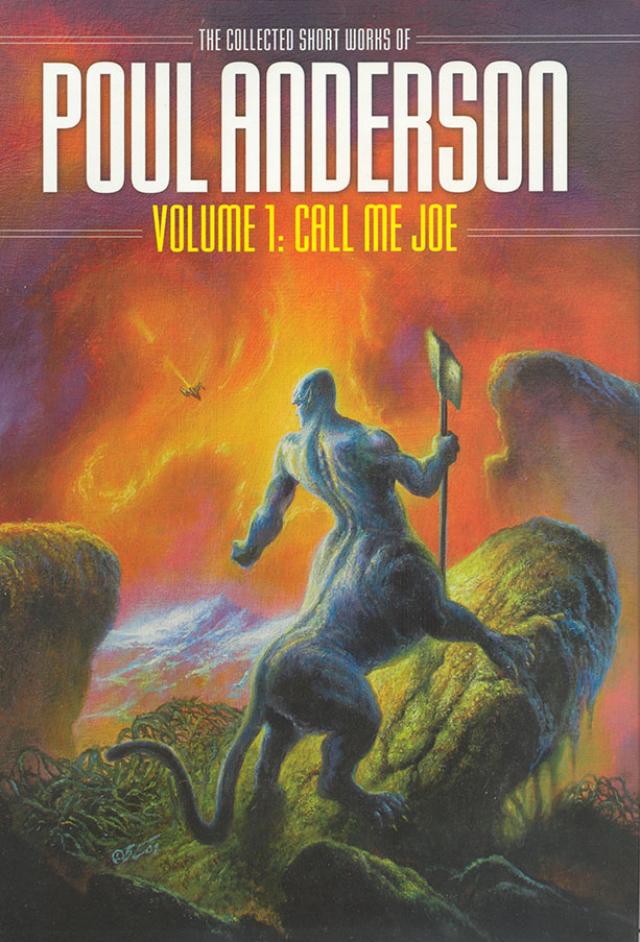


The thing that emerged, as Joe’s hands closed on it, was only about half his size, but it had six monstrously taloned feet and a pair of three-fingered hands that reached after his eyes. Joe cursed, lifted it while it writhed, and dashed it to the floor. It screamed, and he heard bones splinter.
“Come on, then!” Joe arched his back and spat at them, like a tiger menaced by giant caterpillars.
They flowed through his tunnel and into the room, a dozen of them entered while he wrestled one that had curled itself around his shoulders and anchored its sinuous body with claws. They pulled at his legs, trying to crawl up on his back. He struck out with claws of his own, with his tail, rolled over and went down beneath a heap of them and stood up with the heap still clinging to him.
They swayed in darkness. The legged seething of them struck the dugout wall. It shivered, a rafter cracked, the roof came down. Anglesey stood in a pit, among broken ice plates, under the wan light of a sinking Ganymede.
He could see now that the monsters were black in color and that they had heads big enough to accommodate some brain, less than human but probably more than apes. There were a score of them or so, they struggled from beneath the wreckage and flowed at him with the same shrieking malice.
Why?
Baboon reaction, thought Anglesey somewhere in the back of himself. See the stranger, fear the stranger, hate the stranger, kill the stranger. His chest heaved, pumping air through a raw throat. He yanked a whole rafter to him, snapped it in half, and twirled the iron-hard wood.
The nearest creature got its head bashed in. The next had its back broken. The third was hurled with shattered ribs into a fourth, they went down together. Joe began to laugh. It was getting to be fun.
“Yee-ow! Ti-i-i-iger!” He ran across the icy ground, toward the pack. They scattered, howling. He hunted them until the last one had vanished into the forest.
Panting, Joe looked at the dead. He himself was bleeding, he ached, he was cold and hungry and his shelter had been wrecked—but he’d whipped them! He had a sudden impulse to beat his chest and howl. For a moment he hesitated. Why not? Anglesey threw back his head and bayed victory at the dim shield of Ganymede.
Thereafter he went to work. First build a fire, in the lee of the spaceship—which was little more by now than a hill of corrosion. The monster pack cried in darkness and the broken ground, they had not given up on him, they would return.
He tore a haunch off one of the slain and took a bite. Pretty good. Better yet if properly cooked. Heh! They’d made a big mistake in calling his attention to their existence! He finished breakfast while Ganymede slipped under the western ice mountains. It would be morning soon. The air was almost still, and a flock of pancake-shaped sky-skimmers, as Anglesey called them, went overhead, burnished copper color in the first pale dawn streaks.
Joe rummaged in the ruins of his hut until he had recovered the water-smelting equipment. It wasn’t harmed. That was the first order of business, melt some ice and cast it in the molds of ax, knife, saw, hammer he had painfully prepared. Under Jovian conditions, methane was a liquid that you drank and water was a dense hard mineral. It would make good tools. Later on he would try alloying it with other materials.
Next—yes. To hell with the dugout, he could sleep in the open again for a while. Make a bow, set traps, be ready to massacre the black caterpillars when they attacked him again. There was a chasm not far from here, going down a long way toward the bitter cold of the metallic-hydrogen strata: a natural icebox, a place to store the several weeks’ worth of meat his enemies would supply. This would give him leisure to—Oh, a hell of a lot!
Joe laughed exultantly and lay down to watch the sunrise.
It struck him afresh how lovely a place this was. See how the small brilliant spark of the sun swam up out of eastern fog banks colored dusky purple and veined with rose and gold; see how the light strengthened until the great hollow arch of the sky became one shout of radiance; see how the light spilled warm and living over a broad fair land, the million square miles of rustling low forests and wave-blinking lakes and feather-plumed hydrogen geysers; and see, see, see how the ice mountains of the west flashed like blued steel!
Anglesey drew the wild morning wind deep into his lungs and shouted with a boy’s joy.
* * *
“I’m not a biologist myself,” said Viken carefully. “But maybe for that reason I can better give you the general picture. Then Lopez or Matsumoto can answer any questions of detail.”
“Excellent.” Cornelius nodded. “Why don’t you assume I am totally ignorant of this project? I very nearly am, you know.”
“If you wish,” laughed Viken.
They stood in an outer office of the xenobiology section. No one else was around, for the station’s clocks said 1730 GMT and there was only one shift. No point in having more, until Anglesey’s half of the enterprise had actually begun gathering quantitative data.
The physicist bent over and took a paperweight off a desk. “One of the boys made this for fun,” he said, ‘‘but it’s a pretty good model of Joe. He stands about five feet tall at the head.”
Cornelius turned the plastic image over in his hands. If you could imagine such a thing as a feline centaur with a thick prehensile tail…The torso was squat, long-armed, immensely muscular; the hairless head was round, wide-nosed, with big deep-set eyes and heavy jaws, but it was really quite a human face. The over-all color was bluish gray.
“Male, I see,” he remarked.
“Of course. Perhaps you don’t understand. Joe is the complete pseudojovian—as far as we can tell, the final model, with all the bugs worked out. He’s the answer to a research question that took fifty years to ask.” Viken looked sidewise at Cornelius. “So you realize the importance of your job, don’t you?”
“I’ll do my best,” said the psionicist. “But if…well, let’s say that tube failure or something causes you to lose Joe before I’ve solved the oscillation problem. You do have other pseudos in reserve, don’t you?”
“Oh, yes,” said Viken moodily. “But the cost…We’re not on an unlimited budget. We do go through a lot of money, because it’s expensive to stand up and sneeze this far from Earth. But for that same reason our margin is slim.”
He jammed hands in pockets and slouched toward the inner door, the laboratories, head down and talking in a low, hurried voice. “Perhaps you don’t realize what a nightmare planet Jupiter is. Not just the surface gravity—a shade under three gees, what’s that?—but the gravitational potential, ten times Earth’s. The temperature. The pressure. Above all, the atmosphere, and the storms, and the darkness!
“When a spaceship goes down to the Jovian surface, it’s a radio-controlled job; it leaks like a sieve, to equalize pressure, but otherwise it’s the sturdiest, most utterly powerful model ever designed; it’s loaded with every instrument, every servomechanism, every safety device the human mind has yet thought up to protect a million-dollar hunk of precision equipment.
“And what happens? Half the ships never reach the surface at all. A storm snatches them and throws them away, or they collide with a floating chunk of Ice Seven—small version of the Red Spot—or, so help me, what passes for a flock of birds rams one and stoves it in!
“As for the fifty per cent which do land, it’s a one-way trip. We don’t even try to bring them back. If the stresses coming down haven’t sprung something, the corrosion has doomed them anyway. Hydrogen at Jovian pressure does funny things to metals.
“It cost a total of about five million dollars to set Joe, one pseudo, down there. Each pseudo to follow will cost, if we’re lucky, a couple of million more.”
Viken kicked open the door and led the way through. Beyond was a big room, low-ceilinged, coldly lit and murmurous with ventilators. It reminded Cornelius of a nucleonics lab; for a moment he wasn’t sure why, then he recognized the intricacies of remote control, remote observation, walls enclosing forces which could destroy the entire moon.
“These are required by the pressure, of course,” said Viken, pointing to a row of shields. “And the cold. And the hydrogen itself, as a minor hazard. We have units here duplicating conditions in the Jovian, uh, stratosphere. This is where the whole project really began.”
“I’ve heard something about that. Didn’t you scoop up airborne spores?”
“Not I.” Viken chuckled. “Totti’s crew did, about fifty years ago. Proved there was life on Jupiter. A life using liquid methane as its basic solvent, solid ammonia as a starting point for nitrate synthesis: the plants use solar energy to build unsaturated carbon compounds, releasing hydrogen; the animals eat the plants and reduce those compounds again to the saturated form. There is even an equivalent of combustion. The reactions involve complex enzymes and—well, it’s out of my line.”
“Jovian biochemistry is pretty well understood, then.”
“Oh, yes. Even in Totti’s day they had a highly developed biotic technology: Earth bacteria had already been synthesized and most gene structures pretty well mapped. The only reason it took so long to diagram Jovian life processes was the technical difficulty, high pressure and so on.”
“When did you actually get a look at Jupiter’s surface?”
“Gray managed that, about thirty years ago. Set a televisor ship down, a ship that lasted long enough to flash him quite a series of pictures. Since then, the technique has improved. We know that Jupiter is crawling with its own weird kind of life, probably more fertile than Earth. Extrapolating from the airborne micro-organisms, our team made trial syntheses of metazoans and—”
Viken sighed. “Damn it, if only there were intelligent native life! Think what they could tell us, Cornelius, the data, the—just think back how far we’ve gone since Lavoisier, with the low-pressure chemistry of Earth. Here’s a chance to learn a high-pressure chemistry and physics at least as rich with possibilities!”
After a moment, Cornelius murmured slyly, “Are you certain there aren’t any Jovians?”
“Oh, sure, there could be several billion of them.” Viken shrugged. Cities, empires, anything you like. Jupiter has the surface area of a hundred Earths, and we’ve only seen maybe a dozen small regions. But we do know there aren’t any Jovians using radio. Considering their atmosphere, it’s unlikely they ever would invent it for themselves—imagine how thick a vacuum tube has to be, how strong a pump you need! So it was finally decided we’d better make our own Jovians.”
Cornelius followed him through the lab into another room. This was less cluttered, it had a more finished appearance; the experimenter’s haywire rig had yielded to the assured precision of an engineer.
Viken went over to one of the panels which lined the walls and looked at its gauges. “Beyond this lies another pseudo,” he said. “Female, in this instance. She’s at a pressure of two hundred atmospheres and a temperature of 194 absolute. There’s a…an umbilical arrangement, I guess you’d call it, to keep her alive. She was grown to adulthood in this, uh, fetal stage—we patterned our Jovians after the terrestrial mammal. She’s never been conscious, she won’t ever be till she’s ‘born.’ We have a total of twenty males and sixty females waiting here. We can count on about half reaching the surface. More can be created as required. It isn’t the pseudos that are so expensive, it’s their transportation. So Joe is down there alone till we’re sure that his kind can survive.”
“I take it you experimented with lower forms first,” said Cornelius.
“Of course. It took twenty years, even with forced-catalysis techniques, to work from an artificial airborne spore to Joe. We’ve used the psibeam to control everything from pseudo insects on up. Interspecies control is possible, you know, if your puppet’s nervous system is deliberately designed for it and isn’t given a chance to grow into a pattern different from the esman’s.”
“And Joe is the first specimen who’s given trouble?”
“Yes.”
“Scratch one hypothesis.” Cornelius sat down on a workbench, dangling thick legs and running a hand through thin sandy hair. “I thought maybe some physical effect of Jupiter was responsible. Now it looks as if the difficulty is with Joe himself.”
“We’ve all suspected that much,” said Viken. He struck a cigarette and sucked in his cheeks around the smoke. His eyes were gloomy. “Hard to see how. The biotics engineers tell me Pseudocentaurus sapiens has been more carefully designed than any product of natural evolution.”
“Even the brain?”
“Yes. It’s patterned directly on the human, to make psibeam control possible, but there are improvements—greater stability.”
“There are still the psychological aspects, though,” said Cornelius. “In spite of all our amplifiers and other fancy gadgets, psi is essentially a branch of psychology, even today—or maybe it’s the other way around. Let’s consider traumatic experiences. I take it the…the adult Jovian fetus has a rough trip going down?”
“The ship does,” said Viken. “Not the pseudo itself, which is wrapped up in fluid just like you were before birth.”
“Nevertheless,” said Cornelius, “the two-hundred-atmospheres pressure here is not the same as whatever unthinkable pressure exists down on Jupiter. Could the change be injurious?”
Viken gave him a look of respect. “Not likely,” he answered. “I told you the J ships are designed leaky. External pressure is transmitted to the uh, uterine mechanism through a series of diaphragms, in a gradual fashion. It takes hours to make the descent, you realize.”
“Well, what happens next?” went on Cornelius. “The ship lands, the uterine mechanism opens, the umbilical connection disengages, and Joe is, shall we say, born. But he has an adult brain. He is not protected by the only half-developed infant brain from the shock of sudden awareness.”
“We thought of that,” said Viken. “Anglesey was on the psibeam, in phase with Joe, when the ship left this moon. So it wasn’t really Joe who emerged, who perceived. Joe has never been much more than a biological waldo. He can only suffer mental shock to the extent that Ed does, because it is Ed down there!”
“As you will,” said Cornelius. “Still, you didn’t plan for a race of puppets, did you?”
“Oh, heavens, no,” said Viken. “Out of the question. Once we know Joe is well established, we’ll import a few more esmen and get him some assistance in the form of other pseudos. Eventually females will be sent down, and uncontrolled males, to be educated by the puppets. A new generation will be born normally—well, anyhow, the ultimate aim is a small civilization of Jovians. There will be hunters, miners, artisans, farmers, housewives, the works. They will support a few key members, a kind of priesthood. And that priesthood will be esp-controlled, as Joe is. It will exist solely to make instruments, take readings, perform experiments, and tell us what we want to know!”
Cornelius nodded. In a general way, this was the Jovian project as he had understood it. He could appreciate the importance of his own assignment.
Only, he still had no clue to the cause of that positive feedback in the K tubes.
And what could he do about it?
* * *
His hands were still bruised. Oh God, he thought with a groan, for the hundredth time, does it affect me that much? While Joe was fighting down there, did I really hammer my fists on metal up here?
His eyes smoldered across the room, to the bench where Cornelius worked. He didn’t like Cornelius, fat cigar-sucking slob, interminably talking and talking. He had about given up trying to be civil to the Earthworm.
The psionicist laid down a screwdriver and flexed cramped fingers.“Whuff !” He smiled. “I’m going to take a break.”
The half-assembled esprojector made a gaunt backdrop for his wide soft body, where it squatted toad fashion on the bench. Anglesey detested the whole idea of anyone sharing this room, even for a few hours a day. Of late he had been demanding his meals brought here, left outside the door of his adjoining bedroom-bath. He had not gone beyond for quite some time now.
And why should I?
“Couldn’t you hurry it up a little?” snapped Anglesey.
Cornelius flushed. “If you’d had an assembled spare machine, instead of loose parts—” he began. Shrugging, he took out a cigar stub and relit it carefully; his supply had to last a long time. Anglesey wondered if those stinking clouds were blown from his mouth of malicious purpose. I don’t like you, Mr. Earthman Cornelius, and it is doubtless quite mutual.
“There was no obvious need for one, until the other esmen arrive,” said Anglesey in a sullen voice. “And the testing instruments report this one in perfectly good order.”
“Nevertheless,” said Cornelius, “at irregular intervals it goes into wild oscillations which burn out the K tube. The problem is why. I’ll have you try out this new machine as soon as it is ready, but, frankly, I don’t believe the trouble lies in electronic failure at all—or even in unsuspected physical effects.”
“Where, then?” Anglesey felt more at ease as the discussion grew purely technical.
“Well, look. What exactly is the K tube? It’s the heart of the esprojector. It amplifies your natural psionic pulses, uses them to modulate the carrier wave, and shoots the whole beam down at Joe. It also picks up Joe’s resonating impulses and amplifies them for your benefit. Everything else is auxiliary to the K tube.”
“Spare me the lecture,” snarled Anglesey.
“I was only rehearsing the obvious,” said Cornelius, “because every now and then it is the obvious answer which is hardest to see. Maybe it isn’t the K tube which is misbehaving. Maybe it is you.”
“What?” The white face gaped at him. A dawning rage crept across its thin bones.
“Nothing personal intended,” said Cornelius hastily. “But you know what a tricky beast the subconscious is. Suppose, just as a working hypothesis, that way down underneath, you don’t want to be on Jupiter. I imagine it is a rather terrifying environment. Or there may be some obscure Freudian element involved. Or, quite simply and naturally, your subconscious may fail to understand that Joe’s death does not entail your own.”