Call me joe, p.67
Call Me Joe,
p.67
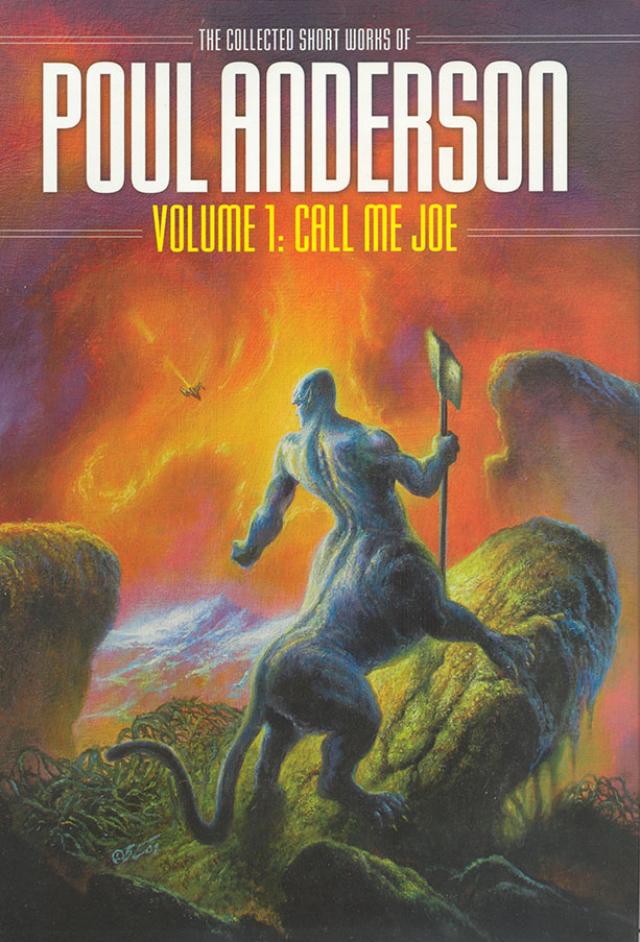


“Okay. Mount that plate over there, please, between those four big coils. And—good luck.” The doctor extended his hand and Hart shook it, thinking to himself that it was a wholly unnecessary gesture. Maybe they’d have better taste in the future.
He climbed up onto the silvery disk and stood looking out between coils that were taller than he was. His knees were a little weak—almost, he was tempted to shout to call a halt—but that would be silly, of course.
The technicians busied themselves about the generator with that casual competence he had always found irritating in their breed. He heard the list of instrument readings called out, someone else said, “Check,” and he thought briefly and wildly, Maybe it’s also mate. A switch slammed down and a blue glow hovered over the coils. He heard a low, rising hum.
* * *
It faded. “Alri, no,” said the doctor. “Du can downstep no.”
Hart had a moment where his mind wobbled, where he thought wildly that it hadn’t worked after all. Great Heaven he was still in the world, still at home—
What had happened to the doctor? Where were the technicians? These weren’t the same men they had been an instant ago!
An instant—no, an age. There was no time flow in the stasis field—he was in the future.
He had thought himself mentally prepared. But it was too sudden. The shock was too blurringly great—shattering, devastating shock of suddenly alien men, alien speech, alien world. He staggered a little, and the doctor stepped up on the platform to support him.
Hart leaned on the man’s arm—a big, solid fellow, which was somehow reassuring—and let the soft, lilting words slide over the surface of his mind. Almost, they were familiar. For a moment he couldn’t follow the speech at all, then he caught words and recognized the changes in accent. Except for the foreign terms and the slang, he could follow the language. Certainly he could get the drift of it.
Only—how long would it take to modify the tongue so much?
He almost croaked the question. The doctor said slowly, “Dis are yaar 2837, du would say. But bay chronomizing nos, are yaar 2841.”
“What on earth—?” The sheer incongruity of it jerked Hart from his daze. He might have accepted a wholly different chronology, but—four years’ difference! “How the hell did that ever happen?”
“Hell?” For a moment, the doctor was puzzled, then his face cleared. “Oh, yes, medyaeval belief.” He smiled. “Skood du raaly ask huw de Heaven. See du, in su-named Second Dark Ages Americas waar under rule of de Kyirk of de Second Coming. Dey waar religio-fanatics whuw held dat chronomizing skood be set up four yaars since dey claimed Christ waar rally borned in 4 b.c. bay uwld chronomizing. Bay time yoke of de Kyirk waar overthruwn, everybody waar used to new style.”
Hart nodded, a little overwhelmed. “I…see…”
It didn’t matter, though. It didn’t matter. The…the Church of the Second Coming was in the past now, the dusty buried past which had still been in the future—ten minutes ago!
Almost nine hundred years. Nine hundred years!
“Here.” The doctor gave him a little flask. “Drink du dis.”
He gulped the liquid. It was tasteless, but it seemed to lay a great calm hand on him; his mind steadied and the trembling went out of his knees. He looked around him.
The chamber was different. The Crypt was not nearly so full, and it bore signs of extensive repair work. Many must have been released, many…But lymphatic cancer was really a tough disease, it would have taken time to work out the cure and if ages of barbarism had intervened—
His eyes swung to the men. There were, as before, two technicians and a doctor. (And the three men of his time were dust these many centuries.) They were large, well-shaped fellows, with dark hair and skin, eyes with a hint of obliquity, high cheekbones—but, clearly, the Caucasoid strain still predominated, however great an admixture there had been. They looked curiously alike, as if they were brothers, and were dressed almost identically—sandals, kilt, and tunic of some faintly iridescent material, with a curious involved pattern reminiscent of Scottish tartans on the left breast. There must have been immense folk wanderings during the dark ages, thought Hart vaguely, fantastic interbreeding and a rise of composite types of man.
He said aloud, slowly, “You have a cure for my case?”
“Of cuwrse, Tov Hart. De uwld records did not survive, but de Crypt and traditions abuwt it did. Su alsuw did de case histories engraved on de metal. We are ready for du no. De meditechnics have bee-an perfected uwnly in de last fifty yaars, and of cuwrse we wanted to be shoor we waar right before waking any of de ‘sleepers.’ ”
“I seem to be one of the last. “
“Indeed, Tov Hart, du are. Case duurs proved more difficult dan had bee-an antsipated. But we have a quick and aisy treating no.”
“Well…” It might only have been the stimulant, or maybe the words, but Hart felt immensely braced. He was going to live! And in a superscientific world of friendly people, he should be able to make his way. His money would hardly have survived all the changes of history, but—well, there must be some provision made for the “sleepers. ”
The world wasn’t such a bad place. Even in the far future, it wasn’t bad.
“I’m afraid you have the better of me,” he said to the doctor. At his puzzled look, he added: “With regard to names, I mean.”
“Oh. Pardon, Tov. We are all Rostoms here. I are Waldor Rostom Chang, here are Hallan Rostom Duwgal and Olwar Rostom Serwitch.”
The three men bowed formally. Hart tried to return the gesture, but couldn’t quite imitate the slight knee bend and the position of hands and head. “Philip Bronson Hart,” he said. “But the middle name isn’t the family name, the last is.”
“As wit us,” said the doctor, Waldor Chang. “Family name nos come last, group name in middle, gived name in front. But dey had not de groupings in time duurs, did dey?” He smiled. “Come du no, towarish, above ground. De clinic are quite nea-ar, and we will suwn have du well.”
The landscape hadn’t changed much, there were still the same hills and trees, the far shining thread of a river, and the wind cool and fresh on their faces. White clouds walked overhead through a sky of sunny blue, and a thrush was singing in a little thicket.
But there were few signs of man. The little village which had once been visible down beside the river had long since moldered into the earth, and the buildings of the Crypt center were gone, replaced with a single-roomed frame hut over the vault itself. Above the trees Hart could see a structure of stone and sun-flashing glass which must be the clinic, but otherwise there was no trace of civilization.
“This region must have become pretty well depopulated in the time since I went to ‘sleep,’ ” he remarked.
“Why, nuw. It are raader heawily settled,” replied Chang. “Dere must be-a, oh, all of a million people witin a radyus of a tousand kilometers.”
“But—that’s less than—How many people are there in the country?”
“About tirty million in Nort America. Or on all Eart, abuwt haaf a billion. Of cuwrse, dere must be-a a good ten million on de oder planets of de Solsystem, and perhaps anoder haaf billion in Centaari and elsewhaar—but little are knuwed abuwt dat.”
“But—in my time, there were over two billion people on Earth!”
Chang gave Hart a quizzical look. “Su I have heared,” he said slowly. “But times have cha-enged, Tov. It may taak du some while to reelayze huw much dey have cha-enged.”
They entered the clinic. A blond young woman who was apparently a nurse stood waiting for them. She wore a crisp white skirt, and nothing else, and she was gorgeous.
She and Chang gave their patient an examination which for thoroughness surpassed anything in his time. He didn’t pretend to understand the machines that buzzed and clicked and glowed around him, the serological tests and the curious symbolic notation. But he hadn’t expected to—naturally, medicine would be far advanced, and he hadn’t troubled himself to learn the details even of the past techniques.
“Very good,” said the doctor at last. “Satisfactry reactions tuw virus Beta, good Delta coefficient—yes, we skood suwn have du well, Tov Hart.”
“What’s the cure?” he asked idly. “In my time they were beginning to think there’d never be a specific for cancer.”
“Dere aren’t, but dere are specifics for de difrent kinds. Artficial diseases have bee-an developed which attack uwnly de disorganized cancer cells. Frinstance, for cancer of de liver we inject a disease of de liver, but one which healthy tissue can resist. De sick cells are eaten away sluwly enough so dat normal tissue grows back to replace dem as dey disappear. It are more complex dan dat, of cuwrse, but dat give du de genral idea-a.” He smiled. “A mont or su in hospital skood suffice for du, and we ran give du de oder tests in de mea-anwhile.”
“The…other—?” It sounded faintly ominous.
“Classficating and su on. Worry du not abuwt it no.”
“Come du,” said the nurse. “I will taak du to ruwm duurs.”
Hart followed her to an elevator. It went up with a pleasingly low acceleration, but his pulse went a little fast just the same. She was exciting!
“What’s your name, please?” he asked. He put on the smile which had usually worked in the past. “We’ll be seeing a lot of each other, I hope.”
The girl frowned, then seemed to make an allowance for him. “Mara Sorens Haalwor.”
“This is a pleasure…you’re not married?” Hart edged closer.
“Mayried? Oh, de uwld style. Nuw, but—” She backed away. Her face bore an expression of distaste, barely covered by politeness. “Please du, Tov Hart—”
“Oh. Sorry.” Hart moved from her, a little chapfallen. Oh, well.
He had a room to himself—he found out later that all hospital patients did—which delighted him. It was large and sunny, more like a living room than anything else. The furniture was curious, rather hard and low-legged—Asiatic influence during the Dark Ages?—but he could get used to that. There was a set of buttons on the wall which he learned how to use when he wanted to read. Central “libraries” had all the books and music in existence, no one owned volumes or records privately anymore. To read anything in existence, one simply called the nearest “library” and asked for it; automatically, the books—actually, record tapes—were flashed onto a screen, the speed being regulated by the reader. Likewise, any music was played directly into the citizen’s own room. There were enough copies of all record tapes to take care of any reasonable number of simultaneous requests, and if a local “library” didn’t happen to have a certain item, it would be relayed from one which did.
Curiously, there were no movie records, and no regular radio or television programs. Hart was too busy catching up with history and language at first to wonder why.
His synthetic disease and the physiological strain of growing new tissue left him a little weak. He stayed close to his room and only went out in the hospital gardens on orders of the staff. Nor did he have any visitors except the medical workers. After a while, he began to be lonely.
He was put through a series of psychological tests more exhaustive than the physical checkups. Here, too, he was baffled by the intricacy of a science evolved immensely beyond the older one which itself had puzzled him. Some of it was recognizable—word-association, elaborate questionnaires much of which seemed to be completely irrelevant, long informal talks with a psychiatrist. And the huge machines which studied him seemed remote descendants of the electroencephalographs he had known. But he went through completely bewildering processes—hypnotism, drugging, physical exercises.
“What’s the idea?” he demanded, a little indignantly. “You seem to want to know me better than I know myself. Why?”
“Psychoclassificating,” said the tester. “All citizens undergo it, with periodic rechecks.”
That sounded ominous. What kind of totalitarian state have I landed in? “What do you do with the results?”
“Counsel, advise, straighten uwt conflicts. And, of cuwrse, arra-enge introductions.” The psychiatrist looked troubled. He kept looking at the elaborate data sheets in his hand, as if he couldn’t quite believe what he saw. “Suwcial integrating of individual depend on what psychotype he are, Tov Hart. No, if du will excoose me, must study dese results—”
Hart went back to his reading. He was having trouble finding out what kind of world he lived in. There were plenty of histories, but they said little about the details of daily life, and they grew remarkably uneventful as they neared the present time. There were also plenty of sociological texts, but these were written in a technical language that left his head whirling—much of the material, indeed, was mathematical. He recognized the symbology as descended from the symbolic logic and calculus of statement of his own time, but since his acquaintance with those had been completely superficial, that didn’t help much.
But manners, customs, family relations, all the million little details which make up life—rather than the abstractions of life, such as history and sociology—were nowhere explicitly described. After all, why should a people concern itself with its own mores? Such things are learned in childhood, are absorbed unconsciously as the individual grows through life. Had any twentieth century anthropologist ever described the habits and customs and beliefs of New York as carefully and objectively as he did those of the upper Congo? Hart found himself in the curious position of having learned more about the social organization of the natives of Procyon IV than those of Sol III.
He went back to history. That he could learn objectively, and with such a background feel his way around contemporary Earth until he learned the social ropes.
But it was not part of the matrix which had produced him. The Church of the Second Coming, the Asiatic invasion of America, the mechaniolatry of the Australian Reformers, the invasion of Luna by the weirdly changed descendants of Earth’s old Martian colonists, the Scientific State, the Overthrow, the retirement of the Dissenters, the evolution of the family groups…Well, what was it? A story, a dream which had passed by while he slept, the thoughts and deeds and struggles of men unthought of in his own age.
Napoleon had been an almost living reality to Hart. He had read Emil Ludwig, he had listened to Die Beiden Grenadiere, he had heard all the tired old jokes about crazy men with hands in their coats, he had been subjected to the wistful reminiscences of old men who had grown up in that forever lost world which came between the Congress of Vienna and the murder at Sarajevo—he had, without being unusually interested in the Corsican, lived in a world where the little man had been a dominating influence even a century after his death. Napoleon was as much a part of his background, part of the complex of events which had, inter alia, produced Philip Hart, as the sun or the moon or the banging canyons of New York.
But could an imperial Roman transported to the twentieth century feel that a defeated dictator of a hundred years ago had existed? Would Napoleon be more than a dusty fiction? Would the Roman consider it logical that Frenchmen should be below the average European height, that the French law should be completely revised, that the Louisiana Territory should be American and Haiti independent, that the Nelson column should rise in London, that the whole existing world should be, all because of one little condottiere? The Roman might realize the fact, with the top of his mind, but it would not look reasonable to him. Because he would not be one of those inevitable results.
Hart gave up trying to make more than superficial sense out of all that had happened since the twentieth century, and simply learned the salient facts. He got a rough outline of the present political and economic status of man.
Earth—and the Lunar cave-cities—were under one rule. The colonists on Venus, Mars, and the outer planet satellites had evolved their own societies, often radically different from that of the mother world; man himself had had to become modified before he could settle the reaches of space, an evolution which had been carried out by the eugenics of the Scientific State with ruthless completeness. There was still regular interplanetary contact, but it was infrequent. The different branches of man had too little in common by now. Once in a great while there would be a ship from one of the colonies on the nearer stars, but distances were too great; even Alpha Centauri was fifty years away, and social evolution was diverging out there.
But could it be said that Earth was—ruled? Not in any traditional sense. The social organization was uniform, and a single council did what little administrative work the planet required. But there was nothing like a real government. History—wars, social changes, migrations, important new discoveries and concepts, events of any great significance—had been slowing for the last three centuries, ever since the family-group society had gained the ascendancy. For the last hundred years or so, nothing had really happened to mankind as a whole. Nothing!
It might be called a philosophical anarchy. Superficially, there was perfect freedom. The general law had almost no regulations on individual behavior. There was, apparently, universal content.
Decadent? No, not in the usual sense. These people were too magnificently healthy, too full of life and laughter. But they were certainly not progressive.
Hart tried to make friends with the nurses, and failed completely. They were all frigidly polite. The male staff members were cordial enough, but there was an inward reserve which increased with the days. Hart wondered what was the matter. His unhappiness waxed with his returning strength.
Chang came in at last. “I think du can leave clinic no,” he said cheerily. “Du have best undergo periodic checkups for a yaar or twuw, but all medics are shoor du are guwing to recover completely.” He handed the patient a set of clothes like his own, but without the group insigne.
Hart got out of the hospital robe and climbed into the garments. “And now what?” he asked. “I’ve tried to plump everybody on what I’m supposed to do, but they’re all so evasive I haven’t really learned a thing.”