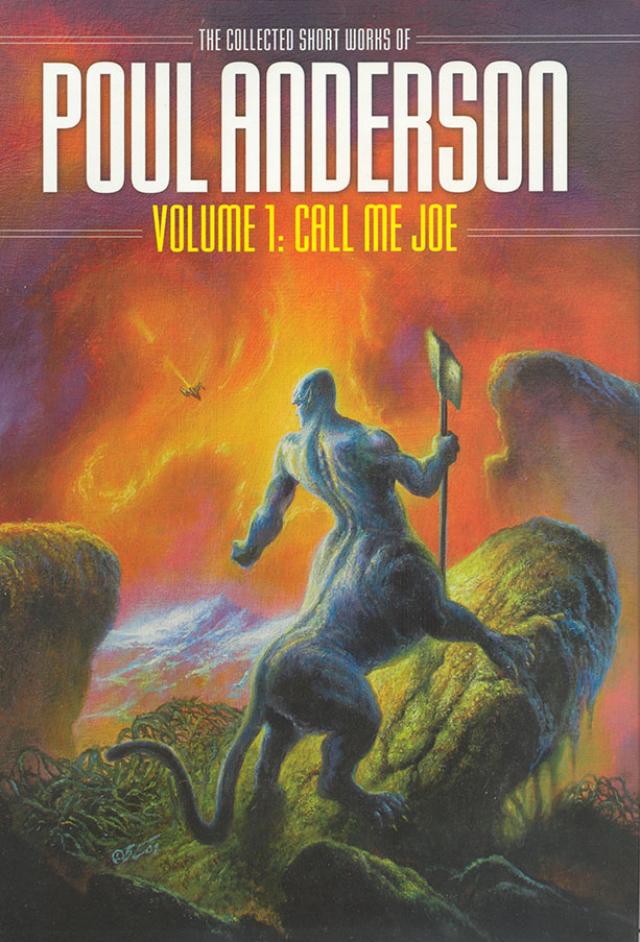
Call me joe, p.30
Call Me Joe,
p.30


They have slain Raddic and Carlon—we have three guardsmen, a Bishop and an Earl—Now we need only be butchers! Evyan, Evyan, warrior Queen, this is your victory!
diomes of leukas roared and jumped across the frontier. Futile, futile, he was doomed to darkness. Evyan’s lithe form moved up against aracles, her sword flamed and the Earl crashed at her feet. Her voice was another leaping brand: “Defend yourself, King!”
Turning, Rogard grew aware that mikillati himself had been right beside him. There was a Barrier between the two men—but mikillati had to retreat from Evyan, and he took one step forward and sideways. Peering into his face, Rogard felt a sudden coldness. There was no defeat there, it was craft and knowledge and an unbending steel will—what was leukas planning?
Evyan tossed her head, and the wind fluttered the lock of hair like a rebel banner. “We have them, Rogard!” she cried.
Far and faint, through the noise and confusion of battle, Cinnabar’s bugles sounded the command of her King. Peering into the haze, Rogard saw that Flambard was taking precautions. Sir theutas was still a menace, where he stood beside sorkas. Sir Cupran of Cinnabar flew heavily over to land in front of the Queen’s Earl’s guardsman, covering the route theutas must follow to endanger Flambard.
Wise, but—Rogard looked again at mikillati’s chill white face, and it was as if a breath of cold blew through him. Suddenly he wondered why they fought. For victory, yes, for mastery over the world—but when the battle had been won, what then?
He couldn’t think past that moment. His mind recoiled in horror he could not name. In that instant he knew icily that this was not the first war in the world, there had been others before, and there would be others again. Victory is death.
But Evyan, glorious Evyan, she could not die. She would reign over all the world and—
Steel blazed in Cinnabar. merkon of leukas came surging forth, one tigerish leap which brought him down on Ocher’s guardsman. The soldier screamed, once, as he fell under the trampling, tearing hoofs, but it was lost in the shout of the leukan Knight: “Defend yourself, Flambard! Defend yourself !”
Rogard gasped. It was like a blow in the belly. He had stood triumphant over the world, and now all in one swoop it was brought toppling about him. theutas shook his lance, sorkas his mace, diomes raised a bull’s bellow—somehow, incredibly somehow, the warriors of leukas had entered Cinnabar and were thundering at the King’s own citadel.
“No, no—” Looking down the long empty row of squares, Rogard saw that Evyan was weeping. He wanted to run to her, hold her close and shield her against the falling world, but the Barriers were around him. He could not stir from his square, he could only watch.
Flambard cursed lividly and retreated into his Queen’s home. His men gave a shout and clashed their arms—there was still a chance!
No, not while the Law bound men, thought Rogard, not while the Barriers held. Victory was ashen, and victory and defeat alike were darkness.
Beyond her thinly smiling husband, Queen dolora swept forward. Evyan cried out as the tall white woman halted before Rogard’s terrified guardsman, turned to face Flambard where he crouched, and called to him: “Defend yourself, King!”
“No—no—you fool!” Rogard reached out, trying to break the Barrier, clawing at mikillati. “Can’t you see, none of us can win, it’s death for us all if the war ends. Call her back!”
mikillati ignored him. He seemed to be waiting.
And Ocher of Cinnabar raised a huge shout of laughter. It belled over the plain, dancing joyous mirth and men lifted weary heads and turned to the young Knight where he sat in his own stronghold, for there was youth and triumph and glory in his laughing. Swiftly, then, a blur of steel, he sprang, and his winged horse rushed out of the sky on dolora herself. She turned to meet him, lifting her sword, and he knocked it from her hand and stabbed with his own lance. Slowly, too haughty to scream, the white Queen sank under his horse’s hoofs.
And mikillati smiled.
* * *
“I see,” nodded the visitor. “Individual computers, each controlling its own robot piece by a tight beam, and all the computers on a given side linked to form a sort of group-mind constrained to obey the rules of chess and make the best possible moves. Very nice. And it’s a pretty cute notion of yours, making the robots look like medieval armies.” His glance studied the tiny figures where they moved on the oversize board, under one glaring floodlight.
“Oh, that’s pure frippery,” said the scientist. “This is really a serious research project in multiple computer-linkages. By letting them play game after game, I’m getting some valuable data.”
It’s a lovely setup,” said the visitor admiringly. “Do you realize that in this particular contest the two sides are reproducing one of the great classic games?”
“Why, no. Is that a fact?”
“Yes. It was a match between Anderssen and Kieseritsky back in—I forget the year, but it was quite some time ago. Chess books often refer to it as the Immortal Game…So your computers must share many of the properties of a human brain.”
“Well, they’re complex things, all right,” admitted the scientist. “Not all their characteristics are known yet. Sometimes my chessmen surprise even me.”
“Hm.” The visitor stooped over the board. “Notice how they’re limping around inside their squares, waving their arms, batting at each other with their weapons?” He paused, then murmured slowly: “I wonder—I wonder if your computers may not have consciousness. If they might not have—minds.”
“Don’t get fantastic,” snorted the scientist.
“But how do you know?” persisted the visitor. “Look, your feedback arrangement is closely analogous to a human nervous system. How do you know that your individual computers, even if they are constrained by the group linkage, don’t have individual personalities? How do you know that their electronic senses don’t interpret the game as, oh, as an interplay of free will and necessity; how do you know they don’t receive the data of the moves as their own equivalent of blood, sweat and tears?” He shuttered a little.
“Nonsense,” grunted the scientist. “They’re only robots. Now—Hey! Look there! Look at that move!”
* * *
Bishop sorkas took one step ahead, into the black square adjoining Flambard’s. He bowed and smiled. “The war is ended,” he said.
Slowly, very slowly, Flambard looked about him. sorkas, merkon, theutas, they were crouched to leap on him wherever he turned; his own men raged helpless against the Barriers; there was no place for him to go.
He bowed his head. “I surrender,” he whispered.
Rogard looked across the red and black to Evyan. Their eyes met, and they stretched out their arms to each other.
* * *
“Checkmate,” said the scientist. “That game’s over.”
He crossed the room to the switchboard and turned off the computers.
Upon the Occasion of Being
Asked to Argue That Love and
Marriage are Incompatible
Love is no lady, but a wench with wings,
Fickle and fleet, the child of wind and sky,
Cool as a fall where tumbling waters ring,
Brazen as sunlight and like moonlight shy.
Love is a hawk no man may hope to tame.
She is not chased, but hers is the attack.
Love is no bride who meekly leads her name,
Nor, being winged, lies always on her back.
How shall you cage the river or the gale?
How shall you pluck and lifelong keep alive
Blossoms in bowls where air is walled and stale?
Love comes to whom she will, not those who strive,
Therefore, my sweet, be in no haste to marry,
So it may be that Love will deign to tarry.
Backwardness
As a small boy he wanted to be a rocket pilot—and what boy didn’t in those days?—but learned early that he lacked the aptitudes. Later he decided on psychology, and even took a bachelor’s degree cum laude. Then one thing led to another, and Joe Husting ended up as a confidence man. It wasn’t such a bad life; it had challenge and variety as he hunted in New York, and the spoils of a big killing were devoured in Florida, Greenland Resort, or Luna City.
The bar was empty of prospects just now, but he dawdled over his beer and felt no hurry. Spring had reached in and touched even the East Forties. The door stood open to a mild breeze, the long room was cool and dim, a few other men lazed over midafternoon drinks and the TV was tuned low. Idly, through cigarette smoke, Joe Husting watched the program.
The Galactics, of course. Their giant spaceship flashed in the screen against wet brown fields a hundred miles from here. Copter view…now we pan to a close-up, inside the ring of UN guards, and then back to the sightseers in their thousands. The announcer was talking about how the captain of the ship was at this moment in conference with the Secretary-General, and the crewmen were at liberty on Earth. “They are friendly, folks. I repeat, they are friendly. They will do no harm. They have already exchanged their cargo of U-235 for billions of our own dollars, and they plan to spend those dollars like any friendly tourist. But both the UN Secretariat and the President of the United States have asked us all to remember that these people come from the stars. They have been civilized for a million years. They have powers we haven’t dreamed of. Anyone who harms a Galactic can ruin the greatest—”
Husting’s mind wandered off. A big thing, yes, maybe the biggest thing in all history. Earth a member planet of the Galactic Federation! All the stars open to us! It was good to be alive in this year when anything could happen…hm. To start with, you could have some rhinestones put in fancy settings and peddle them as gen-yu-wine Tardenoisian sacred flame-rocks, but that was only the beginning—
He grew aware that the muted swish of electrocars and hammering of shoes in the street had intensified. From several blocks away came a positive roar of excitement. What the devil? He left his beer and sauntered to the door and looked out. A shabby man was hurrying toward the crowd. Husting buttonholed him. “What’s going on, pal?”
“Ain’t yuh heard? Galactics! Half a dozen of ’em. Landed in duh street uptown, some kinda flying belt dey got, and went inna Macy’s and bought a million bucks’ wortha stuff ! Now dey’re strolling down dis-a-way. Lemme go!”
Husting stood for a while, drawing hard on his cigarette. There was a tingle along his spine. Wanderers from the stars, a million-year-old civilization embracing the whole Milky Way! For him actually to see the high ones, maybe even talk to them…it would be something to tell his grandchildren about if he ever had any.
He waited, though, till the outer edge of the throng was on him, then pushed with skill and ruthlessness. It took a few sweaty minutes to reach the barrier.
An invisible force-field, holding off New York’s myriads—wise precaution. You could be trampled to death by the best-intentioned mob.
There were seven crewmen from the Galactic ship. They were tall, powerful, as handsome as expected: a mixed breed, with dark hair and full lips and thin aristocratic noses. In a million years you’d expect all the human races to blend into one. They wore shimmering blue tunics and buskins, webby metallic belts in which starlike points of light glittered—and jewelry! My God, they must have bought all the gaudiest junk jewelry Macy’s had to offer, and hung it on muscular necks and thick wrists. Mink and ermine burdened their shoulders, a young fortune in fur. One of them was carefully counting the money he had left, enough to choke an elephant. The others beamed affably into Earth’s milling folk.
Joe Husting hunched his narrow frame against the pressure that was about to flatten him on the force screen. He licked suddenly dry lips, and his heart hammered. Was it possible—could it really happen that he, insignificant he, might speak to the gods from the stars?
* * *
Elsewhere in the huge building, politicians, specialists, and vips buzzed like angry bees. They should have been conferring with their opposite numbers from the Galactic mission—clearly, the sole proper way to meet the unprecedented is to set up committees and spend six months deciding on an agenda. But the Secretary-General of the United Nations owned certain prerogatives, and this time he had used them. A private face-to-face conference with Captain Hurdgo could accomplish more in half an hour than the councils of the world in a year.
He leaned forward and offered a box of cigars. “I don’t know if I should,” he added. “Perhaps tobacco doesn’t suit your metabolism?”
“My what?” asked the visitor pleasantly. He was a big man, running a little to fat, with distinguished gray at the temples. It was not so odd that the Galactics should shave their chins and cut their hair in the manner of civilized Earth. That was the most convenient style.
“I mean, we smoke this weed, but it may poison you,” said Larson. “After all, you’re from another planet.”
“Oh, that’s OK,” replied Hurdgo. “Same plants grow on every Earth-like planet, just like the same people and animals. Not much difference. Thanks.” He took a cigar and rolled it between his fingers. “Smells nice.”
“To me, that is the most astonishing thing about it all. I never expected evolution to work identically throughout the universe. Why?”
“Well, it just does.” Captain Hurdgo bit the end off his cigar and spat it out onto the carpet. “Not on different-type planets from this, of course, but on Earth-type it’s all the same.”
“But why? I mean, what process—it can’t be coincidence!”
Hurdgo shrugged. “I don’t know. I’m just a practical spaceman. Never worried about it.” He put the cigar in his mouth and touched the bezel of an ornate finger ring to it. Smoke followed the brief, intense spark.
“That’s a…a most ingenious development,” said Larson. Humility, yes, there was the line for a simple Earthman to take. Earth had come late into the cosmos and might as well admit the fact.
“A what?”
“Your ring. That lighter.”
“Oh, that. Yep. Little atomic-energy gizmo inside.” Hurdgo waved a magnanimous hand. “We’ll send some people to show you how to make our stuff. Lend you machinery till you can start your own factories. We’ll bring you up to date.”
“It—you’re incredibly generous,” said Larson, happy and incredulous.
“Not much trouble to us, and we can trade with you once you’re all set up. The more planets, the better for us.”
“But…excuse me, sir, but I bear a heavy responsibility. We have to know the legal requirements for membership in the Galactic Federation. We don’t know anything about your laws, your customs, your—”
“Nothing much to tell,” said Hurdgo. “Every planet can pretty well take care of itself. How the hell you think we could police fifty million Earth-type planets? If you got a gripe, you can take it to the, uh, I dunno what the word would be in English. A board of experts with a computer that handles these things. They’ll charge you for the service—no Galactic taxes, you just pay for what you get, and out of the profits they finance free services like this mission of mine.”
“I see,” nodded Larson. “A Coordinating Council.”
“Yeh, I guess that’s it.”
The Secretary-General shook his head in bewilderment. He had sometimes wondered what civilization would come to be, a million years hence. Now he knew, and it staggered him. An ultimate simplicity, superman disdaining the whole cumbersome apparatus of interstellar government, freed of all restraints save the superman morality, free to think his giant thoughts between the stars!
Hurdgo looked out the window to the arrogant towers of New York. “Biggest city I ever saw,” he remarked, “and I seen a lot of planets. I don’t see how you run it. Must be complicated.”
“It is, sir.” Larson smiled wryly. Of course the Galactics would long ago have passed the stage of needing such a human ant hill. They would have forgotten the skills required to govern one, just as Larson’s people had forgotten how to chip flint.
“Well, let’s get down to business.” Hurdgo sucked on his cigar and smacked his lips. “Here’s how it works. We found out a big while back that we can’t go letting any new planet bust its way into space with no warning to anybody. Too much danger. So we set up detectors all over the Galaxy. When they spot the, uh, what-you-call-’ems—vibrations, yes, that’s it, vibrations—the vibrations of a new star drive, they alert the, uh, Coordinating Council and it sends out a ship to contact the new people and tell ’em the score.”
“Ah, indeed. I suspected as much. We have just invented a faster-than-light engine…very primitive, of course, compared to yours. It was being tested when—”
“Uh-huh. So me and my boys are supposed to give you the once-over and see if you’re all right. Don’t want warlike peoples running around loose, you know. Too much danger.”
“I assure you—”
“Yes, yes, pal, it’s OK. You got a good strong world setup and the computer says you’ve stopped making war.” Hurdgo frowned. “I got to admit, you got some funny habits. I don’t really understand everything you do…you seem to think funny, not like any other planet I ever heard of. But it’s all right. Everybody to his own ways. You get a clean bill of health.”
“Suppose…” Larson spoke very slowly. “Just suppose we had not been…approved—what then? Would you have reformed us?”
“Reformed? Huh? What d’you mean? We’d have sent a police ship and blown every planet in this system to smithereens. Can’t have people running loose who might start a war.”
Sweat formed under Larson’s arms and trickled down his ribs. His mouth felt dry. Whole planets—
But in a million years you would learn to think sub specie aeternitatis. Five billion warlike Earthlings could annihilate fifty billion peaceful Galactics before they were overcome. It was not for him to judge a superman.
* * *