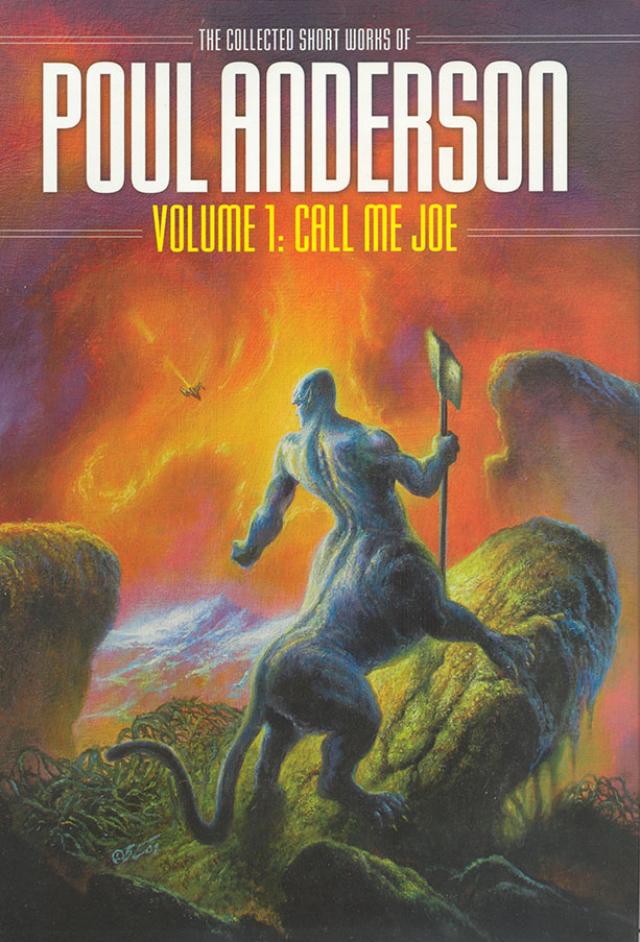
Call me joe, p.73
Call Me Joe,
p.73


“I can’t tell you anything else,” Diaz said.
“Oh, you could,” Rostock answered gently. “You know as well as I what can be done with a shot of babble juice. Not to mention other techniques—nothing melodramatic, nothing painful or disabling, merely applied neurology—in which I believe Unasia is ahead of the Western countries. But don’t worry, Captain. I shall not permit any such breach of military custom.
“However, I do want you to understand how much trouble we went to, to get you. When combat began, I reasoned that the ships auxiliary to a dreadnaught would be the likeliest to suffer destruction of the type which leaves a few survivors. From the pattern of action in the first day, I deduced the approximate orbits and positions of several American capital ships. Unasia tactics throughout the second day were developed with two purposes: to inflict damage, of course, but also to get the Ho so placed that we would be likely to detect any distress signals. This cost us the Genghis—a calculated risk that did not pay off—I am not omniscient. But we did hear your call.
“You are quite right about the importance of this ship here. My superiors will be horrified at my action. But of necessity, they have given me carte blanche. And since the Ho itself takes no direct part in any engagement if we can avoid it, the probability of our being detected and attacked was small.”
Rostock’s eyes held Diaz’s. He tapped the table, softly and repeatedly, with one fingernail. “Do you appreciate what all this means, Captain?” he asked “Do you see how badly you were wanted?”
Diaz could only wet his lips and nod.
“Partly,” Rostock said, smiling again, “there was the desire I have mentioned, to…er…check up on American activities during the last cease-fire period. But partly, too, there was a wish to bring you up to date on what we have been doing.”
“Huh?” Diaz half scrambled from his chair, sagged back and gaped.
“The choice is yours, Captain,” Rostock said. “You can be transferred to a cargo ship when we can arrange it, and so to an asteroid camp, and in general receive the normal treatment of a war prisoner. Or you may elect to hear what I would like to discuss with you. In the latter event, I can guarantee nothing. Obviously I can’t let you go home in a routine prisoner exchange with a prime military secret of ours. You will have to wait until it is no longer a secret—until American intelligence has learned the truth and we know that they have. That may take years. It may take forever, because I have some hope that the knowledge will change certain of your own attitudes.
“No, no, don’t answer now. Think it over. I will see you again tomorrow. In twenty-four hours, that is to say.”
Rostock’s eyes shifted past Diaz, as if to look through the bulkheads. His tone dropped to a whisper. “Have you ever wondered, like me, why we carry Earth’s rotation period to space with us? Habit; practicality; but is there not also an element of magical thinking? A hope that somehow we can create our own sunrises? The sky is very black out there. We need all the magic we can invent. Do we not?”
* * *
Several hours later, alarms sounded, voices barked over the intercoms, spin was halted but weight came quickly back as the ship accelerated. Diaz knew just enough Mandarin to understand from what he overheard that radar contact had been made with American units and combat would soon resume. The guard who brought him dinner in his cubicle confirmed it, with many a bow and hissing smile. Diaz had gained enormous face by his audience with the man in the suite.
He couldn’t sleep, though the racket soon settled down to a purposeful murmur with few loud interruptions. Restless in his bunk harness, he tried to reconstruct a total picture from the clues he had. The primary American objective was the asteroid base system of the enemy. But astromilitary tactics were too complicated for one brain to grasp. A battle might go on for months, flaring up whenever hostile units came near enough in their enormous orbitings to exchange fire. Eventually, Diaz knew, if everything went well—that is, didn’t go too badly haywire—Americans would land on the Unasian worldlets. That would be the rough part. He remembered ground operations on Mars and Ganymede far too well.
As for the immediate situation, though, he could only make an educated guess. The leisurely pace at which the engagement was developing indicated that ships of dreadnaught mass were involved. Therefore no mere squadron was out there, but an important segment of the American fleet, perhaps the task force headed by the Alaska. But if this was true, then the Ho Chi Minh must be directing a flotilla of comparable size.
Which wasn’t possible! Flotillas and subfleets were bossed from dreadnaughts. A combat computer and its human staff were too big and delicate to be housed in anything less. And the Ho was not even as large as the Argonne had been.
Yet what the hell was this but a command ship? Rostock had hinted as much. The activity aboard was characteristic: the repeated sound of courier boats coming and going, intercom calls, technicians hurrying along the corridors, but no shooting.
Nevertheless…
Voices jabbered beyond the cell door. Their note was triumphant. Probably they related a hit on an American vessel. Diaz recalled brushing aside chunks of space-frozen meat that had been his Corps brothers. Sammy Yoshida was in the Utah Beach, which was with the Alaska—Sammy who’d covered for him back at the Academy when he crawled in dead drunk hours after taps, and some years later had dragged him from a shell-struck foxhole on Mars and shared oxygen till a rescue squad happened by. Had the Utah Beach been hit? Was that what they were giggling about out there?
Prisoner exchange, in a year or two or three, will get me back for the next round of the war, Diaz thought in darkness. But I’m only one man. And I’ve goofed somehow, spilled a scheme which might’ve cost the Unies several ships before they tumbled. It’s hardly conceivable I could smuggle out whatever information Rostock wants to give me. But there’d be some tiny probability that I could, somehow, sometime. Wouldn’t there?
I don’t want to. Dios mio, how I don’t want to! Let me rest a while, and then be swapped, and go back for a long furlough on Earth, where anything I ask for is mine and mainly I ask for sunlight and ocean and flowering trees. But Carl liked those things too, didn’t he?
* * *
A lull came in the battle. The fleets had passed each other, decelerating as they fired. They would take many hours to turn around and get back within combat range. A great quietness descended on the Ho. Walking down the passageways, which thrummed with rocket blast, Diaz saw how the technicians slumped at their posts. The demands on them were as hard as those on a pilot or gunner or missile chief. Evolution designed men to fight with their hands, not with computations and pushbuttons. Maybe ground combat wasn’t the worst kind at that.
The sentries admitted Diaz through the door of the warning. Rostock sat at the table again. His coifed features looked equally drained, and his smile was automatic. A samovar and two teacups stood before him.
“Be seated, Captain,” he said tonelessly. “Pardon me if I do not rise. This has been an exhausting time.”
Diaz accepted a chair and a cup. Rostock drank noisily, eyes closed and forehead puckered. There might have been an extra stimulant in his tea, for before long he appeared more human. He refilled the cups, passed out cigarettes, and leaned back on his couch with a sigh.
“You may be pleased to know,” he said, “that the third pass will be the final one. We shall refuse further combat and proceed instead to join forces with another flotilla near Pallas.”
“Because that suits your purposes better,” Diaz said.
“Well, naturally. I compute a higher likelihood of ultimate success if we followed a strategy of…no matter now.”
Diaz leaned forward. His heart slammed. “So this is a command ship,” he exclaimed “I thought so.”
The blue eyes weighed him with care. “If I give any further information,” Rostock said—softly, but the muscles tightened along his jaw—“you must accept the conditions I set forth.”
“I do,” Diaz got out.
“I realize that you do so in the hope of passing on the secret to your countrymen,” Rostock said. “You may as well forget about that. You won’t get the chance.”
“Then why do you want to tell me? You won’t make a Unie out of me, General.” The words sounded too stuck up, Diaz decided. “That is, I respect your people and so forth, but…uh…my loyalties lie elsewhere”
“Agreed. I don’t hope or plan to change them. At least, not in an easterly direction.” Rostock drew hard on his cigarette, let smoke stream from his nostrils, and squinted through it. “The microphone is turned down,” he remarked. “We cannot be overheard unless we shout. I must warn you, if you make any attempt to reveal what I am about to say to you to any of my own people, I shall not merely deny it but order you sent out the airlock. It is that important.”
Diaz rubbed his hands on his trousers. The palms were wet. “Okay,” he said.
“Not that I mean to browbeat you, Captain,” said Rostock hastily. “What I offer is friendship. In the end, maybe, peace.” He sat a while longer, looking at the wall, before his glance shifted back to Diaz. Suppose you begin the discussion. Ask me what you like.”
“Uh…” Diaz floundered about, as if he’d been leaning on a door that was thrown open. “Uh…well, was I right? Is this a command ship?”
“Yes. It performs every function of a flag dreadnaught, except that it seldom engages in direct combat. The tactical advantages are obvious. A smaller, lighter vessel can get about much more readily, hence be a correspondingly more effective directrix. Furthermore, if due caution is exercised, we are not likely to be detected and fired at. The massive armament of a dreadnaught is chiefly to stave off the missiles that can annihilate the command post within. Ships of this class avoid that whole problem by avoiding attack in the first place.”
“But your computer! You, you must have developed a combat computer as…small and rugged as an autopilot… I thought miniaturization was our specialty.”
Rostock laughed.
“And you’d still need a large human staff,” Diaz protested. “Bigger than the whole crew of this ship!
“Wouldn’t you?” he finished weakly.
Rostock shook his head. “No.” His smile faded. “Not under this new system. I am the computer.”
“What?”
“Look.” Rostock pulled off his hood.
The head beneath was hairless, not shaved but depilated. A dozen silvery plates were set into it, flush with the scalp; in them were plug outlets. Rostock pointed toward the office. “The rest of me is in there,” he said. “I need only set the jacks into the appropriate points of myself, and I become…no, not part of the computer. It becomes part of me.”
He fell silent again, gazing now at the floor. Diaz hardly dared move, until his cigarette burned his fingers and he had to stub it out. The ship pulsed around them. Monet’s picture of sunlight caught in young leaves was like something seen at the far end of a tunnel.
“Consider the problem,” Rostock said at last, low. “In spite of much loose talk about giant brains, computers do not think, except perhaps on an idiot level. They simply perform logical operations, symbol-shuffling, according to instructions given them. It was shown long ago that there are infinite classes of problems that no computer can solve: the classes dealt with in Gödel’s theorem, that can only be solved by the nonlogical process of creating a metalanguage. Creativity is not logical and computers do not create.
“In addition, as you know, the larger a computer becomes, the more staff it requires, to perform such operations as data coding, programming, retranslation of the solutions into practical terms, and adjustment of the artificial answer to the actual problems. Yet your own brain does this sort of thing constantly…because it is creative. Moreover, the advanced computers are heavy, bulky, fragile things. They use cryogenics and all the other tricks, but that involves elaborate ancillary apparatus. Your brain weighs a kilogram or so, is quite adequately protected in the skull, and needs less than a hundred kilos of outside equipment—your body.
“I am not being mystical. There is no reason why creativity cannot someday be duplicated in an artificial structure. But I think that structure will look very much like a living organism; will, indeed, be one. Life has had a billion years to develop these techniques.
“Now if the brain has so many advantages, why use a computer at all? Obviously, to do the uncreative work, for which the brain is not specifically designed. The brain visualizes a problem of, say, orbits, masses, and tactics, and formulates it as a set of matrix equations; then the computer goes swiftly through the millions of idiot counting operations needed to produce a numerical solution. What we have developed here, we Unasians, is nothing but a direct approach. We eliminate the middle man, as you Americans would say.
“In yonder office is a highly specialized computer. It is built from solid-state units, analogous to neurons, but in spite of being able to treat astromilitary problems, it is comparatively small, simple, and sturdy device. Why? Because it is used in connection with my brain, which directs it. The normal computer must have its operational patterns built in. Mine develops synapse pathways as needed, just as a man’s lower brain can develop skills under the direction of the cerebral cortex. And these pathways are modifiable by experience; the system is continually restructuring itself. The normal computer must have elaborate failure detection systems and arrangements for rerouting. I in the hookup here sense any trouble directly, and am no more disturbed by the temporary disability of some region than you are disturbed by the fact that most of your brain cells at any given time are resting.
“The human staff becomes superfluous here. My technicians bring me the data, which need not be reduced to standardized format. I link myself to the machine and…think about it…there are no words. The answer is worked out in no more time than any other computer would require. But it comes to my consciousness not as a set of figures, but in practical terms, decisions about what to do. Furthermore, the solution is modified by my human awareness of those factors too complex to go into mathematical form—like the physical condition of men and equipment, morale, long-range questions of logistics and strategy and ultimate goals. You might say this is a computer system with common sense. Do you understand, Captain?”
Diaz sat still for a long time before he said, “Yes. I think I do.”
Rostock had gotten a little hoarse. He poured himself a fresh cup of tea and drank half, struck another cigarette and said earnestly: “The military value is obvious. Were that all, I would never have revealed this to you. But something else developed as I practiced and increased my command of the system. Something quite unforeseen. I wonder if you will comprehend.” He finished his cup. “The repeated experience has…changed me. I am no longer human. Not really.”
The ship whispered, driving through darkness.
“I suppose a hookup like that would affect the emotions,” Diaz ventured. “How does it feel?”
“There are no words,” Rostock repeated, “except those I have made for myself.” He rose and walked restlessly across the subdued rainbows in the carpet, hands behind his back, eyes focused on nothing Diaz could see. “As a matter of fact, the emotional effect may be a simple intensification. Although…there are myths about mortals who became gods. How did it feel to them? I think they hardly noticed the palaces and music and feasting on Olympus. What mattered was how, piece by piece, as he mastered his new capacities, the new god won a god’s understanding. His perception, involvement, detachment, totalness…there are no words.”
Back and forth he paced, feet noiseless but metal and energies humming beneath his low and somehow troubled voice. “My cerebrum directs the computer,” he said, “and the relationship becomes reciprocal. True, the computer part has no creativity of its own; but it endows mine with a speed and sureness you cannot imagine. After all, a great part of original thought consists merely in proposing trial solutions—the scientist hypothesizes, the artist draws a charcoal line, the poet scribbles a phrase—and testing them to see if they work. By now, to me, this mechanical aspect of imagination is back down on the subconscious level where it belongs. What my awareness senses is the final answer, springing to life almost simultaneously with the question, and yet with a felt reality to it such as comes only from having pondered and tested the issue thousands of times.
“Also, the amount of sense data I can handle is fantastic. Oh, I am blind and deaf and numb away from my machine half! So you will realize that over the months I have tended to spend more and more time in the linked state. When there was no immediate command problem to solve, I would sit and savor total awareness. Or I would think.”
In a practical tone: “That is how I perceived that you were about to sabotage us, Captain. Your posture alone betrayed you. I guessed the means at once and ordered the guards to knock you unconscious. I think, also, that I detected in you the potential I need. But that demands closer examination. Which is easily given. When I am linked, you cannot lie to me. The least insincerity is written across your whole organism.”
He paused, to stand a little slumped, looking at the bulkhead. For a moment Diaz’s legs tensed. Three jumps and I can be there and get his gun! But no, Rostock wasn’t any brainheavy dwarf. The body in that green uniform was young and trained. Diaz took another cigarette. “Okay,” he said. “What do you propose?”
“First,” Rostock said, turning about—and his eyes kindled—“I want you to understand what you and I are. What the spacemen of both factions are.”
“Professional soldiers,” Diaz grunted uneasily. Rostock waited. Diaz puffed hard and plowed on, since he was plainly expected to, “The last soldiers left. You can’t count those ornamental regiments on Earth, nor the guys sitting by the big missiles. Those missiles will never be fired. World War Three was a large enough dose of nucleonics. Civilization was lucky to survive. Terrestrial life would be lucky to survive, next time around. So war has moved into space. Uh…professionalism…the old traditions of mutual respect and so forth have naturally revived.” He made himself look up. “What more clichés need I repeat?”