Call me joe, p.57
Call Me Joe,
p.57
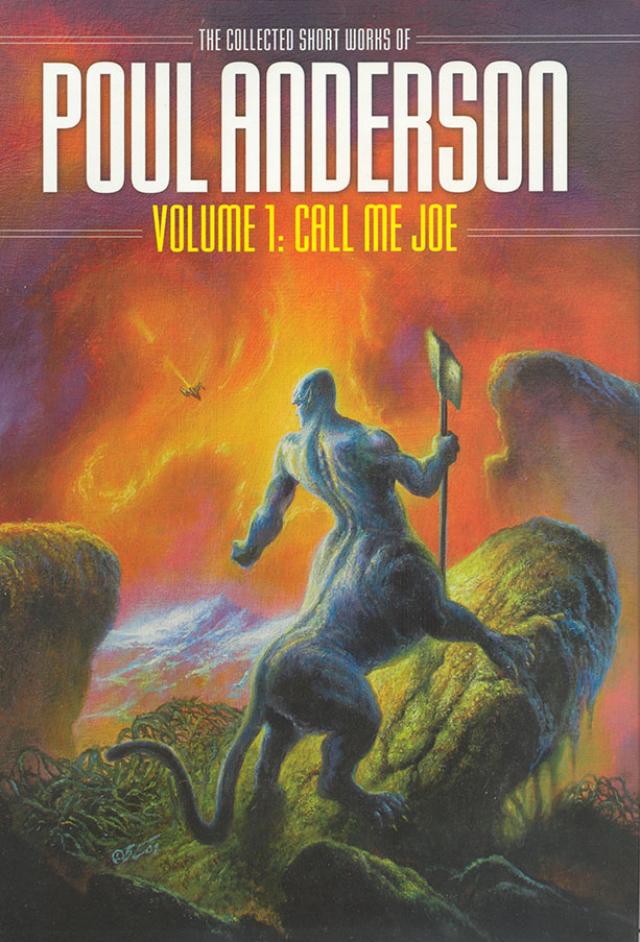


“You understand want this means, I suppose,” Jonafer said. “There’ll be no problem to ending the practice. We’ll simply tell we have a new and better Holy Food, and prove it with a few pills. Terrestrial-type meat animals can be reintroduced later and supply what’s necessary. In the end, no doubt our geneticists can repair that faulty Y chromosome.”
He could not stay contained any longer. His mouth opened, a gash across his half-seen face, and he rasped: “I should praise you for saving a whole people. I can’t. Get your business over with, will you?”
Evalyth trod forward to stand before Moru. He shivered but met her eyes. Astonished, She said: “You haven’t drugged him.”
“No,” Jonafer said. “I wouldn’t help you.” He spat.
“Well, I’m glad.” She addressed Moru in his own language: “You killed my man. Is it right that I should kill you?”
* * *
“It is right,” he answered, almost as levelly as she. “I thank that my woman and my sons are to go free.” He was quiet for a second or two. “I have heard that your folk can preserve food for years without it rotting. I would be glad if you kept my body to give to your sons.”
“Mine will not need it,” Evalyth said. “Nor will the sons of your sons.”
Anxiety tinged his words: “Do you know why I slew your man? He was kind to me, and like a god. But I am lame. I saw no other way to get what my sons must have; and they must have it soon, or it would be too late and they could never become men.”
“He taught me,” Evalyth said, “how much it is to be a man.”
She turned to Jonafer, who stood tense and puzzled. “I had my revenge,” she said in Donli’s tongue.
“What?” His question was a reflexive noise.
“After I learned about the dipteroid phenomenon,” she said. “All that was necessary was for me to keep silent. Moru, his children, his entire race would go on being prey for centuries, maybe forever. I sat for half an hour, I think, having my revenge.”
“And then?” Jonafer asked.
“I was satisfied and could start thinking about justice,” Evalyth said.
She drew a knife. Moru straightened his back. She stepped behind him and cut his bonds. “Go home,” she said. “Remember him.”
Barbarous Allen
All in the merry month of March,
When the tax collector’s callin’,
Sweet William took a club and went
To call on Barbarous Allen.
He bopped him once, he bonked him twice,
He barfed him three times runnin’.
Said Allen with a sad sweet smile:
“Young man, you’re simply stunnin’.”
He lived alone up in his eave
But by his pets was che-ered:
The bats that nested in his ears,
The buzzard in his be-ard.
Sweet William said: “You stole my gal.
Now give me back my Ellen!”
“I don’t think you could carry her down
The hill,” said Barbarous Allen.
And then he took a naily club
And whopped sweet William strongly.
His American blood flowed red, white, and blue.
(He never voted wrongly.)
Said William: “Now it is my turn.
Hold still, you Barbarous Allen.”
He whonked him hard; his club was like
A redwood pine tree (for the sake of the meter) fallin’.
Then Allen bashed, and William smashed,
Until the sun was fallin’
And finally the hermit crashed
To earth, did Barbarous Allen.
Said William, speakin’ to the cave:
“Come out, my gentle Ellen.
Go home with me, for now you’re saved
From cruel Barbarous Allen.”
And out she came, and whacked him good.
Go home, you rat,” said Ellen.
“The whole damn township ain’t as much
A (wow!) MAN as Barbarous Allen!”
Welcome
Barlow’s first astonishment was at how little different the future seemed. He had thought that five hundred years would change every detail beyond imagination. To be sure, nothing was quite like the twentieth century United States; but contemporary Mexico had been a good deal more exotic than the North American Federation of the United World Republics looked.
Several persons awaited him when he emerged from the superenergy state. All but one were men, ranging from boyish to middle-aged: two Orientals, a Negro, the others white. They wore shirts, trousers, and fabric shoes, of synthetic material in subdued colors, cut much like Barlow’s. One had a sleek pistol-like weapon in a holster, but left it there, unafraid of the newcomer. They all gathered around, made sympathetic noises in accented but recognizable English, led him to a couch and gave him a drink. The room was windowless, with a fluorescent ceiling and ventilator grilles. A workbench supported miscellaneous scientific equipment, most of which Barlow could identify.
“Heh, now, buddo, swallow this an’ you’ll feel better.”
Barlow obeyed mechanically. He had a bad case of the shakes. A gentle, relaxing warmth spread through him. Within minutes he could regard his situation as calmly as if it were someone else’s. He felt happy, his mind clearer and quicker than usual. And yet, he thought, this was not so different from the tranquilizers of his era.
“I guess he’s ’kay now, Joe,” said a young man.
The oldest, who appeared to be the leader, nodded. “How’re you?” he smiled, offering his hand. ‘‘I’m Joe Grozen. Here’s my primary daughter Amily. She ’nsisted on seeing you arrive. I won’ ask you to ’member any other names right off.”
“Tom Barlow.” He was much taken with Amily, who was tall and well-formed, with dark hair falling past a heart-shaped blue-eyed face and halfway down her back. She wore sandals, shorts, a kind of tee shirt, and a friendly expression. “What, uh, what year is this?”
“Twen’y-four nine’y-seven,” she replied.
“The twelfth April. Your calculations were very close. This place was readied special for your coming.”
He had to ask it, with his heart in his throat despite all soothing drugs: “Is there any way for me to return?”
Joe Grozen’s broad red visage grew sober. “No,” he muttered. “ ’Fraid not.”
Barlow sighed. “Never mind. I didn’t expect it. Travel into the past, an obvious absurdity. All I did was give myself a jolt of energy, a vector along the time axis rather than through space, and so increased my rate of existence several millionfold…But you know all about that.” He fumbled after a cigarette.
“Oh, yes,” said an Oriental. “The phenomenon’s well un’erstood today.” He bowed. “Though ’s an honor to meet its first discoverer. So youthful you are, too.”
“Sam’s chief o’ the technics department,” explained Amily. “Natur’lly he’d be mos’ in’erested in the science aspect. An’ Phil here.” She laid a hand briefly on the shoulder of the Negro. “He heads up the sociohist’ry section. He’ll want to ask you all sorts o’ questions ’bout the past.”
“You’ll have status all your life in my department, if you wish,” Phil assured Barlow. “Special lecturer, consultant, whatever you want to call it. We’re missing so much information about everything prior to the Atomic Wars.”
“Shut up, you damn scientists,” said Joe good-naturedly. “Our frien’ Tom is first of all a free human being. You can quiz him later, but give the poor tovarsh time to get used to us first. How y’ feeling now, Tom?”
“Okay.” Barlow drew heavily on his cigarette. It might have been the drug, or simply the conviction, now proven, that his farewells in the twentieth century had been final. But whatever the cause, that era already seemed remote—though he had departed it less than half an hour ago, as far as his conscious mind knew. His fears had not materialized: emergence in a desert, or an Orwellian dictatorship, or something equally horrible. He’d gambled on finding a world where his own romantic advent would give him a head start in establishing himself. (Surely, even in the course of five hundred years, there had not been many time leapers. The messages he left, sealed into marked blocks of concrete, had been carefully designed to arouse the curiosity of future humankind about Thomas Barlow.) These easy-going, familiar-looking people dissolved the tension in him. His gamble had paid off.
“Sure, I’m fine,” he said. “Tired, is all.”
Joe nodded. “That I un’erstan’. We got a home all prepared for you. You can rest up there. I’d like to give you a welcoming banquet this evening, though. Lots o’ people want to meet you.”
“I don’t need—” Barlow was interrupted as Amily took him by the hand.
“You come with me,” she said. “I’ll take you to your place. On the way I can give you a lining o’ what the world’s like these days.”
“Now, wait,” objected Phil.
“Wait yourself,” she chuckled. “I know you, you ol’ professor. You’d stuff him so full o’ precise information he wouldn’ know his charge from a Dirac hole. What he needs right now is facts, not data.”
“An’ someone to snuggle with,” Sam teased.
She made a face at him. Joe grinned. “What’s the use o’ being the Pres’dent’s daughter, Tom, if she can’ get to know you ahead of all the other girls?” he said. “You’re going to be the most chased bachelor on this planet, in case you hadn’ guessed.”
As a matter of fact, Barlow had guessed, but it was pleasant to have his anticipations borne out.
There was a little more conversation, then he left the room with the young woman. They went through a very ordinary door and down a very ordinary hall to an underground garage. Gray-clad men, shaven-headed, bowed to Amily with extreme deference and wheeled forth a small, brightly colored, teardrop-shaped machine. The seats, within a transparent canopy, were luxurious. She punched controls and leaned back. Under some kind of automatic piloting, the vehicle whirred up a ramp and into the air.
From above, Barlow saw endless miles of buildings. The effect was more like Chicago than any futuristic megalopolis: drab, dirty cubicles, with nearly solid streams of pedestrians moving through the canyons between. Enormous vehicles, freight and passenger, rumbled on elevated ways which sometimes ducked below ground. Only a few private cars were to be seen, flitting like the one which bore him over the city.
“What’s the population?” he asked slowly.
Amily shrugged. “Who knows? For the whole world, maybe fifteen billion.”
He whistled. A fifth of that number had been obscene enough when he departed his own century. However, progress must have been made in food production: algae, ocean farming, and whatnot. He was pleased to note that the air was free of smog. Probably exhaustion of chemical fuels had forced total conversion to atomic-electrical power.
Still, fifteen billion! He asked about other planets, and was a trifle saddened, but not surprised, to hear that they were visited about as often and as significantly as Pago Pago or Antarctica had been in his day.
“What sort of government do you have?” he inquired.
Amily’s laugh was as musical a sound as he had ever heard. “True scientist, you! First you find out ’bout Mars, then ’bout affairs at home! Well, if I ’member my hist’ry right, you had many sep’rate countries in the twentieth century. That was before the Atomic Wars, no? All one country now, the United World Republics. How else could fifteen billion people survive?”
“And I suppose all the races are equal?”
“What? I don’ un’erstan’.”
With some effort, he got across to her the idea that secondary physical characteristics had once been considered important. She was as startled and amused to hear of race riots as he had once been to learn of blood spilled by early Christians over the iota distinguishing homoousian from homoiousian.
“That’s cheering,” he said. “As I’d hoped.” She regarded him closely, for minutes while the aircar whispered through an April sky the color of her eyes. “Your message was never clear as to why you left,” she said.
He looked away, down to the brick and concrete earth, up again to clouds. “It’s hard to explain. Disgust would be the simplest word. I had no close personal ties after my mother died. And I saw freedom being crushed in most of the world, rotted and vulgarized in my own country; I read interviews with allegedly sane leaders, who spoke calmly of incinerating some tens of millions of women and children, if national policy so demanded. What had I to lose?”
She grimaced. “You did wisely, Tom. I won’er why so few others did the same. But then, there were the Atomic Wars, an’ all their aftermath. Not much chance for escape. Nowadays, not much incentive. Who, with access to a time accelerator, ’d want to leave this world?”
He watched her, healthy, serene, and beautiful, and thought: Who, indeed? Of course he hadn’t found any Utopia, but he hadn’t been so naive as to expect that. It was enough to have found hope. He took out another cigarette, offered her one, and was politely refused. “Very few people use tobacco,” she said. “Maybe jus’ ’cause how expensive ’tis. But if you want, ’s your own affair.”
“The supremely civilized art,” he said. “Minding one’s own business.”
She gave him a long, sidewise look. “Could be my business too,” she murmured. “You’re a han’some buddo, Tom.”
The drug didn’t slow down his pulse much.
He steered the conversation toward herself. She told him she was interested in sports and theatricals. Another bit of semantic confusion straightened itself out after he realized that “amateur performances” would have been a redundant phrase. All art nowadays was amateur, in the sense of being done for love (and, admittedly, social prestige) by people who had no need to do it for money. The mass-produced entertainment of Barlow’s birth century was long forgotten. He was not displeased to learn that scientific research, as opposed to technology and engineering, was classed among the arts. Amily voiced a few opinions on Shakespeare’s real intent in Hamlet and Lear, which might be banal to her contemporaries but to Barlow were so novel and perceptive that he felt this would prove one of the great artistic eras.
“But I did expect more change,” he said. “More inventions, especially. What I’ve seen looks less than fifty years in advance of my period. No offense,” he hastened to add.
Her expression was puzzled rather than hurt. “Why should there be change? Isn’ this aircar good enough?”
Perhaps these folk were only rationalizing a static technology forced on them by swollen population and dwindled resources. Obviously capitalism such as Barlow’s America had known, with its inherent need to innovate, was extinct. But he didn’t mind. So much so-called progress had been sheer hokum anyhow. Let the world take a thousand years to digest the authentic advances of the Industrial Revolution; give the simple graces of living a chance to catch up.
The car glided down to a platform on the fiftieth floor of a skyscraper. The surrounding buildings were as hideous as most of the continent-wide city; but this tower stood clean and proud, its starkness relieved by colorful beds of mutated flowers on each terrace. “So many men wanted to sponsor you, we set up a fund an’ got a special place,” said Amily. She squeezed his arm. “But I saw you first, ’member.”
With that buildup, he was surprised at the modesty of the apartment: two smallish rooms, plus bath and kitchenette. Amily showed him how to operate the gadgets, which were little different from those he knew. He was more interested in the quiet good taste of the interior decoration. The bookshelves were filled with finer volumes than he was accustomed to, most of them handbound. He wouldn’t have much trouble getting used to the spelling, he saw. A music library ranged from medieval chants to modern symphonies almost as foreign to his ear; but in between he found many old friends, and when he tried out part of the Beethoven Ninth, he had never heard it better performed.
“I think you’re hungry,” said the girl. She opened a built-in refrigerator. “Lemme make you a san’wich.” The meat was exotic, the bread far tastier than that library paste sold under the name in Barlow’s milieu. He ate with pleasure, downing a bottle of excellent beer.
“Might be best you nap now,” she said. “Been a strain, I know.”
“I feel fine,” he said, rising.
“Tha’s jus’ the tranquistim,” she warned. “Tonight’ll be a big do. Last till all hours.”
He edged closer. She stayed where she was. Her eyelashes fluttered, long and smoky against smooth sunbrowned cheeks. “I can rest tomorrow,” he said.
“Sure. You’re your own master here, Tom. Later Dad’ll find some status position for you, but tha’s nominal. An’ no hurry ’bout it.”
He stopped, struck by a thought. In all this bewilderment of newness, it hadn’t occurred to him before. But if he really was such a wonder, he had been received with extraordinary quietness and informality. “What does your father do?” he asked.
“Why, Joe’s the Pres’dent o’ the world. Didn’ you realize?” She laughed afresh. “I s’pose not. We all get so used to each other, all good frien’s not standin’ on ceremony, we plain forgot—Oh, yes, Joe’s the Pres’dent. Sam Wong heads the World Department o’ Technics, Phil Faubus is chief sociohistorian, Ivan—No matter.”
He needed a while to shed his preconceptions. That the chief executive of fifteen billion people could be so human seemed almost a contradiction in terms. He noticed he’d stepped back from Amily.
She noticed too, seized both his hands and pulled him closer. “Don’ be scared,” she said merrily. “Jus’ ’cause I’m the Pres’dent’s daughter, I won’t eat you. Got other plans.”
Barlow decided to take things as they came. “I told you before,” he said. “Please don’t rush off.”
“Well,” she answered, low-voiced, ‘‘I’m not in that much of a hurry…”
An hour or two later, when she declared that now he did need a rest and he was inclined to agree, he asked casually if she had any brothers or sisters.