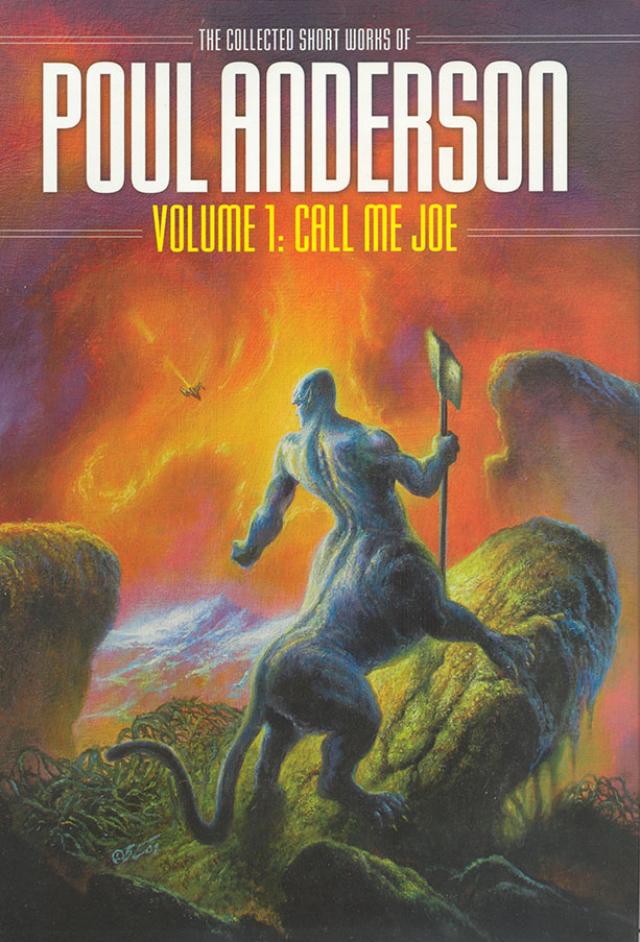
Call me joe, p.25
Call Me Joe,
p.25


She led him into a drab and cluttered parlor. “Won’t you sit down, Mr. Everard? Please don’t talk too loudly. The family are all asleep. They get up early.”
Everard made himself comfortable. Mary perched on the edge of the sofa, watching him with large eyes. He wondered if Wulfnoth and Eadgar were among her ancestors. Yes…undoubtedly they were, after all these centuries. Maybe Schtein was too.
“Are you in the Air Force?” she asked. “Is that how you met Charlie?”
“No. I’m in Intelligence, which is the reason for this mufti. May I ask when you last saw him?”
“Oh, weeks ago. He’s stationed in France just now. I hope this war will soon be over. So silly of them to keep on when they must know they’re finished, isn’t it?” She cocked her head curiously. “But what is this news you have?”
“I’ll come to it in a moment.” He began to ramble as much as he dared, talking of conditions across the Channel. It was strange to sit conversing with a ghost. And his conditioning prevented him from telling the truth. He wanted to, but when he tried his tongue froze up on him.
“…and what it costs to get a bottle of red-ink ordinaire—”
“Please,” she interrupted impatiently. “Would you mind coming to the point? I do have an engagement for tonight.”
“Oh, sorry. Very sorry, I’m sure. You see, it’s this way—”
A knock at the door saved him. “Excuse me,” she murmured, and went out past the blackout drapes to open it. Everard padded after her.
She stepped back with a small shriek. “Charlie!”
Whitcomb pressed her to him, heedless of the blood still wet on his Jutish clothes. Everard came into the hall. The Englishman stared with a kind of horror. “You…”
He snatched for his stunner, but Everard’s was already out. “Don’t be a fool,” said the American. “I’m your friend. I want to help you. What crazy scheme did you have, anyway?”
“I…keep her here…keep her from going to—”
“And do you think they haven’t got means of spotting you?” Everard slipped into Temporal, the only possible language in Mary’s frightened presence. “When I left Mainwethering, he was getting damn suspicious. Unless we do this right, every unit of the Patrol is going to be alerted. The error will be rectified, probably by killing her. You’ll go to exile.”
“I…” Whitcomb gulped. His face was a mask of fear. “You…would you let her go ahead and die?”
“No. But this has to be done more carefully.”
“We’ll escape…find some period away from everything…go back to the dinosaur age, if we must.”
Mary slipped free of him. Her mouth was pulled open, ready to scream. “Shut up!” said Everard to her. “Your life is in danger, and we’re trying to save you. If you don’t trust me, trust Charlie.”
Turning back to the man, he went on in Temporal: “Look, fellow, there isn’t any place or any time you can hide in. Mary Nelson died tonight. That’s history. She wasn’t around in 1947. That’s history. I’ve already got myself in Dutch: the family she was going to visit will be out of their home when the bomb hits it. If you try to run away with her, you’ll be found. It’s pure luck that a Patrol unit hasn’t already arrived.”
Whitcomb fought for steadiness. “Suppose I jump up to 1948 with her. How do you know she hasn’t suddenly reappeared in 1948? Maybe that’s history too.”
“Man, you can’t. Try it. Go on, tell her you’re going to hop her four years into the future.”
Whitcomb groaned. “A giveaway—and I’m conditioned—”
“Yeh. You have barely enough latitude to appear this way before her, but talking to her, you’ll have to lie out of it because you can’t help yourself. Anyway, how would you explain her? If she stays Mary Nelson, she’s a deserter from the W.A.A.F. If she takes another name, where’s her birth certificate, her school record, her ration book, any of those bits of paper these twentieth-century governments worship so devoutly? It’s hopeless, son.”
‘Then what can we do?”
“Face the Patrol and slug it out. Wait here a minute.” There was a cold calm over Everard, no time to be afraid or to wonder at his own behavior.
Returning to the street, he located his hopper and set it to emerge five years in the future, at high noon in Piccadilly Circus. He slapped down the main switch, saw the machine vanish, and went back inside. Mary was in Whitcomb’s arms, shuddering and weeping. The poor, damned babes in the woods!
“Okay.” Everard led them back to the parlor and sat down with his gun ready. “Now we wait some more.”
It didn’t take long. A hopper appeared, with two men in Patrol gray aboard. There were weapons in their hands. Everard cut them down with a low-powered stun beam. “Help me to tie ’em up, Charlie,” he said.
Mary huddled voiceless in a corner.
When the men awoke, Everard stood over them with a bleak smile. “What are we charged with, boys?” he asked in Temporal.
“I think you know,” said one of the prisoners calmly. “The main office had us trace you. Checking up next week, we found that you had evacuated a family scheduled to be bombed. Whitcomb’s record suggested you had then come here, to help him save this woman who was supposed to die tonight. Better let us go or it will be worse for you.”
“I have not changed history,” said Everard. “The Danellians are still up there, aren’t they?”
“Yes, of course, but—”
“How did you know the Enderby family was supposed to die?”
“Their house was struck, and they said they had only left it because—”
“Ah, but the point is they did leave it. That’s written. Now it’s you who wants to change the past.”
“But this woman here—”
“Are you sure there wasn’t a Mary Nelson who, let us say, settled in London in 1850 and died of old age about 1900?”
The lean face grinned. “‘You’re trying hard, aren’t you? It won’t work. You can’t fight the entire Patrol.”
“Can’t I, though? I can leave you here to be found by the Enderbys. I’ve set my hopper to emerge in public at an instant known only to myself. What’s that going to do to history?”
“The Patrol will take corrective measures…as you did back in the fifth century.”
“Perhaps! I can make it a lot easier for them, though, if they’ll hear my appeal. I want a Danellian.”
“What?”
“You heard me,” said Everard. “If necessary, I’ll mount that hopper of yours and ride a million years up. I’ll point out to them personally how much simpler it’ll be if they give us a break.”
That will not be necessary.
Everard spun around with a gasp. The stunner fell from his hand.
He could not look at the shape which blazed before his eyes. There was a dry sobbing in his throat as he backed away.
Your appeal has been considered, said the soundless voice. It was known and weighed ages before you were born. But you were still a necessary link in the chain of time. If you had failed tonight, there would not be mercy.
To us, it was a matter of record that one Charles and Mary Whitcomb lived in Victoria’s England. It was also a matter of record that Mary Nelson died with the family she was visiting in 1944, and that Charles Whitcomb had lived a bachelor and finally been killed on active duty with the Patrol. The discrepancy was noted, and as the smallest paradox is a dangerous weakness in the space-time fabric, it had to be rectified by eliminating one or the other fact from ever having existed. You have decided which it will be.
Everard knew, somewhere in his shaking brain, that the Patrolmen were suddenly free. He knew that his hopper had been…was being…would be snatched invisibly away the instant it materialized. He knew that history now read: W.A.A.F. Mary Nelson missing, presumed killed by bomb near the home of the Enderby family, who had all been at her house when their own was destroyed; Charles Whitcomb disappearing in 1947, presumed accidentally drowned. He knew that Mary was given the truth, conditioned against ever revealing it, and sent back with Charlie to 1850. He knew they would make their middle-class way through life, never feeling quite at home in Victoria’s reign, that Charlie would often have wistful thoughts of what he had been in the Patrol…and then turn to his wife and children and decide it had not been such a great sacrifice after all.
That much he knew, and then the Danellian was gone. As the whirling darkness in his head subsided and he looked with clearing eyes at the two Patrolmen, he did not know what his own destiny was.
“Come on,” said the first man. “Let’s get out of here before somebody wakes up. We’ll give you a lift back your year. 1954, isn’t it?”
“And then what?” asked Everard.
The Patrolman shrugged. Under his casual manner lay the shock which had seized him in the Danellian’s presence. “Report to your sector chief. You’ve shown yourself obviously unfit for steady work”
“So…just cashiered, huh?”
“You needn’t be so dramatic. Did you think this case was the only one of its kind in a million years of Patrol work? There’s a regular procedure for it.
“You’ll want more training, of course. Your type of personality goes best with Unattached status—any age, any place, wherever and whenever you may be needed. I think you’ll like it.”
Everard climbed weakly aboard the hopper. And when he got off again, a decade had passed.
The First Love
by Olaf Haraldsson
From my hill I followed
The faring, when on horseback,
Lightly did the lovely
Let herself be outborne;
And her shiny eyes
Did all my joy bereave me.
Known it is, to no one
Naught of sorrows happen.
Formerly in fairness,
Filled with golden blossoms,
Trees stood green and trembling
Tall above the jarldom.
Soon their leaves grew sallow,
Silently, in Russia.
Only gold now garlands
Ingigerdha’s forehead.
The Double-Dyed Villains
The Premier of Luan was speaking, and over the planet his face glared into telescreens and his voice rang its anger. Before the Administration Building milled a crowd that screamed itself hoarse before the enormously magnified image on the wall, screamed and cheered and surged like a living wave against the tight-held lines of the Palanthian Guard. There was mob violence in the air, a dog would have bristled at the stink of adrenalin and sensed the tension which crackled under the waves of explosive sound. The tautness seemed somehow to be transmitted over the screens, and watchers on the other side of the world raved at the image.
The Premier was young and dynamic and utterly sure of himself. There was steel in his tones, and his hard handsome face was vibrant with a deep inward, strength. He was, thought Wing Alak, quite a superior type.
In spite of being in the capital of the planet, Alak preferred sitting alone in his hotel room and watching the telescreen to joining the mob that yelled its hosannahs in the streets. He sat back with a drink in one hand and a cigarette in the other, physically relaxed as the speech shouted at him:
“…not only a matter of material gain, but of sacred Luanian honor. Lhing was ours, ours by right of our own blood and sweat and treasure, and the incredible betrayal of the League in giving it to Marhal as a political bribe shall not be permitted to succeed. We will fight for our rights and honor—if need be, we will fight the Patrol itself—fight and win!”
The cheers rose fifty stories to rattle the windows of Alak’s room. Overhead rushed a squadron of navy speedsters, their gravitic drives noiseless but the thunder of cloven air rolling in their wake, and each of them carried bombs which could wipe out a city. Alak’s thoughts turned to a more potent menace, the monster cruisers and battleships orbiting about Luan—yes, the situation was getting out of hand. He wondered, suddenly and grimly, if it might not have gone too far to be remedied.
“…we will not fight alone. The whole Galaxy waits only one bold leader to rise and throw off the yoke of the League. For four hundred years we have groaned under the most corrupt and cynical tyranny ever to rise in all man’s tortured history. The League government remains in power only by such an unbelievable network of intrigue, bribery, threat, terror, betrayal, and appeal to all the worst elements of society that the like has never before been imagined. This is not mere oratory, people of Luan, it is sober truth which we have slowly and painfully learned over generations. Your government has carefully compiled a list of corrupt and terroristic acts of the Patrol which include every violation of every moral law existing on every planet in the universe, and each of these accusations has been verified in every detail. The Marhalian thievery is a minor matter in that list—but Luan has had enough!”
Wing Alak puffed on his cigarette in nervous breaths. It was, he reflected bleakly, not exaggerated more than political oratory required, and the anger of Luan’s Tranis Voal had its counterpart on more planets than he cared to think about.
The speech paused for cheers, and the door chime sounded in Alak’s room. He turned in his seat, scowling, to face the viewplate. It showed him a hard, unfamiliar face, and his hand stole toward his tunic pocket. Then he thought: No, you fool! Force is the most useless possible course—here!
He rose, pressing the admittance button, and he felt his spine crawl as four men entered. They were obviously secret agents—only what did police want with a harmless commercial traveler from Maxlan IV?
“Wing Alak of Sol III,” declared one of the men, “you are under arrest for conspiracy against the state.”
“There…must be some mistake.” Alak licked his lips with just the right amount of nervousness, but his stomach was turning over with the magnitude of this catastrophe. “I am Gol Duhonitar of Maxlan IV—here, my papers.”
The detective took them and put them in a pocket. “Forged identity papers are important evidence,” he said tonelessly.
“I tell you, they’re genuine, you can see the Patrol stamp and the League secretary for Maxlan has his signature—”
“Sure. Doesn’t prove a thing. Search him, Gammal.”
Voal’s voice roared from the telescreen: “As of today, Luan has officially seceded from the Galactic League and war has been declared on Marhal. And let the Patrol’s criminals dare try to stop us!”
* * *
Thokan looked across the table at his visitor, and then back at the notes heaped before him. “Just what does this mean?” he asked slowly.
The newcomer, a Sirian like himself, shrugged. “Let’s not waste time,” he said. “You want to win the coming system-wide election. Here are fifty thousand League credits, good anywhere in the civilized Galaxy, as a retainer. There are a million more waiting if you lose.”
Thokan half rose, then settled back. His tendrils hung limply. “Lose?” he whispered.
“Yes. We don’t want you as Director of this system. But we have nothing against you personally, and would rather pay you to conduct a losing campaign than spend even more money corrupting the electorate and otherwise fighting you. If you really try, you can win an honest election. But we are determined that Ruhoc shall continue as Director, and, to put it melodramatically, we will stop at nothing to insure your defeat.”
Strickenly, Thokan looked into the visitor’s bleak eyes: “But you said you were from the Patrol!”
“I am.”
“The Patrol—” Thokan’s voice rose. “But Cosmos! The Patrol is the law-enforcement agency of the League!”
“That’s right. And, friend, you don’t know what a really dirty campaign is like till you’ve seen the Patrol in action. However, we don’t want to ruin your reputation and your private business and the honesty of a lot of officials connected with elections. We would much prefer simply to pay you to stop campaigning so effectively.”
“But—Oh, no—But why?”
“You are an honest being, too honest and too set in your views—including a belief in the League constitution’s clause that the Patrol should stay out of local politics—for us. Ruhoc is a scoundrel, yes, but he is open to suggestions if they are, shall I say, subsidized. Also, under him the present corruption and hopeless inefficiency of the Sirian military forces will continue.”
“I know—it’s one of the major points in my campaign—Cosmos, you race-traitor, do you want the Centaurians simply to come in and take us over?” Thokan snarled into the Patrolman’s impassive face. “Have they bribed the Patrol? Do they really run the League? You incredible villain, I—”
“You have your choice.” The voice was pitiless. “Think it over. My orders are simply to spend what is necessary to win Ruhoc the election. How I spend it is a matter of indifference to me.”
* * *
As the policeman approached him, Alak drew a deep breath and let one hand, hanging by his side, squeeze the bulb in that tunic pocket. The situation was suddenly desperate, and his act was of ultimate emergency.
The sphere of brain-stunning supersonic vibrations emitted by the bulb was so heterodyned that most of Alak’s body, including his head, was not affected. But otherwise it had a range of some meters, and the detective dropped as if poleaxed. They’d be out for some minutes, but there was no time to lose, not an instant of the fleeing seconds. Alak grabbed his cloak, reversing it to show a dark blue color quite unlike the gray he had been seen wearing. He put its cowl over his red hair, shading his thin sharp features, and went out the door. The change should help some when his description was broadcast. It had better help, he thought grimly. He was the only Patrolman on a planet that had just proclaimed its intentions of killing Patrolmen on sight.
Hurry, hurry!
He went down the nearest gravity shaft and out the lobby into the street. Voal’s speech had just ended, and the crowds were howling themselves hoarse. Alak mingled with them. Luan having been colonized largely by Baltravians, who in turn were descendants of Terrestrials, he was physically inconspicuous, but his Solarian accent was not healthy at the moment. Sol was notoriously the instigator and leader of the Galactic League.