Call me joe, p.61
Call Me Joe,
p.61


“You may be right,” said Arsfel. His tone was disconcertingly like that with which an adult comforts a child by a white lie.
“Le’s go!” snarled Belgotai.
* * *
In 26,000 the forests still stood and the pyramid had become a high hill where trees nodded and rustled in the wind.
In 27,000 a small village of wood and stone houses stood among smiling grain fields.
In 28,000 men were tearing down the pyramid, quarrying it for stone. But its huge bulk was not gone before 30,000 a.d., and a small city had been built from it.
Minutes ago, thought Saunders grayly, they had been talking to Lord Arsfel of Astracyr, and now he was five thousand years in his grave.
In 31,000 they materialized on one of the broad lawns that reached between the towers of a high and proud city. Aircraft swarmed overhead and a spaceship, small beside Arsfel’s but nonetheless impressive, was standing nearby.
“Looks like de Empire’s got heah,” said Belgotai.
“I don’t know,” said Saunders. “But it looks peaceful, anyway. Let’s go out and talk to people.”
They were received by tall, stately women in white robes of classic lines. It seemed that the Matriarchy now ruled Sol, and would they please conduct themselves as befitted the inferior sex? No, the Empire hadn’t ever gotten out here; Sol paid tribute, and there was an Imperial legate at Sirius, but the actual boundaries of Galactic culture hadn’t changed for the past three millennia. Solar civilization was strictly home-grown and obviously superior to the alien influence of the Vro-Hi.
No, nothing was known about time theory. Their visit had been welcome and all that, but now would they please go on? They didn’t fit in with the neatly regulated culture of Terra.
“I don’t like it,” said Saunders as they walked back toward the machine. “Arsfel swore the Imperium would keep expanding its actual as well as its nominal sphere of influence. But it’s gone static now. Why?”
“Ih tink,” said Belgotai, “dat spite of all his fancy mathematics, yuh were right. Nawthing lasts forever.”
“But—my God!”
Chapter 4
End of Empire
34,000 a.d. The Matriarchy was gone. The city was a tumbled heap of fire-blackened rocks. Skeletons lay in the ruins.
“The barbarians are moving again,” said Saunders bleakly. “They weren’t here so very long ago; these bones are still fresh, and they’ve got a long ways to go to dead center. An empire like this one will be many thousands of years in dying. But it’s doomed already.”
“What’ll we do?” asked Belgotai.
“Go on,” said Saunders tonelessly. “What else can we do?”
35,000 a.d. A peasant hut stood under huge old trees. Here and there a broken column stuck out of the earth, remnant of the city. A bearded man in coarsely woven garments fled wildly with his woman and brood of children as the machine appeared.
36,000 a.d. There was a village again, with a battered old spaceship standing hard by. There were half a dozen different races, including man, moving about, working on the construction of some enigmatic machine. They were dressed in plain, shabby clothes, with guns at their sides and the hard look of warriors in their eyes. But they didn’t treat the new arrivals too badly.
Their chief was a young man in the cape and helmet of an officer of the Empire. But his outfit was at least a century old, and he was simply head of a small troop which had been hired from among the barbarian hordes to protect this part of Terra. Oddly, he insisted he was a loyal vassal of the Emperor.
The Empire! It was still a remote glory, out there among the stars. Slowly it waned, slowly the barbarians encroached while corruption and civil war tore it apart from the inside, but it was still the pathetic, futile hope of intelligent beings throughout the Galaxy. Some day it would be restored. Some day civilization would return to the darkness of the outer worlds, greater and more splendid than ever. Men dared not believe otherwise.
“But we’ve got a job right here,” shrugged the chief. “Tautho of Sirius will be on Sol’s necks soon. I doubt if we can stand him off for long.”
“And what’ll yuh do den?” challenged Belgotai.
The young-old face twisted in a bitter smile. “Die, of course. What else is there to do—these days?”
They stayed overnight with the troopers. Belgotai had fun swapping lies about warlike exploits, but in the morning he decided to go on with Saunders. The age was violent enough, but its hopelessness daunted even his tough soul.
Saunders looked haggardly at the control panel. “We’ve got to go a long ways ahead,” he said. “A hell of a long ways.”
50,000 a.d. They flashed out of the time drive and opened the door. A raw wind caught at them, driving thin sheets of snow before it. The sky hung low and gray over a landscape of high rocky hills where pine trees stood gloomily between naked crags. There was ice on the river that murmured darkly out of the woods.
Geology didn’t work that fast; even fourteen thousand years wasn’t a very long time to the slowly changing planets. It must have been the work of intelligent beings, ravaging and scoring the world with senseless wars of unbelievable forces.
A gray stone mass dominated the landscape. It stood enormous a few miles off, its black walls sprawling over incredible acres, its massive crenellated towers reaching gauntly into the sky. And it lay half in ruin, torn and tumbled stone distorted by energies that once made rock run molten, blurred by uncounted millennia of weather—old.
“Dead,” Saunders voice was thin under the hooting wind. “All dead.”
“No!” Belgotai’s slant eyes squinted against the flying snow. “No, Mahtin, Ih tink Ih see a banner flying.”
The wind blew bitterly around them, searing them with its chill. “Shall we go on?” asked Saunders dully.
“Best we go find out wha’s happened,” said Belgotai. “Dey can do no worse dan kill us, and Ih begin to tink dat’s not so bad.”
Saunders put on all the clothes he could find and took the psychophone in one chilled hand. Belgotai wrapped his cloak tightly about him. They started toward the gray edifice.
The wind blew and blew. Snow hissed around them, covering the tough gray-green vegetation that hugged the stony ground. Summer on Earth, 50,000 a.d.
As they neared the structure, its monster size grew on them. Some of the towers which still stood must be almost half a mile high, thought Saunders dizzily. But it had a grim, barbaric look; no civilized race had ever built such a fortress.
Two small, swift shapes darted into the air from that cliff-like wall. “Aircraft,” said Belgotai laconically. The wind ripped the word from his mouth.
They were ovoidal, without external controls or windows, apparently running on the gravitic forces which had long ago been tamed. One of them hovered overhead, covering the travelers, while the other dropped to the ground. As it landed, Saunders saw that it was old and worn and scarred. But there was a faded sunburst on its side. Some memory of the Empire must still be alive.
Two came out of the little vessel and approached the travelers with guns in their hands. One was human, a tall well-built young man with shoulder-length black hair blowing under a tarnished helmet, a patched purple coat streaming from his cuirassed shoulders, a faded leather kilt and buskins. The other…
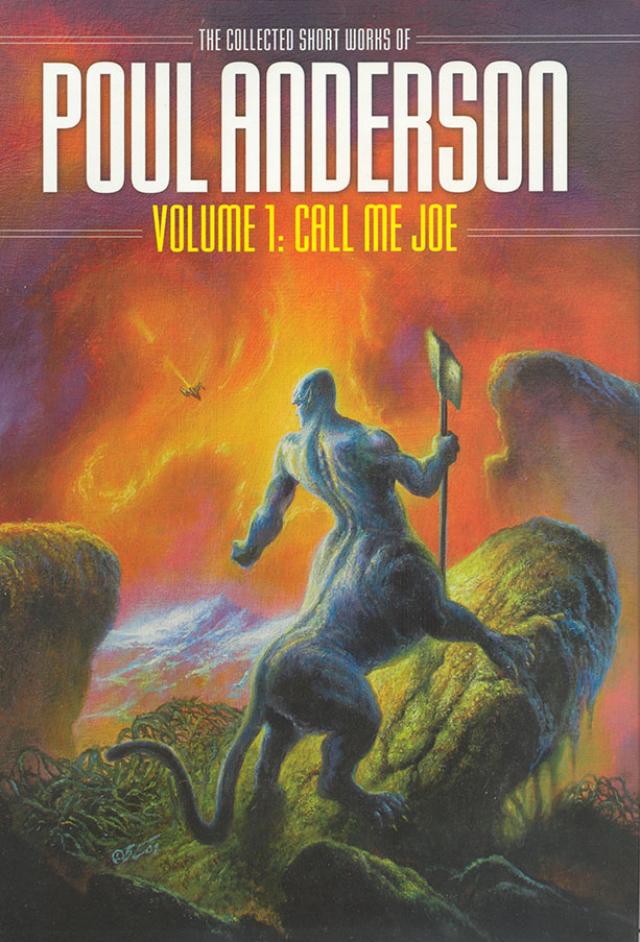
He was a little shorter than the man, but immensely broad of chest and limb. Four muscled arms grew from the massive shoulders, and a tufted tail lashed against his clawed feet. His head was big, broad-skulled, with a round half animal face and cat-like whiskers about the fanged mouth and the split-pupilled yellow eyes. He wore no clothes except a leather harness but soft blue-gray fur covered the whole great body.
The psychophone clattered out the man’s hail: “Who comes?”
“Friends,” said Saunders. “We wish only shelter and a little information.”
“Where are you from?” There was a harsh, peremptory note in the man’s voice. His face-straight, thin-boned, the countenance of a highly bred aristocrat—was gaunt with strain. “What do you want? What sort of spaceship is that you’ve got down there?”
“Easy, Vargor,” rumbled the alien’s bass. “That’s no spaceship, you can see that.”
“No,” said Saunders. “It’s a time projector.”
“Time travelers!” Vargor’s intense blue eyes widened. “I heard of such things once, but—time travelers!” Suddenly: “When are you from? Can you help us?”
“We’re from very long ago,” said Saunders pityingly. “And I’m afraid we’re alone and helpless.”
Vargor’s erect carriage sagged a little. He looked away. But the other being stepped forward with an eagerness in him. “How far back?” he asked. “Where are you going?”
“We’re going to hell, most likely. But can you get us inside? We’re freezing.”
“Of course. Come with us. You’ll not take it amiss if I send a squad to inspect your machine? We have to be careful, you know.”
The four squeezed into the aircraft and it lifted with a groan of ancient engines. Vargor gestured at the fortress ahead and his tone was a little wild. “Welcome to the hold of Brontothor! Welcome to the Galactic Empire!”
“The Empire?”
“Aye, this is the Empire, or what’s left of it. A haunted fortress on a frozen ghost world, last fragment of the old Imperium and still trying to pretend that the Galaxy is not dying—that it didn’t die millennia ago, that there is something left besides wild beasts howling among the ruins.” Vargor’s throat caught in a dry sob. “Welcome!”
The alien laid a huge hand on the man’s shoulder. “Don’t get hysterical, Vargor,” he reproved gently. “As long as brave beings hope, the Empire is still alive—whatever they say.”
He looked over his shoulder at the others.
“You really are welcome,” he said. “It’s a hard and dreary life we lead here. Taury and the Dreamer will both welcome you gladly.” He paused. Then, unsurely, “But best you don’t say too much about the ancient time, if you’ve really seen it. We can’t bear too sharp a reminder, you know.”
The machine slipped down beyond the wall, over a gigantic flagged courtyard to the monster bulk of the—the donjon, Saunders supposed one could call it. It rose up in several tiers, with pathetic little gardens on the terraces, toward a dome of clear plastic.
The walls, he saw, were immensely thick, with weapons mounted on them which he could see clearly through the drifting snow. Behind the donjon stood several long, barracks-like buildings, and a couple of spaceships which must have been held together by pure faith rested near what looked like an arsenal. There were guards on duty, helmeted men with energy rifles, their cloaks wrapped tightly against the wind, and other folk scurried around under the monstrous walls, men and women and children.
“There’s Taury,” said the alien, pointing to a small group clustered on one of the terraces. “We may as well land right there.” His wide mouth opened in an alarming smile. “And forgive me for not introducing myself before. I’m Hunda of Haamigur, general of the Imperial armies, and this is Vargor Alfri, prince of the Empire.”
“Yuh crazy?” blurted Belgotai. “What Empire ?”
Hunda shrugged. “It’s a harmless game, isn’t it? At that, you know, we are the Empire—legally. Taury is a direct descendant of Maurco the Doomer, last Emperor to be anointed according to the proper forms. Of course, that was five thousand years ago, and Maurco had only three systems left then, but the law is clear. These hundred or more barbarian pretenders, human and otherwise, haven’t the shadow of a real claim to the title.”
The vessel grounded and they stepped out. The others waited for them to come up. There were half a dozen old men, their long beards blowing wildly in the gale, there was a being with the face of a long-beaked bird and one that had the shape of a centauroid.
“The Court of the Empress Taury,” said Bunda.
“Welcome.” The answer was low and gracious.
Saunders and Belgotai stared dumbly at her. She was tall, tall as a man, but under her tunic of silver links and her furred cloak she was such a woman as they had dreamed of without ever knowing in life. Her proudly lifted head had something of Vargor’s looks, the same clean-lined, high-cheeked face, but it was the countenance of a woman, from the broad clear brow to the wide, wondrously chiseled mouth and the strong chin. The cold had flushed the lovely pale planes of her cheeks. Her heavy bronze-red hair was braided about her helmet, with one rebellious lock tumbling softly toward the level, dark brows. Her eyes, huge and oblique and gray as northern seas, were serene on them.
Saunders found tongue. “Thank you, your majesty,” he said in a firm voice.
“If it please you, I am Martin Saunders of America, some forty-eight thousand years in the past, and my companion is Belgotai, free companion from Syrtis about a thousand years later. We are at your service for what little we may be able to do.”
She inclined her stately head, and her sudden smile was warm and human. “It is a rare pleasure,” she said. “Come inside, please. And forget the formality. Tonight let us simply be alive.”
* * *
They sat in what had been a small council chamber. The great hall was too huge and empty, a cavern of darkness and rustling relics of greatness, hollow with too many memories. But the lesser room had been made livable, hung with tapestries and carpeted with skins. Fluorotubes cast a white light over it, and a fire crackled cheerfully in the hearth. Had it not been for the wind against the windows, they might have forgotten where they were.
“—and you can never go back?” Taury’s voice was sober. “You can never get home again?”
“I don’t think so,” said Saunders. “From our story, it doesn’t look that way, does it?”
“No,” said Hunda. “You’d better settle down in some time and make the best of matters.”
“Why not with us?” asked Vargor eagerly.
“We’d welcome you with all our hearts,” said Taury, “but I cannot honestly advise you to stay. These are evil times.”
It was a harsh language they spoke, a ringing metallic tongue brought in by the barbarians. But from her throat, Saunders thought, it was utter music.
“We’ll at least stay a few days,” he said impulsively. “It’s barely possible we can do something.”
“I doubt that,” said Hunda practically. “We’ve retrogressed, yes. For instance, the principle of the time projector was lost long ago. But still, there’s a lot of technology left which was far beyond your own times.”
“I know,” said Saunders defensively. “But—well, frankly—we haven’t fitted in any other time, as well.”
“Will there ever be a decent age again?” asked one of the old courtiers bitterly.
The avian from Klakkahar turned his eyes on Saunders. “It wouldn’t be cowardice for you to leave a lost cause which you couldn’t possibly aid,” he said in his thin, accented tones. “When the Anvardi come, I think we will all die.”
“What is de tale of de Dreamer?” asked Belgotai. “You’ve mentioned some such.”
It was like a sudden darkness in the room. There was silence, under the whistling wind, and men sat wrapped in their own cheerless thoughts. Finally Taury spoke.
“He is the last of the Vro-Hi, counselors of the Empire. That one still lives—the Dreamer. But there can never really be another Empire, at least not on the pattern of the old one. No other race is intelligent enough to coordinate it.”
Hunda shook his big head, puzzled. “The Dreamer once told me that might be for the best,” he said. “But he wouldn’t explain.”
“How did you happen to come here—to Earth, of all planets?” Saunders asked.
Taury smiled with a certain grim humor. “The last few generations have been one of the Imperium’s less fortunate periods,” she said. “In short, the most the Emperor ever commanded was a small fleet. My father had even that shot away from him. He fled with three ships, out toward the Periphery. It occurred to him that Sol was worth trying as a refuge.”
The Solar System had been cruelly scarred in the dark ages. The great engineering works which had made the other planets habitable were ruined, and Earth herself had been laid waste. There had been a weapon used which consumed atmospheric carbon dioxide. Saunders, remembering the explanation for the Ice Ages offered by geologists of his own time, nodded in dark understanding. Only a few starveling savages lived on the planet now, and indeed the whole Sirius Sector was so desolated that no conqueror thought it worth bothering with.
It had pleased the Emperor to make his race’s ancient home the capital of the Galaxy. He had moved into the ruined fortress of Brontothor, built some seven thousand years ago by the nonhuman Grimmani and blasted out of action a millennium later. Renovation of parts of it, installation of weapons and defensive works, institution of agriculture…“Why, he had suddenly acquired a whole planetary system!” said Taury with a half-sad little smile.
* * *
She took them down into the underground levels the next day to see the Dreamer. Vargor went along too, walking close beside her, but Hunda stayed topside; he was busy supervising the construction of additional energy screen generators.
They went through immense vaulted caverns hewed out of the rock, dank tunnels of silence where their footfalls echoed weirdly and shadows flitted beyond the dull glow of fluorospheres. Now and then they passed a looming monstrous bulk, the corroded hulk of some old machine. The night and loneliness weighed heavily on them, they huddled together and did not speak for fear of rousing the jeering echoes.
“There were slideways here once,” remarked Taury as they started, “but we haven’t gotten around to installing new ones. There’s too much else to do.”
Too much else—a civilization to rebuild, with these few broken remnants. How can they dare even to keep trying in the face of the angry gods? What sort of courage is it they have?