Mathews tale, p.13
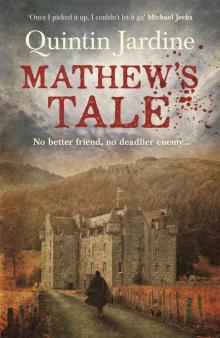
Mathew's Tale,
p.13


‘Ready for it, aye, sir. Whether I’ll be ony good at it, that’s another matter. What would you have me do?’
‘When you worked for the Clelands, did you ever drive them to Edinburgh?’
Beattie shook his head. ‘Not the twins, no. Their faither I did, old Sir George, once or twice.’
‘When you did, where did you take him? Did he have a town house?’
‘He had small one, yes, in a street in the centre of the city; it was in a terrace, not in its own grounds, but with a lane behind for stabling. MacPherson, the old man who was head coachman afore me, said that when Lady Cleland was alive it was used often, but that after she died, Sir George had little interest in it.’
‘But perhaps his sons had. I want you to find out if Gavin is there. Discreetly, mind; he need not discover our interest in him until he has to.’
Beattie smiled. ‘I will do my best not to be noticed, sir.’
Mathew chuckled. ‘Your best is all you can do, Ewan. I acknowledge that you were not built to be easily forgotten.’ The coachman was three inches shorter than Mathew, but much broader built, with legs like small tree trunks.
‘If I took my beard off, sir?’ he suggested.
‘Maybe that will not be necessary; to a man like Gavin Cleland, a servant’s face is not one to be recalled.’ The chuckle evolved into a gentle laugh. ‘Given your respective positions on the coach he might well recognise your arse, but the other end will be much less familiar.’
Beside him at the table, on his blind side, Matt did not join in the laughter. ‘Can I go looking for him?’ he asked, but there was no humour on his face, or in his voice.
‘You will not,’ Mathew replied. ‘Make no mistake, your father is in a bad situation, and you must do nothing to worsen it. You are in my care, and like it or not, boy, you are under my orders. Your father knows that and because of it he is content. You will see Cleland, but only in court.’
He pushed his plate away from him and rose to his feet. ‘To that end, let us go. Ewan, I have no idea how long we will be; when you are done, go to the hotel salon and wait for us if necessary.’
‘Where are we going?’ young Matt asked, as the pair stepped out into Waterloo Place. ‘To see my father?’ he added hopefully.
‘Not yet. When we do that I want to have news to give him.’ In truth, Mathew wanted to delay the boy’s visit to the jail for as long as possible, to give David’s battered face time to heal. ‘We are going in search of a solicitor, whose name I was given by Sheriff Stirling.’
‘Will he speak for my father in court?’
‘No,’ Mathew replied. ‘That must be done by counsel, that is, by an advocate. The solicitor prepares the case for his client, and counsel presents it.’
‘Who is this man, this soli . . . ?’
‘Solicitor. His name is Paul Johnston and he has chambers in Hanover Street; that, I am told, is not far from here.’
In fact it was less than half a mile, past Register House, then along Princes Street. The turn into Hanover Street was opposite the Royal Scottish Academy building, another Athenian design by the architect Playfair. It struck Mathew as vaguely similar to what the National Monument might have been, although on a smaller scale.
They had no time to admire it; Stirling had warned that after nine thirty the solicitor would probably have left for court, and Mathew’s pocket watch showed twenty past. Happily they did not have much further to walk. The pavement rose up towards George Street, where a statue of the recently deceased monarch after whom it had been named looked up at Edinburgh Castle. A few yards short of that Mathew spotted a brass plate with the engraving, ‘Mr Paul Johnston, Solicitor’.
‘This is our man,’ he told his companion, then climbed the stone steps that led to the door on which the sign was mounted.
There was a knocker. He rapped three times, and waited.
After a minute or so, the door was opened, and a man stood. He was blinking furiously, either at the disturbance or at the sunlight, they could not be sure. His age could have been anywhere between thirty and forty. He was cadaverous in appearance with a bald head, hollow cheeks, and spectacles perched on the bridge of his nose. He wore a royal blue jacket, with noticeably frayed cuffs, and he held a top hat in his left hand.
‘This is not convenient,’ he stammered, agitated. ‘You catch me on the point of leaving for Parliament Hall. You must make an appointment. I can see you tomorrow, if you wish.’
‘Our situation is more urgent than that, Mr Johnston,’ Mathew said. ‘You are Mr Johnston, I take it.’
‘Yes, yes. In the Supreme Courts, sir, everyone’s situation is always urgent. Tomorrow, I say.’
Mathew smiled. ‘If you do not reach the court by ten o’clock, will someone die?’ he asked.
The question provoked another bout of furious blinking. ‘No,’ Johnston conceded.
‘Will an innocent man be put on a ship for Botany Bay?’
‘No.’
‘If you are a few minutes late, will anyone actually notice?’
‘I am always there for ten o’clock, sir.’
‘Then please break the habit of a lifetime, Mr Johnston, if not for us, then for my friend Sheriff Robin Stirling.’
The lawyer’s countenance changed in an instant. A surprised smile replaced the agitated frown; his spectacles fell from his nose but he caught them in his right hand.
‘Sheriff Stirling?’ he repeated. ‘Why did you not say so?’
‘There was barely an opportunity until now. My name is Mathew Fleming, of Waterloo House, Lanarkshire, and my young friend here is Matt McGill. We are in need of a lawyer and this is a capital matter. When I asked Robin for a recommendation, yours was the first name to pass his lips . . . although he did say that I might have to pour a bucket of water down your trousers to get your attention.’
‘My old university tutor knows me too well,’ Johnston agreed. ‘I am sorry for my abruptness. Very few clients seek me out in my chambers; I am usually approached in Parliament Hall itself. Come inside and tell me about your predicament.’
He led them into a hallway, then into the first room on the right. It had two tables, one set against a window that looked out on to the busy street, the other against the opposite wall.
‘Some people like to be seen with me,’ he explained, ‘others prefer discretion.’
‘Then let us be visible,’ Mathew declared. ‘I want everyone in Edinburgh to know my business.’
‘And what is that?’
‘My good friend, Matt’s father, is facing trial for his life. The evidence against him is a farrago of wicked lies dreamed up to cover the guilt of another man, his principal accuser.’
‘But are all the liars telling the same story?’
‘Yes, they are.’
‘Then let me hear their side and then yours, and I will see what is to be done.’
Chapter Twenty-One
EWAN BEATTIE COULD NOT remember when last he had been so unexpectedly pleased. His master had entrusted him with a task that had nothing to do either with horses or with their equipment, and that was a rare occurrence in his world.
Yes, the evening before he had been asked to look after the boy, but as a coachman it was a daily occurrence for him to have people in his care.
He only had one problem as he set out on his mission. He had forgotten the name of the street in which the Cleland town house was located, if he had ever known it. Ten years had gone by since he had taken old Sir George there, on the occasion of a visit to Edinburgh by the late King. On that arrival, as on every other, the Laird had simply given him instructions as he had neared their destination, ‘Left ahead’, or ‘Turn right here, Beattie’, until they had reached their destination, and then he had always directed him to the stables and small yard at the rear. Unusually for a gentleman, the old fellow had never been too haughty to use the servants’ entrance.
The only clue that Ewan could recall for certain was the number nineteen, displayed in iron letters on the gatepost as he drove in. Whatever the street might be, he knew that number, even if he had never actually seen the frontage of the building. Of one thing also he was sure. If the Cleland twins had arrived in their own coach, its driver would know the main entrance, for that pair would use no other.
When he set out from the hotel he was instantly and completely lost. He had no bearings, as he was to the east of Princes Street at the outer limits of what they called the New Town, whereas invariably he had arrived from the west.
The only solution, he decided, was to walk the length of Princes Street, then down Maitland Street, if necessary, before turning on his heel and trying to recreate those earlier journeys from memory.
As soon as he set out, he experienced a strange feeling, one of being shut in by the tall buildings on either side of him. On his coach, he was impervious to anything, but alone and on foot, that was a great difference. Once he passed into Princes Street, open on one side as it was, that trepidation passed . . . only to be replaced by another.
On his earlier visits to Edinburgh, he had remained in the house, at Sir George’s pleasure, never venturing out other than in the coach, and even that had been a rare circumstance. Thus he had never been conscious of the number of people in the streets, far more than he had ever seen gathered in one place. In Princes Street, as he headed west, an army hundreds strong seemed to be marching in the other direction, all of them in a mighty hurry and expecting him to step out of the way. That he did not do; as a result more than one man bounced off him, throwing him fierce looks that faded invariably as they realised how solid he was.
Before long he crossed to the other side, where the gardens were, and where the oncomers were fewer in number. As he walked, he looked for clues, familiar turnings on the other side of the road, seeing none until he reached St John’s Church.
‘There, I think,’ he murmured, and crossed the street, mindful of the carriages, aware that if a coachman was run over he would never hear the end of it.
He had gone more than half a mile before the descent towards the Water of Leith told him he was heading out of the city. Damning his memory, he retraced his steps, and realised that he had made only a small mistake. He turned instead into Charlotte Square . . . ‘Left here, Beattie’ . . . and crossed it, before turning into Albyn Place . . . ‘Right here, man, and gentle on the cobbles’ . . . and soon he was on familiar ground, as Albyn Place became Queen Street.
Past the gardens on the north side of the street and then . . . ‘Left here, Beattie.’
The coachman needed no further prompting; his sense of direction was fully in place, and his equilibrium restored. Just before he made the turn into Duke Street, he looked up and saw Calton Hill, realising that he had come almost full circle and had travelled four times as far as had been necessary.
As the road sloped away from him he remembered reining in the horses, and almost automatically glanced to his right, and saw the entrance to the lane. He crossed the street and ventured along the passageway; sure enough, he had not gone far before he came to a familiar gatepost, bearing the number nineteen. Looking beyond, he saw the door that led into the basement of the house, and above, well above, the rear attic room that had been his on his brief stays with the old Laird.
Beattie ventured no further. Instead he returned to Duke Street and walked down to the next junction, to check the name of the thoroughfare: Albany Street; the Cleland town house was number nineteen Albany Street.
On the corner, on the northern side, there was a small shop, a milliner. Beattie was standing by it when he saw a small carriage approaching from the other end of the street. As he looked he saw the driver haul on the reins, bringing the vehicle to a halt, not far from where he stood. Instinctively he looked into the shop window, then after a few seconds ventured a quick glance.
The horse was turning in the full width of the empty street. A man had climbed down from the conveyance and stood on the pavement, reaching into a pocket as if for a key.
Beattie’s eyes were keen, he knew who he was looking at; even from that distance he could see that the new arrival was dishevelled, crumpled and blue-chinned, and that beyond question it was Sir Gavin Cleland.
Chapter Twenty-Two
‘WELL?’ MATHEW ASKED, WHEN Matt had finished his story. ‘What do you think of it?’
‘What did Sheriff Stirling think?’ Johnston countered. ‘After all, it is he who has committed Mr McGill for trial.’
‘Yes, but he only heard one side of the story, the false allegation.’
‘Mr Fleming, that is all the Sheriff is required to hear at this stage. The accused is only able to defend himself once the indictment is laid.’
‘All I can tell you is that Robin did not think the boy a liar when he heard him.’
‘No,’ the lawyer said, firmly, ‘and neither did I. Unfortunately I will not be on the jury and nor will I be on the Bench.’
‘What does the Bench have to do with it? Surely the judge is bound to try the case impartially, without showing favour to either side.’
‘Surely he is. Have you ever heard of Lord Braxfield?’
‘Of course I have,’ Mathew replied. ‘He was a Lanarkshire man.’
‘No doubt, but he was a Crown man first and foremost. Happily, Lord Cooper, the present Lord Justice General, sets a different example. However it is less than likely that he will take the trial; I hear he is ill.’
Johnston looked, earnestly, over the top of his spectacles. ‘I am the most intrigued,’ he murmured, ‘by what you say of the interest of the Lord Advocate in this case. Sir Gregor Cleland was a minor landowner, a baronet rather than a baron. It may be that the murder of any titled gentleman inflames him, but even so, he has been unusually expeditious in this case.’
He raised his arms above his head, his fingers interlocked. ‘The ways of the Crown Office are often a mystery to me, but I am only a humble solicitor. We will have to see what counsel thinks. Before we do that we must retain one, the best available.’ He glanced at Mathew. ‘How deep is your pocket, Mr Deputy Lieutenant?
‘Deep enough for this purpose.’
‘Then let us walk up the hill to Parliament House and see who is for hire.’
The solicitor ushered them out of his office, leading the way back to Princes Street, and then across it, along the side of the Royal Academy Building, and up the steep hill that led first to the Bank of Scotland and then on to St Giles Cathedral. The roadway was macadamised rather than cobbled, and their guide told them that it was known as The Mound.
By the time they reached the top, Johnston’s breath was rasping in his chest and his face was flushed. Mathew wondered if the man was a consumptive.
‘Do you make that climb every day?’ he asked.
‘With difficulty,’ the lawyer replied. ‘I had a touch of pleurisy a month ago. The physician said I should recuperate for longer, but I could not. People depend on me and if I am not there, well, some might go unrepresented or, worse, be represented by the wrong sort. There are charlatans here, sir.’
‘Then guide us well. Where is Parliament Hall?’
‘Follow.’ He led his clients across the courtyard in front of St Giles and past a building so new that its grey stone almost shone. ‘That is the great library,’ he told them, ‘the home of the Writers to the Signet, of which I have the honour to be a member; but it is not where we are going. We are for Parliament House, round the corner.’
The trio walked on until they reached an unprepossessing doorway, with a small, illegible sign at the side. Beyond it lay an entrance porch.
‘The first call I must pay is to the Lord Advocate’s office, to find out where this matter stands. You gentlemen may care to wait in here.’
He threw open a door at the side. ‘This is Parliament Hall; in the days when we had one of those, over a hundred years ago, it sat here. Now it is the home of the Supreme Court. It is not in session at the moment, but when it is,’ he pointed to the right, ‘it sits at the far end there.’
Mathew and Matt looked as he directed, and saw a high mahogany tower, faced by an enclosure with a table between them and rows of seats on either side.
‘I shall not be long,’ Johnston told them. ‘When I am back, we will be in a position to recruit.’
As he left, Mathew looked around the great hall; the end opposite to the court was lit by a huge window, and set into the far wall he saw a stone fireplace, which was unlit. Then he looked up, and gasped. The roof was built entirely of great beams of wood, carved in a series of arches with gold crests, and with its supports fastened into the walls.
‘Is that not a marvel?’ he whispered.
Young Matt shrugged his solid shoulders. ‘It’s a roof,’ he grunted.
They stood by the door for fifteen minutes, watching men in robes and wigs, usually in twos, occasionally in a trio, walking up and down the length of the great hall. They appeared to be conversing, but to what purpose neither of the watchers could tell.
Finally, Paul Johnston returned, carrying a document, bound in ribbon; if anything his cheeks looked even more sunken, and his face even more pale.
‘You have news?’ Mathew asked.
‘Yes,’ he replied, ‘but not good. The indictment against Mr McGill is completed already and it will be put to him on Friday, in the court.’
‘You mean the trial begins this week?’
‘No, not that soon; on Friday he will only be asked how he pleads, guilty or otherwise. That is a formality; he will be committed for trial, and that will begin next Tuesday. I say “begin”, but only a single day has been allocated for it. I have never known the Lord Advocate to proceed so fast. I asked his clerk why it was. He could only tell me that since the evidence is clear-cut and he has a longer trial to follow after, Mr Douglas wants to clear the decks.’
‘Douglas?’
‘James Douglas, KC; he is the Lord Advocate, and the most powerful man in Scots law, save only for the Lord Justice General himself. He leads the prosecution service, but more than that, he is a member of the Westminster Parliament and responsible there for all of our Scottish affairs.’