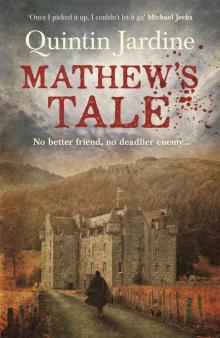
Mathews tale, p.28
Mathew's Tale,
p.28


On balance he had done more good than harm, and won even more powerful allies along the way, but would David have wanted any of it? He doubted it; his peaceful friend would have wanted him to look after Lizzie and leave Cleland to ruin himself as undoubtedly he would have, given time.
He knew then that he would not go to the Lawnmarket in a few weeks’ time to watch a terrified man stand before a festive mob that would cheer every last kick as he danced on the end of the rope. There would be no point, for even if he did, he would only look away and feel guilt at his part in a man’s death, even a man so thoroughly reptilian as the baronet.
He remembered David McGill’s last words, and how the Scottish form of prayer continued: ‘Forgive us our debts as we forgive our debtors.’ That is what his friend would have done, but forgiveness came hard to Mathew Fleming.
Tickling the horse into action, he left Lanark at a much more gentle pace than he had come, and drove back to Carluke, wondering how Lizzie would take the news, and whether he should even tell her, given the possibility that she had raised with him that morning.
As he reached the village, and the shop came into sight, he saw a small group of women outside, gathered in conclave. Unusually, there was a man among them; even from that distance, he had no difficulty in recognising Joel Fisher, the blacksmith. He was never away from his forge during the day, and so the sight of him raised concern and brought a frown to Mathew’s face.
He rapped the horse to speed it up.
‘Why the gathering?’ he asked, as he pulled up beside the group, jumping out of the cabin as he spoke.
The women looked at him, fearfully. ‘It’s Lizzie,’ Fisher said, quietly.
He would have run straight into the shop had not the smith caught his arm. ‘She’s a’ right, Mathew,’ he said. ‘My Beth’s wi’ her. Let me tell you what’s happened first. It was the Laird.’
‘Cleland, what about him? If he has hurt a hair on her head, Joel, so help me God I will disembowel him.’
‘You may no’ be the first.’
‘Tell me, man,’ Mathew hissed, ‘quickly.’
‘It must be twenty minutes, now,’ Fisher said. ‘Beth wis in the shop. Wi’ a few others, when Cleland burst in. He wis drunk, she said, and he wis ravin’, goin’ on about jumped-up rabble takin’ ower his estate, and that they’d die first. Beth said he’d’ve struck her, but young Matt jumped in and hut him first, knocked him richt across the shop flair, and then when he got up, he nutted him.’
The blacksmith imitated the action. ‘That wis enough for Cleland,’ he continued. ‘He scrambled oot the door and on tae his horse, but Matt went after him in that cart o’ his. He’d just been deliverin’, so it was harnessed at the door.
‘The Laird went aff along the Crossford road wi’ the lad followin’. He’ll never catch him though, Mathew. Thon’s a thoroughbred Cleland was on, even tho’ it’s gelded. Ah’ve shod it mony a time. It’s a richt spirited bastard, wi’ a temper too.’
Mathew had calmed down. ‘Thanks, Joel. Twenty minutes you say?’
‘Aye; the chances are the lad’ll be back soon. As for the Laird . . . Whit was he on about, Mathew?’
‘It’s a long story, friend. I’ll tell you later, but first I must see to Lizzie.’
She smiled at him, weakly, as he came into the shop. ‘Joel told me,’ he said.
‘I’m fine, love. I’m not hurt and I am as sound as I was last time you saw me.’ She grinned again. ‘As for that stepson of yours,’ she murmured, ‘you have taught him some bad habits. Go after him, Mathew, and bring him back. Cleland will be halfway to England by now.’
‘He will need to go further than that,’ Mathew told her. ‘The whores have been found, and turned on him. He is bound for the Calton Jail and what happens after that.’ As he spoke he felt renewed enthusiasm for watching Cleland swing. ‘I’ll go for Matt. We dinna want him flogging that pony to death.’
The group outside had dispersed, apart from Joel Fisher, who was waiting for his wife. Mathew thanked him again then climbed back into the small coach and headed up the Crossford road.
Many years had gone by since he had taken it, sixteen, he realised as he cantered out of the village. When he had returned to Carluke from the war, that was the way he had taken. He had chosen it because it was quiet, old Gracie having been a slightly nervous animal, easily startled by passing traffic.
On that rough track, at the copper beech crossing, where it intersected with another route that led ultimately to Ayr, he had met the Cleland twins, and the seed of a grudge had been planted in Gavin’s mind.
He smiled, sadly, at the memory of the two threatening to tie him to the tree the place was named after. ‘Whelps,’ he murmured. ‘Bound for an early death for all their privileges.’
The road was rough and had many rises and dips. As he reached each crest he expected to find Matt returning, having given up a fruitless chase, and yet he did not, not until he reached the top of the hill where the track took a curve and the copper beech came into sight for the first time.
He reached the summit, where the road levelled out, and he saw it, and he saw his stepson . . . and his heart seemed to drop into his stomach.
The great old tree was bare of leaves, but it had borne fruit. Sir Gavin Cleland hung from it by the neck, swinging and twisting in the January wind. Matt stood alongside, holding the reins of his pony, while Cleland’s gelding, in a Netherton saddle, grazed at the roadside.
Mathew lashed his horse, startling it into closing the last hundred and fifty yards at a gallop. If he had any hope of reviving the baronet, it vanished as soon as he saw his blackened, bruised, bleeding face with its dead but still desperate eyes, and its bulging tongue.
‘Oh laddie,’ he cried, as he reached the scene, ‘what in heaven’s name have you done?’
‘What needed doing,’ Matt replied; he sounded exhausted and not entirely convinced by his own words. ‘The dog killed my father, and might have done the same to my mother if I had not been there. What would you have done, Mathew?’
‘I would not have put my own life in jeopardy,’ he retorted, angrily, ‘for something as worthless as this, otherwise I’d have killed him myself, months ago. Tell me what happened.’
‘I was almost ready to give up the chase,’ the young man told him. ‘I told old Meggie here, just one more hill, and if he is not in sight, we turn back. And there he was; his horse must have thrown him, for he lay on the road, quite still. I hoped that he was dead, but when I got close I could hear him breathing, roughly.
‘I knew what I had to do,’ Matt said. ‘I have my old tea chest in the cart, the one I use for delivering orders, and I had the rope I use to bind it securely. I heaved him up from the road. When he came to his senses he was lying on the upturned chest, there was a noose round his neck, and the rope was over the bough above. I pulled it up, drawing him to his feet, and when he was at full stretch I tied it off.’
His eyes narrowed, with his frown. ‘He shouted at first, as if he thought it was a bad joke. When he realised I was serious, that became a plea, then a whimper, and finally a coward’s tears; so unlike my father. I led Meggie on, and left him swinging.’
Mathew closed his eye.
‘It took him a while to die,’ the young man added, quietly. ‘Quite a few minutes went by before he stopped kicking and twitching. I never thought it would be like that, Mathew.’
‘And do you feel the better for it?’ he asked, sharply.
‘No. I thought I would, but no.’
‘Thank God for that, at least. If only you had kept your anger in check, son, and contented yourself with chasing him out of the shop. As of this morning, the law was ready to do this to him, although more humanely. Even now, Andrew Dunlop, the Sheriff’s man, will be on his way to Cleland Hall to arrest him. When he cannot find him, he will come looking.
‘Do you know what I should do?’ he asked, his tone one of despair. ‘As a magistrate I should hold you and take you to the Sheriff myself. No matter what this creature’s crime, this is murder. Even at your age, you are liable to be sent to Australia for life.’
Matt squared his shoulders. ‘Then so be it.’
‘No it will not,’ Mathew snapped. ‘Your mother will not have that to endure. Listen, I was never here, and neither were you. Old Meggie never did crest that hill and I met you further back along the road. We will leave Cleland here with his horse. Dunlop will find him, and with any luck he will report that, having seen no way out of his troubles, and knowing his lying whore witnesses would one day be found, he chose to end his own life, using his mount as a platform.’ He nodded, to himself. ‘Yes, that will be his assumption and he will look no further. The Sheriff’s verdict will be suicide.’
Barely a second later his satisfaction vanished as an old memory came back to him.
‘Unless,’ he exclaimed, ‘Dunlop asks himself one question. “Where did Cleland get the rope?” If he does . . .’ His voice trailed off, but his meaning did not need speaking aloud.
‘Matt, I believe in the law, but I love your mother more, and you. I will lie for you, or better, say nothing, but if a single honest person says when asked that Cleland had no rope on his saddle when he left Carluke, then the procurator fiscal will have no choice but to investigate, and a true system of justice will put you in the dock.’
Even as he spoke he realised what he had to do.
‘It may never happen,’ he said, ‘but I must guard against it. When I was not much older than you, I went away, for six years. You must do the same, for a while at least, otherwise none of us will have a moment of certainty. It will be hard for all of us who love you, but this way, at least you will have the prospect of return. From Australia there is none.
‘Now,’ he said, ‘let us get ourselves clear of this place, in case Mr Dunlop moves faster than I give him credit for.’
Chapter Forty-Eight
‘MATHEW,’ LIZZIE ASKED, AS they stood on the Glasgow quayside, ‘can you not talk him out of this, even at this last minute? Cleland is dead, by his own hand they’re saying, to beat the hangman. The cause of Matt’s anger is removed. I thought we could settle down to a calm life, yet the boy insists he is determined to travel, to see the other side of the Atlantic.’
He had not told her the truth of what happened under the copper beech, nor would he ever. ‘I could talk him out of it,’ he admitted, ‘if I chose to. But if I did, the hankering would return sooner rather than later, and he might even go further away.’
‘Is there anywhere further away than Massachusetts?’ she murmured.
‘Oh yes, my love,’ Mathew said, ‘and a lot less hospitable.’
‘This is all so sudden.’
‘Maybe, but a passage has come up on a ship bound for Boston, and the opportunity is too good to miss. He will not be alone, though. Ewan will go with him and stay for a year at least, until we see how he settles down. They are not short of money, nor will they ever be, so they may live and travel in comfort.’
He laughed. ‘I have a notion, too, that he will pay his way over there. America is a vast market for saddles, and he carries with him drawings and prices for mine, with testimonials from across Europe. And for the luggage too: those United States are vast, and folk have no choice but to travel distances. You know how good at selling Matt is in the shop; I fancy we will have orders coming back soon, from far away.’
‘Not only leather goods,’ Matt added. ‘I have read that they are already starting to build railways to link the states. One day they will cross the continent. Mother, this will be an adventure.’ He came to her and hugged her, then bent to kiss his sister and ruffle young Marshall’s hair.
‘I know what you are thinking,’ he told her. ‘You are remembering when I was your age and Mathew went off to the army. Well, I am going to fight no one,’ he said. ‘I am going to travel, and I am going to study on the way, and when I come back in a few years, I will have learned more than I would at any university. Jane knows that and she says she will wait for me. Look after her as Granny Fleming took care of you and trust me to come back safe and sound.’
‘I trust you, son. It’s the other buggers in the world I will worry about.’
‘Then do not, for I will be fine.’ As he spoke a whistle sounded. ‘I have to go now, or Ewan will be crossing the Atlantic on his own.’ He laughed. ‘The poor man! Weeks without looking up a horse’s arse. How will he manage?’
‘You have your passport document?’ Mathew asked.
Matt nodded.
‘Good. You are called Matthew McGill Fleming on it because my name may open doors, even over there, but you know who you are, Matt, and you always will. Go on now.’ He hugged him close, and whispered, ‘I will send word when I believe it safe.’
‘God keep him, Mathew,’ Lizzie whispered as she watched him jog up the gangplank. ‘He is so young.’
‘That lad will get by on his own,’ he assured her. ‘He is the sort that new nation needs. I have a feeling that we may go and visit him, before he returns to us. Be honest, now. Did you really want him stuck in Carluke for the rest of his life?’
She thought about his question for a while, as the ship cast off and eased away from the quayside. As it moved to midstream, heading for the Firth of Clyde and the great ocean beyond, she whispered, ‘No, not really. Our old world is not for him.’
Her husband laughed aloud. ‘Master and mistress of Cleland Hall,’ he exclaimed. ‘I am not sure that it’s for us either, but let us go home and find out.’
Quintin Jardine, Mathew's Tale