Mathews tale, p.21
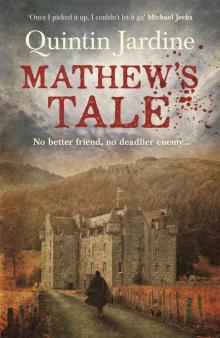
Mathew's Tale,
p.21


‘Then you would be a fool. You proved yourself a fine shot when you murdered your brother, but you have never faced anyone with a pistol in his hand. Nor have you faced me. I was a soldier, sir, and I have killed far, far better men than you.’
He pointed up at the scaffold, where David’s head and shoulders could still be seen, turning slowly on the rope.
‘That is the fate I have in mind for you, and when it happens I will be stood right here, watching you foul your breeches when you feel the rope on your neck. Believe me, Cleland, you are as good as dead, and when it happens, this same crowd will cheer the hangman, and throw flowers, not rotten fruit, at the Provost and his friends.’
He pushed him away, so hard that the man tripped and fell, then returned to care for his fatherless charge.
Chapter Thirty-Two
MATHEW DROVE THE CARRIAGE back to Waterloo House that afternoon, with Matt behind him in the closed compartment. The young man had said not a word since his father’s execution.
He ignored the heavy rain that had been falling all day. He was lost in dark thoughts, and once or twice had to restrain himself from pushing the horses too hard. He eased off still further as they came close to home. Half a mile away, just out of sight of the house, he stopped altogether and joined his companion in the cabin.
‘Are you ready for this?’ he asked.
Matt nodded.
‘What will you tell your mother?’
‘That you did everything you could but the court was set against Faither from the very start.’
‘What else?’
‘That he was the bravest man I have ever seen.’
‘Good. There is no denying that.’
They covered the rest of the ground at little more than walking pace. As they approached the house the rain lessened, and by the time they turned into the long driveway it had stopped altogether, and the evening sun was breaking through.
Mathew had dreaded facing Lizzie, but as he approached the great house, the main door opened, and she stepped out. She was dressed in black, as was Hannah who followed her. A small movement made him glance up, and spot the children, Jean and Marshall, with their faces pressed against the glass of an upstairs window.
He drew the carriage to a halt, jumping down from the driver’s bench, just as Matt emerged from cover and rushed into his mother’s arms. He was taller and broader than she, and she seemed to disappear into his embrace. They wept together, for several minutes, their emotions released and uncontrollable.
Mathew stood back, looking helplessly at his own mother.
When they were spent, and had recovered themselves, Lizzie kissed her boy on the cheek and passed him into Hannah’s care. She took him inside, leaving the two alone.
‘So it’s true,’ she murmured, her eyes red and puffy from her tears. ‘Gavin Cleland’s lie has killed my husband.’
‘That, and the weakness of men who put their own interests first. How did you know?’ he asked. ‘I hoped you would not find out until I told you myself.’
‘Uncle Peter came to see me. He was distraught, the poor man; he had heard of the part his son-in-law played in our eviction, and he came to apologise. They are gone, he said, Daphne and Grose, vanished overnight.’ She paused ‘And he brought me this. It came to the shop with the newspapers this afternoon.’
She opened her hand and showed him, folded, a copy of his pamphlet. ‘So you see, Mathew, I know everything,’ She held up the printed paper. ‘I take it this was your doing.’
He nodded. ‘I published it anonymously. It was all that was left open to me. It damn near started a riot at the . . .’ He stopped in mid-sentence.
‘You can say it!’ Her sudden, shrill, bitter laugh shocked him. ‘At the hanging: there are no soft words for it. Will this man Douglas have seen your paper too?’
‘I would be amazed if he had not, but he is committed to Cleland, for reasons of family and of reputation.’
‘And my children and I, we must go on, must we, living close to that man?’ Her voice was low and venomous.
‘For now, but that will be good, for you will see him suffer. I have plans for that murderer. I told him as much this morning. He may think himself impervious, but he is not. You must keep Matt close, though,’ he added. ‘He is dangerous at the moment; young, hot-headed and strong. There is anger burning in him, and you must damp it down with love.’
‘I could feel it there; the lad is like a volcano.’ Her lips trembled. ‘He said his father died well. Does that mean he was there?’
‘I tried my best to prevent it, but if necessary he would have gone through Beattie, and a locked door, to get there. He did not see it, though, Lizzie, I promise you, any more than I did, for I turned his head away and mine.’
She nodded. ‘Had I been in Edinburgh,’ she murmured, ‘you would not have kept me away either.’
‘That I know. How are you now?’
‘Broken-hearted, but it will mend. I will be fine, for the children. I have felt like this before, remember. When Captain Feather’s letter told me you were dead, that was like being widowed too, for in my heart we were man and wife already.’
In mine too, he thought. And like a fool I went off to war, starting a chain of events that has led us here.
‘Mathew . . .’ Lizzie hesitated for a second or two ‘. . . where is David, where is his body? I have heard that they give bodies to the anatomists after execution.’
‘They did, but no longer, I discovered, not since the Anatomy Act was passed a couple of years back. Normally he would have been buried in an unmarked grave, but Mr Johnston, my solicitor, reached a financial understanding with the undertaker. He is on his way back here now, under the guard of Ewan Beattie, who has been with him every step of the way from the Lawnmarket. I never realised till now what a good man he is.’
‘Will I be able to see him?’ she asked.
‘If you wish. When I saw him, afterwards, he looked peaceful. But not Matt, I suggest; he needs no more images in his brain. You go inside now; tend to him, and to the wee ones, even though they will not understand what has happened. Stand the coffin in the hall when it arrives; I have a visit to make, concerning the funeral, and another matter.’
As Lizzie went indoors, he led the horses and their carriage round to the rear of the house, to the stables, and left them under the care of the groom. Then he saddled his own mount, and set off towards Carluke, with his anger beginning to smoulder once again.
Even though it was high summer and the day had brightened, there was lamplight showing in the manse parlour as he arrived. John Barclay came to the door to greet him, recoiling a little as he saw him, unsmiling and fierce in his heavy travel-soiled overcoat.
‘Mathew,’ the minister began, ‘from your expression . . .’
He strode past him and into the parlour. Its curtains were half-drawn, and the dim light made him look even more menacing.
‘How could you refuse me, John?’ he boomed. ‘How could you decline to come and speak for one of your own? Did you think David guilty? Was that it?’
‘It was his word against that of three witnesses,’ Barclay replied, tentatively.
‘His word, the word of an elder of your kirk, and that of his son. And two of those witnesses have disappeared. But even so, even if he had been guilty of the crime in his anger, it was your duty to come forward and speak to his character.’
‘I . . .’
‘Be quiet! When David came to see you, did he have a pistol with him?’
‘No, of course not.’
‘Of course not, but you heard a shot?’
‘Yes.’
‘And afterwards when David told you his story, did you look outside?’
‘I went to the place where he said it had happened, and saw nothing but a patch of blood where Sir Gregor had lain.’
‘When you were out, was the well cover in place?’
‘Yes, as always, to keep the children safe.’
‘When the chain that raises it is wound in, it makes a noise. Do you hear it from inside the manse?’
‘Always. It makes a frightful racket.’
‘Between the shot and David’s arrival, did you hear it?’
‘No, but what does that have to do with the matter?’
‘Now, nothing,’ Mathew glared at him as he shouted, ‘for it is too late and David is hanged. But had you done your duty and come to court as I asked, that fact, from your mouth, would have shown Gavin Cleland for the liar he is. And yet you chose not to; you stayed skulking in your big cold house and let your friend go to the gallows.’
Barclay sighed, then collapsed into his armchair. ‘I could not come,’ he whispered. ‘I am an old man, Mathew, and not a rich one. I must be in that pulpit next door until I die, for I have no other choice. As you know, as an elder, the charge in this parish is in the gift of the Laird. He appointed me as the minister and he may remove me at will. You must realise that, surely?’
‘I do, but I’d thought you a better man. You were told to stay away; I guessed that days ago, but I need to hear you say it.’
‘I had a visit from Philip Armitage,’ the minister admitted. ‘He told me that the new Laird would be extremely displeased if I involved myself in the McGill trial, and that I would lose my living if I disregarded his wishes.’
‘And you were a coward.’
‘Like it or not, Mathew,’ Barclay protested, ‘he is my master.’
‘Then I am a fool, because I thought God was your master.’
The old man winced, as if he had been struck.
‘You have one chance to redeem yourself, in my eyes and before David’s widow and son. His coffin will be lying in Waterloo House by now. I want you to conduct his funeral service and to bury him in the churchyard, next to his parents.’
Barclay stared at his hands clasped together in his lap. ‘That I cannot do either. David is a convicted murderer; that is a fact that not even you can alter. I cannot bury him in consecrated ground.’
‘You could,’ Mathew countered, ‘but your fear of Cleland stops you. That man is profoundly wicked, John. He has killed David, as sure as if he had shot him in the back down the road there, and now he has destroyed you. Old friend, you have lost two elders in the one day. I will send my written resignation to the session clerk, and I will not set foot in Carluke Parish Church again while you are in its pulpit. You are a fool, you know. If I had known your loyalty was for sale, I could have outbid Cleland.’
Chapter Thirty-Three
‘WHAT WILL WE DO, Mathew?’ Lizzie asked, her face twisted unattractively by yet more anxiety. Her son was perched beside her on the arm of her chair; he looked far more exhausted than any fifteen-year-old should.
‘First, you will calm yourself, please,’ he replied. ‘But not with the brandy,’ he added. ‘That can darken a person as easily as it lightens her. After that? This is what I propose. Tomorrow, the three of us will go to the new minister at Cambusnethan; he is a young man, I’m told, and his congregation like him. I will explain to him our situation and you will ask him if he will conduct David’s funeral service.’
‘Is the Cam’nethan graveyard not consecrated?’ young Matt asked.
‘It is, but I have somewhere else in mind for your father. One of my fields, up behind the house, the one where the horses graze, and the cows that give us our milk, it rises to a hilltop. I would like to bury David there, and raise a stone to him; his grave will be fenced off, and I will leave room for others, if you wish. His soul is with God, and that is what matters; his body is entrusted to us.’ He looked at Lizzie. ‘What do you say to that?’
She smiled, and once again she was beautiful. ‘I say, can I choose the epitaph?’
‘Of course; that is your privilege. What will it say, do you know yet?’
‘Oh yes,’ she replied at once. ‘It should read, “Here lies a good and gentle man, who died blameless, as he lived.” Or will that be too long for the stone?’
‘The monument will fit the epitaph, not the other way around.’
David McGill’s funeral service was set for six days after his death, at noon. Those who attended would do so at Mathew’s personal invitation, and the leather factories were to be closed for the day as a mark of respect. Only one person declined: Sheriff Robin Stirling sent his written apologies, saying that he was deeply troubled by the part he had played in David’s death and felt that his presence there might be wounding to his widow and children, to whom he presented his sympathies and deepest regrets.
‘What does that mean?’ Lizzie asked when he showed her the letter on the day before, in the summer house, in the afternoon.
‘It means that my friend is worried that he was deceived when he committed David for trial, for he is as just a judge as lives, and any miscarriage at all, not only a fatal one, is anathema to him.’
‘He may judge this correctly, though,’ she said. ‘I understand his position, but Matt still bears resentment towards everyone involved. I am working on him, but it will take time. He is changed, Mathew.’
‘No wonder.’
‘He says he will not return to Lanark Grammar. He is afraid his classmates would taunt him. If they did, I am afraid of what he would do. I tried to reason with him, to tell him that education is a weapon in the hands of a man who knows how to use it, but he would have none of it.’
‘Nor I,’ Mathew chuckled. ‘Its absence has done me no harm. Let him leave, Lizzie. He will be none the worse of it either, and you will spare the other boys a few broken pates by letting him have his way. We will find work for him between us. He may be too young for his father’s old position, but there are many things I could have him do, and teach him. Stockley and I are building a new foundry in Yorkshire and expanding Coatbridge still further. I always have need of men; the busier he is and the more he sweats, the less time he will have to brood.’
He smiled. ‘But then again, he might prefer to work for his mother. I spoke to Peter Wright yesterday; he will sell me the shop, and his house. He is going to live in the cottage his daughter has run away from. Congratulations, shopkeeper.’
Lizzie’s mouth fell open. ‘I did not think you serious when you said that,’ she gasped.
‘When was I ever flippant? The business is done.’
‘Mathew,’ she said, suddenly serious, ‘I will not be your kept woman, or be seen to be.’
‘Nor would I wish you to be. You will pay me rent, to give us each a clear conscience, but only when you are established in the business and we can both see that it can afford it. The arrangement between Peter and me is private; it will seem that he has given you the shop out of remorse, for his son-in-law’s action.’ He beamed. ‘Come on, Lizzie, just say yes, will you?’
‘Oh, very well, and thank you, landlord.’ She laughed lightly, then looked up at him. ‘Did you have a hand in our Daphne’s vanishing?’ she asked.
‘Let us just say that Mr Grose was given a choice, and took the wiser option. That was only for your cousin’s sake, though. I am not inclined to be gentle with anyone who has been involved in this awful thing, even those who think they are beyond my reach.’
‘The judges are beyond everyone, are they not?’
‘They think they are, but it is not so simple. They have power, but our constitution, such as it is, places them apart from Government, so they cannot reach beyond their own sphere, and even there they can only judge what is brought before them. They are outside of the politics of the nation. Do you understand?’
‘I think so,’ she replied. ‘I read the newspapers too, remember.’
‘Then you may know this also. The Lord Advocate does not simply head the Crown Office and direct prosecution. He is a member of the Government in London, and its voice in Scotland. Thus, that office has great political power, and in it, James Douglas was impervious. And yet he has given it up.’
‘Why would he?’
‘Because his mentality is that of an Edinburgh lawyer, not a London politician. He never aspired to be Prime Minister; he always sought Scotland’s highest judicial office and as Lord Advocate he was able to appoint himself into it.’
‘Appoint himself?’ Lizzie repeated. ‘Surely not.’
‘That is the way these games are played, believe me. Douglas will also believe he can appoint his own successor as Lord Advocate, through the Home Secretary, Lord Melbourne. Who will he choose? My friends are certain it will be his close friend Gordon Graham, KC. Well, we will see about that.’
‘What can you do about it?’ she asked
‘Perhaps nothing, but . . . the Duke of Wellington may be a Tory and not a Whig, and he may no longer be Prime Minister, but he remains the towering figure in Westminster. He has the ear of King William, and everyone knows it. Retired or not, the Duke’s suggestions are orders. And who is as close to him as any? Colonel Sir Victor Feather, MP, the very same headstrong young man who wrote to my mother nineteen years ago, to tell her she was childless, and who has been mortified by his mistake since he discovered it.’
He leaned towards her, confidentially, lowering his voice in case it could be overheard. ‘Where do you think my military orders came from at first, those that made me rich? Where do you think they come from still? Through Victor, I have met the Duke, on my visits to London. He remains fiercely loyal to his veterans, and I am of his party. James Douglas thought he could threaten me with financial loss, but he had no idea. But it may be I can harm him. When it became clear that David was doomed, I wrote to Victor, and told him every piece of the story. We will see what comes of that.’
‘These things are beyond me,’ Lizzie confessed.
‘Then forget them. Leave them to me. To be honest, I dinna ken how I understand them, but I do. I must have brought the knowledge back from the dead. If so, a damaged liver was a price worth paying. As for my eye, I read ten times as much with one as I ever did with two.’ He paused. ‘Enough of all that though, let us take care of David tomorrow, then I can move on. Once that is done, all sorts of things are going to happen.’