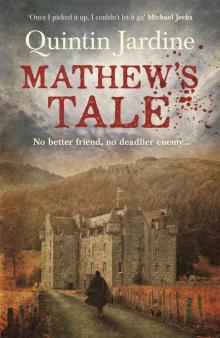
Mathews tale, p.5
Mathew's Tale,
p.5


‘It comes to my uncle’s shop,’ she told him. ‘The coach drops off a packet, and Uncle Peter makes sure that a’ the letters go where they’re intended.’
‘It’s delivered into your uncle’s hands?’
‘No, there’s a box, wi’ a padlock. The coachman has a key, and the other’s kept in the shop.’
‘Have you ever emptied the box?’
‘No. That’s done either by Uncle Peter or by my . . .’ Her eyes widened and then filled with anger.
She rose to her feet, and would have run from the cottage if Hannah Fleming had not come in from the kitchen in time to hear their last exchange.
‘No, lassie!’ she cried out with enough authority in her voice to halt Lizzie in her tracks. ‘You have your bairn tae think of. Sit ye back doon and tak’ yer tea, an’ a scone, or go hame tae your husband if ye’d rather.
‘If something amiss has been done, then we’ve a’ been wronged, all three of us. This is a matter that I will deal with, and I know how I’ll go about it.’
Chapter Seven
PETER WRIGHT MIGHT HAVE been able to face down John Barclay across his counter, if he had called upon him alone, but in the face of Hannah Fleming’s calm but piercing stare as she stood beside the minister, he had no chance.
‘There is a concern, Mr Wright,’ Barclay began. ‘As you have seen, Mistress Fleming’s son Mathew is returned from the war with Bonaparte, when a’body in the village thought him dead, thanks to a false report from France.’
Wright nodded, vigorously. ‘In- ind- indeed,’ he stammered. ‘I fair took a turn when he came into the shop. No’ that I recognised him, ye understand, no’ at first, with that great blemish on his countenance. It was only when he demanded to see our Elizabeth that I realised who he was. I was inc- inc- incredulous, I do not mind confessing.’
‘And why were you incredulous, Mr Wright?’ The clergyman fixed him with the glare he reserved for the most brazen sinners in his flock. ‘Was it because you thought he was returned from the dead? Or was it because you knew, in fact, that he was alive, but hoped would never be seen in this village again? One letter might go missing, sir, maybe more, yet after he recovered from his all but fatal wound, Mathew Fleming must have written twenty times to Mistress McGill, Miss Marshall as she was, and it seems that not a single missive reached her.’
‘I . . .’ the grocer began, then stopped, staring at the floor.
‘Did you withhold those letters wilfully?’ Barclay snapped.
Wright shook his head. ‘Not I,’ he whispered.
‘No, not you,’ said Hannah, with unprecedented fury hissing in her every word. ‘But your sister, that’s another matter; Sadie, wi’ all her airs, and her fanciful notions, who offered me nae condolence when Captain Feather’s letter arrived three years ago, and who rushed her daughter intae marriage with a worthy gentleman as soon as she could.’
‘You must ask her.’
‘Oh we will, Mr Wright,’ Barclay told him, ‘but we know the truth of it already.’
‘Sadie is a very determined woman,’ her brother moaned.
‘And you are a very weak man, and not worthy of the trust that is placed in you as keeper of folks’ letters.’ He looked at Hannah. ‘Come, Mistress Fleming, we will call on Mistress Marshall and see what she has to say for herself.’
In any small community, word of mouth travels faster than fire. When Sadie Marshall opened her door on the minister and the brooding thunderstorm that stood by his side, it was clear from her expression that she knew why they had called.
But she was of stronger stuff than her brother.
‘Yes,’ she declared, defiantly, as the question was put to her, ‘I kept those letters from my daughter. It was my duty to her as her mother.’
She was much shorter than either of her visitors, only five feet high in her youth and stooped a little in middle age, but her eyes were full of sparks as she gazed up at them.
‘With respect to you, Mistress Fleming, I never wanted Elizabeth wedded to a Carluke tradesman. I wanted better than that for the girl. In truth I wanted better than David McGill, but at her age, and given that she was spoiled goods, he’s a reasonable match for her. But the last thing I would allow would be for her to be wedded to a cripple from the war.
‘When I heard your son was dead, Mistress Fleming, I respected your loss, but in my heart I was pleased, as I had been pleased the day that Mathew went off to the army.’
‘So you are saying,’ Hannah murmured, ‘that you welcomed the death of my husband, which brought that about?’
The other woman flinched a little. ‘No, I’m no’ saying that,’ she protested. ‘There but for the grace o’ God; my Thomas is dear to me, and I wouldna be parted from him.’
‘Yet you allowed Mistress Fleming to live under an even greater burden,’ Barclay countered. ‘You allowed her to go on believing that Mathew was dead, when in fact you knew full well he was not.’
‘It was for my daughter’s sake!’
The storm within Hannah broke. ‘Rubbish!’ she shouted. ‘It was for yer own sake, for yer own jumped-up notions. Ye’re a stupid, vain cratur, Sadie Marshall, and you always were. I’ve always kent that. My, wumman, a’ the village has. And cruel too. That was kent and a’, the way you used to beat that poor lass when she was wee, until your husband pit a stop tae it.’
She saw surprise in Sadie’s eyes.
‘Oh aye, Ah kent aboot that. Lizzie telt Mathew aboot it; she showed him the marks you left on her erse. He telt his faither and my Robert telt your man. That’s how he found out, no’ from Lizzie, for she never said a word tae him. You never deserved a child as loyal as she was.
‘Aye,’ she raged, ‘your cruelty was known, but I never dreamt it ran so deep as to let me live for three years thinkin’ that my life’s purpose was over, and that my boy was gone. You are a wicked, wicked woman, Mistress Marshall, but you may find that your sin has cost you dear, for when we left Lizzie she was saying that you would never speak to her again, or see your grandchild, after it’s born, which I pray to God will happen safely, for as long as you live.’
‘She’ll know I did it for her own good,’ Sadie murmured.
‘No. She’ll ken that ye did it for your own vanity.’
‘And so will the whole congregation,’ John Barclay boomed. ‘You and your husband will be at church on Sunday.’
‘Not Thomas,’ the woman protested. ‘He kent nothing of what I did.’
‘But he will find out. You will tell him, and you will bring him to church on Sunday, where I will denounce you from the pulpit for the evil woman you are. After that, you will be an outcast in this village. No one will speak to you, other than maybe your husband and sons, but I cannot be sure even of them. Your brother, he’ll be forced, finally, to stand up to you, if only for the sake of his business.’
‘You can’t do that,’ Sadie wailed.
‘Oh but woman, I can and I will!’ the minister retorted, fiercely. ‘Your daughter’s first thought was to have you exposed in the stocks, to be mocked and pelted with ordure. I myself would be inclined to ask the magistrate to order that very thing.’ He paused allowing her fear to take full hold.
‘But you will be spared that humiliation,’ he continued. ‘This is not God’s mercy, and it’s not mine either. It’s that of Mathew Fleming. He has forbidden that any such complaint be made on his behalf, and has persuaded your daughter to relent. He said that the last person to do him harm was executed for his trouble, and that now he believes that the greatest punishment is to live with the knowledge of your own self and of the kind of person the world sees you to be.’
‘And my daughter? What of her marriage to David McGill?’
Barclay frowned. ‘Right or wrong, that was celebrated, and pledges given, before God, but I know that He must be rightly displeased at your deception.’
Chapter Eight
MATHEW FLEMING HAD BEEN imagining his first night back under his mother’s roof for most of the six years of his absence. In those dreams the place had been lit brightly, by lamps and candles, logs had been roaring in the grate and a roast bird had been on the table ready for carving. And, of course, there had been three places set.
He had never contemplated the way it transpired, he in his father’s chair, and Hannah in hers, well fed on stew and boiled potatoes but afterwards staring into the hearth at a wood fire that was so reluctant to spark into life it seemed to be drawing heat from the room rather than giving it.
Over supper she had asked him about the war, but he had been reluctant to discuss it. ‘Those things are not for this house, Mother, or for this village. The world is much bigger than you could imagine and much nastier than you would want to know. The prospect of possibly imminent death affects men in different ways, but it does not inspire chivalry or mercy.
‘My officer, Captain Feather, was a fool in some ways, but he was sensible in others. He realised that if he looked after the men under his command, they would look after him. Sadly, he was the exception, not the rule.’
‘Then be thankful for him, and for yon doctor. Those folk cared about ye, and a man cannae ask for more.’
‘Can he not?’ Mathew murmured. ‘Lizzie cares for me, as much as she ever did, and yet look at our situation. If only I’d been less headstrong when those recruiters came calling.’
‘No,’ Hannah retorted, firmly. ‘Ye did what ye did for whit ye thocht were the best of reasons, and that was good. If you reproach yersel’ for it now, ye’ll do so for the rest of your life and you will live and die an unhappy man. The money ye left me was consolation and it kept me in my home. It wasnae a’ in vain.’
‘But it didn’t keep you for ever. How have you managed, Mother?’
She laughed. ‘By workin’, son. How did ye think? Did I no’ tell ye I was the best seamstress in this village? Mr Barclay made sure Ah had plenty o’ work, and so did Sir George, when he heard what had happened wi’ the man Hinshelwood.’
‘As well,’ he sighed. ‘My thoughts of sending money home soon came to nothing. There was no money, after I’d clothed and fed myself, and bought all the other things a soldier needs but must find for himself.’ His face darkened.
‘And it’s how he finds them. There are things happen in war that I will not bring back here, but let me just say that if you are on the wrong side, then nothing is sacred, no property secure, no person inviolable. I would have nothing to do with any of that. At first my comrades mocked me for it, until they saw that I fought as well as they did, and better than most.’
‘Ye were a corporal, thon letter said. Whit’s that?’
‘It’s a petty rank, Mother; non-commissioned, they call it. I was discharged as a sergeant . . . not that the money was much better. In fact by the time . . .’ He smiled.
‘What?’ she asked.
‘Och,’ he smiled, ‘after my wound, when I could not abide beer, I used to buy it for my comrades. Hah!’ he laughed. ‘They drank rather more than I did, the damned sponges.’
‘That’s good.’
He turned his head and fixed his good eye upon her. ‘Is it indeed?’
‘Aye. It means ye looked after others, and that ye were a man o’ respect. Amang them, amang yer own kind, ye were a leader. As you were there, at war, so you will be in peace. And if that eye is the price of you being at hame for good, then while I would rather ye had baith, Ah’ll regard it as worth payin’.’
‘I have never sought seek to lead,’ he told her. ‘I seek to serve, with the skills I’ve learned from my father and on my travels. But where?’
‘Where?’ she repeated. She was about to say more when they were interrupted by a knock on the door, just loud enough to be heard. Hannah looked at her son, lodged firmly in his chair. ‘Whit are ye waiting for?’ she asked. ‘You’re the heid o’ this household now, Sergeant Fleming. You answer the door.’
‘I’ll never be that while you’re alive, Mother,’ he chuckled, but rose all the same.
The caller was a man. He stood half in shadow but catching enough of the light from within to be recognisable.
‘Mr McGill,’ Mathew said, loud enough for Hannah to hear. ‘What can we do for you, sir?’
‘I wondered if I might have a word.”
Mathew wondered also; he wondered whether McGill had come for a confrontation, to put him in his place. But that thought vanished quickly, as soon as he sensed that the man was apprehensive.
‘Of course,’ he replied, solemnly. ‘Please come in.’
He stood aside, to let their visitor enter. Hannah rose to her feet.
‘Please, please, Mistress Fleming,’ McGill said, ‘sit down, sit down.’
‘Would ye rather I left you two men alone?’ she asked.
‘No, Mother,’ her son said, ‘you’ll not be banished to the kitchen in your own house. I’m sure that Mr McGill would not expect it.’
‘Of course not,’ he agreed.
Mathew pointed him to his own vacated chair and perched himself on a fireside stool. ‘Well now,’ he began, an invitation that was seized.
‘First and foremost, Mr Fleming . . .’ McGill began, and was waved to silence.
‘Let’s not make this more formal than need be. It’s Mathew and David. Agreed?’
Their guest smiled, shyly, and some of his nervousness seemed to leave him. ‘Yes, thank you,’ he agreed.
‘Mathew, whatever else, I am glad to see you, back home and well from the war. I was as shocked as anyone when that false report was received. As for what has happened since . . . I cannot find the words to describe what that woman has done. You are a victim, sir, and so is Elizabeth. I’d agree to any punishment you sought for her.’
‘My mother and I are both content,’ he replied, ‘that retribution should be left to Mr Barclay. I think you will find when he gets up in that pulpit on Sunday that he will not be charitable.’
‘What would you have done, in the army?’ McGill asked.
‘Hypothetical,’ Mathew replied. His mother raised an eyebrow; she had no idea what the word meant and wondered where he had come by it.
‘I never met the soldier,’ he went on, ‘who would have betrayed a comrade in such a way. All I can say is that I doubt whether such a person would have survived his next action.’
‘What can I do?’
Mathew stared at him. ‘You, David? Why should you do anything?’
‘Because I know how the land lies. You and Lizzie were betrothed before you left, in the eyes of the whole village. When I was invited by her mother to call on her, she was in mourning for you. If she had known of your survival, she would never have accepted my proposal . . . and if I had known, sir, it would never have been made.’
‘But the fact is that it was, and that it was accepted. What are you saying?’
‘That if you ask me, I’ll stand aside. It can be as if that awful report from Waterloo had never arrived.’
Inwardly, Mathew was close to being overwhelmed by McGill’s generosity, but he concealed his feelings. ‘No, man,’ he said quietly. ‘It can never be. Lizzie is with child. Are you saying to me that you would let them both go, or that you would keep the child?’
‘The child must be with his mother.’
‘And his father, be he alive,’ he said, ‘and David, you look hale and hearty to me. More than that you are a man of substance, which I am not, not yet at any rate. Here is the truth. My mother raised me to believe, and my life has taught me too, that we can only play with the cards that we are dealt.
‘Nobody can unwrite Captain Feather’s letter, or undo Sadie Marshall’s treachery. The poet Burns said, “Facts are chiels that winna ding,” and that is true. If I allowed you to step aside, then you would be a victim too, and I would be less of a man than I would want to be.’
He paused. ‘Tell me, have you offered the same to Lizzie?’
‘No, not yet. This is between us.’
‘Ah, but it’s not. She has a voice and a view on what is right and what is wrong, and I believe I know her well enough to speak for her here. Your offer is noble; if we accepted it, then we would be less than noble, and neither of us could thole that. Tell me this too. If this came to pass, would you be happy, for the rest of your days? Be honest, man.’
There was a long silence before McGill shook his head. ‘No,’ he whispered. ‘I love her, no doubt of that.’
‘Then it’s clear. How could we know true happiness, if ours was bought at the cost of yours? My answer, David, is, “Thank you, but no.” I am reconciled to what has happened and so must Lizzie be. She’ll have your child and the three of you will live happily for as long as God allows.’
‘I do not know what to say,’ the other man murmured.
‘Then say nothing more,’ Hannah Fleming told him. ‘Ye’ve shown us the man you are, and we’re both happy that Lizzie’s in good hands.’
‘Thank you, Mistress.’ McGill rose to leave.
Holding a lamp to light the way, Mathew walked with him, to where his horse, in its carriage harness, was tethered. He examined the rig, as a professional. ‘Some of these straps need renewing, man,’ he said. ‘You should attend to it, especially since you’ll be carrying a bairn in this contraption.’
‘Would you do it for me, Mathew?’ McGill asked. ‘It belongs to the estate, and that is the standard of Hinshelwood’s work.’
‘I would, if I were here,’ he replied. ‘But that will not be the case. I cannot stay here, David, man. I’ll vanish as suddenly as I returned.’
‘But this village is your home.’
Mathew shook his head. ‘No, it is not. This village is where I grew up but for the last six years my home has been where I made it. It would not be right for me to stay here. Look at the havoc my homecoming has created, although I have only been here for a few hours.’ He smiled in the lamplight. ‘Had I known I was dead I would probably have stayed that way.